
The Trust Fortress: How Latter-day Saints Resist a 60-Year National Decline
Analysis of Social & Institutional Trust using the General Social Survey


TL;DR Latter-day Saints report the highest trust of religious leaders compared to every other religion measured and higher social trust on average. These two trends could be connected.
This post was inspired from a previous article written by Stephen Cranney analyzing the decline of trust in religion and other institutions. And, it’s true. One of the landmark pieces of Political Science literature shows that social trust and social capital have declined over time starting in the mid-1960s and have continued to the present day. But, how do Latter-day Saints fit into this picture? Are they more or less trusting of other people? Do they trust institutions? Does the type of institution matter? Let’s explore these questions today.
As a side note, Stephen has a lot of great work and data analysis that he writes over at Times and Seasons that I would recommend checking out if you like the content here.
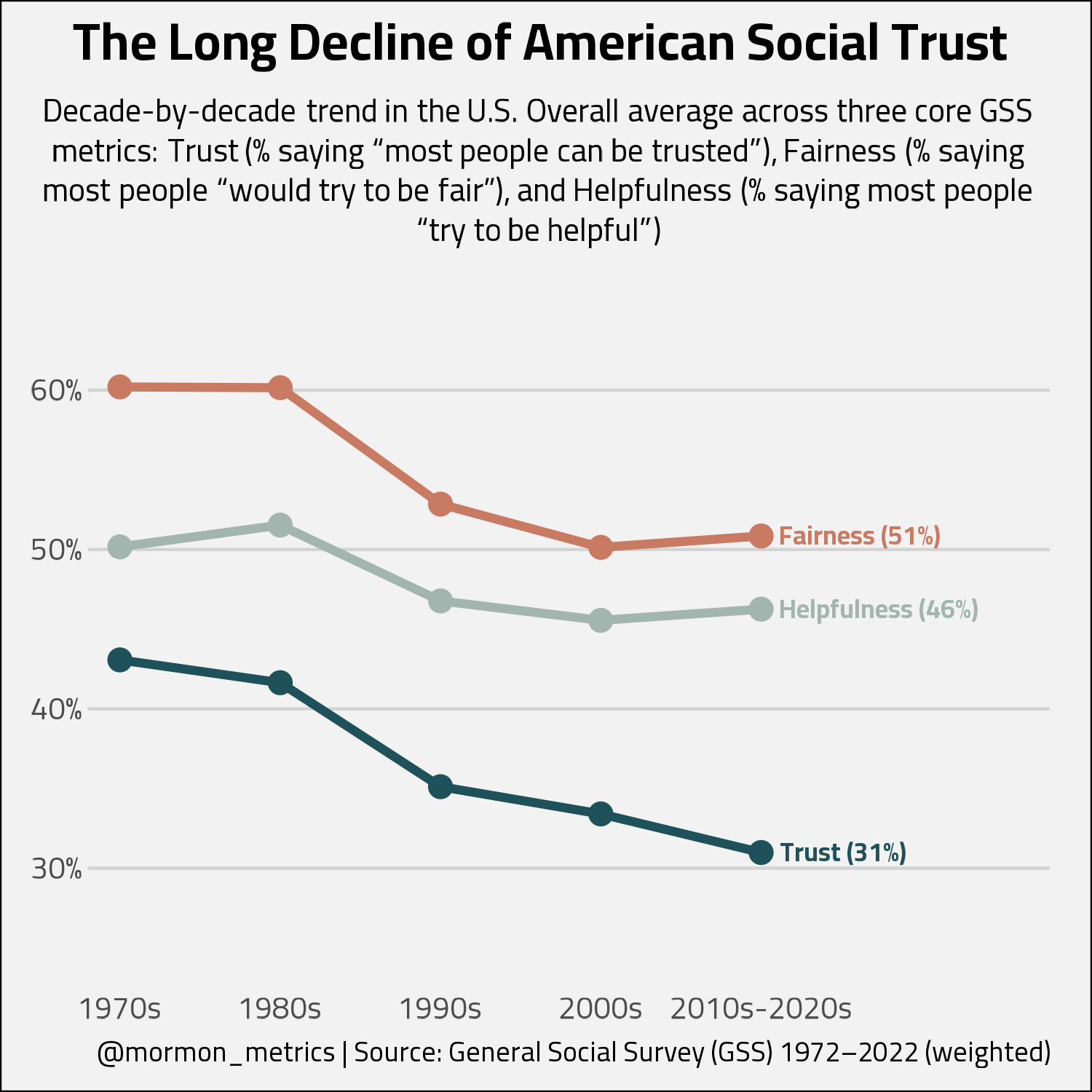
In our dataset here we can see that (in the US Overall) the % who think “most people can be trusted” has steadily declined over the decades.
Along with social trust, fewer people in the US believe most other people “try to be fair” and “try to be helpful” than in previous decades.
So that’s our baseline.
Now, what does social trust look like broken out by religion?
Latter-day Saint Score Higher On Social Trust Overall
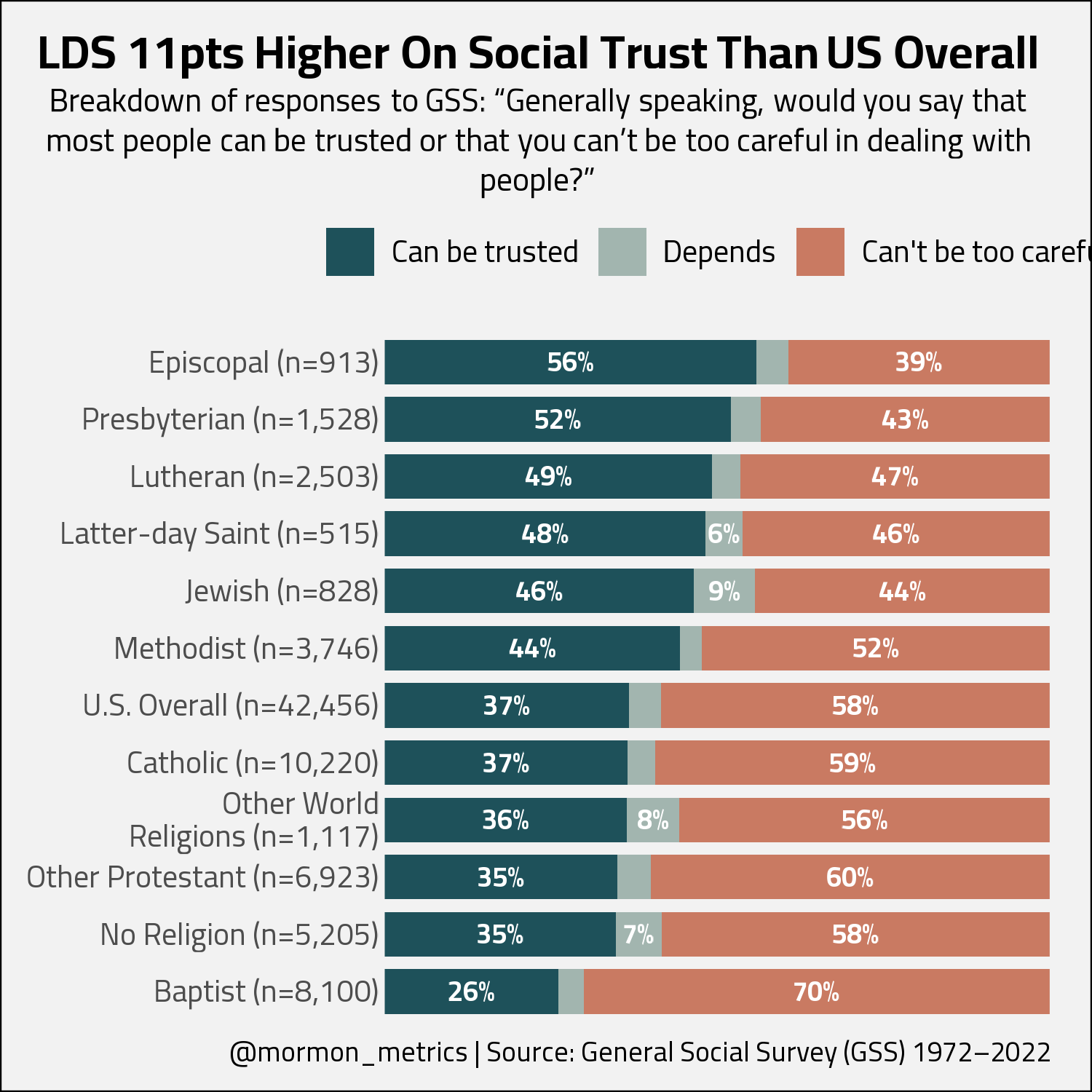
Aggregating all the data over the decades, we find that LDS average 11 points higher on social trust compared to the US overall. They are not the highest denomination (Lutherans, Episcopalians, and Presbyterians all score higher), but still quite high.
Let’s look social trust across religions over time.
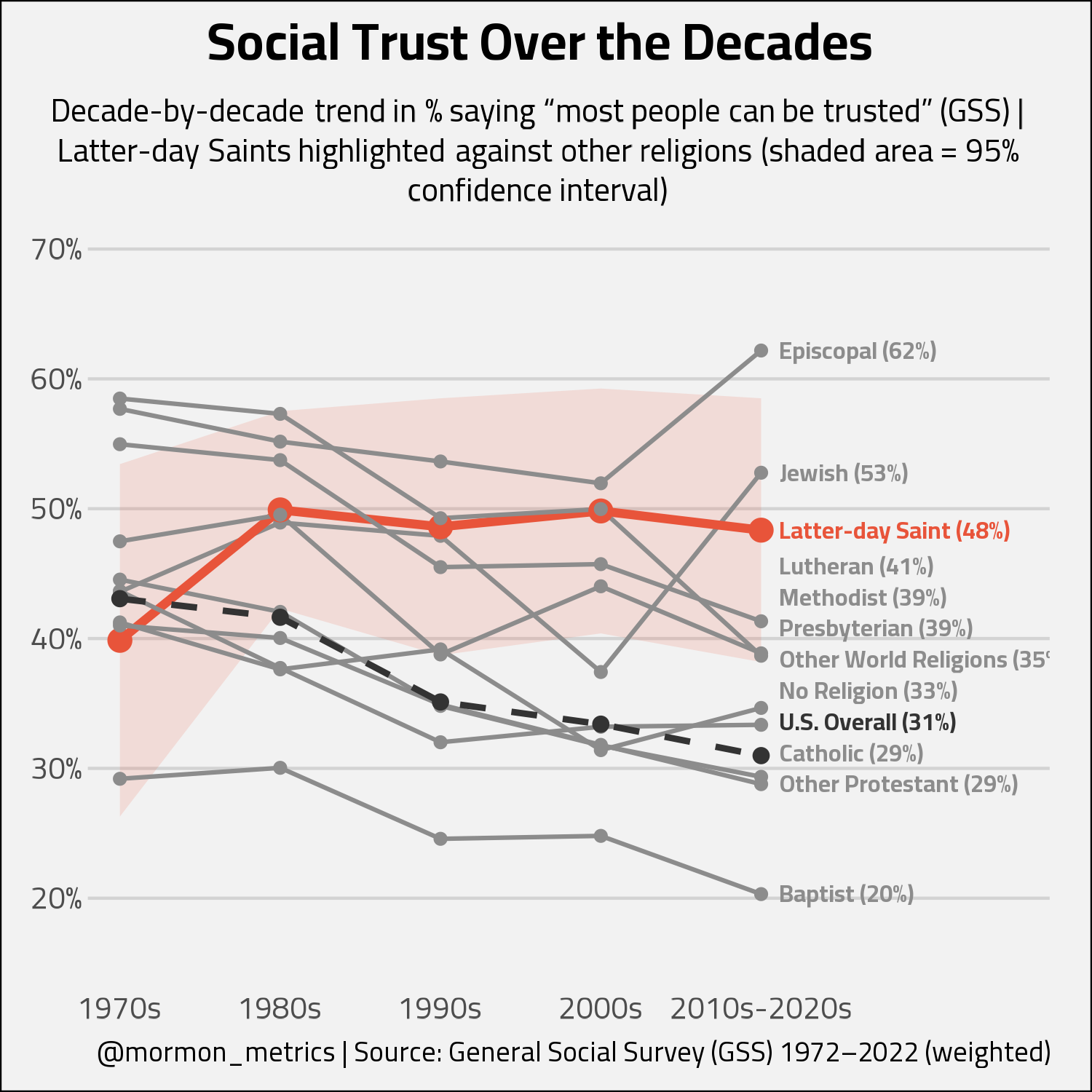
While many religions have trended downward, Latter-day Saints have stayed remarkably flat — hovering around 50%. This is quite resilient given the downward trend of most other religions and the US Overall.1
High Confidence In Organized Religion; Mixed Bag On Other Topics
To me, these next two charts are the most interesting.
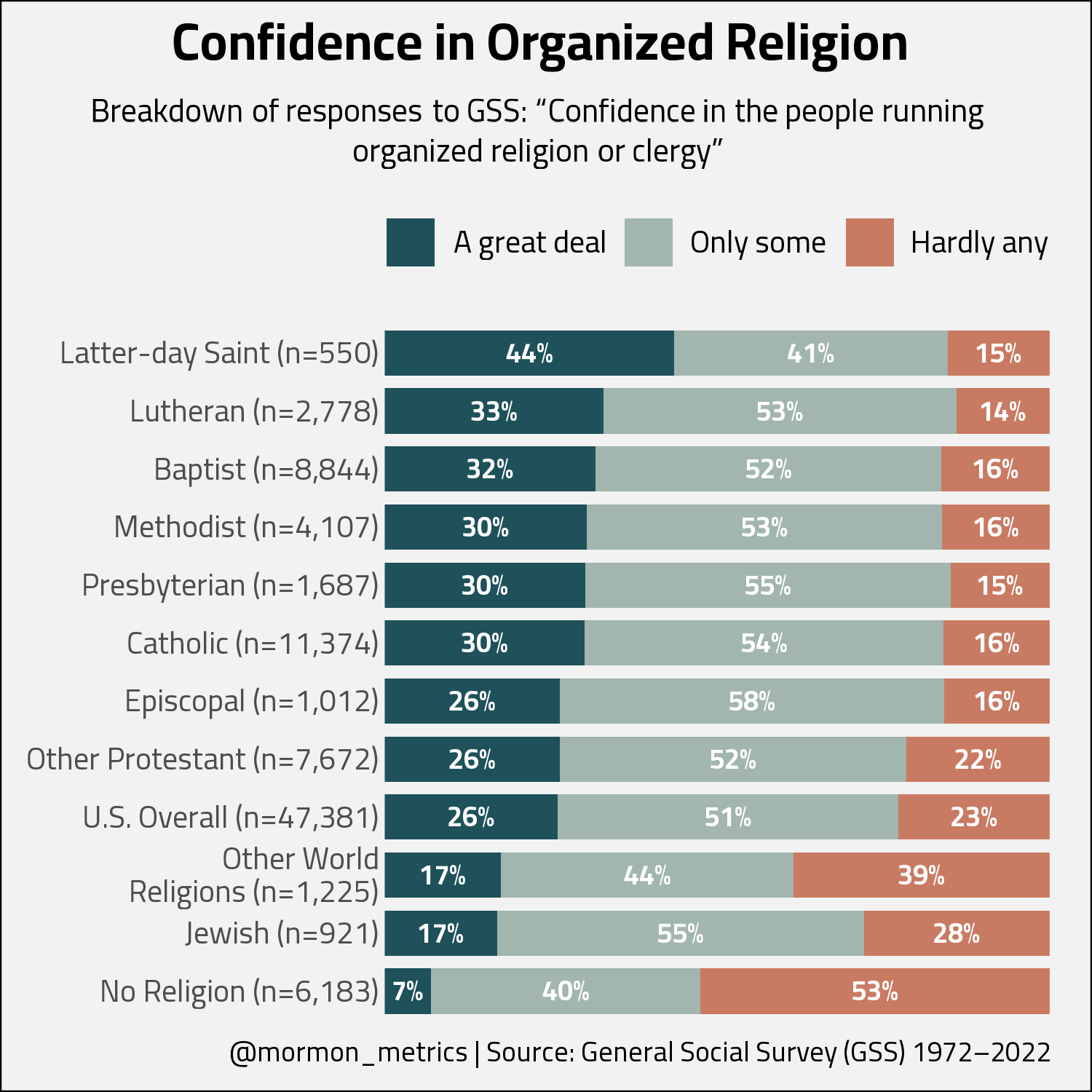
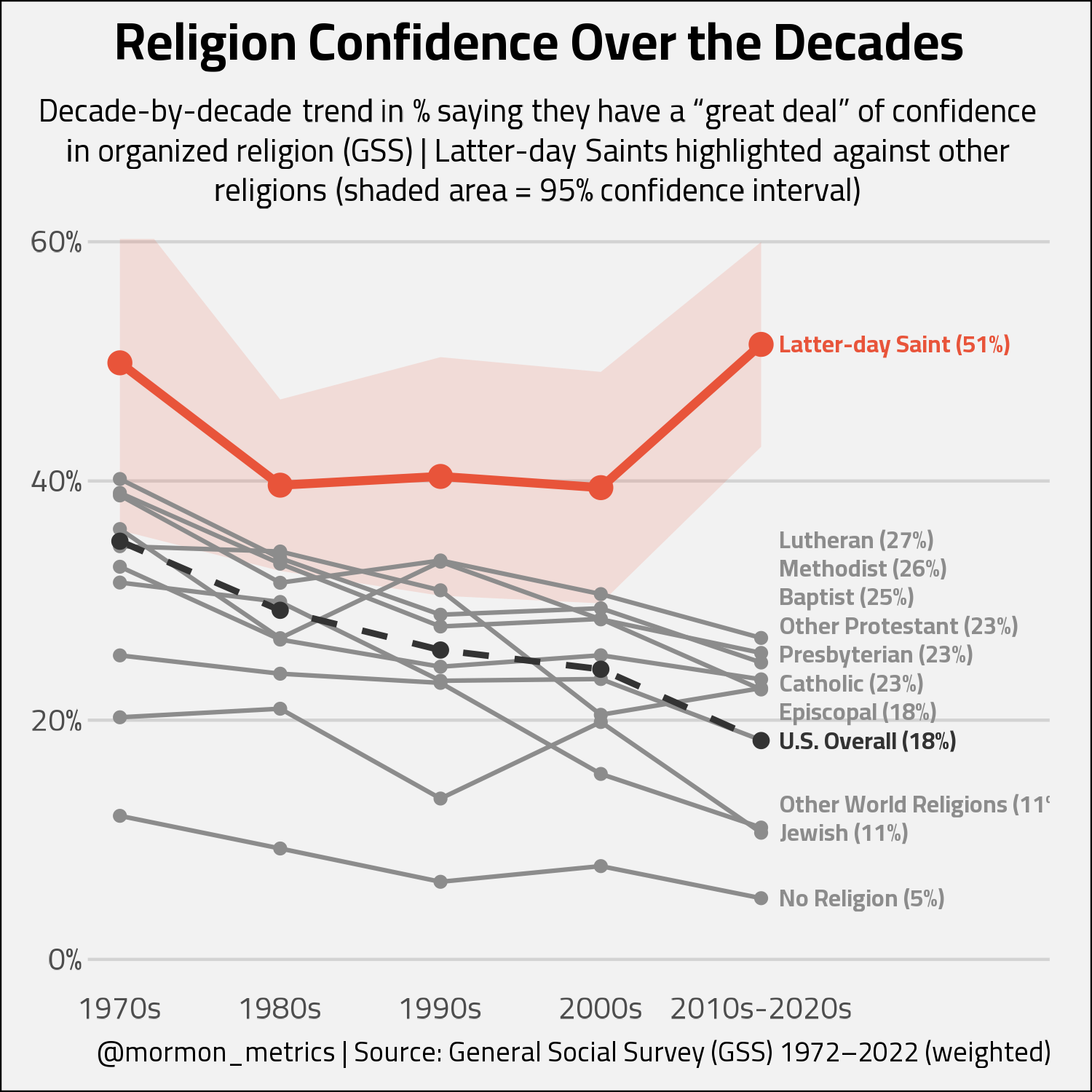
Latter-day Saints are the most trusting of religious institutional leaders out of every single other religion.
Not only do Latter-day Saints have the most trust in organized religious leaders or clergy, there is over a 10 point gap between the next highest! So, there is quite a bit of separation.
When you look at the trend over time, this pattern becomes even more striking. Essentially every other religion has declined in religious leader trust; however, Latter-day Saints have become even more trusting in their leaders.
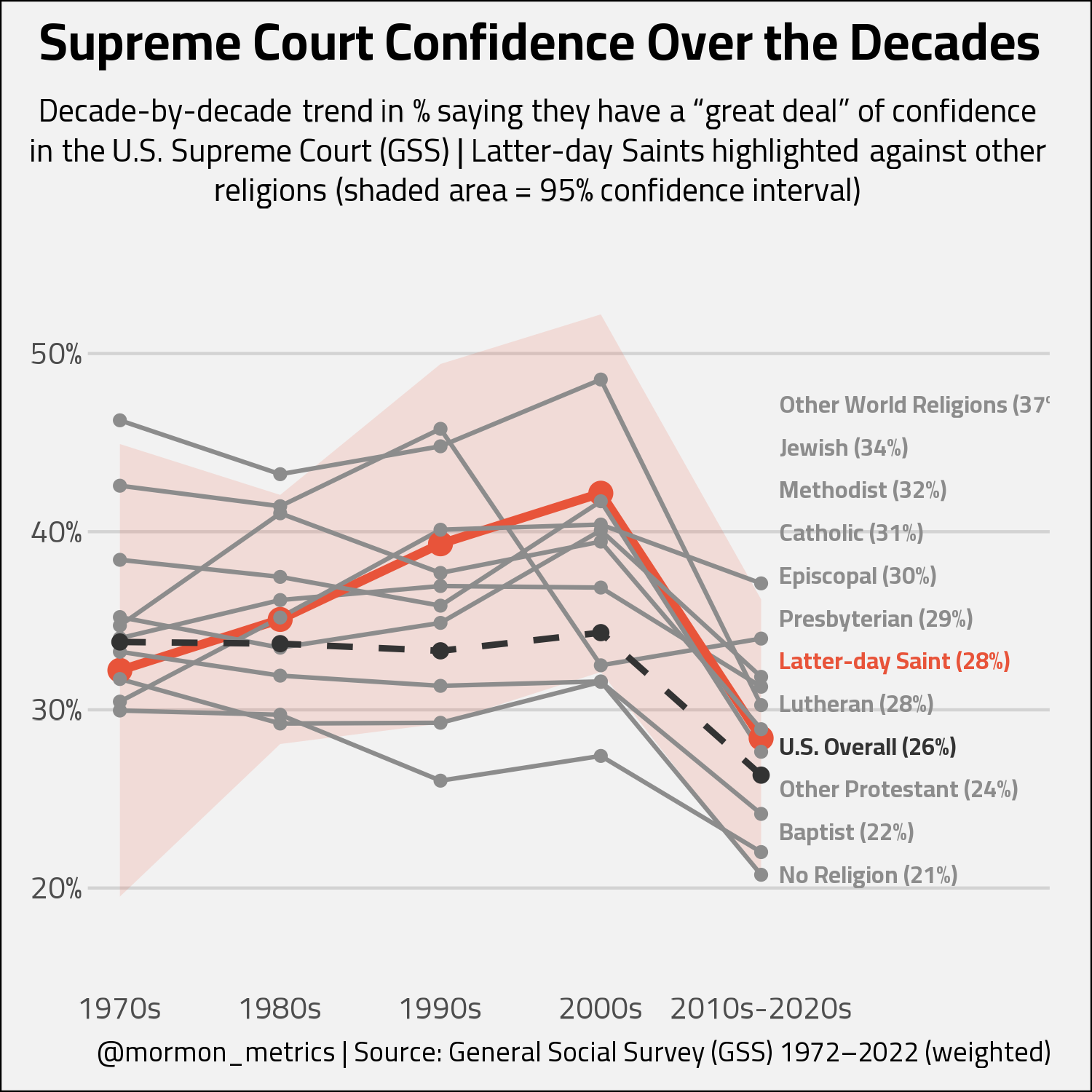
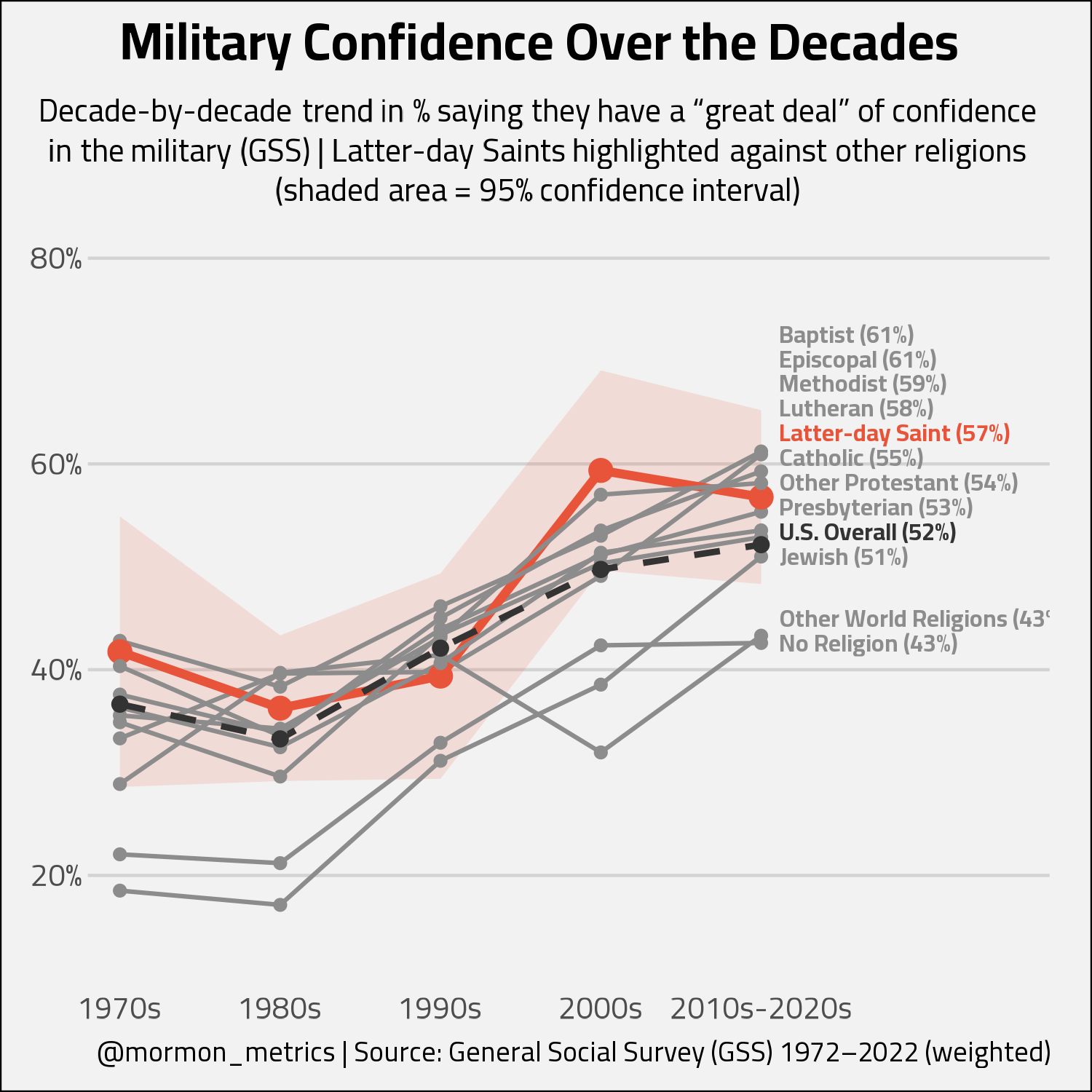
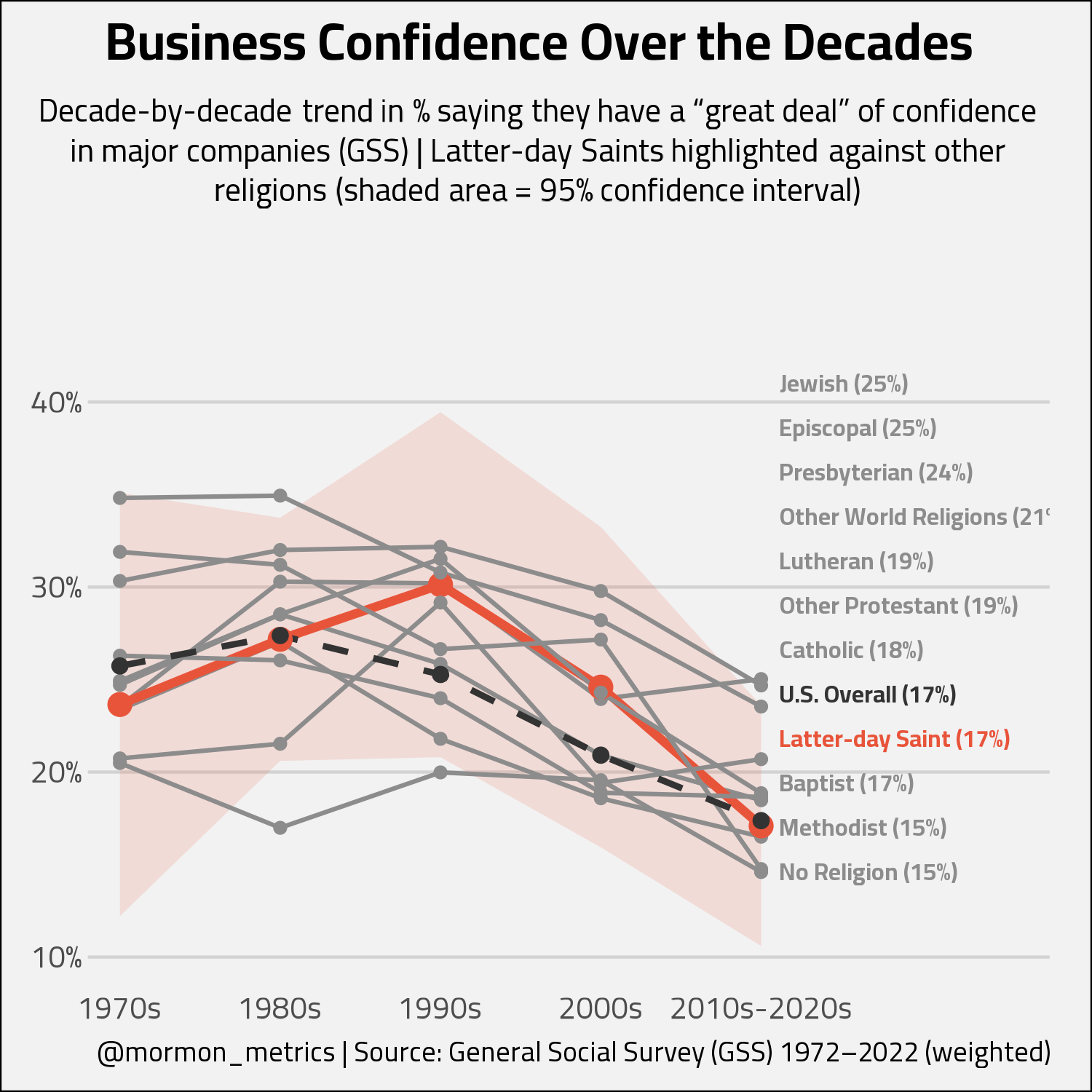
Interestingly, this is not true across the board of all institutions. Beyond religious institutions, Latter-day saints seem to be about average and follow the US Overall trend in trust in the military, supreme court, and big business as seen in the three charts below. So, in other words, Latter-day Saints’ religious institutional trust doesn’t carry over to other institutions necessarily.
Is There A Relationship Between Social Trust And Religious Trust?
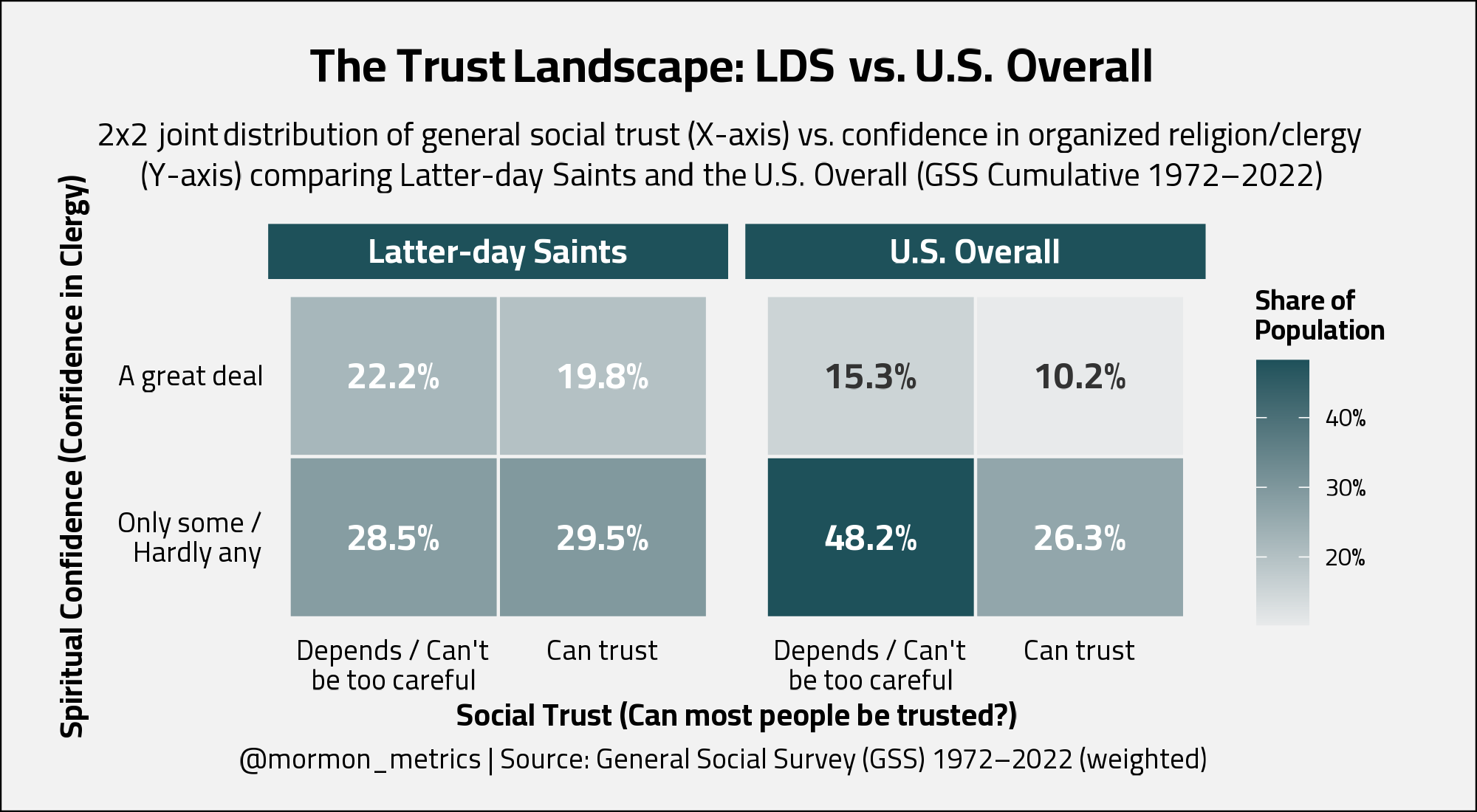
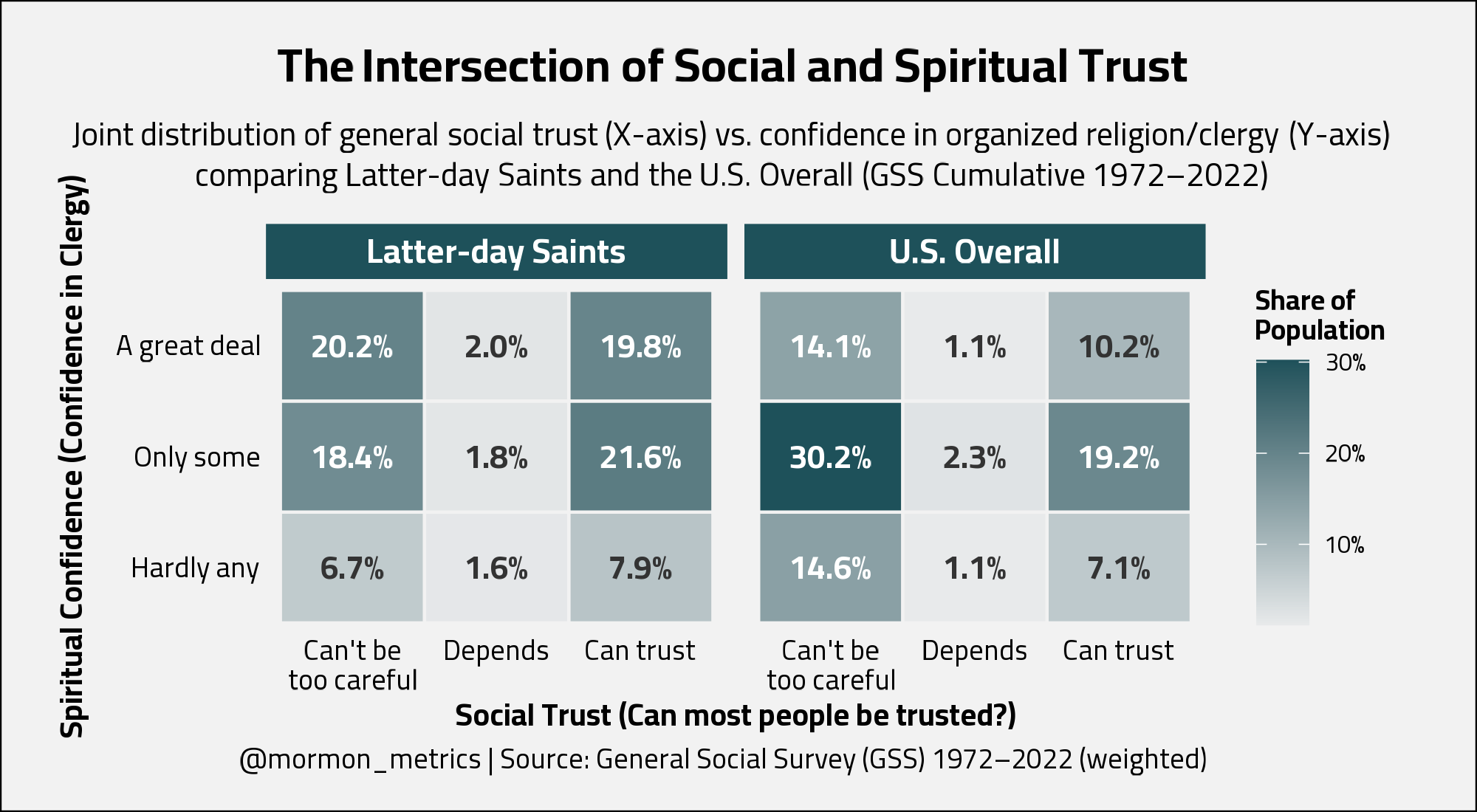
For my last chart, I wanted to create a heat map showing the relationship (if there was one) between an individual having Religious Trust vs. Social Trust. It seems like there is definitely some correlation.
Latter-day Saints are twice as likely to be in the high social trust high religious clergy trust bucket compared to the US population.
Additionally, Latter-day Saints are nearly half as likely compared to the US overall to be in the low social trust low religious clergy trust bucket.2
Conclusion
Looking at the data over time, it’s clear that while the rest of the country is caught in a 60-year downward spiral of distrust, Latter-day Saints in some ways are defying gravity. By maintaining a “great deal” of confidence in their religious leaders—which has climbed to 51% while the national average cratered to 18%—they’ve built a unique institutional stronghold.
This isn’t just about loyalty to a church; the heatmaps suggest this institutional confidence is related to their social trust. Perhaps because they trust the institution, they are twice as likely to trust their neighbors and nearly half as likely to fall into the national cynicism bucket (being distrustful of people and religion). While they are just as skeptical of big business as everyone else, their religious trust may have created a landscape that is resilient to some societal forces of distrust.
I have actually written about some of this before using data from two different surveys. If you are interested in more data on this topic, check the links below 👇
Did you know Latter-day Saints have more friends on average?

See more social trust & community data here looking at the LDS Enclaves (the very LDS area in Utah and Southern Idaho):

As always, the code I used to write this post is available here.
You’ll notice in these time series graphs, the 2010s and 2020s are combined. This is to boost the nsize in the last data point. So far there have been 2 surveys in the 2020s, but in the latest one, they stopped releasing the Mormon variable, so its really only one survey and a handful of Mormons. So, because of this, I combined those decades together.
I flattened some of the categories for ease of interpretation, but the full heat map can be seen here.
Why the low scores for our Baptist friends?