
Are Mormons Immune From The Loneliness Epidemic?
Exploring a loneliness battery on a recent national survey


Introduction
Among several other notable trends since the dawn of the world wide web, one of them is increased loneliness. All age groups report feeling more lonely than in previous time periods. Social capital has decreased across America. Interestingly, though, I am finding that Mormons are resilient to these changes or at least they self-report they are.
Charts
Looking at how often Mormons feel loneliness, we have our first chart…
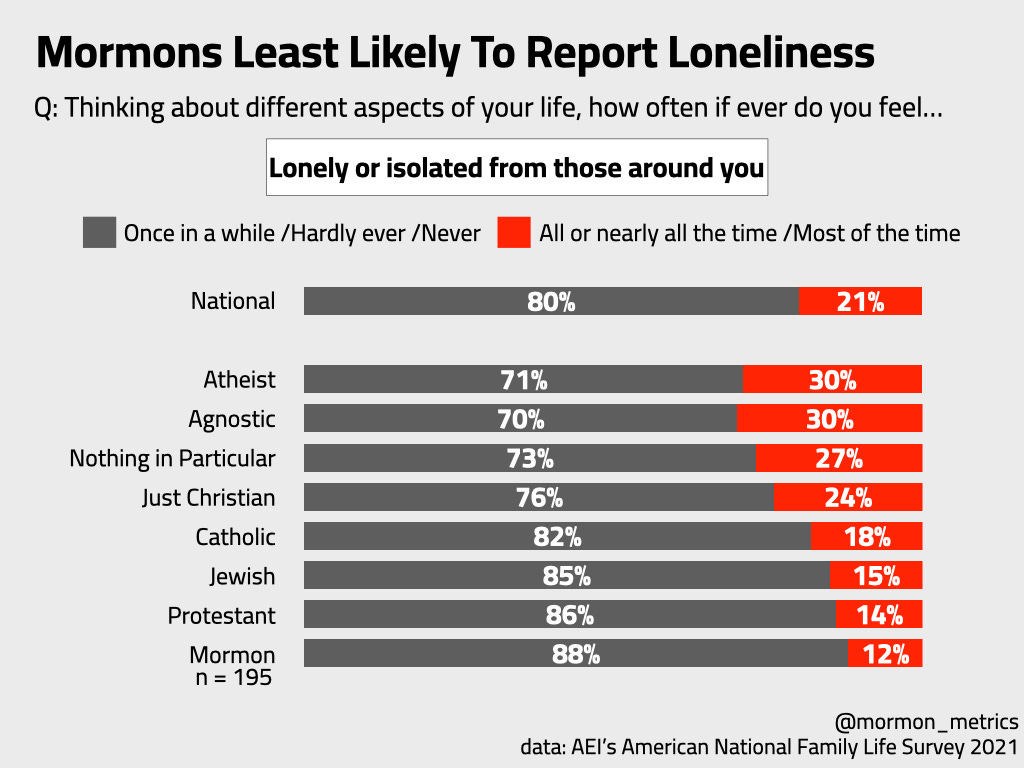
Mormons are actually the least likely to report feeling lonely frequently - half as much as the national average.
To me this hints that religion likely provides some protection against loneliness since the three religiously unaffiliated groups report the most loneliness. These groups report feeling lonely twice as much as Mormons do.
I also found a question asking about the number of close friends you have.
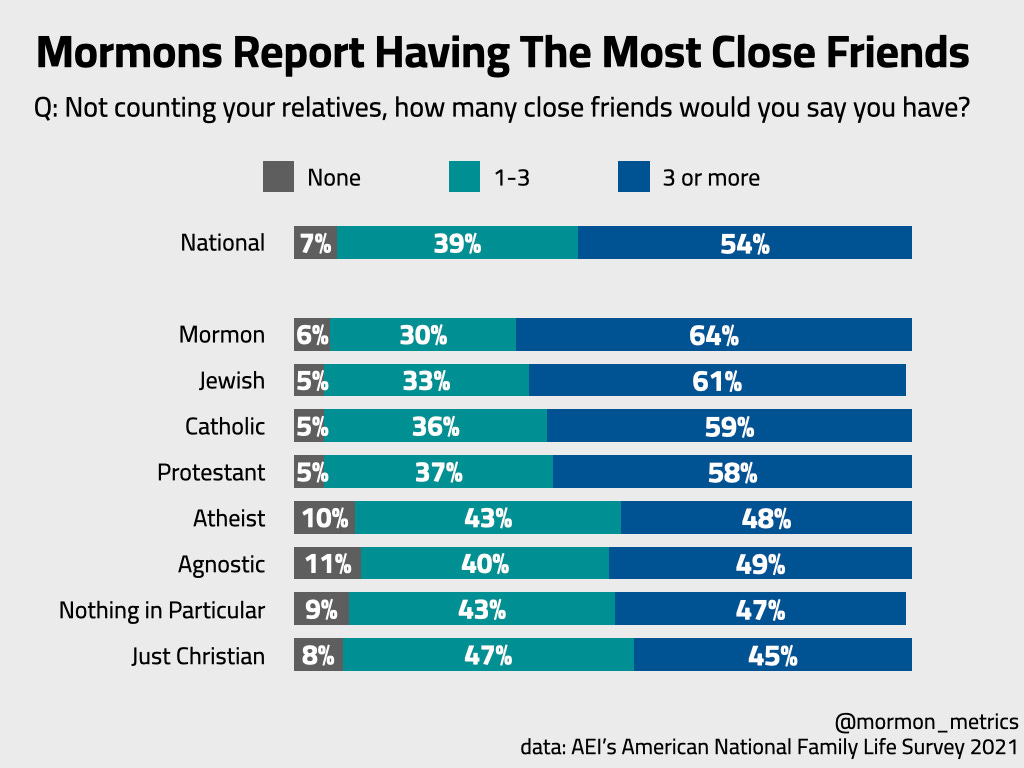
Again, we see that Mormons are the most likely group to say they have 3 or more close friends. Mormons are among the least likely group to report having no close friends.
Just as before the intuition holds with the three religiously unaffiliated groups reporting having fewer close friendships.
Those saying they identify as “just christian“ seem to be a middle ground between the religiously unaffiliated and the more organized religions. They don’t report being as lonely as the religiously unaffiliated, but also do not report having as many friends as the religiously affiliated.
There were a few other relevant questions on the survey to this topic. My initial thought was perhaps Mormons with large families may feel “too busy to enjoy life“ compared with other groups, but they self-reported otherwise.
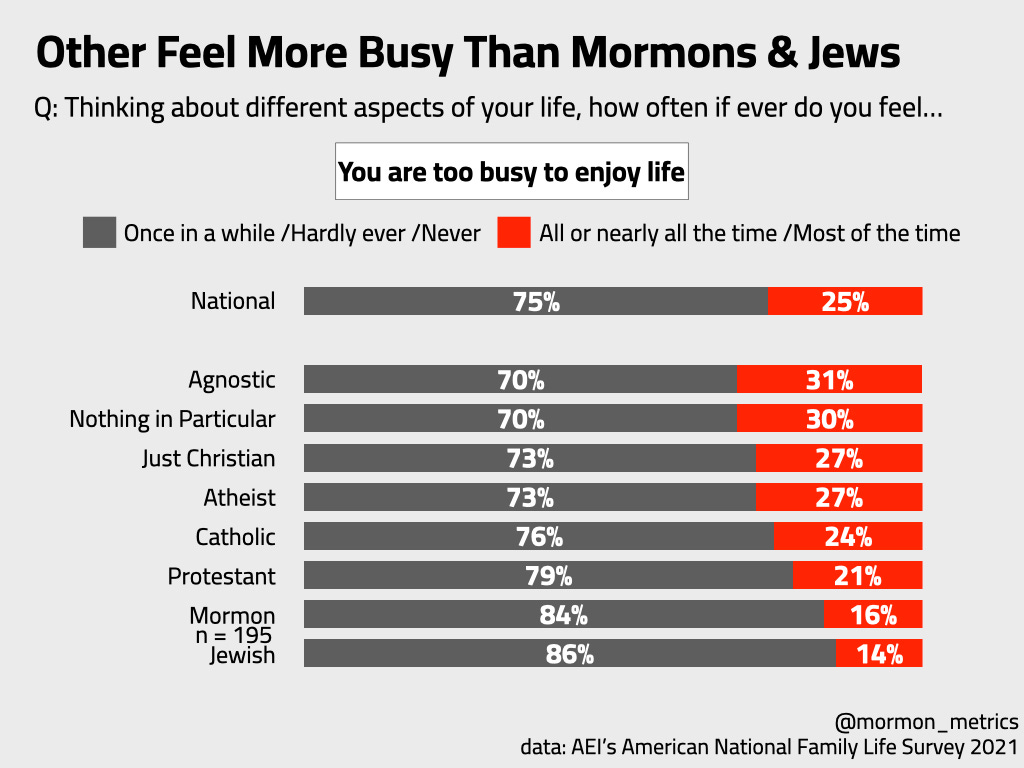
Mormons report are among the least likely groups to report this.
When I first saw the breaks for this next question, I was quite surprised. Many people feel that there are few people they can trust. In my opinion, we are potentially entering a dangerous time in American society where fewer people are trusting critical American institutions and fewer people are trusting others.
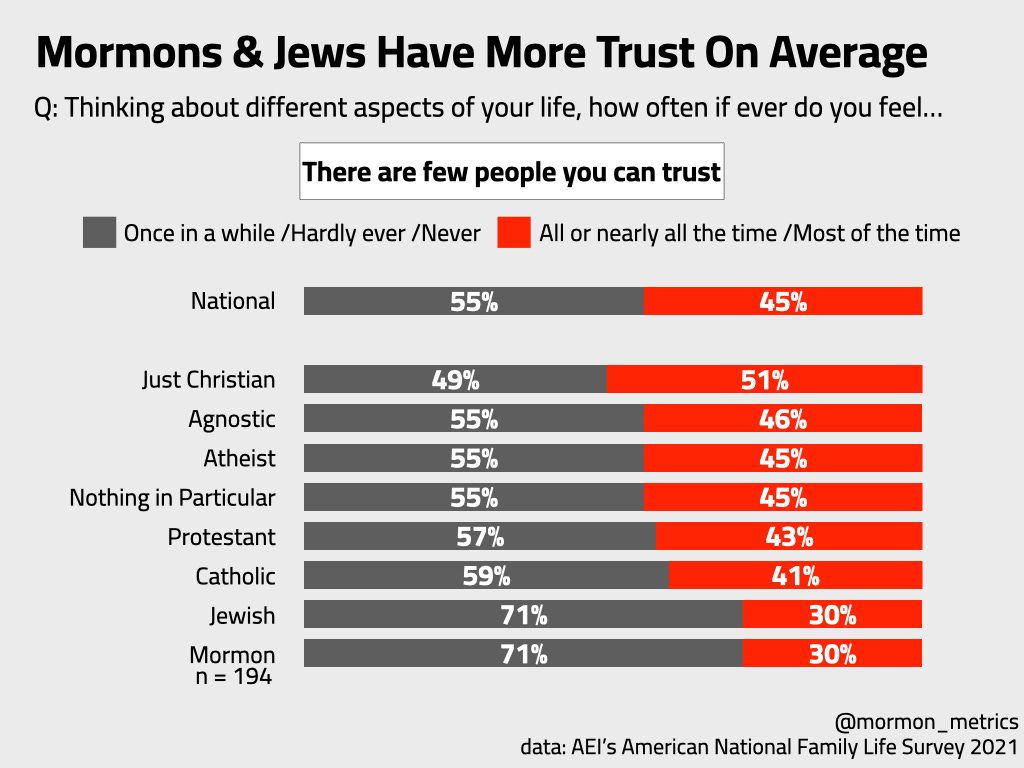
While 3 in 10 Mormons feel like there are few people they can trust, Mormons and Jews are the most trusting religious group measured here.
Conclusion
In this analysis, I see evidence for the strength Mormon (and Jewish) social networks.
Mormons report having the most close friendships.
Mormons are the least likely group to report feeling lonely frequently.
Mormons also seem to be more trusting of others generally.
I think these strong social networks have shielded many Mormons from the epidemic of loneliness. Generally, we see a trend where those identifying with organized religion are less likely to report feeling lonely. Those most vulnerable seem to be the religiously unaffiliated. I suspect that the expectations of the religion also play a role in this relationship because lower expectation religions perhaps cannot create the interconnectedness and community of high expectations ones. For example, those identifying as “just christian“ are not as shielded from loneliness as Mormons who are in a more structured and high demand environment.