
What Is Causing The Decline Of LDS Devotion Pt2
How might serving a mission be related? Continued root cause analysis.


This is a continuation of investigating the “decline of the devout.” The trend was identified in the 2025 Mormon Typology Report, then last week I posted a first look into the “why is it declining” analysis. Also, a quick note on terms: In this analysis, I use the word ‘Devout’ as a shorthand to describe a specific group of Latter-day Saints—those who reported all three of the following: attending church weekly, praying several times a day, and saying religion is ‘very important’ in their life. An index like this is common method in social science to measure things like high religious observance, though it doesn’t capture all the personal ways an individual might manifest their faith or devotion.
Last week, I identified that the decline in devotion seemed to be driven by the younger age groups (pictured below).
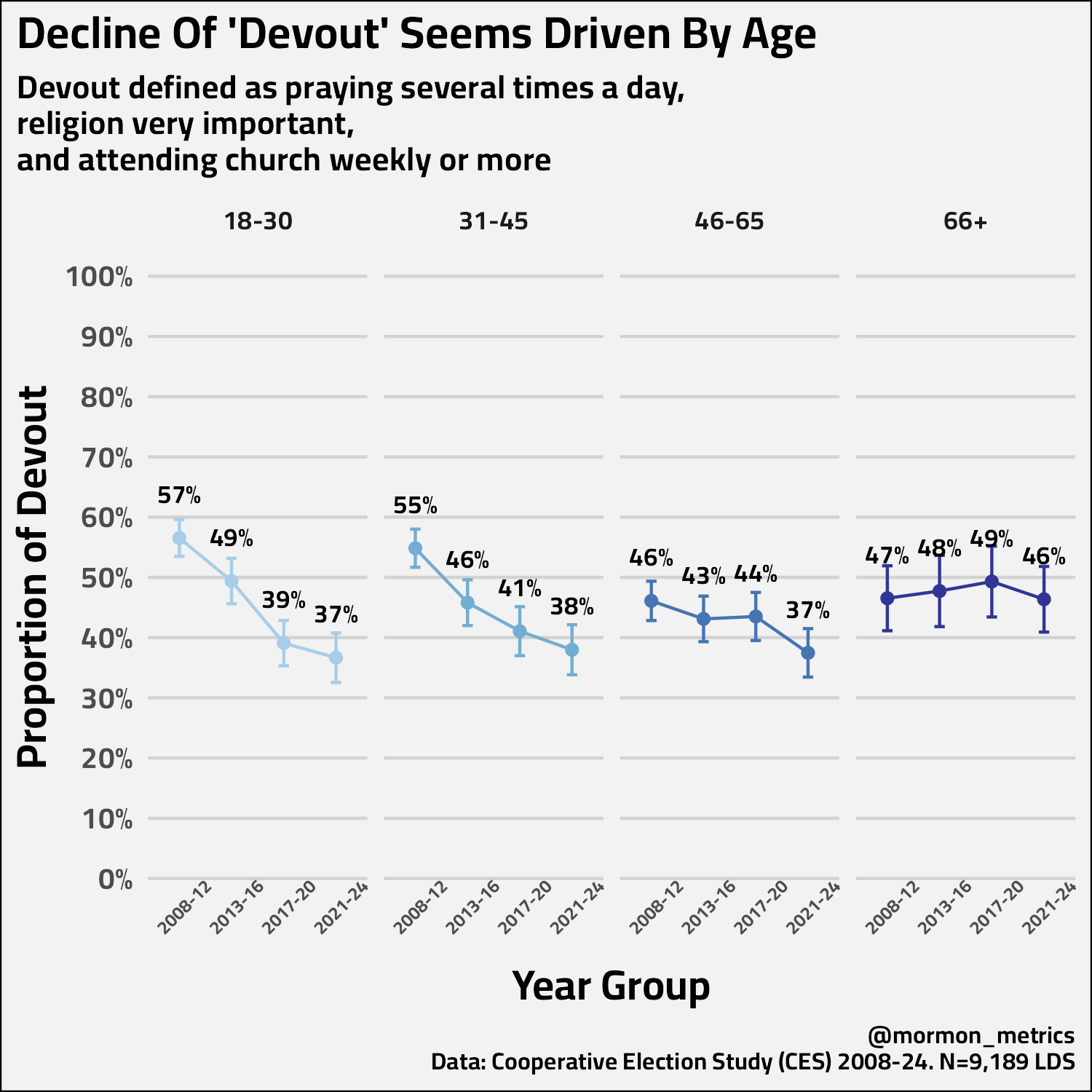
Since young people go on Mormon mission, a natural followup question is… How does missionary service play into this trend? Are missions in the last decade less effective at “converting” a missionary hence a decrease in young LDS devotion?
Previously, I have written that missions do, in fact, work. There is a “missionary bump” in young LDS devotion right around the mission age (pictured below).
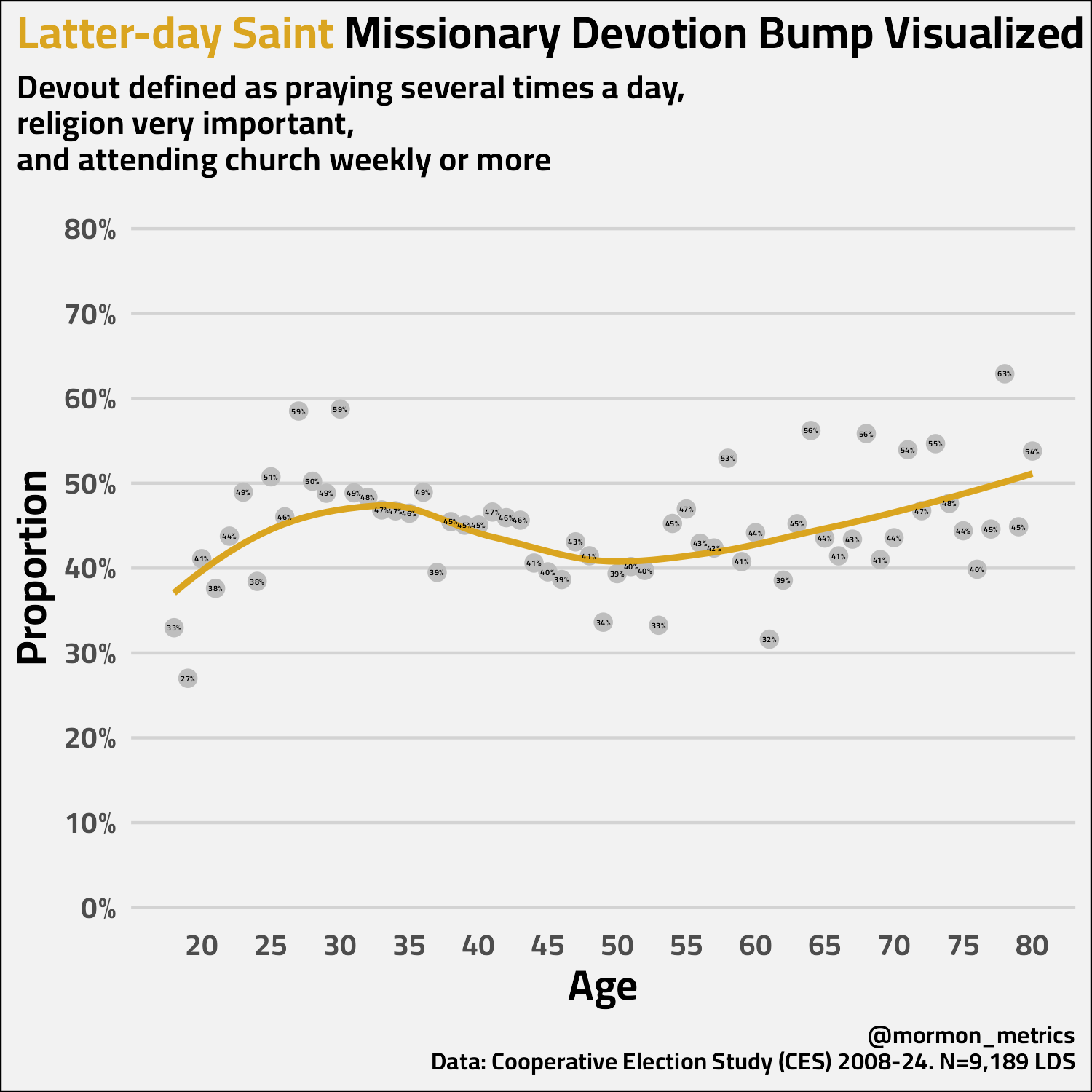
But, our trending decrease in devotion among young people may call this chart into question. Is this “missionary bump” driven by the previous generation of young people, but today’s young people its flatlined? Let’s separate it out.
Methodological note: So in the chart above, I took the average devotion across every age. Because we are splitting the sample in half (before vs. after 2015) for a clearer trend, I averaged the devotion of every 3 year age group, so you will see 1/3 as many dots per line in hopes of getting a clearer trend.
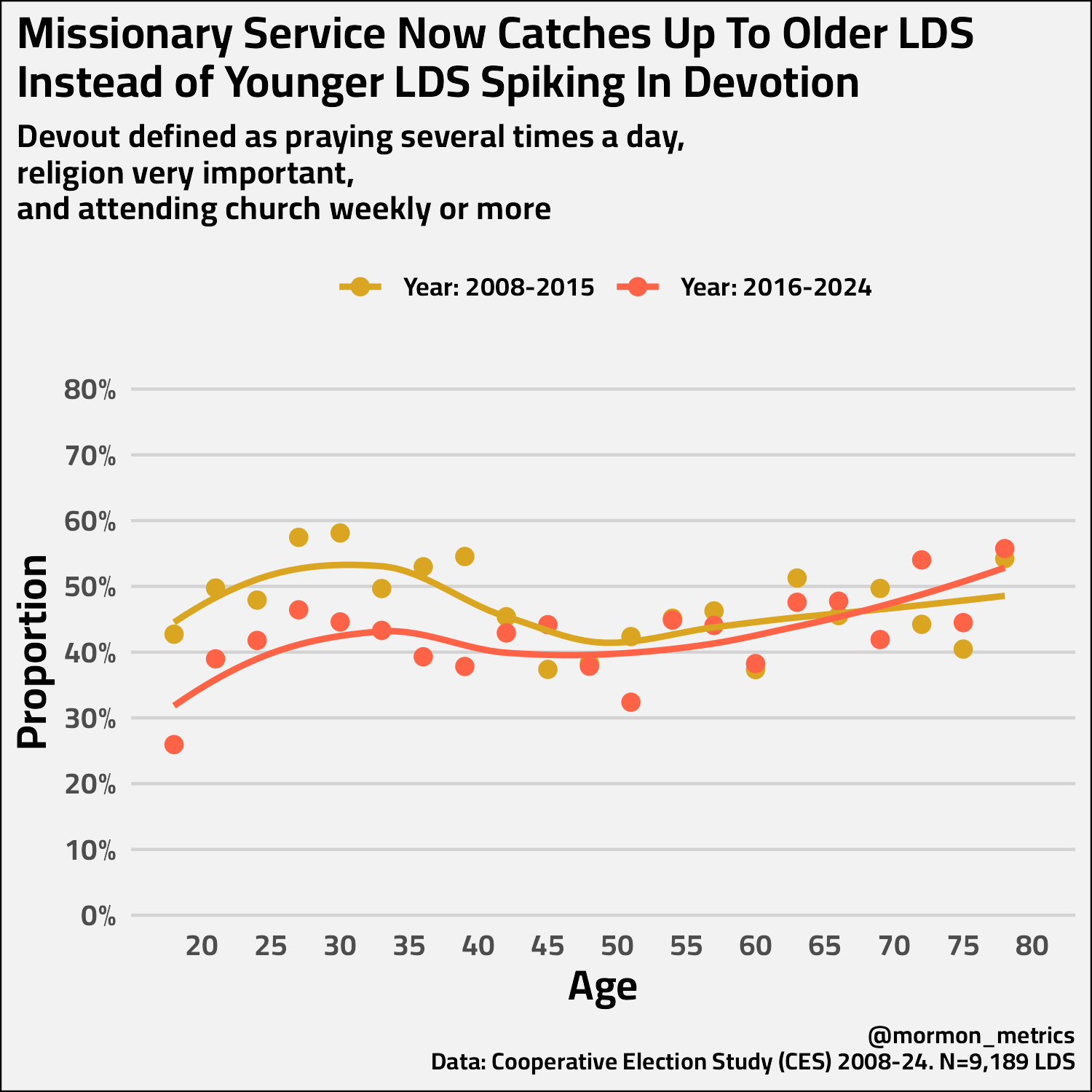
So what does this chart say to me…
We see the “missionary bump” in both groups, but we can clearly see a time period division among the younger LDS whereas the older LDS look quite similar across periods. So, from this chart, it seems missionary work still increases devotion as it had before, but the younger group is just starting from a lower baseline of devotion. Interestingly, in the early time period, devotion spiked among the younger group — seeming higher than at any other age. In the most recent time period, there is still a bump, but it seems the bump is less of a spike and more like playing catch up to the older folks who remain similar in devotion across time periods. This could suggest that whatever is causing the change in devotion may happen before missionary service or is unrelated to missionary service.
Overall, the data suggests that the mission experience itself is still effective at increasing devotion, but it is working with a younger generation that is starting from a lower baseline than their predecessors.
This problem is tricky because we don’t have a sense of the proportion of LDS that have gone on missions. Are more? are fewer? What about coming home early? Answers to those questions would likely affect our takeaways from this chart.
One theory in the comments of last week’s post was that perhaps devotion is actually consistent over time, but there is less of a hard line in identifying as Mormon/Latter-day Saint today therefore causing more borderlanders to stay and the overall devotion line to decrease. This is very possible since I have written previously about a rise of never/seldom church attenders that identify as LDS; however, here are a few contextualizing facts. The proportion of Latter-day Saints in the US population is likely decreasing over time despite higher birth rates. The rate of US LDS disaffiliation has likely increased in the last 20 years.
What does devoutness look like in the US population?
I had a few followers/subscribers asking about how the US population compares in devoutness to LDS.
Let’s take a look.
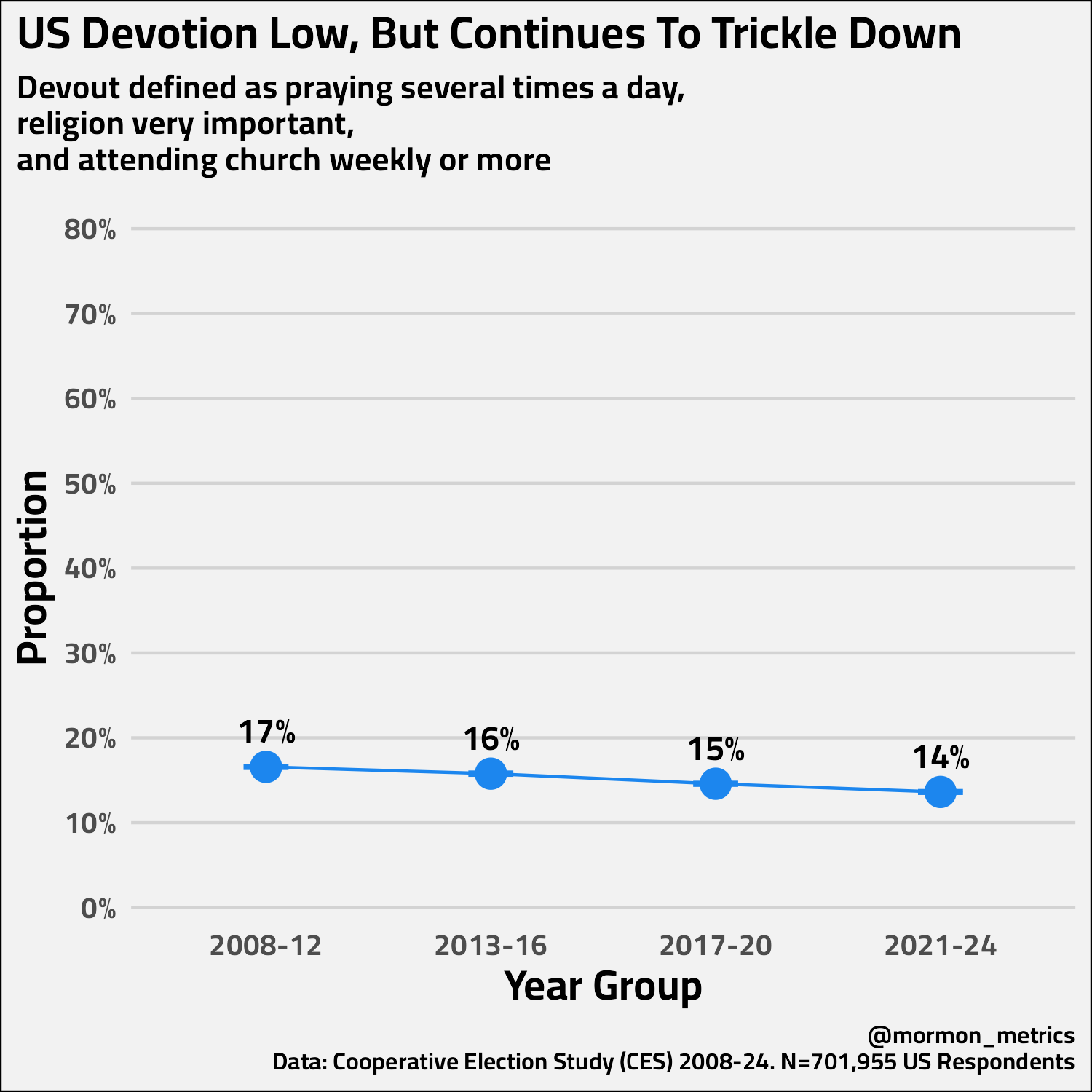
Firstly, note that US LDS are more than double the devotion of US Overall even in the recent lower years. For LDS in the first year group they started at 52% devout falling to 39% by the last year group which is significantly higher than the US Overall 14%.
During this time, the US Overall continued to trickle down from 17% to 14%.
The LDS drop of 13 points of devotion is much larger than the US overall drop of 3 points, but the LDS number has a lot more space to move.
What does US devotion look like by age?
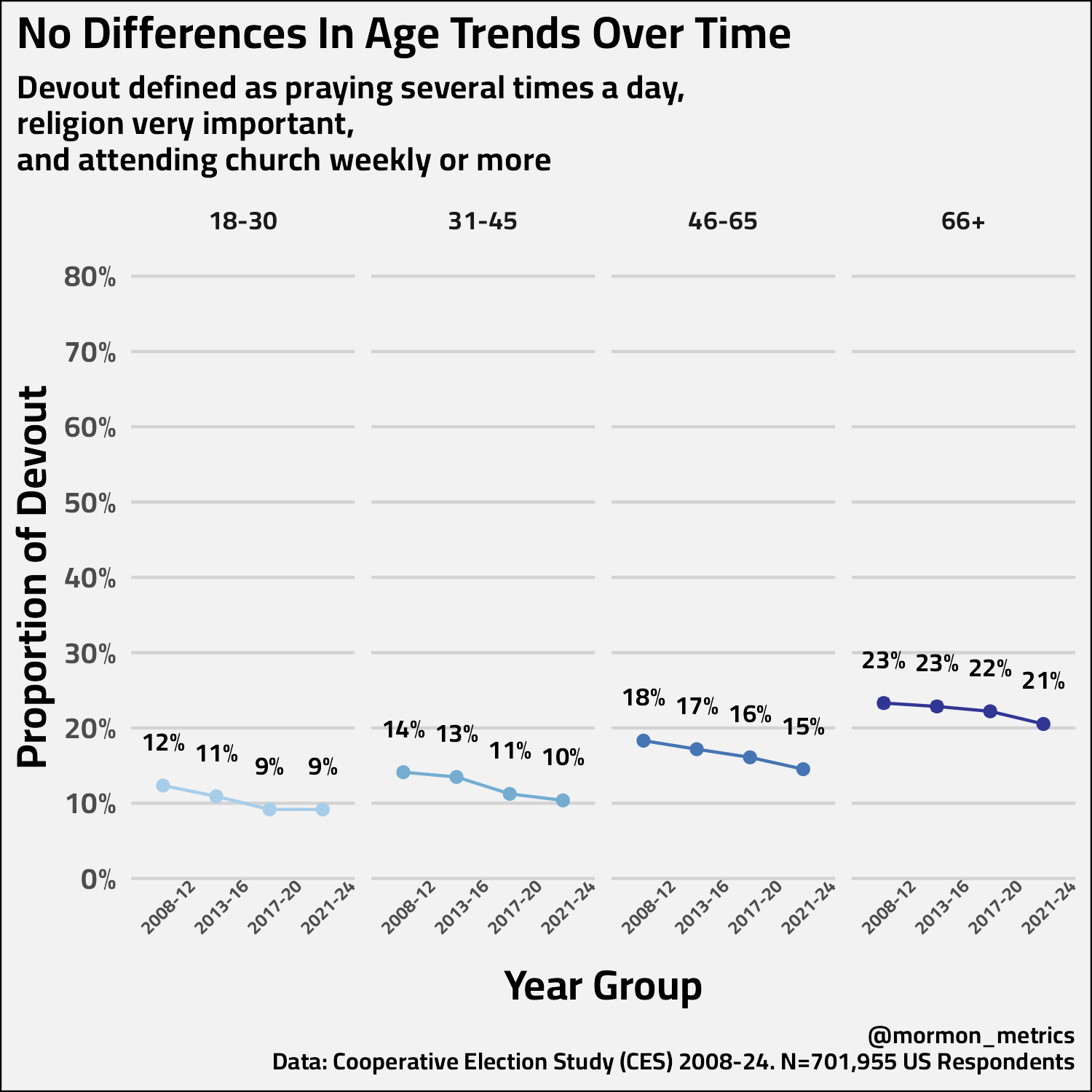
It seems ALL age groups devotion have decreased over time at a similar rate. Notably these findings differ from the LDS numbers where the older groups are stagnant, but the younger groups have seen decline.
Anyways…
That’s the post for this week. Let me know what you think in the comments. Are there aspects of this that I could explore more to understand this LDS trend? What is missing from this analysis that is also possible for me to obtain?
“We decide what to believe by deciding who to believe.“ Arnold Kling
Similarly, I argue that we decide how devout to be by deciding how devout others will likely be.
There can be heavy pressure on LDS men to serve a mission. Serving a mission shows devotion. This added devotion is likely to result in marriage with a more devout spouse.
But what happens if devotion begins to fall among teenagers? What if teenagers get the sense that their peers are becoming less devout? What if apostasy is on the rise among the youth?
If serving a mission shows devotion, but the pool of candidate spouses is trending toward less devout, then a mission may worsen your marriage prospects, or more likely, be less worthwhile.
Missions are important devices for the devout or those wanting to be married to a devout spouse. But what if you don’t want to be married to a devout spouse?
Then serving a mission would be less beneficial.
Serving a mission has game theoretic qualities. See the Prisoner’s Dilemma.
The ultimate goal is not to be devout, but rather to pursue knowledge that will serve you and your future family best.
In summary, game theory in the context of identifying a spouse may help explain “What is driving the generational decline in LDS devotion, and does missionary service still strengthen devotion the way it used to?”
I would like to see stats on early returning missionaries. I don’t feel like there has been transparency from the Church on this issue. I would like to state that there is nothing wrong or any shame in coming home early. We need to accept that different people have different experiences and support and love them.