
Part 2: The Post-2014 Religious Shift. Are Latter-day Saints Beating Secular Headwinds?
Looking Closer At Protestant Denominations vs. Latter-day Saints


Last week, we compared Latter-day Saints to broad christian categories: Evangelical Protestants, Mainline Protestants, and Catholics. This week, I break these categories into names other christians might identify with (baptist, presbyterian, etc.)
Our previous main takeaway was that when looking at the largest Christians Traditions in the US, while the snapshot in 2024 shows Latter-day Saints resistance to secular headwinds, looking at a trend most metrics across practice and belief (but, mostly practice) are declining faster. Read the full post below:

Now, let’s dive deeper into denominations…
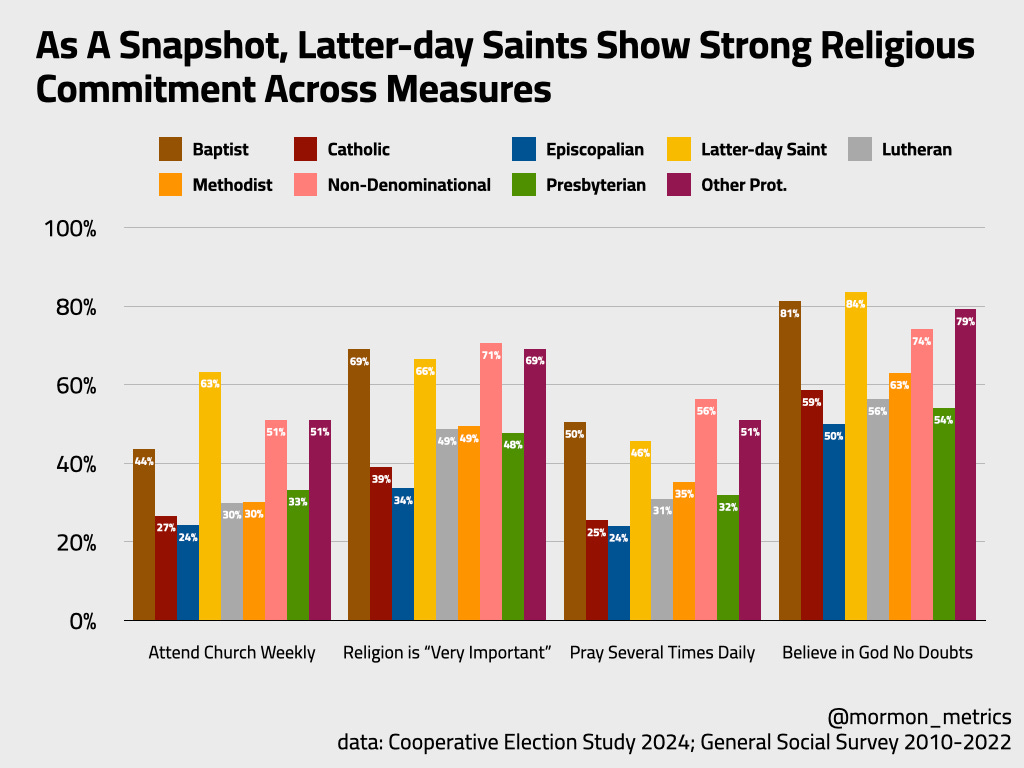
As a snapshot when we look across religious measures, Latter-day Saints are consistently near the top breaking things out by tradition — particularly with weekly church attendance! Using the belief in God GSS question, Latter-day Saints are at 84% who say they believe in God without doubts.
Now let’s look at the trend lines across religious denominations…
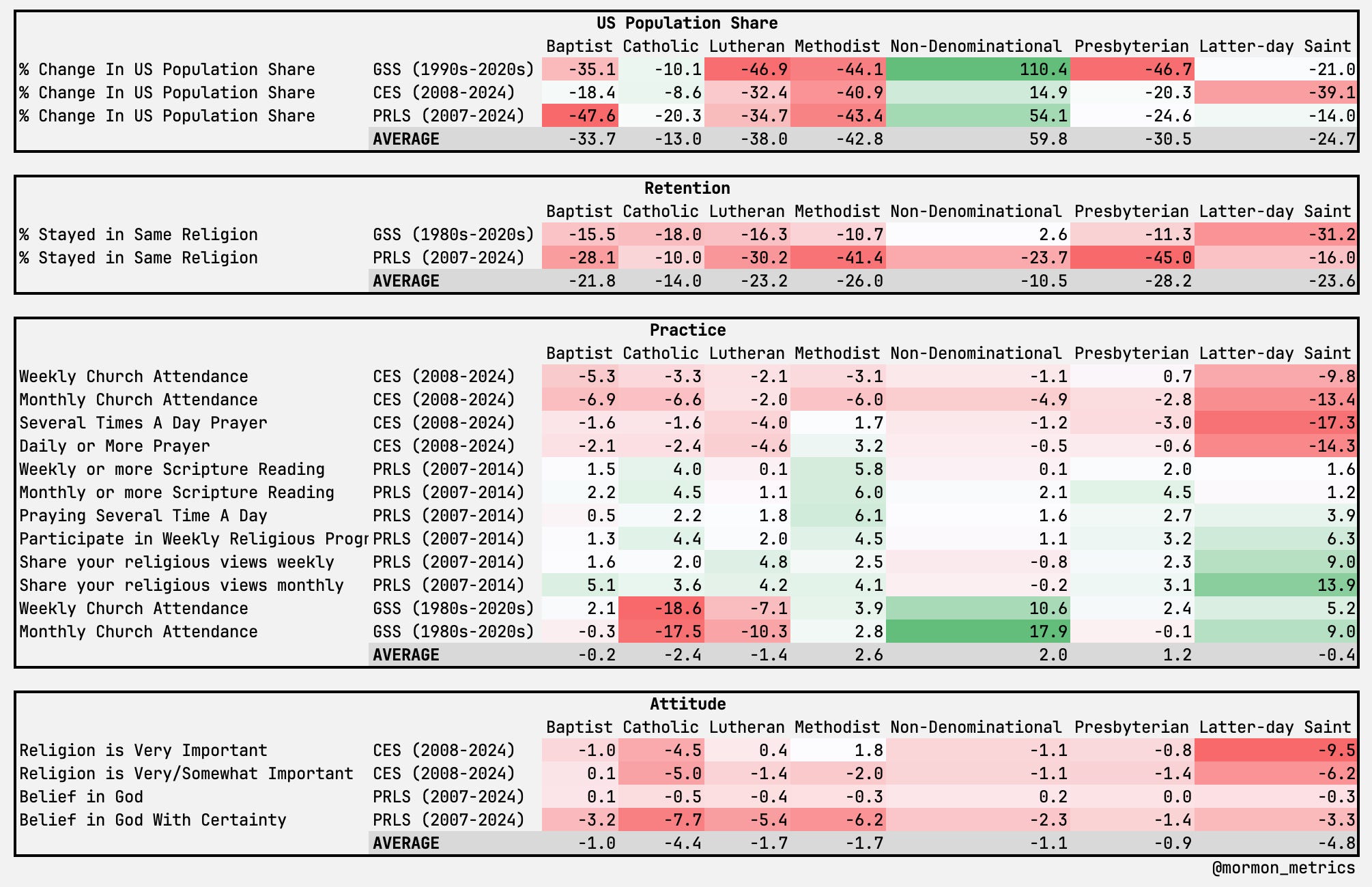
So there are a few things that immediately standout:
Not all Christian denominations have declined, Non-denominational Christians have doubled in their size according the the GSS data from 1990s to present day. Our numbers are more contextualized seeing that Latter-day Saints look similar to other Christian traditions in population share decreases — with Non-denominational numbers bolstering the Mainline and Evangelical overall numbers.
We see a similar pattern in disaffiliation. Latter-day Saints look pretty middle of the pack in those leaving the tradition compared to other denominations. As I have noted before, most protestants are remaining protestant, but switching denominations within protestantism (many likely moving to non-denominational christian) as seen in this chart from pew I’ve shared before. It is more common for Latter-day Saints to identify with no religion after leaving.
One other thing: You’ll notice the practice metrics in this chart don’t look as bad for Latter-day Saints compared to my post last week. This is due to our time range for the Pew data being cut off prematurely. In this post we have pew data for 2007 to 2014 instead of 2007 to 2024. Unfortunately, the protestant denomination variable is not available in the public use file for data privacy reasons, but I will update these numbers when it is eventually released.
But, this early data access cutoff actually revealed something interesting…
If you look at the full trendline for pew (2007-2024) the practice metrics show strong overall decreases most dropping between -10 and -20 points (see my last post for that data)! But, looking at the 2007 to 2014 time period, many practice metrics actually increased. This suggests that the stronger decline in religious commitment and orthodoxy among Latter-day Saints occurred between 2014 and 2024.
In our CES data in the table above, we can see the full trend line validated from 2008 to 2024 which show strong drops in practice that are much more stark than other denominations.
These stats actually validate the trend we found from the Mormon Typology Report (pictured below).
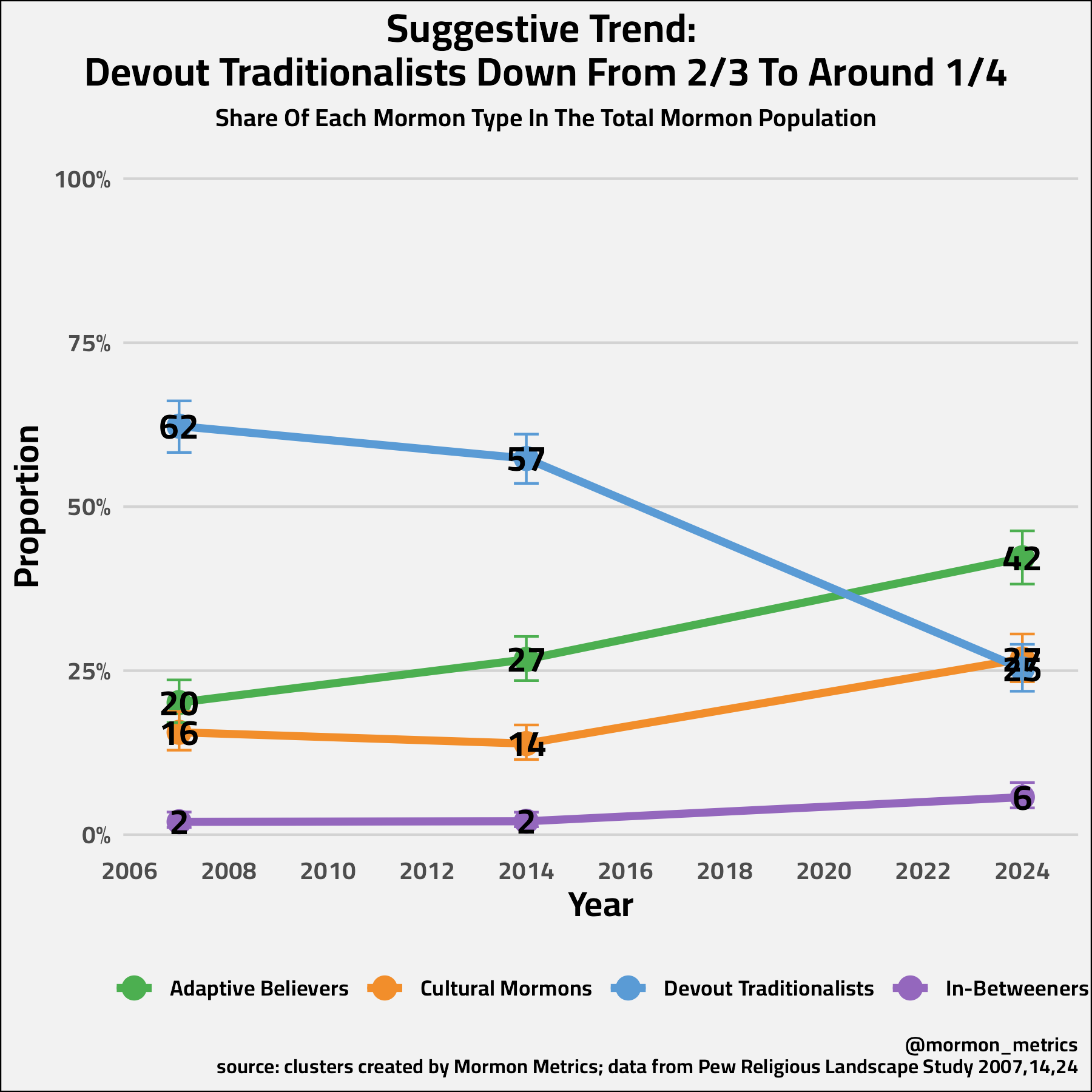
Particularly after the 2014 year, we see a large drop in the “Devout Traditionalists” which is the group showing the highest levels of devotion and practice.
Conclusions
So what are my takeaways from this two part secular headwinds exercise?
As a snapshot in 2024, Latter-day Saints show strong resiliency to secular headwinds with high scores on metrics across belief and devotion compared to most other christian traditions.
Looking at trends over time,
For population share and retention, Latter-day Saints fare similarly to many Protestant denominations — not better and not worse. Non-denominational Christianity is absorbing much of the Protestant exodus, which inflates overall Protestant retention numbers.
For practice and belief metrics, LDS are likely declining faster than other Christian traditions and denominations across all the data points and full time periods we examined — though we would want to confirm this with the full 2024 Pew data when the restricted-use file is released.
As suggested in this post, sharper declines in religious practice and commitment for Latter-day Saints occurred after the year 2014, which passes the smell test for me since after 2014 was a period of cultural and institutional disruption (inside and outside the church).
Let me know what you think about this analysis in the comments. Do you agree with my findings. Did I miss anything or overlook something?
Code for this post available here.
Hi Alex -
Moderate time reader, first time commenter :)
Thanks for all the excellent context and highest regards. In case it matters (viewpoint epistemology and all that) I'm an LDS friendly atheist living in a part of Southern California with a reasonably high LDS presence - I'd guess my children's high school was probably 10-12% LDS; my grandparents were all southern-inflected Baptists of varying levels of orthopraxy against which my parents independently rebelled pretty hard (before meeting each other).
I'll point one rather obvious variable for the post-2014 shift, namely some changes that started becoming quite visible in the Republican Party starting late 2015; if you could find some finer granularity time series to at least temporally correlate (GSS is biennial and of course you have the pre and post election sides of the CES) that would be very interesting.
(I'm embarrassed to say that I don't speak R so I can't easily mung your code for myself, although I suspect my high powered "AI" could probably translate the R into MATLAB at which I am a decent 2L speaker with all the statistics addons).
Would be fascinating to compare, if the statistics exists, similar statistics for LDS growth, disaffiliation, etc. for other first world countries with relatively high LDS populations and at least hypothetically similar sociological placement of LDS versus Gentile. You'd also have to take a look at how geographically concentrated versus not those other-country LDS are; I would expect LDS in other countries might have a more urban concentration than the US, but not the state level concentration we do (where less than a third of the Church members live east of the Rockies , although that is slowly changes as you know far better than I).
That's going to be a little tough since per https://ldschurchgrowth.blogspot.com/ there are only a few candidates above 1%: NZ, Chile, and Uruguay.
Given the enormous LDS penetration into the South Pacific, I'd have to wonder what fraction of the 2.3% (!) of New Zealanders who are LDS would code "white" by NZ standards.
Coding Pacific Islander (about 7% of the total NZ population) would play hugely into the NZ LDS' sociological position versus the broader NZ culture (plus in NZ you have the very unique position of the Maori, very different than e.g. Aboriginals in Australia: 0.6% LDS or Canada: 0.5%).