
Are Latter-day Saints Beating Secular Headwinds?
Analysis of the Cooperative Election Study, Pew Religious Landscape Study, and the General Social Survey


Every few months, a new claim circulates about the state of the LDS Church in America. The institution points to record missionary numbers and a committed, practicing membership. Critics point to empty pews and a generation walking away. Both sides cite data. Both sound confident. And from the outside, it’s genuinely hard to know who to believe.
The snapshot picture actually favors the institution. Latter-day Saints in 2024 show higher levels of religious practice and commitment than Catholics, Mainline Christians, and on some measures, even Evangelicals. The members who show up — who pray, who attend, who say their faith is central to their lives — are doing so at rates that most Christian traditions in America can’t match. That’s not spin. That’s what the data shows.
But a snapshot only tells part of the story. When you ask not just “how devout are members today” but “how has that changed over time,” some important patterns emerge. Across retention, religious practice, and religious attitudes, Latter-day Saints are declining faster than comparable Christian traditions — not just losing members at the margins, but showing steeper drops in prayer, scripture reading, and church attendance among those who still identify.
Both things are true simultaneously. The question is which one you’re asking. Let’s look at both.
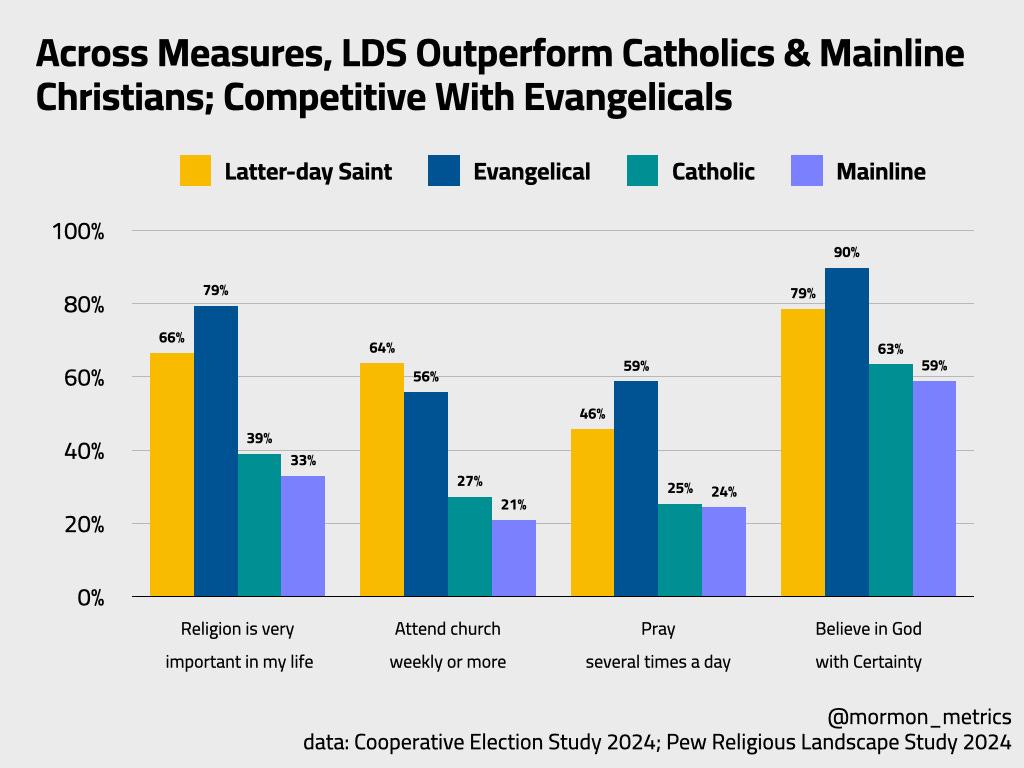
Across four measures of religious practice and belief, Latter-day Saints outperform both Catholics and Mainline Christians by wide margins. On weekly church attendance — perhaps the most concrete behavioral measure of religious commitment — 64% of LDS respondents attend weekly, compared to 56% of Evangelicals, 27% of Catholics, and 21% of Mainline Christians. Evangelicals lead on most other metrics, including prayer frequency (59% vs 46%) and certainty of belief in God (90% vs 79%), though the gaps are smaller than those between LDS and the other two traditions. By any reasonable reading of this snapshot, active Latter-day Saints rank among the most religiously committed groups in American Christianity.
But snapshots don’t tell us whether things are getting better or worse — for that, we need to look at change over time.
To do that, I pulled tracked questions from three of the most reputable surveys in the US: the Cooperative Election Study (CES), the Pew Religious Landscape Study (PRLS), and the General Social Survey (GSS). I organized the metrics into four categories: US population share, retention of those raised in each tradition, religious practice, and religious attitudes. For GSS figures, I pooled respondents across decades rather than using single-year endpoints, which smooths out year-to-year noise and produces more stable estimates.
The table below shows percentage point change for each metric over time, broken out across four Christian traditions. The average row at the bottom is most useful as a relative comparison across groups — it’s less meaningful as a standalone number.
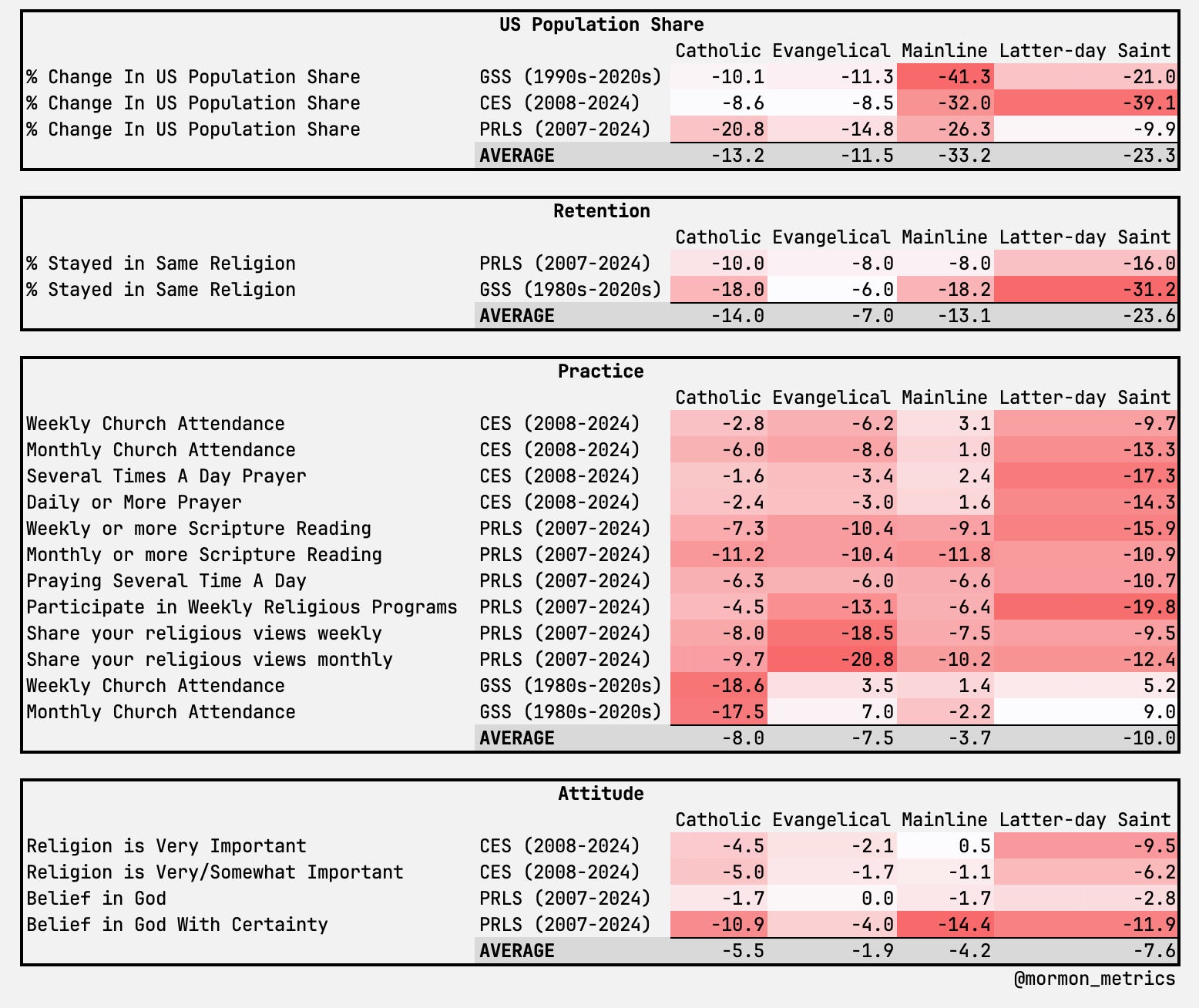
A few things stand out. Across nearly every category — retention, practice, and attitude — Latter-day Saints show the steepest declines. The gaps are sometimes modest, but on several metrics they’re substantial. On retention, GSS data shows the share of people raised LDS who still identify as LDS has fallen 31 points since the 1980s — compared to 6 points for Evangelicals and 18 points for Catholics. On religious practice, LDS prayer frequency has dropped 17 points since 2008 according to CES data, compared to 3 points for Evangelicals. Weekly participation in religious programs is down 20 points since 2007, nearly double the Evangelical decline of 13 points over the same period.
The attitude numbers tell a similar story. The share of LDS members who say religion is very important in their life has fallen 9.5 points since 2008 — more than four times the Evangelical drop of 2 points over the same period.
The one area where LDS fare relatively better is raw population share, where Mainline Christians have declined more steeply by some measures. That’s a meaningful caveat — Mainline decline is severe and well-documented — but it doesn’t change the overall pattern.
So what about the youth?
Now, let’s look at a snapshot of those age 45 and under by religious tradition in 2024.
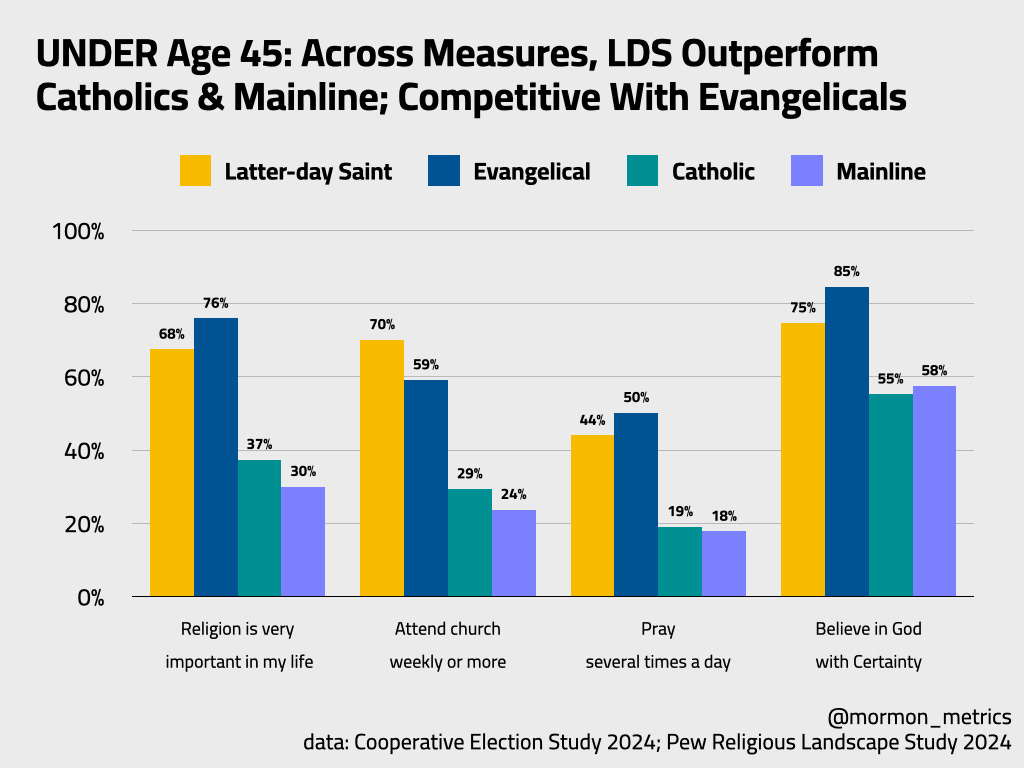
First, the good news for the institution. Even among younger Latter-day Saints — the generation that critics claim is walking away en masse — the snapshot picture in 2024 is genuinely strong. 70% attend church weekly, 68% say religion is very important, and 75% believe in God with certainty. These numbers would be the envy of almost any religious tradition in America. The rising generation, at least as a snapshot, looks committed.
But the trend data tells a different story — and it's where the findings get most concerning.
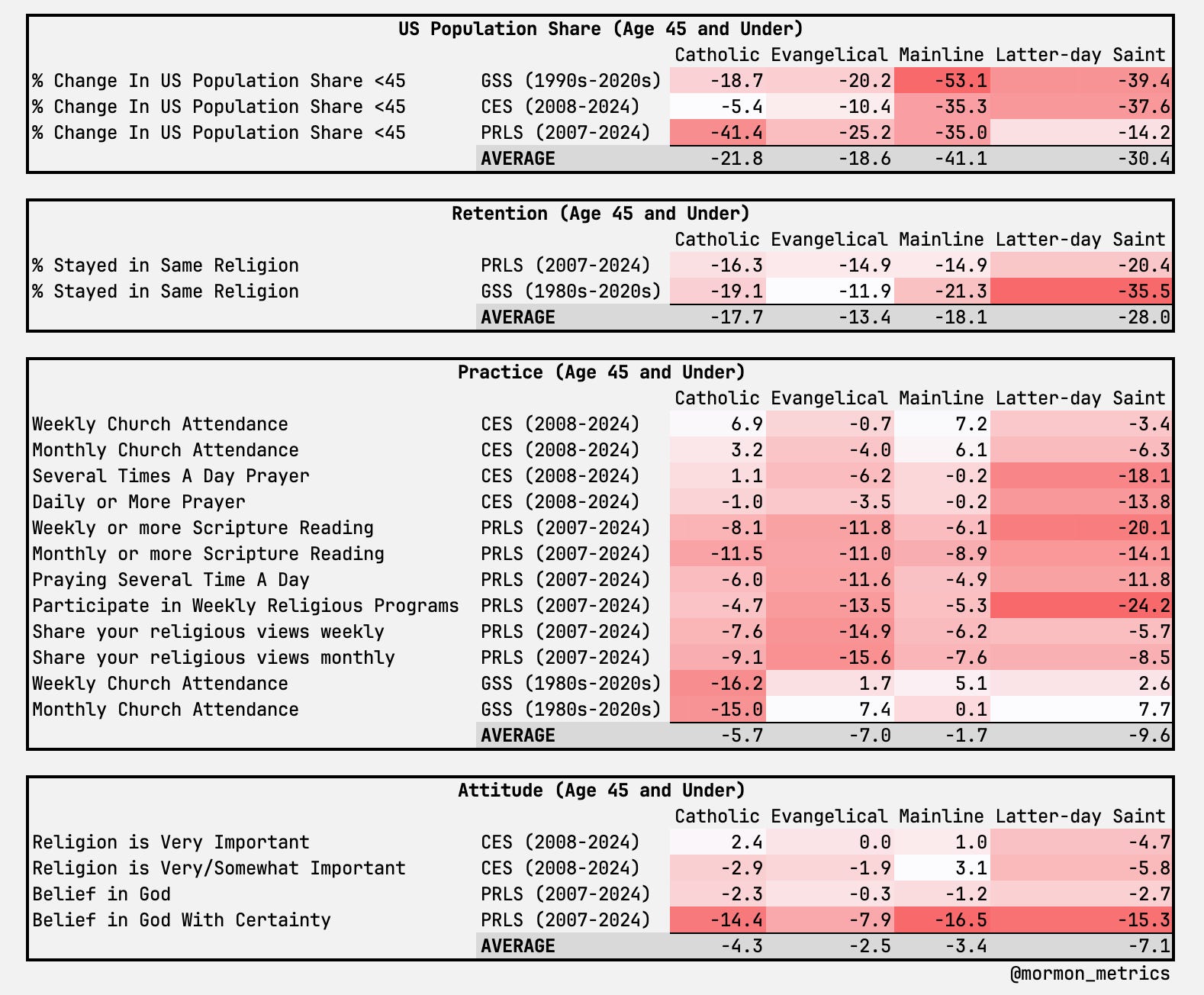
Among Latter-day Saints under 45, the rate of decline on religious practice is sharper than any other tradition we measured, and in several cases it isn’t close. Weekly participation in religious programs has fallen 24 percentage points since 2007 — nearly double the Evangelical drop of 13 points over the same period. Prayer several times a day has declined 18 points among young LDS, compared to 6 points among young Evangelicals. Weekly scripture reading is down 20 points.
The retention numbers are perhaps the starkest finding in this entire analysis. In the 1970s/80s GSS data, roughly 82% of people raised LDS still identified as LDS. In the 2010s/2020s, that figure is approximately 46% — a 35-point drop. The comparable drop for young Evangelicals is 12 points (73% to 61%), and for young Catholics 19 points (80% to 61%). By this measure, the LDS Church is losing its young people at roughly three times the rate of Evangelicals.
One important caveat: LDS sample sizes are modest across all three surveys. The GSS pools roughly 140 respondents under 45 per decade group(1970s/80s, 2010s/2020s), while CES and Pew have an estimated 200-300 LDS respondents under 45 per wave. For a group representing 1-2% of the US population, this is simply a data limitation we have to work with. Any individual estimate should be held loosely. What gives me reasonable confidence in the overall picture is the consistency of the pattern — three independent surveys, across multiple metrics, all pointing in the same direction. That convergence is harder to dismiss than any single number.
Conclusion
So, are Latter-day Saints beating secular headwinds?
The honest answer is: it depends on what you’re measuring — and that distinction matters more than most people in this debate acknowledge.
As a snapshot, yes. Active Latter-day Saints in 2024 show levels of religious practice and commitment that most Christian traditions in America would envy. The institution is right to point to that. It’s real.
But as a trend, no. Across retention, religious practice, and religious attitudes, Latter-day Saints are declining faster than Catholics and Evangelicals — the two largest and most comparable Christian traditions in the US. The margin isn’t small. On several metrics, it isn’t close. And the youth data, despite showing a committed core, reveals that the pipeline is narrowing faster among young Latter-day Saints than among young Christians in the breaks we looked at.
Next week I want to dig into individual Protestant traditions — Baptists, Methodists, Pentecostals — rather than grouping them into broad Evangelical and Mainline buckets. That comparison may tell a more nuanced story. If you have thoughts on what I should look at, or think I missed something this week, leave a comment below.
Update: one note I forgot to mention, the pew numbers for retention in the tables have the same numbers for Evangelical and Mainline. This is because there wasn't a born again question asked in the religion you were raised in 2007, so this is just an average across Protestants overall. The actually numbers probably look more like the GSS where Evangelicals have better retention and Mainline have worse.
Very enlightening, well-balanced. Church leaders have long pointed to the Church’s growth as evidence supporting its truth claims. President Russell M. Nelson’s wave of temple announcements has seemed to reinforce earlier statements such as President Jeffrey R. Holland’s questionable assertion that the Church was experiencing “double-digit growth of stakes every week of our lives.” Yet for many, the reality is more complicated. In numerous congregations, attendance is thinner than in years past, raising questions about whether official narratives of growth fully reflect reality.
Ireland offers a useful example. In 2022, the Church reported roughly 4,000 individuals on its membership rolls in the country, while the national census recorded just over 1,000 citizens who identified as Latter-day Saints—a discrepancy of about 75 percent. Differences of this magnitude invite reasonable questions about how membership figures are counted.
Given the Church’s emphasis on detailed record-keeping, greater transparency regarding membership and activity rates (following the example of the Adventists) would go a long way toward clarifying these discrepancies and reducing speculation about the Church’s current trajectory.
This aligns much more closely with my lived experiences. I know that alone isn't a metric of truth, but I do find it a relief that I'm not totally crazy. I wish the church would release the numbers of active temple recommends in the world rather than just the number of people who've at some point been baptized and confirmed. I feel that would be a much more accurate, if still imperfect, metric of LDS activity and retention.