How Are Global Latter-day Saints Doing On Mental Health?
Harvard/Baylor Global Flourishing Survey Pt3


This is part 3 of a 4 part series on the Harvard/Baylor Global Flourishing Study and what it tells us about Latter-day Saints. Subscribe to read part 4 next week answering, “Are Latter-day Saints Prone To Certain Personality Characteristics?”
Read part 1: Finally, A Closer Look At Members Outside the US
Read part 2: Are Latter-day Saints More Likely To “Flourish”?
This is more or less a follow-up from last week where we saw that when we break down Harvard/Baylor’s human flourishing score into parts, while LDS scored highest across religions on “Meaning & Purpose”, their worst component was “Mental & Physical Health.”
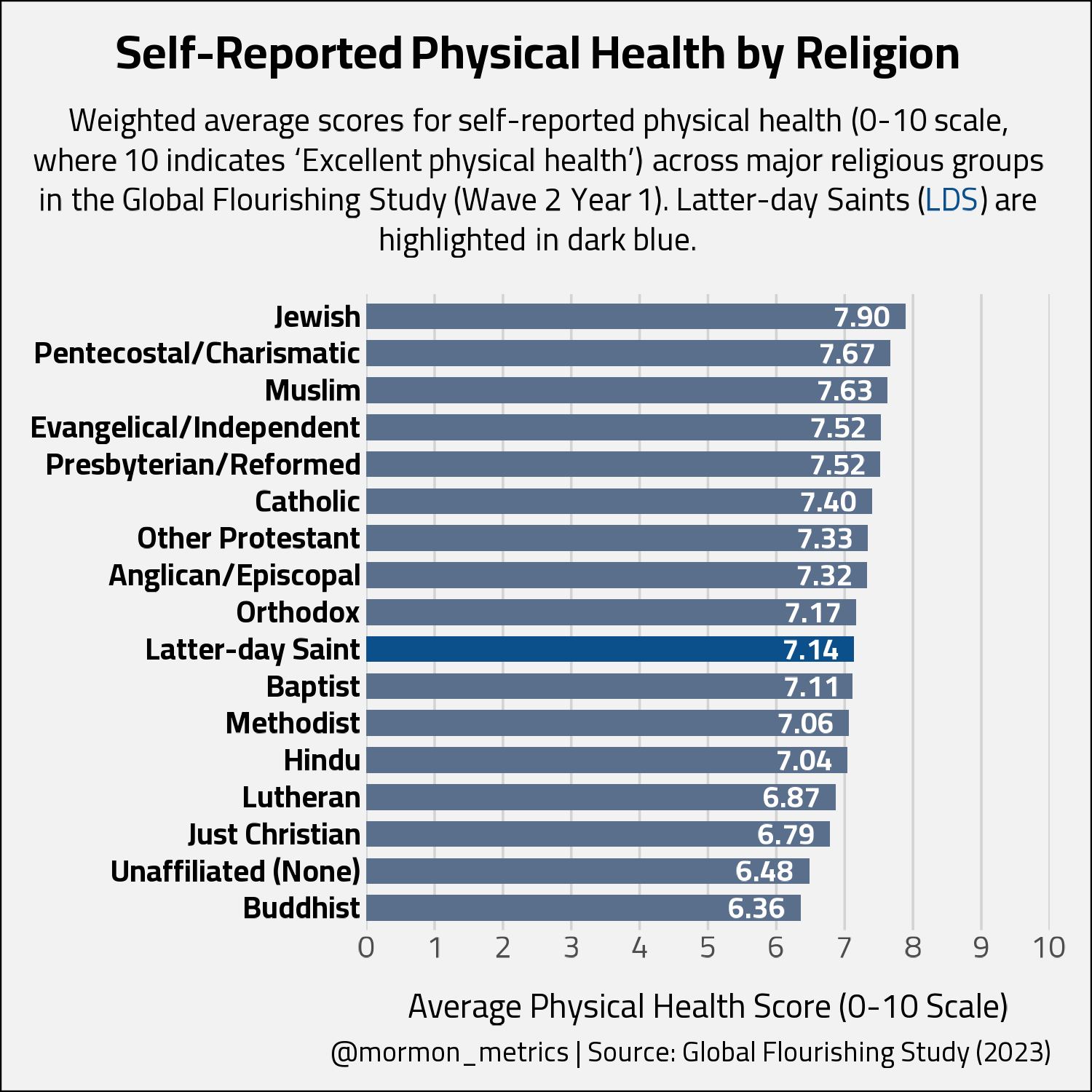
I don’t think there’s much of a story with the physical health domain here—previous research have already well-documented that active Latter-day Saints outlive the general population by about 6 to 10 years on average.1 But for those curious, I’ve included a chart below for self-reported physical health, which tracks right at the global average.2 For mental health & LDS, the literature is a bit more nuanced and developing, and the Global Flourishing Study asks several mental health questions. So, let’s explore these today.
Specifically, we have some actual question scales psychologists use to help diagnose depression(PHQ-2) and anxiety(GAD-2). So let’s see how global Latter-day Saints break-out on these scales.
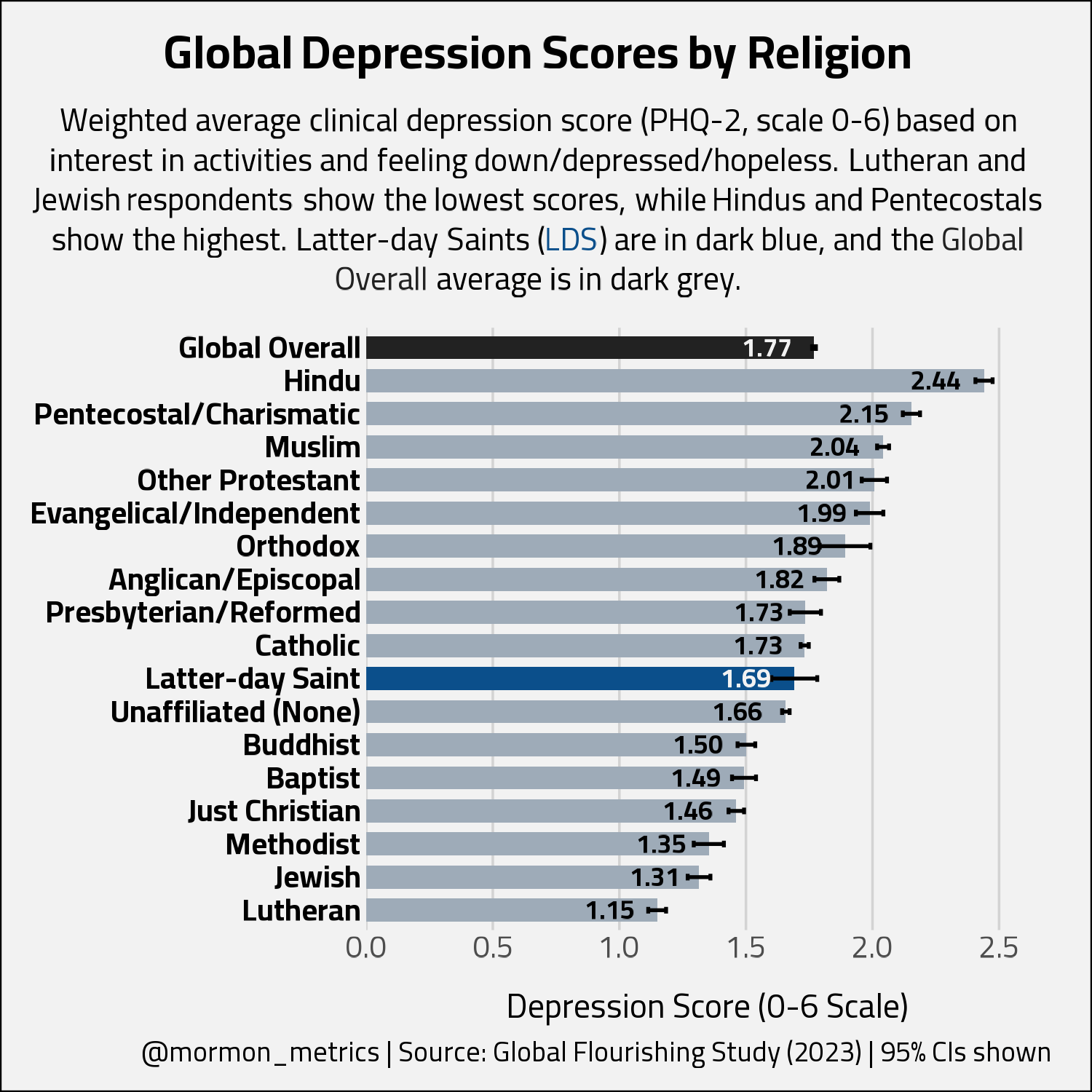
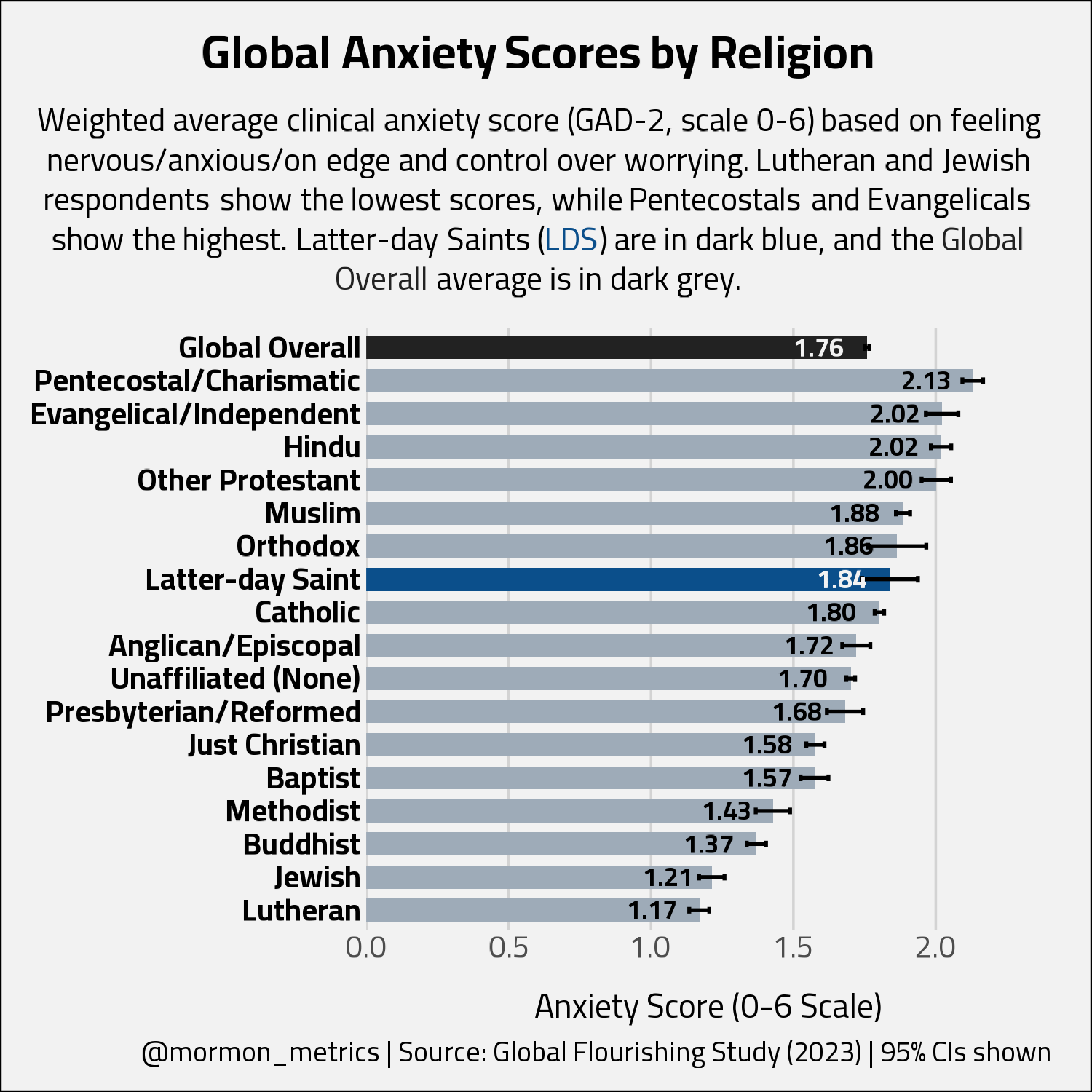
Looking at a simple average of each score, Latter-day Saints are lower than average on the Depression score and higher than average on the Anxiety score, but for both they are statistically indistinguishable from the global average at the 95% confidence level.
But, like we did last week, what if we control for demographic variables? Does that change our result?
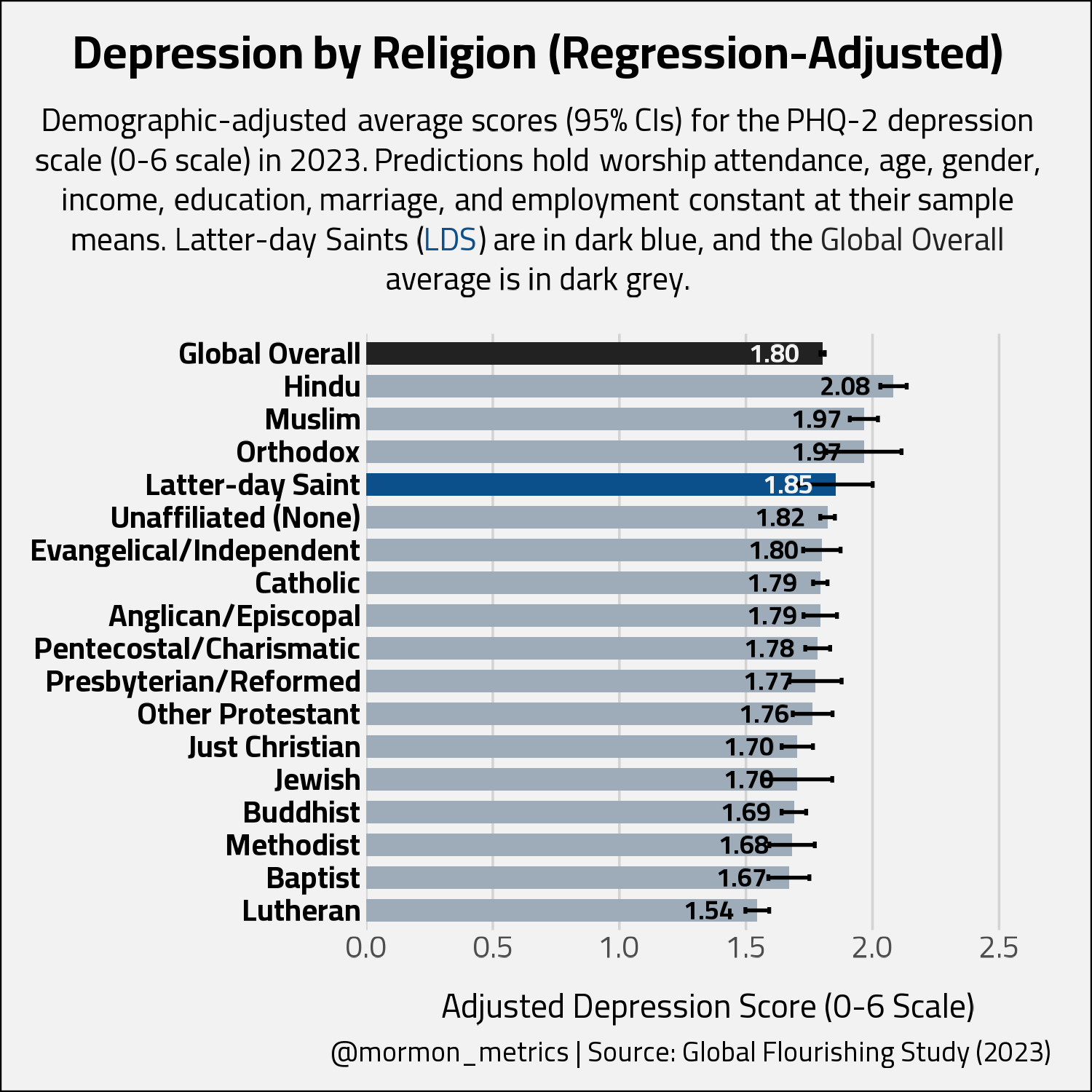
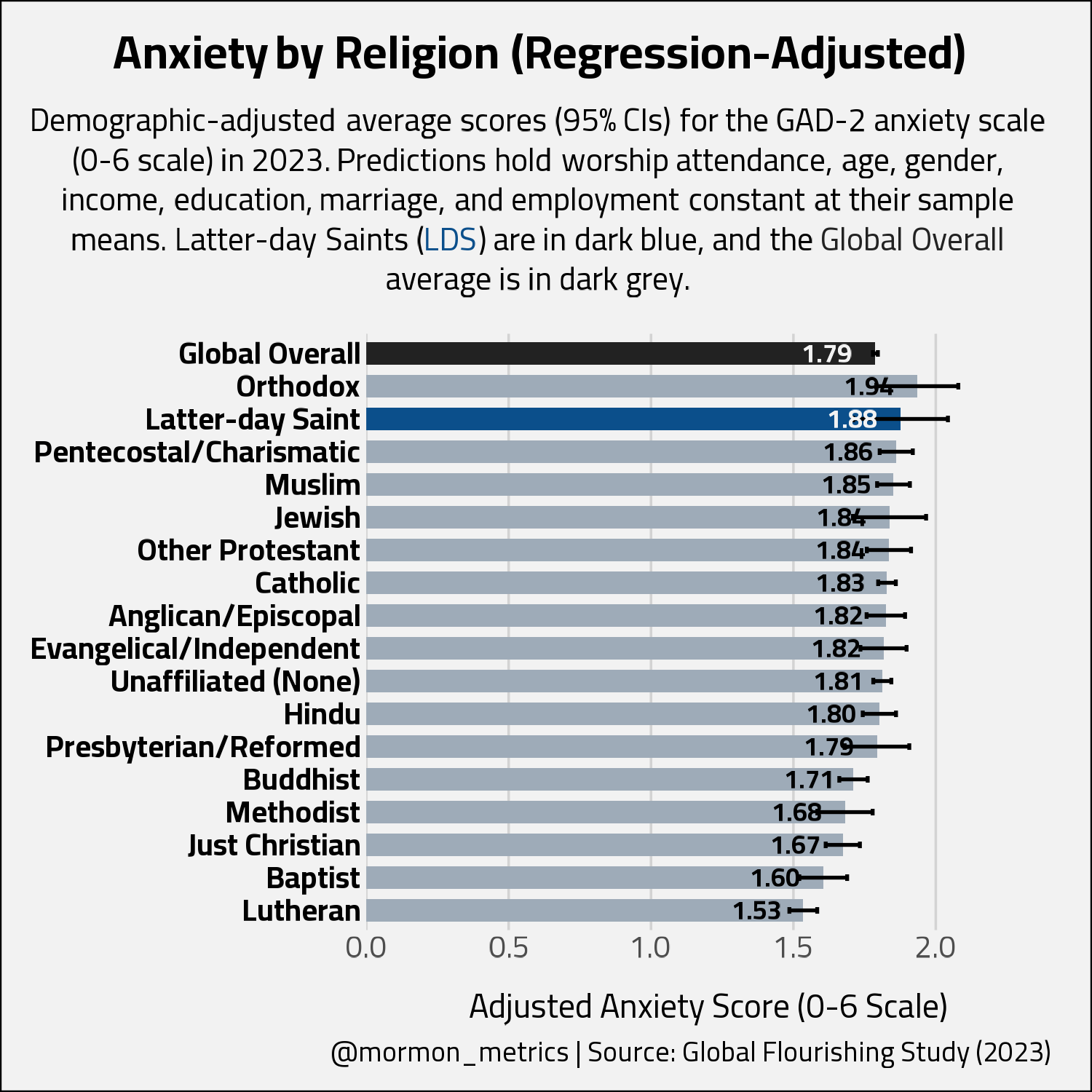
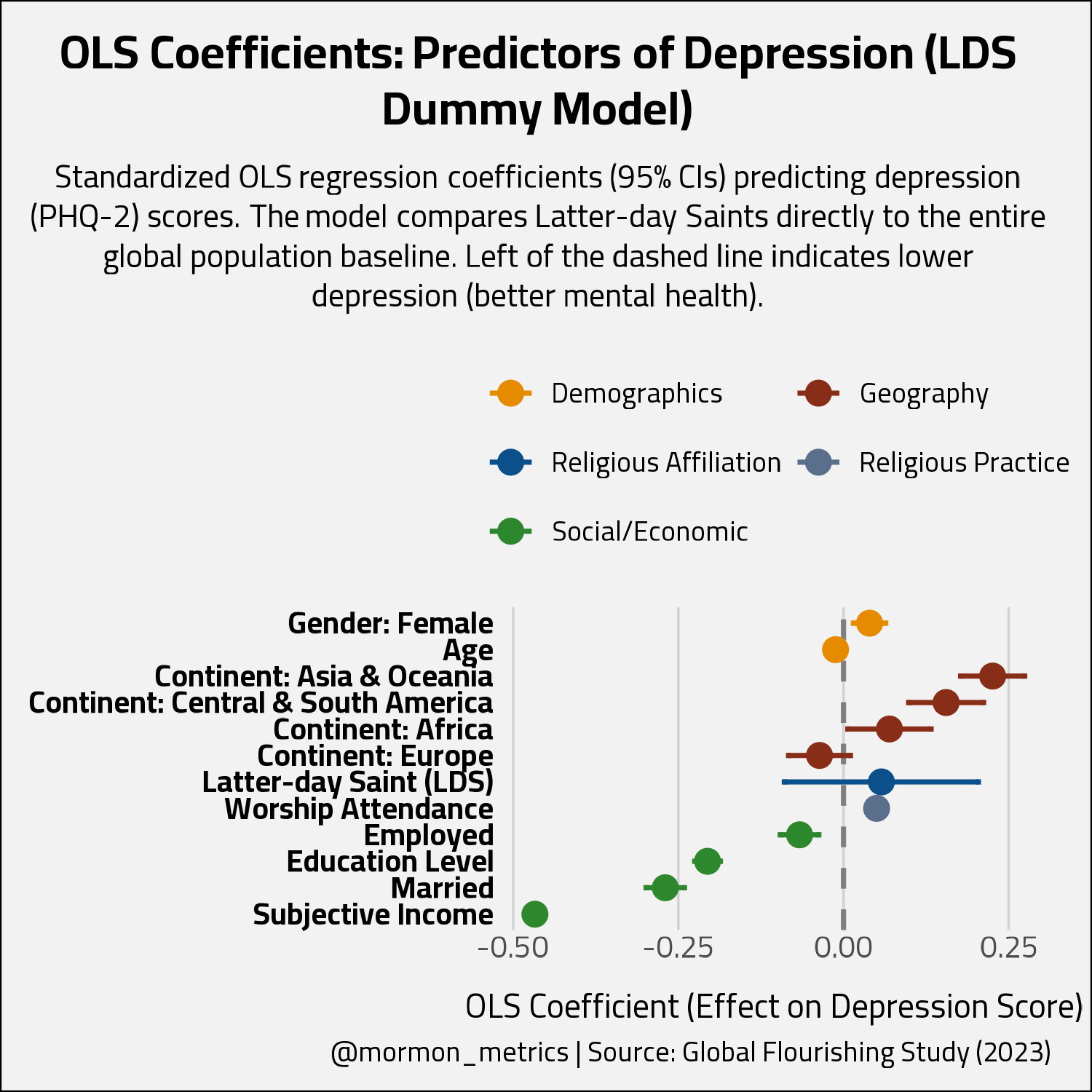
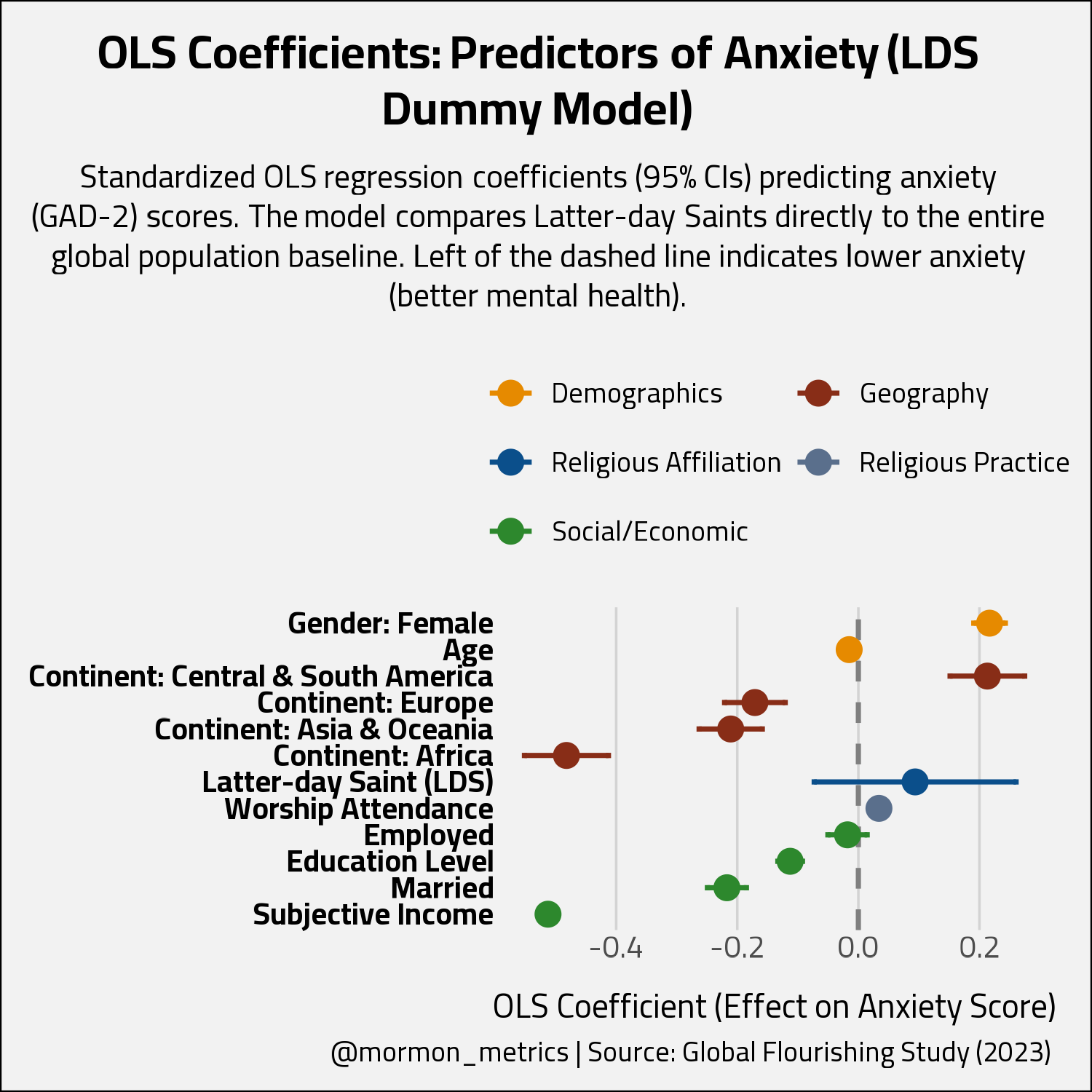
There are some religions where identifying as them meaningfully improve your mental health score (I’m looking at Lutherans, Baptists, Just Christians), but it is not so for LDS. LDS are higher than the average for both anxiety and depression and rank higher on these compared to most other religions in our model’s placement; however, the LDS are not statistically different than the global overall. It does raise some questions though…
If you like forest plots, take a look at the results of the models predicting anxiety and depression. It seems like LDS originally scored higher because they are correlated with higher subjective income, education, and marriage rates which are all correlated with better mental health3
What Might Be Behind These Mediocre To Bad LDS Mental Health Scores? I’ve Seen Research That Says LDS Have Better Mental Health On Average!
A previous literature review found that “Latter-day Saints are typically found to have better mental health than those of other religions or no religion.”
So, how do we square these findings today with this review?
As the authors of this literature review note, “we have no peer-reviewed research on Latter-day Saints and mental health internationally” (outside the US).
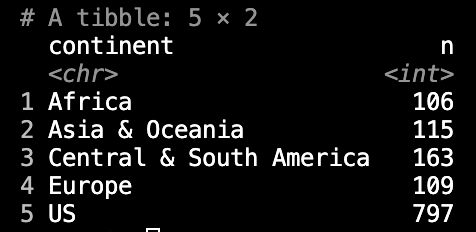
The study I am analyzing today is a rare, large, international study across 22 countries and 200,000 respondents! Is it possible that the other regions outside the US could be dragging down the overall LDS mental health scores?
Let’s take a look.
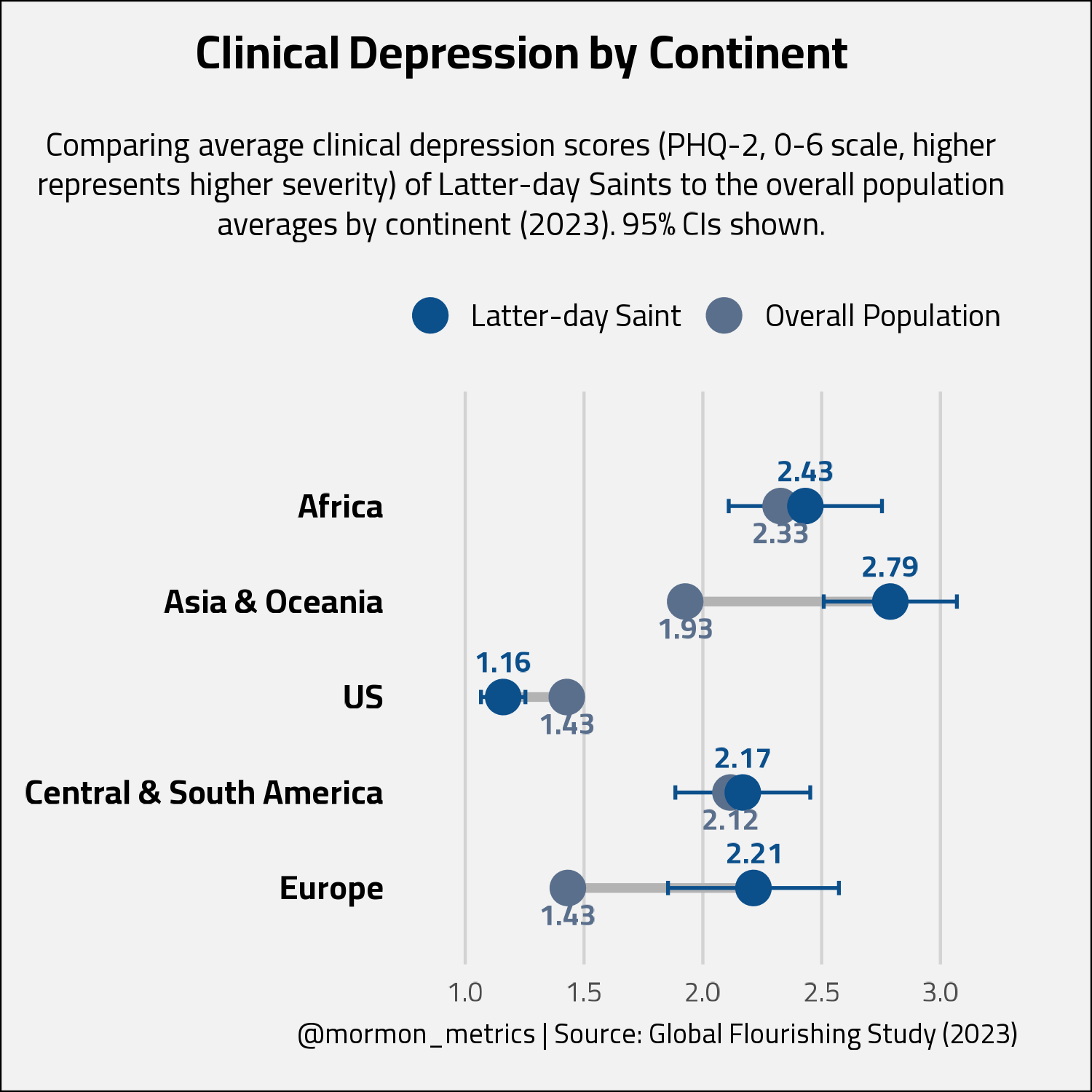
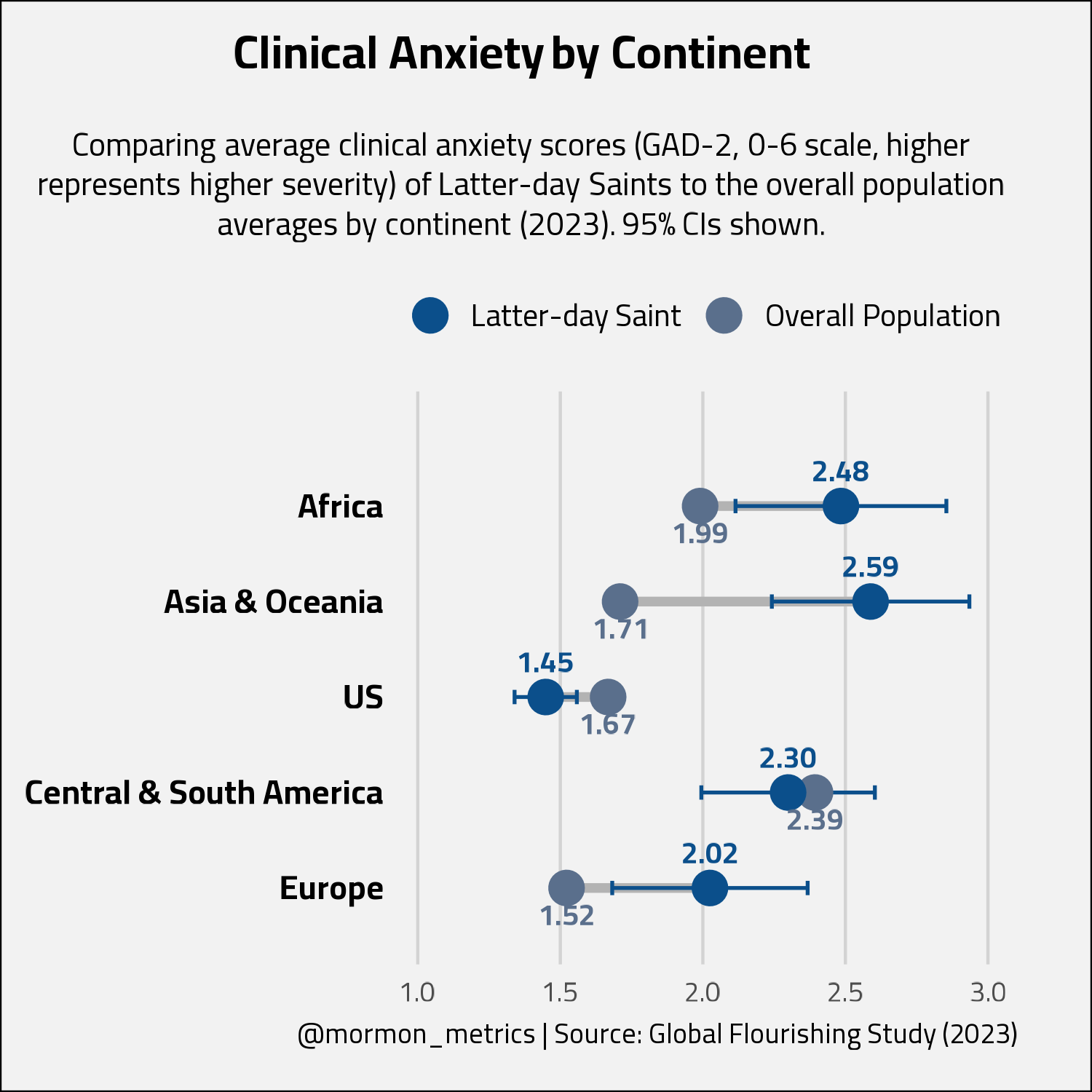
These results are fascinating. Looking at the Global Flourishing Study, and zooming in on the US, US Latter-day Saints have lower depression and anxiety score than the US overall which is consistent with the study reference above. And, the differences are statistically significant (though notably this is a simple average without demographic controls).
But when you look at the international data, we see a reason the overall LDS mental health scores are worse than expected. LDS in Europe, Asia & Oceania, and Africa are statistically more likely to score worse on Anxiety than their regional average. And, LDS in Europe and Asia & Oceania, are statistically more likely to score worse on Depression than their regional average.
I also put a footnote for the statisticians among you with more details and a robustness check.4
What Does This Mean?
The data on other regions of the world is food for thought. Why would Africa, Asia & Oceania, and Europe all report statistically significantly worse mental health while the US report better mental health on anxiety and depression?5
Do you have any thoughts or theories on this point?
As an aside, this data also makes my warnings and advice in part 1 all the more meaningful.
In part 1, we saw that LDS in Europe had very low practice and religious experience metrics compared to the rest of the world and I raised that as a red flag 🚩.
But, in our post today, we see that despite a good European overall baseline for mental health, European LDS are statistically significantly more likely to score worse on anxiety and depression.
What this means is that across multiple metrics, the church as it stands is arguably doing the worst in the most secular environment, Europe. So, again, I will reiterate my unsolicited advice now with more supporting data points: prioritize efforts to understand and help the church thrive in today’s most secular environments (Europe). This advice is essentially “future-proofing” assuming the world continues secularizing.
Do you agree with my advice?
Come back next week to read part 4 (which will be a much lighter read 🙂) answering, “Are Latter-day Saints Prone To Certain Personality Characteristics?”
See you next week!
UCLA longitudinal study of high priests: https://www.sciencedirect.com/science/article/abs/pii/S0091743507003258?via%3Dihub
Utah life expectancy study of LDS and nonLDS:
https://www.demographic-research.org/volumes/vol10/3/10-3.pdf
Life Expectancy Comparison of Utah, Denmark, and Sweden
https://www.researchgate.net/publication/235774449_The_Male-Female_Health-Survival_Paradox_and_Sex_Differences_in_Cohort_Life_Expectancy_in_Utah_Denmark_and_Sweden_1850-1910
Self reported physical health score by religion
Here are the results for the Depression model
Here are the results for the Anxiety model.
One of the issues with the comparison of LDS by continents is that the control group may not match the LDS group. For example, in Asia, LDS will have a lot of representation in the Philippines and not is much in other Asian countries which means that these simple means might just show more of a country composition difference than an actual LDS difference. To this end as a robustness check, I statistically matched the control group within each continent to the LDS in that continent using several demographic variables (including country) with bootstrapping and calculated the anxiety and depression scores. I found a similar relationship that is reported here (though only Europe retains statistical significance on Depression at the 90% confidence interval, but directionally all point the negative direction and with more than 100 people in each cell we may see a more robust relationship). Also, the statistically significant premium in the US actually disappeared and the point estimate now points the other way. The code will be released for all of this in part 4. Here are those charts:
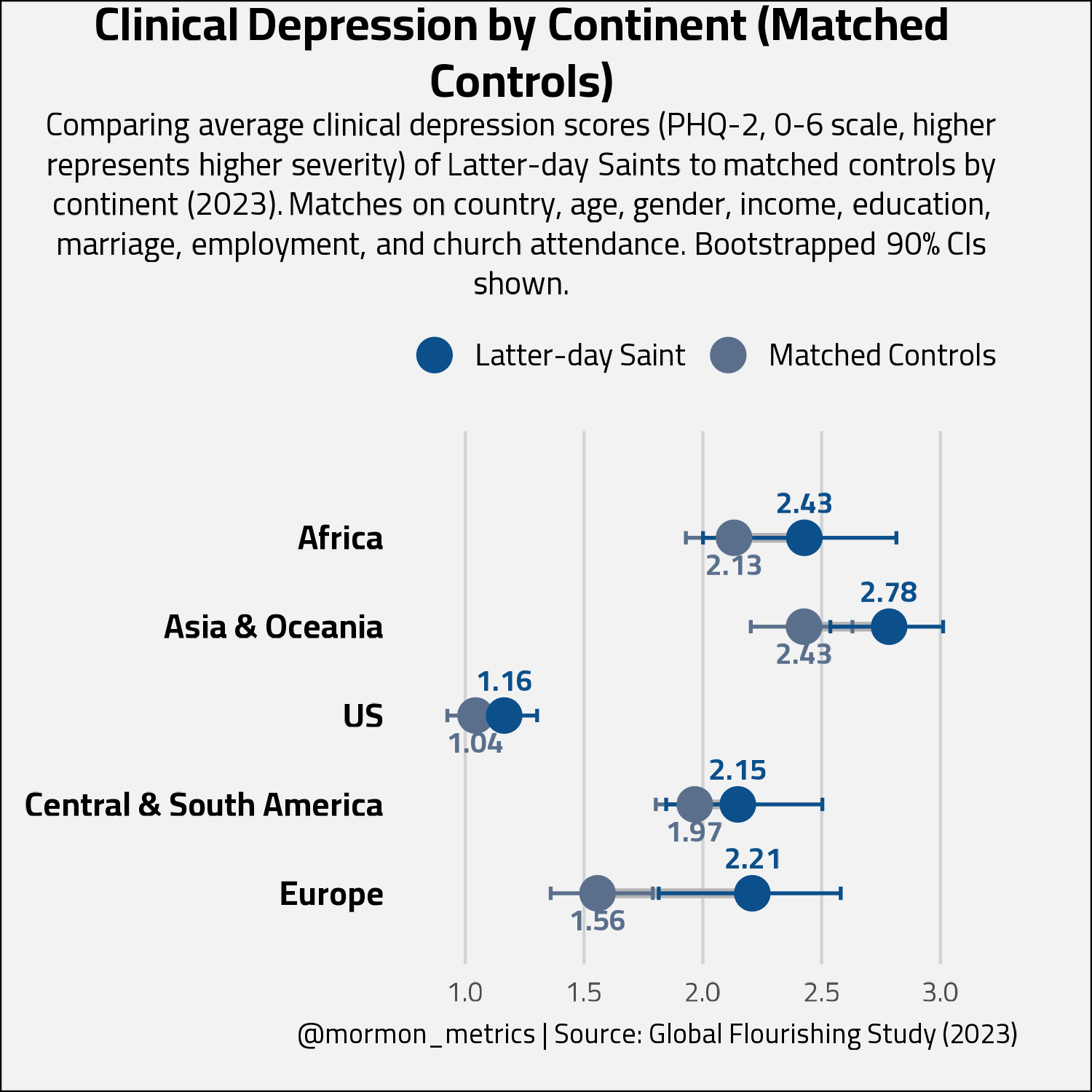
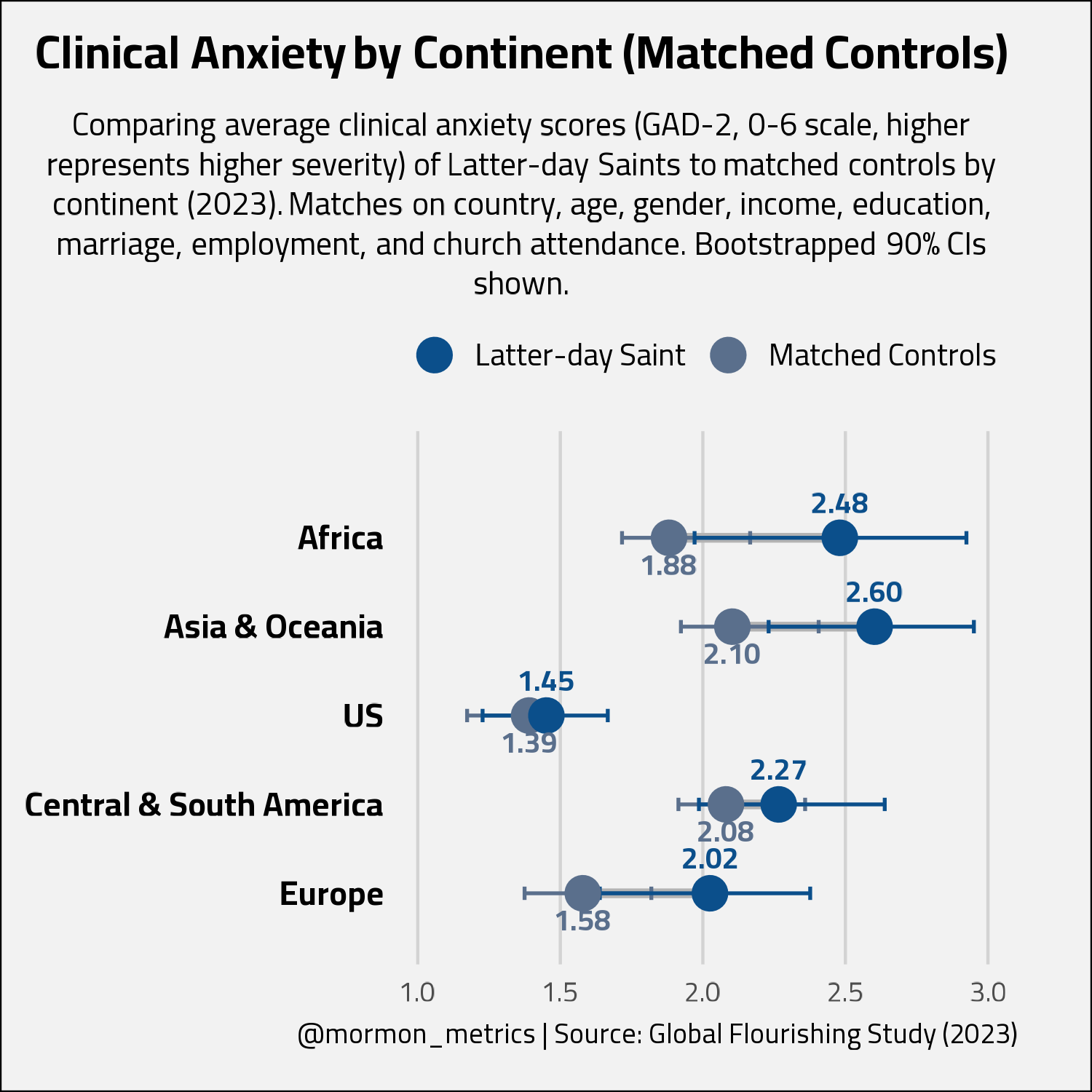
Though one important caveat to remember is that while this is the best publicly accessible data we have available for LDS in continents outside of the US, in the end, we still have between 100 and 200 LDS respondents per continent outside of the US. Weird samples can be drawn! Though to draw three weird samples in a row for three continents seems more unlikely…