Finally, A Closer Look At Members Outside the US
Harvard/Baylor Global Flourishing Survey Pt1


This is part 1 of a 4 part series on the Harvard/Baylor Global Flourishing Study and what it tells us about Latter-day Saints. Subscribe to read part 2 next week answering, “Are Latter-day Saints More Likely To Flourish?”
Usually on most of my posts — especially on social media — I have commenters asking, “well this data is just from the US, but LDS is a global church! What about the others?” Well, today let’s talk about the others.
Within the last few weeks, Harvard/Baylor gave public access to their global flourishing study fielded by Gallup. It includes over 200,000 survey respondents across 22 different countries across continents. Of the 200,000, there are 1,290 people identifying with the Church of Jesus Christ of Latter-day Saints (Mormon tradition) in the sample represented in 18 of the 22 countries across Africa, Asia, Oceania, Europe, and the Americas.
Not only do we have a survey with reach across continents, there are several religious measures (prayer frequency, scripture reading, church attendance, personal religious importance). We’ve been tracking these metrics for the US Mormons, but what about members outside of the US?
Here is a look at our LDS sample by country…
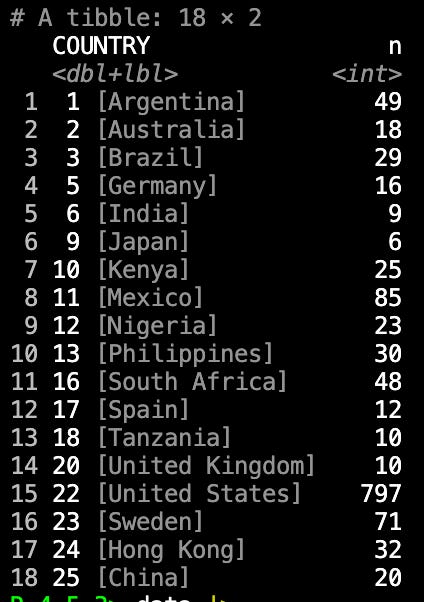
Still the majority of our sample is from the US and while the sample is too small to look at Mormons country by country, we can combine the data by continent to consolidate our sample and get a cleaner read.
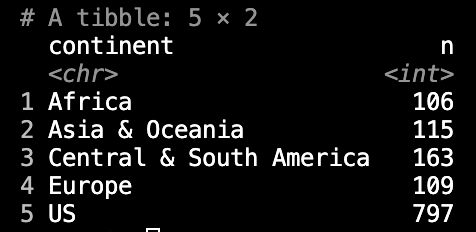
After combining by continent, we have over 100 people in each cell (with the most people being in the US). Obviously, we would appreciate higher sample sizes, but I’d love for you to point me to another publicly accessible resource with global church data and sample sizes larger than this.
Also, to be clear before we start, comparing these regions isn’t about making a value judgment on which culture or way of life is “better.” Rather, the value lies in treating these different regions as unique social ecosystems. By looking at how a global, standardized faith behaves in radically different environments, we can better understand the invisible forces—like social trust, culture, or institutional density—that shape how humans connect to the LDS religion in the modern world.
Charts
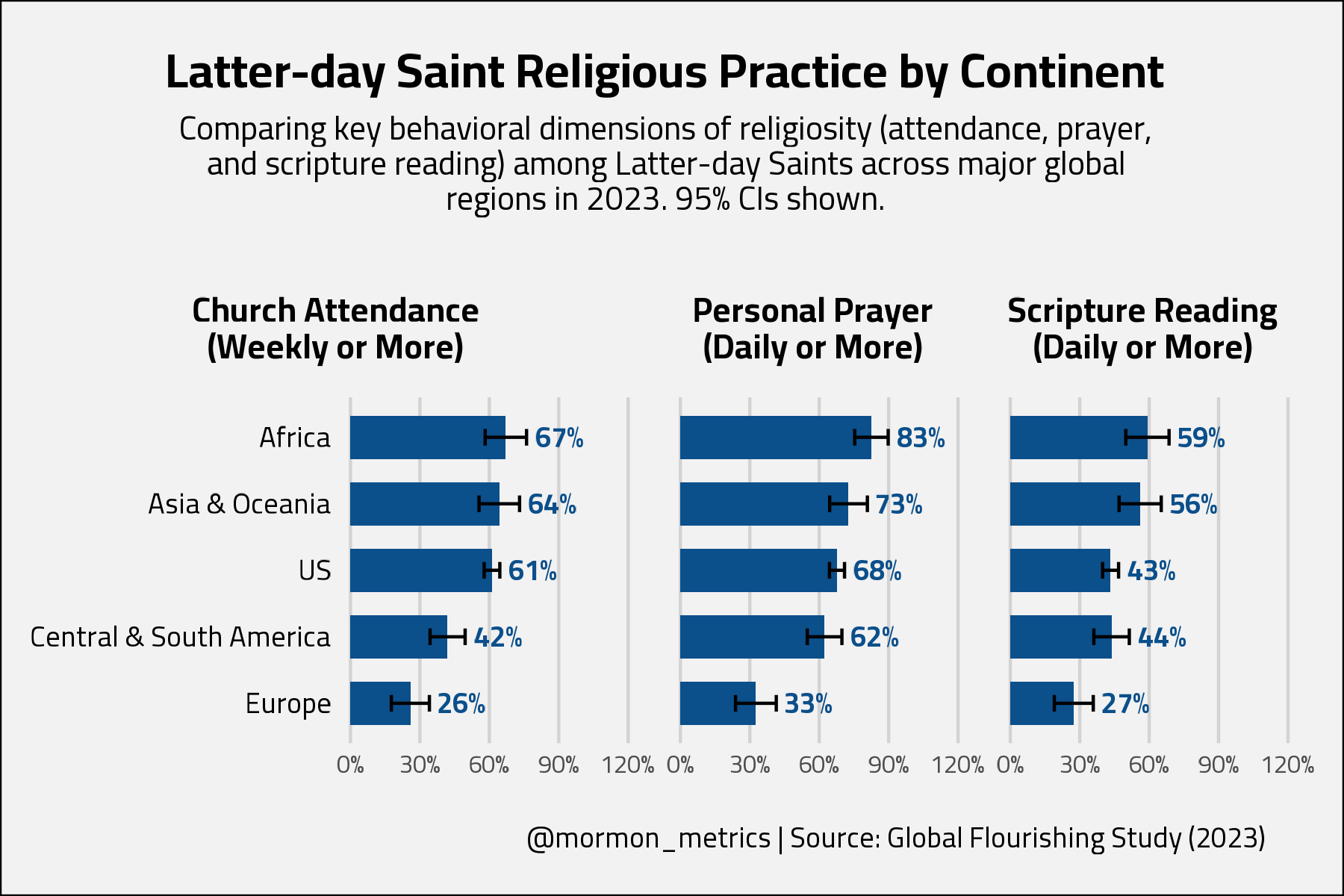
I think the big takeaway from this chart is there are regional differences in practice metrics! Africa, the US, Asia & Oceania top the list in self reported religious practice.
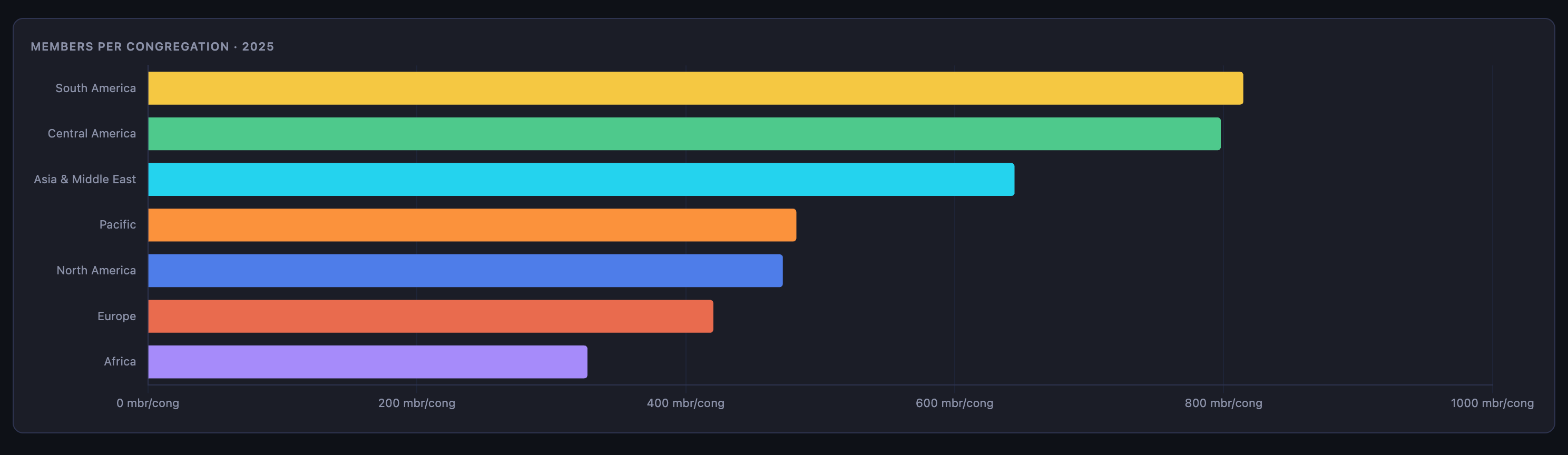
From previous analyses of members per congregation, South America and Central America have indicated higher inactivity rates, so seeing them on the lower end of the threshold (especially for church attendance) is not particularly surprising. However, with Europe, we don’t see the same members per congregation disparity we see in Central and South America, so seeing them so low was surprising to me.
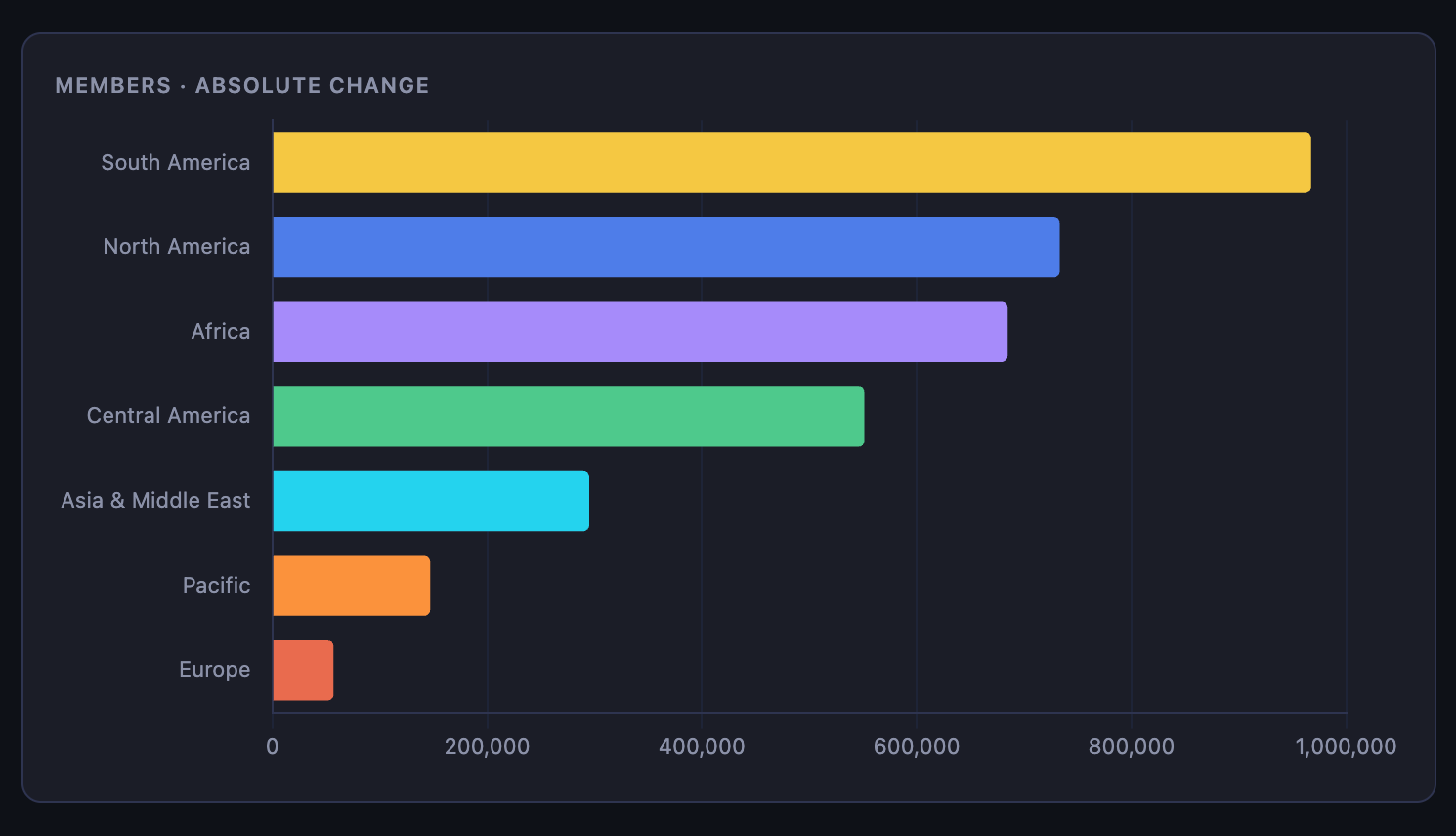
However, looking at the past 15 years (2011-2025) of official membership record data, Europe has grown the slowest numbers-wise — including losing 171 congregations as shown in the chart below.
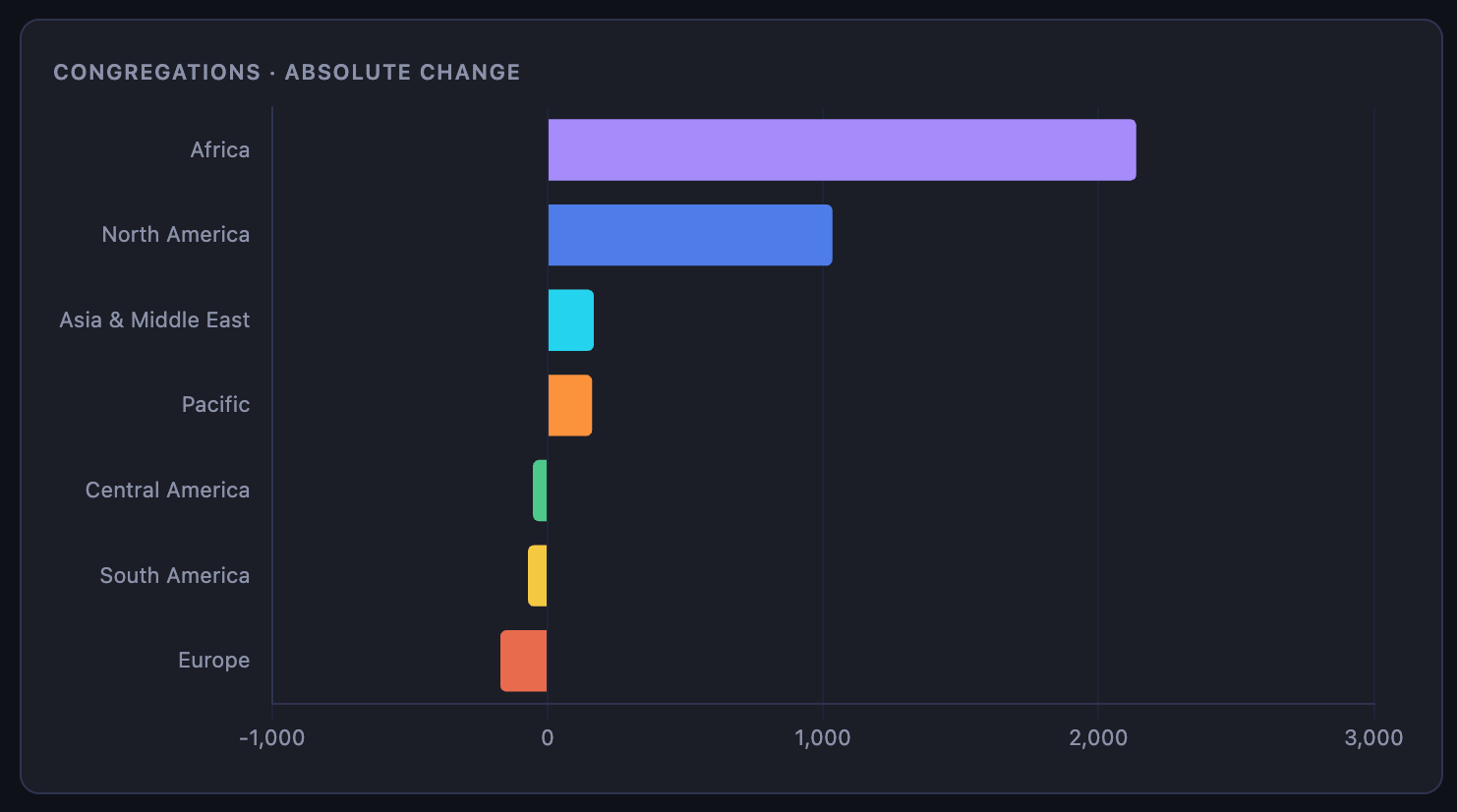
Note: these three dark, colorful bar charts were screenshots from my church membership dashboard freely accessible/exporable here.
Practice is only one side of the coin, what about LDS religious experience by world region?
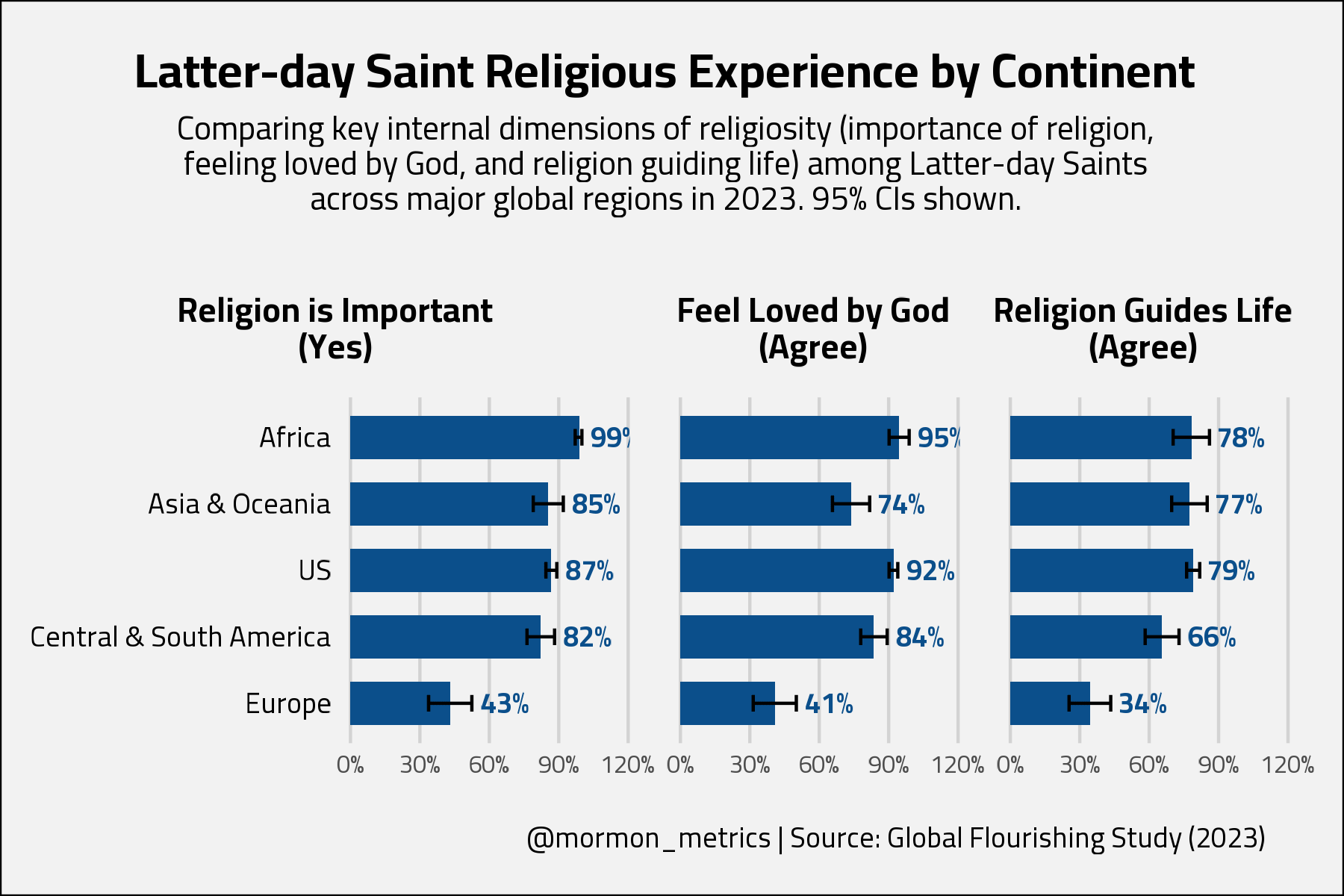
Africa, US, and Asia & Oceania top the charts in religious experience. They feel religion is important, feel loved by God, and agree that religion guides their life.
Interestingly, looking at metrics looking at religious experience, Central & South America are more likely to be in line with the other regions.
Europe, however, is well below all other regions.
So, this raises the question…
What is going on with Europe?
A helpful place to start is looking at regional baselines. In other words, is Europe so low because everyone in Europe is low?
Well, let’s check.
In these charts, for readability, I combined the three metrics into a scale. Higher number indicates higher levels of religious practice or religious experience and vice versa for lower numbers.
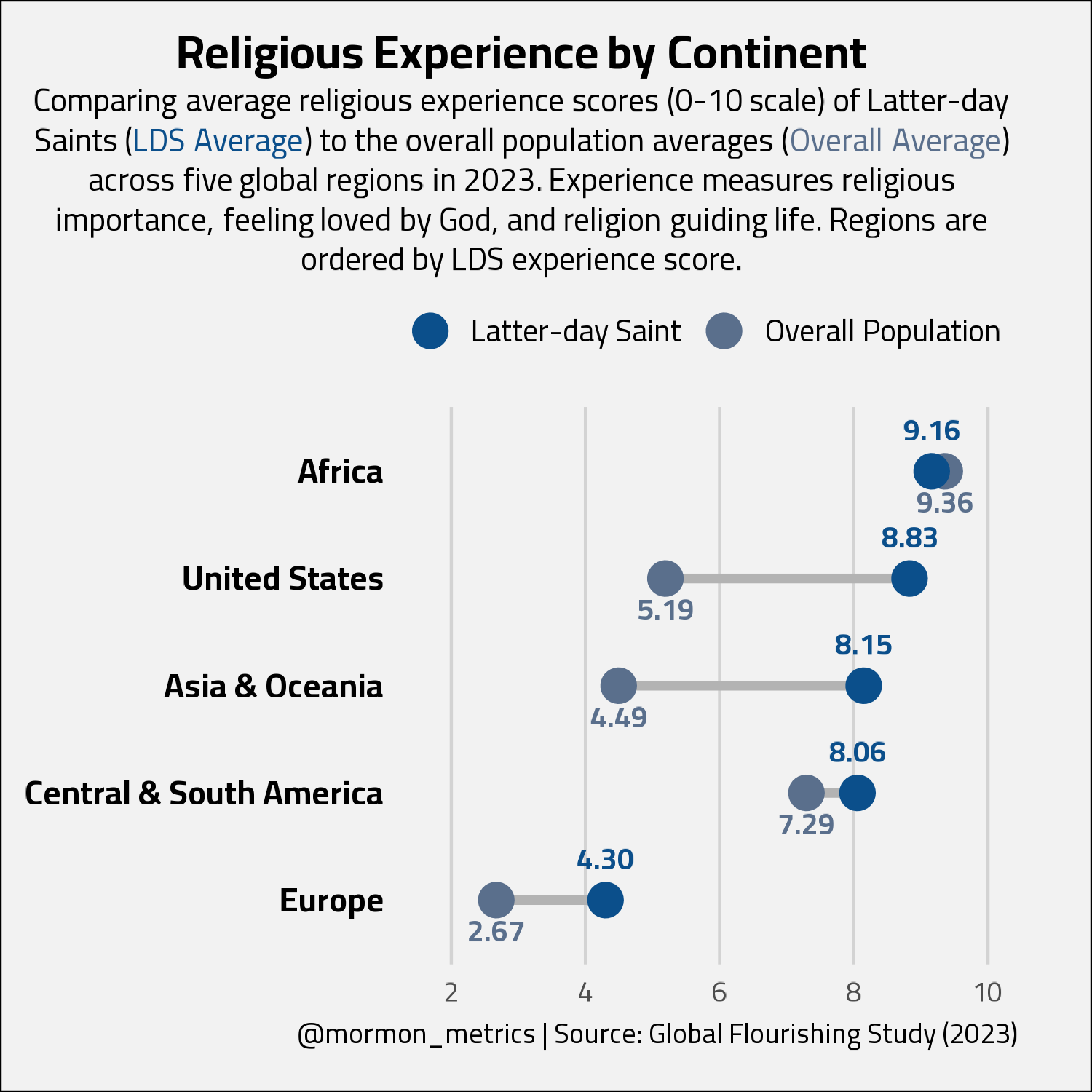
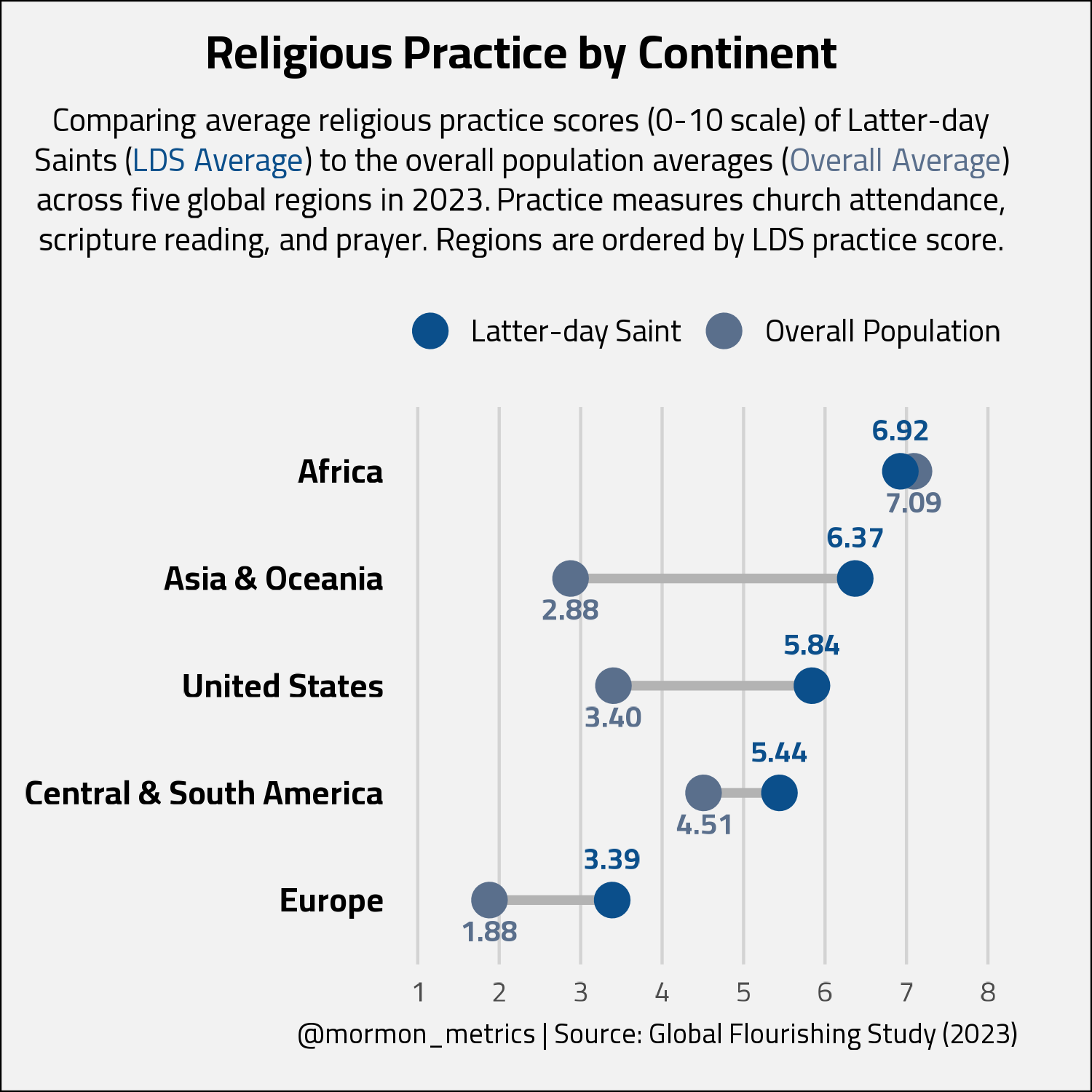
I think these charts tell a story of the effects of cultural influence on religious practice. For each continent, LDS see a Religious Practice or Experience premium — with the exception of Africa which starts with an exceptionally high religious baseline. But, it’s pretty clear why Europe is so low. Look at the cultural environment of Europe — religion is least prioritized there.
The next question that comes from these charts is “why are the premiums different for different regions?” For example, in the US there is like 4pt LDS premium (where US LDS practice religion at higher rates than the US baseline) on the index vs in Europe we only have a 2 pt LDS premium?
The answer? I’m not sure.
Here are a few theories…
One potential theory for this difference in regional premiums could be the changing social costs of a secularizing environment. As a country or region becomes more secular, it’s possible that the social cost for individuals practicing a high-demand religion starts to climb. In other words, active religious participation might increasingly be viewed by neighbors as out of touch or countercultural. If that's true, a region like the US—which remains less uniformly secular than Europe—might offer a more normalized baseline where practicing faith doesn't carry as heavy of a social tax, potentially allowing the LDS premium on these metrics to stretch a bit wider.
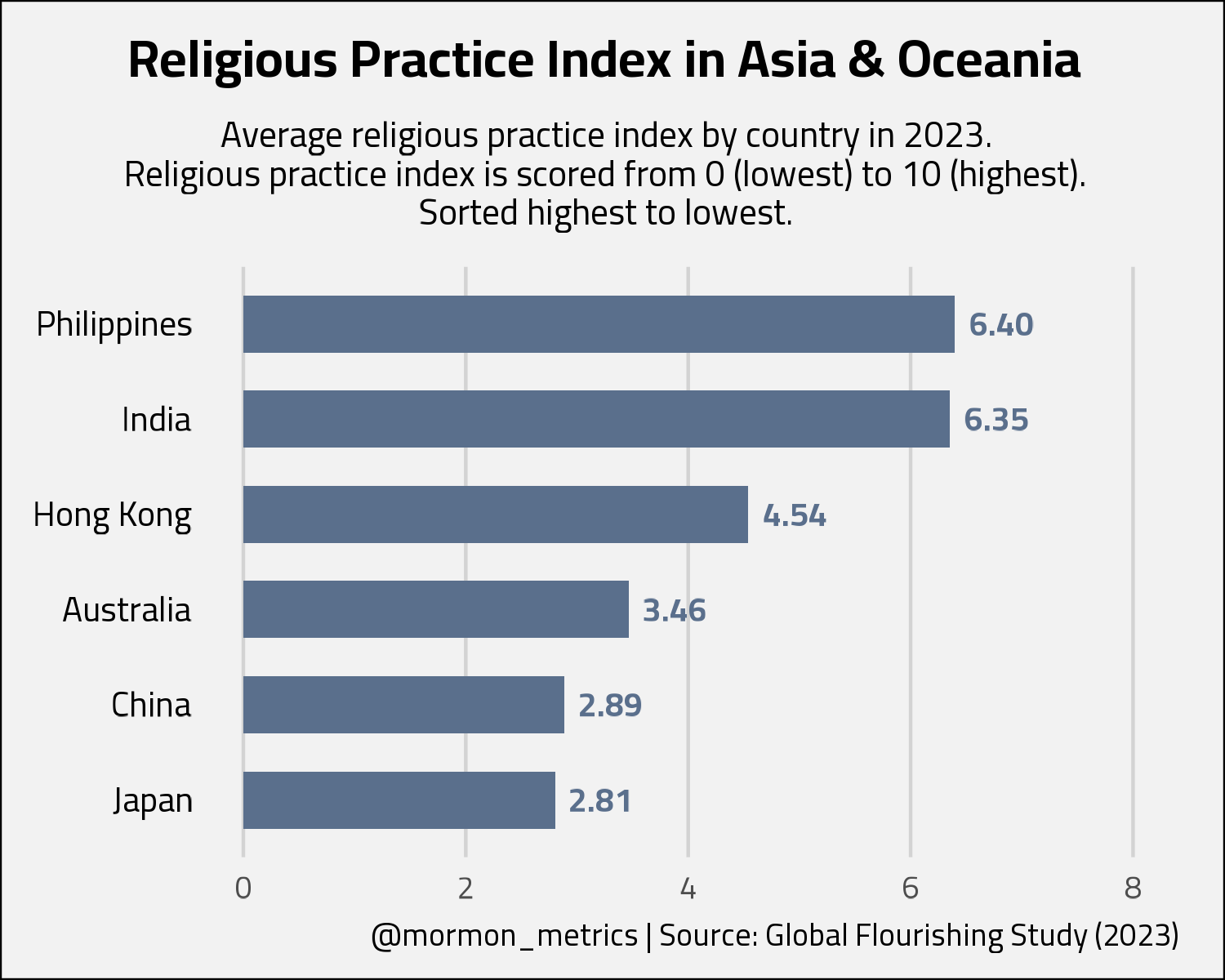
I think the difference in Asia & Oceania LDS premium is at least somewhat composition driven. The Philippines is more religious than other countries in that region and the church has historically grown well in the Philippines. So, the overall Asia, Oceania sample is likely more secular, than the LDS sample which is more represented in the religious alcove of the Philippines.1
Wrapping Things Up & Implications
We got a rare look at global data across 22 countries and over 200,000 respondents to tell us:
LDS religious practice and experience differ regionally, with Africa leading the pack across most metrics and Europe trailing behind.
We find a correlation between regional practice and experience scores and LDS scores by region.
I theorize your home region’s religious environment can have a profound effect on your regional religious community and even your personal religious devotion and practice in that community.
This has important implications for the future!
If the world and the US (where a plurality of LDS members reside) continue to secularize, we see supporting evidence here that cultural climate can create real challenges in practicing faith and nurturing religious community.
The church may not have problems this year or next year with finding and retaining members, but imagine 50 to 100 years from now? Will other regions look like Europe looks today? If so, what will this mean for the health of the Church of Jesus Christ of Latter-day Saints?
Here is my unsolicited advice to church leaders from a data perspective: If I were leading the church into the next century, I would be experimenting and focusing on figuring out how to grow a successful, thriving religious environment that coexists in a deeply secular (perhaps sometimes hostile) counterculture. So essentially, I would be throwing a bunch of stuff at the wall in Europe to see what sticks.
Of course I could be wrong, convert numbers have seen real growth in some European countries in recent years and perhaps that could continue. This just represents my best guess of what the future looks like and my recommendation for what to do about it.
Here’s a look at the religious practice index by country in Asia & Oceania