
Who Is More Likely To Pay Tithing? The Rich Or The Poor?
Referencing The Latest Data From Pew Research Center & B. H. Roberts Foundation


Introduction
Early on in Mormon Metrics (about a year ago), I wrote a post looking at Mormons and household income and found that US Mormons are overall pretty average/middle class and are, as a group, not proportionally wealthier than the US population.

I got a comment on this post asking…
Are full tithe paying Mormons wealthier than the comparative non-Mormon population?
Are full tithe payers wealthier than non-tithe payers or inactive/less active Mormons?
Today, let’s try to answer these questions and I’ll add a similar question to the list as well…
How does tithing status change by member income?
One caveat I will note in this analysis is that we are dealing with two topics where people are incentivized to lie (social desirability bias)… how much money you make and if you are a full - tithe payer. Even though the CFLDS was an online survey and the PRLS was mostly online, i imagine if you compare the self reported data with the actual/true answers, the self reported data would likely be inflated on both questions.
Charts
Let’s make some charts using the 2024 Pew Religious Landscape study.
First let’s get an overview of some of our groups…
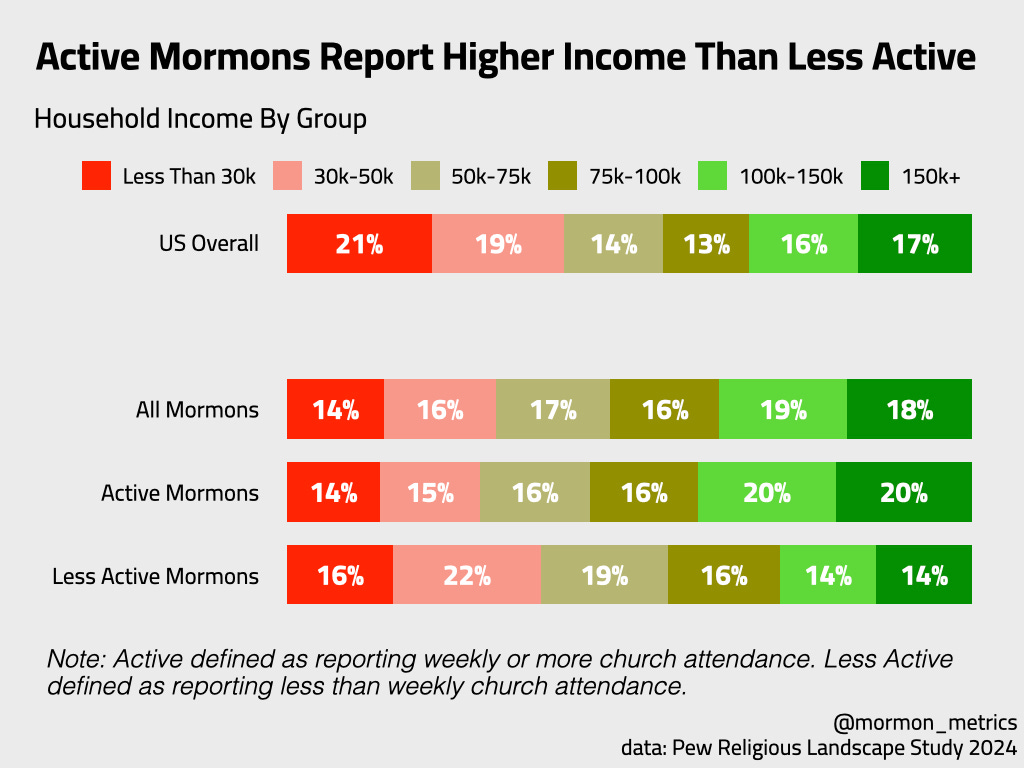
Based off of this chart, I ran a few statistical tests to confirm things…
Mormons did not have a statistically higher or lower income than the US overall population according to data from PRLS.
When I tested active Mormons, they had a statistically higher income than the US overall. And, less active Mormons had a statistically lower income than the US overall.
Unfortunately, this chart doesn’t really answer our question. We came for the tithing breaks.
And when I looked, there was no Pew tithing variable. Luckily, we can look at National Current and Former LDS Survey by the B. H. Roberts Foundation which has a tithing question.
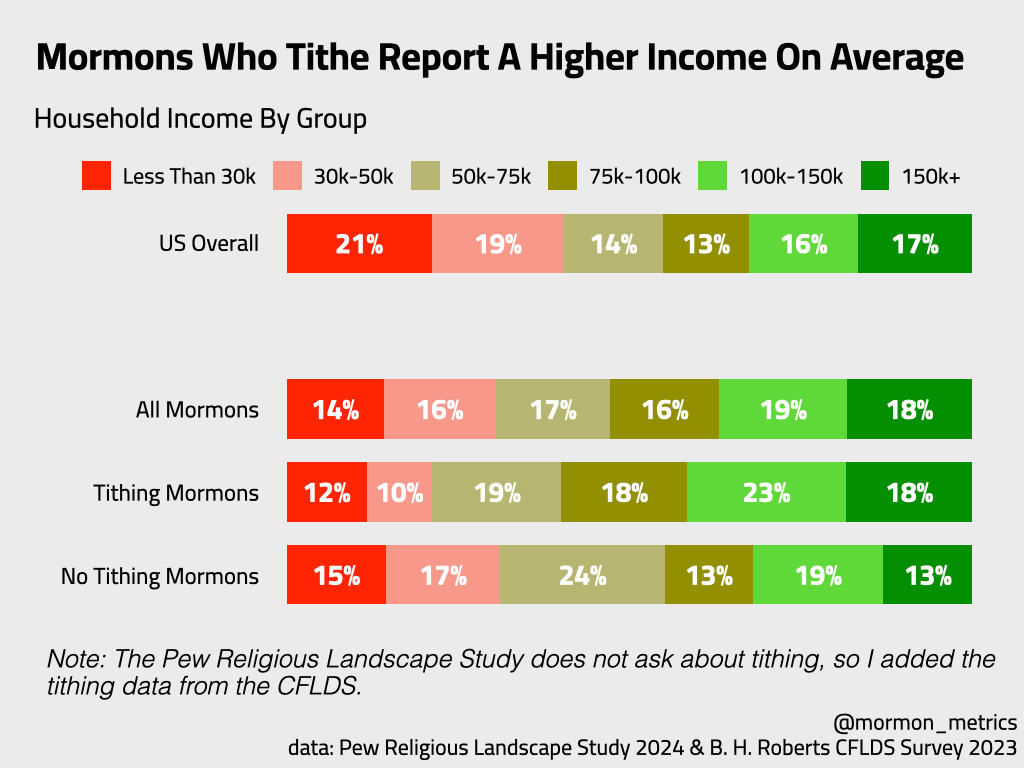
Methodological note: the US overall numbers and all Mormons numbers are from the PRLS. The tithing breaks are from the CFLDS. These are two different survey with different methodologies, so seeing some differences between the two dataset are understandable. From the looks of it, the CFLDS Mormon sample may be a bit wealthier than the PRLS, but they are pretty similar.
So we can answer our two questions…
Are full tithe paying Mormons wealthier than the comparative non-Mormon population? Yes, likely. Especially since we found active members were and there is likely a large overlap between active members and tithe-paying members.
Are full tithe payers wealthier than non-tithe payers or inactive/less active Mormons? Yes, likely. We also found a statistically significant difference in income in active vs. less active.
Now let’s answer our last question…
How Does Tithing Status Change By Member Income?
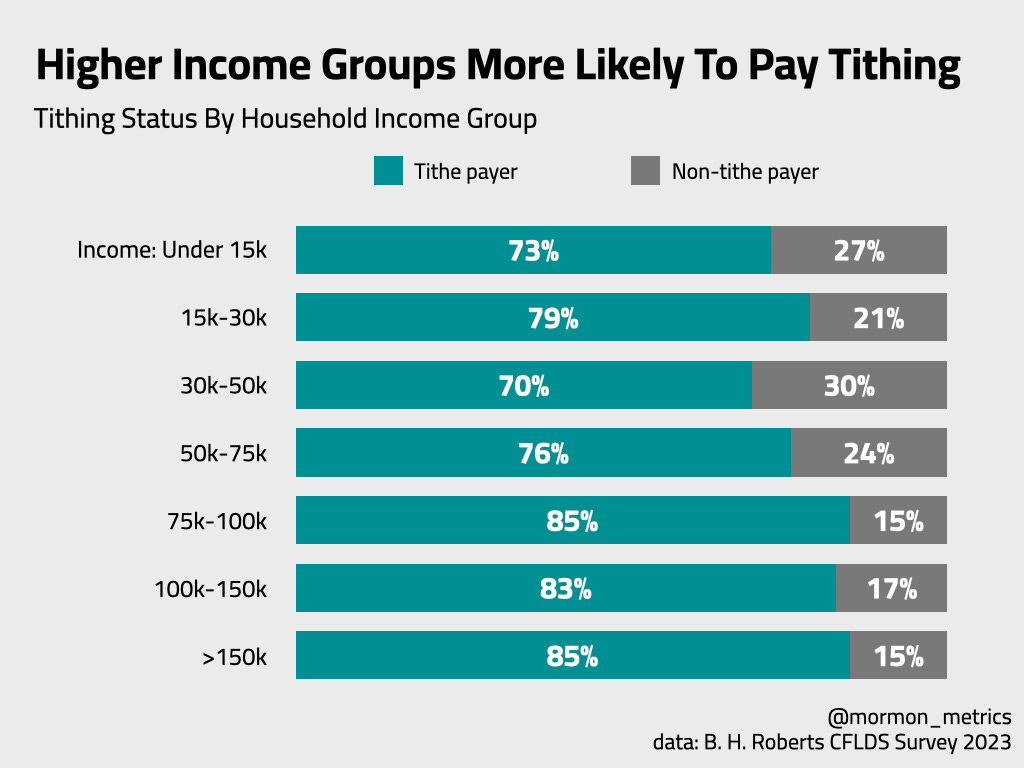
As income increases members are more likely to pay tithing. This isn’t terribly surprising as perhaps people with higher income are more likely to have excess money where lower income people would have less money available after meeting their basic needs.
Also note how high the tithing baseline was! I’m sure other churches would kill for a baseline in the 70s-80s. And this is whether someone claims they are a full 10% tithe payer!
I would be interested if the income-tithing relationship is true in other churches. Are higher incomes still more likely to pay? Or is donating tithing more common among lower incomes? I believe in many other churches there is not a 10% full tithe paying status and a special building they can enter that requires that status. This likely changes the economics of tithing giving in other churches. With different rules, are the poor or the rich more likely to chip in as the tithing plate is passed around? Perhaps I will look into this another week if I can find data on it.
Conclusion
So, wrapping up…
Active and Tithe paying member reported a higher household income than the US population overall, less active, and non tithe-paying members. We see a statistically different income between active and less active members which is also likely correlated with tithe-paying and non tithe-paying members. However, looking at the Mormon group in aggregate they do not make statistically more or less money than the US overall population.
Higher incomes were more likely to report paying a full tithe than lower incomes.
What do you think about this analysis? Would you add anything? Did I miss something?
Let me know what you think in the comments and see you next week!
Code available here. Data available here (CFLDS) and here (PRLS).
There is a clear plateau over $75k. No difference in tithe status stats between $80k and $200k. but more difficult to interpret the dynamics below $75k. Is $30-50k really the least likely to pay tithing -maybe the most economically challenging, if welfare cushions the lowest two categories? Or are these differences just noise?