
Are Latter-day Saints More Likely To "Flourish"?
Pt 2 of my analysis of Harvard/Baylor's Global Flourishing Study


This is part 2 of a 4 part series on the Harvard/Baylor Global Flourishing Study and what it tells us about Latter-day Saints. Subscribe to read part 3 next week answering, “How Are Latter-day Saints Doing On Mental Health?” Read last week’s global look at LDS religious practice metrics.
As a reminder, Harvard/Baylor gave public access to their global flourishing study fielded by Gallup. It includes over 200,000 survey respondents across 22 different countries across continents. Of the 200,000, there are 1,290 people identifying with the Church of Jesus Christ of Latter-day Saints (Mormon tradition) in the sample represented in 18 of the 22 countries across Africa, Asia, Oceania, Europe, and the Americas.
Today, I want to look at one of the main objectives of their study which is understanding human flourishing, which Harvard defines as “a state in which all aspects of a person’s life are good.”
To measure this, they have 10 questions and to get the flourishing score, you just take a simple average of these questions below (answer the questions on a scale from 0-10). The 10 questions span 5 domains…
Happiness & Life Satisfaction
Overall, how satisfied are you with life as a whole these days?
In general, how happy or unhappy do you usually feel?
Mental & Physical Health
In general, how would you rate your physical health?
How would you rate your overall mental health?
Meaning & Purpose
Overall, to what extent do you feel the things you do in your life are worthwhile?
I understand my purpose in life.
Character & Virtue
I always act to promote good in all circumstances, even in difficult and challenging situations.
I am always able to give up some happiness now for greater happiness later.
Close Relationships
I am content with my friendships and relationships.
My relationships are as satisfying as I would want them to be.
I’m sure there are plenty of ways you can debate whether this is actually “human flourishing,” but it is likely a decent measure of whether you think you are happy and feel confident in your life direction. But feel free to let me know what you think about their index.
So, are Latter-day Saints more likely to flourish according to this definition?
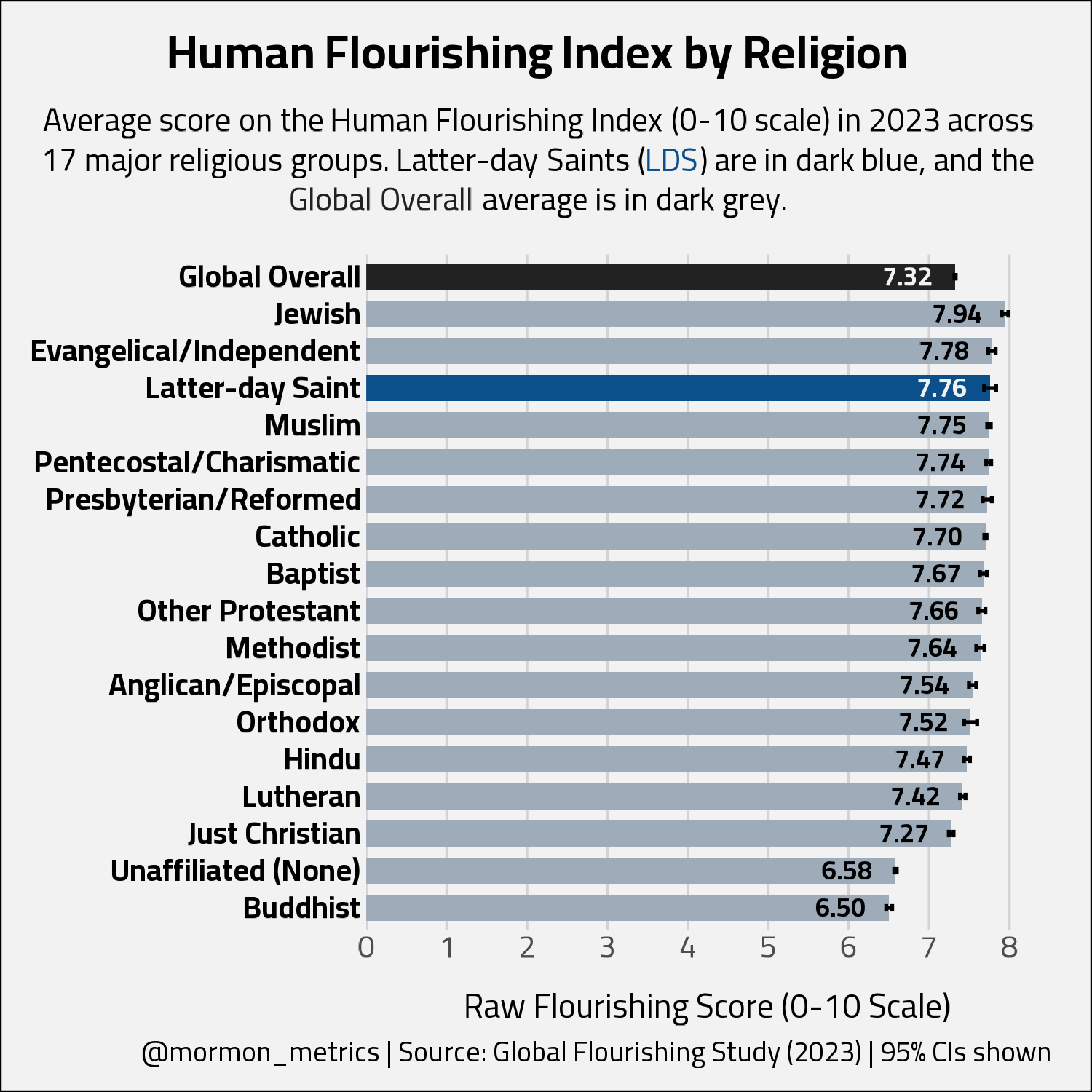
The answer is yes. They are statistically significantly more likely to flourish than the Global overall.
This is just looking at a simple average, but is there more to the story?
For example, like we saw last week, the majority of the LDS sample is from the US, so is what we are seeing just a U.S. flourishing bump and not as much to do with LDS (there are 21 other countries a part of this study)? Or is it some other demographic factor working in the background like income or marital status?
So let’s do some regression analysis to control for some of these demographic variables…
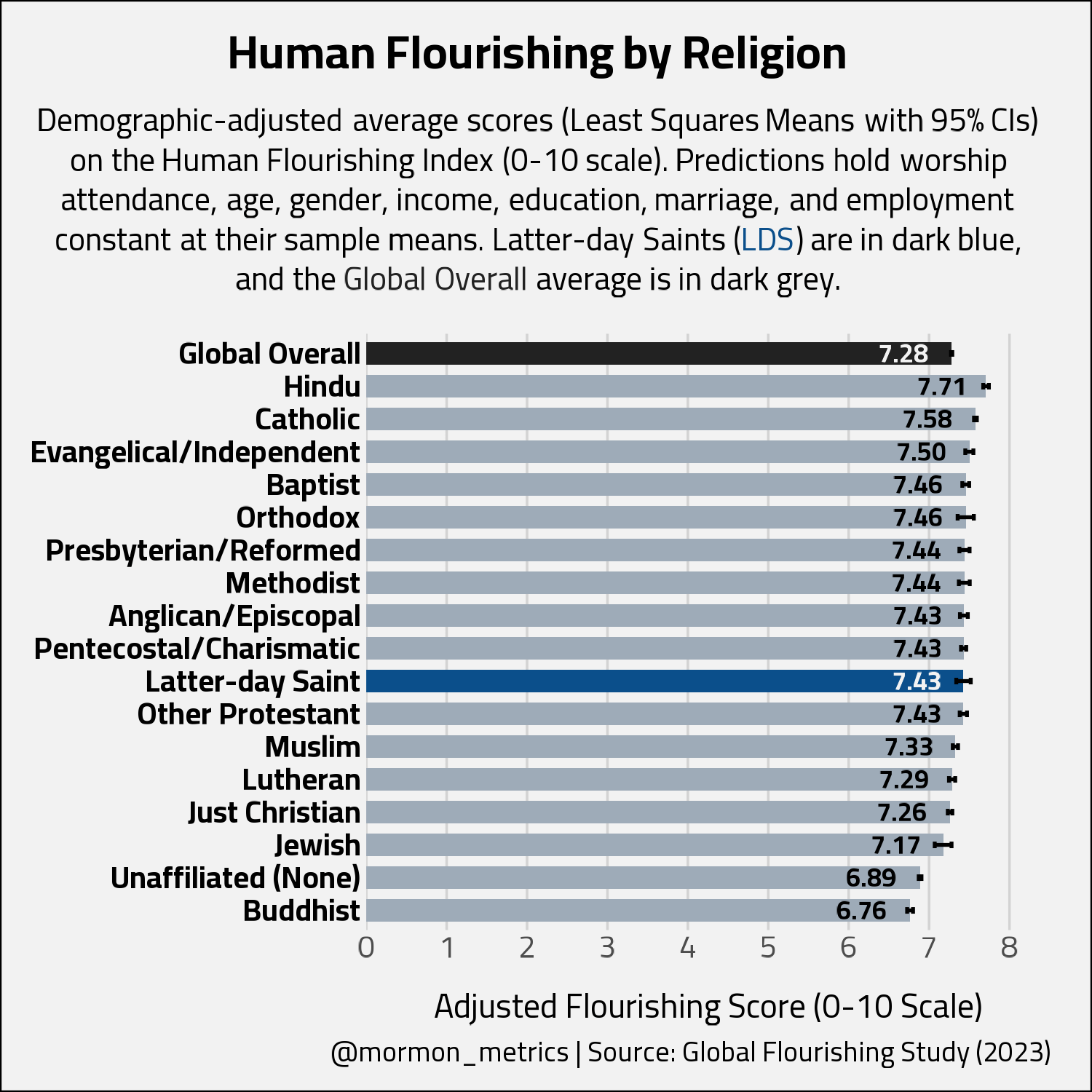
After holding several demographic variables constant (age, income, employment, geography, etc.), our chart changes meaningfully for several religions:
We now see LDS in the middle of the Protestant pack in predicting flourishing. When testing for statistical significance, LDS no longer statistically more likely to flourish than the average though our best guess is still higher than average.
Jews previously at the top of flourishing now fall toward the bottom of most other religions once controlling for demographic factors
Hindus previously in the middle, have now shot up to the top with a comfortable advantage to other religious practices. Catholics see a similar increase now ranking at #2.
Why did LDS go from being the top 3 to comfortably in the middle when adjusting for demographics?
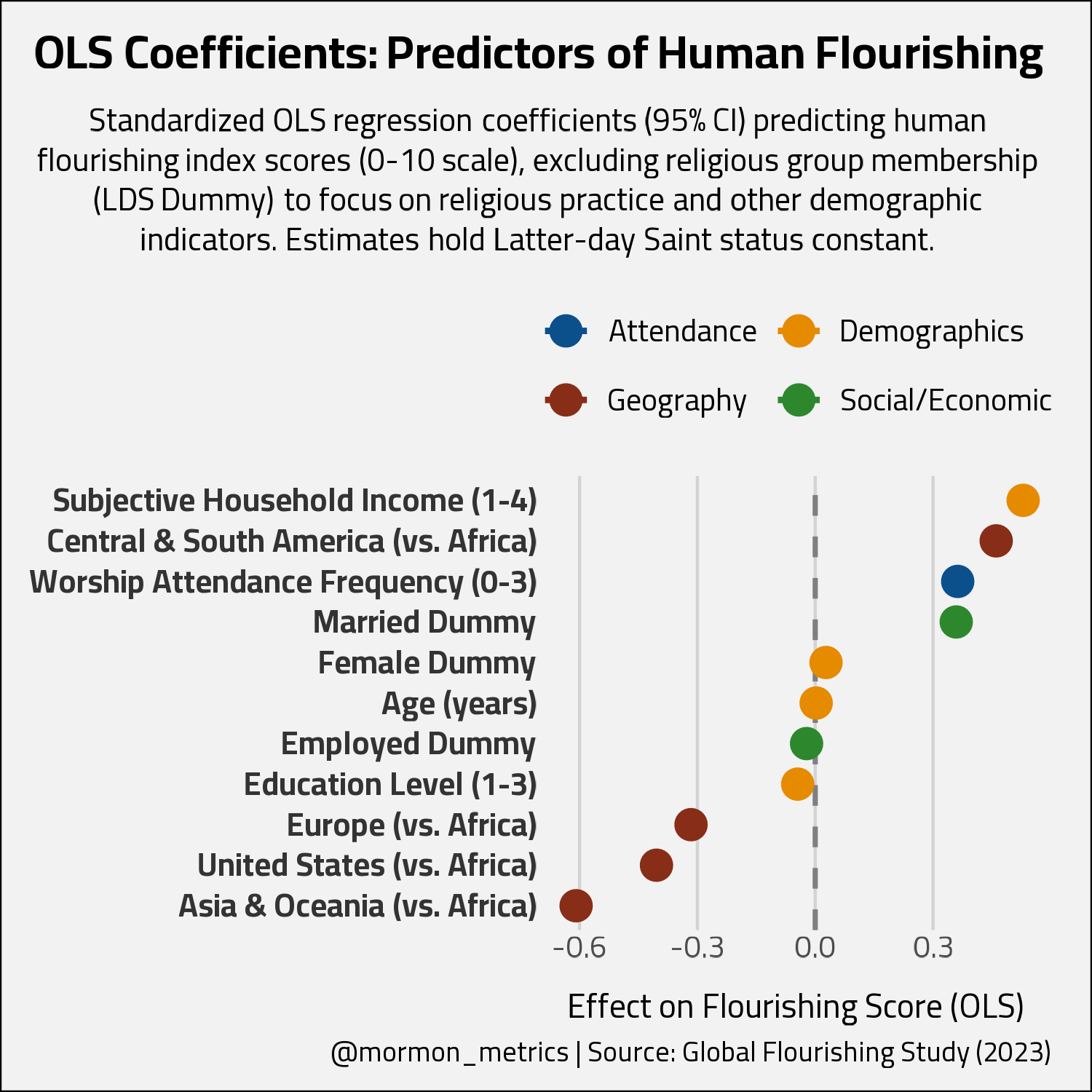
Well, it turns out certain demographic variables are correlated with the flourishing index and some of those variables are also correlated with Mormonism.
The likely culprits:
Latter-day Saints are more likely to be married and married people score higher on the flourish index.
Latter-day Saints are generally more likely to attend church than other religions and church attenders score higher on the flourish index.
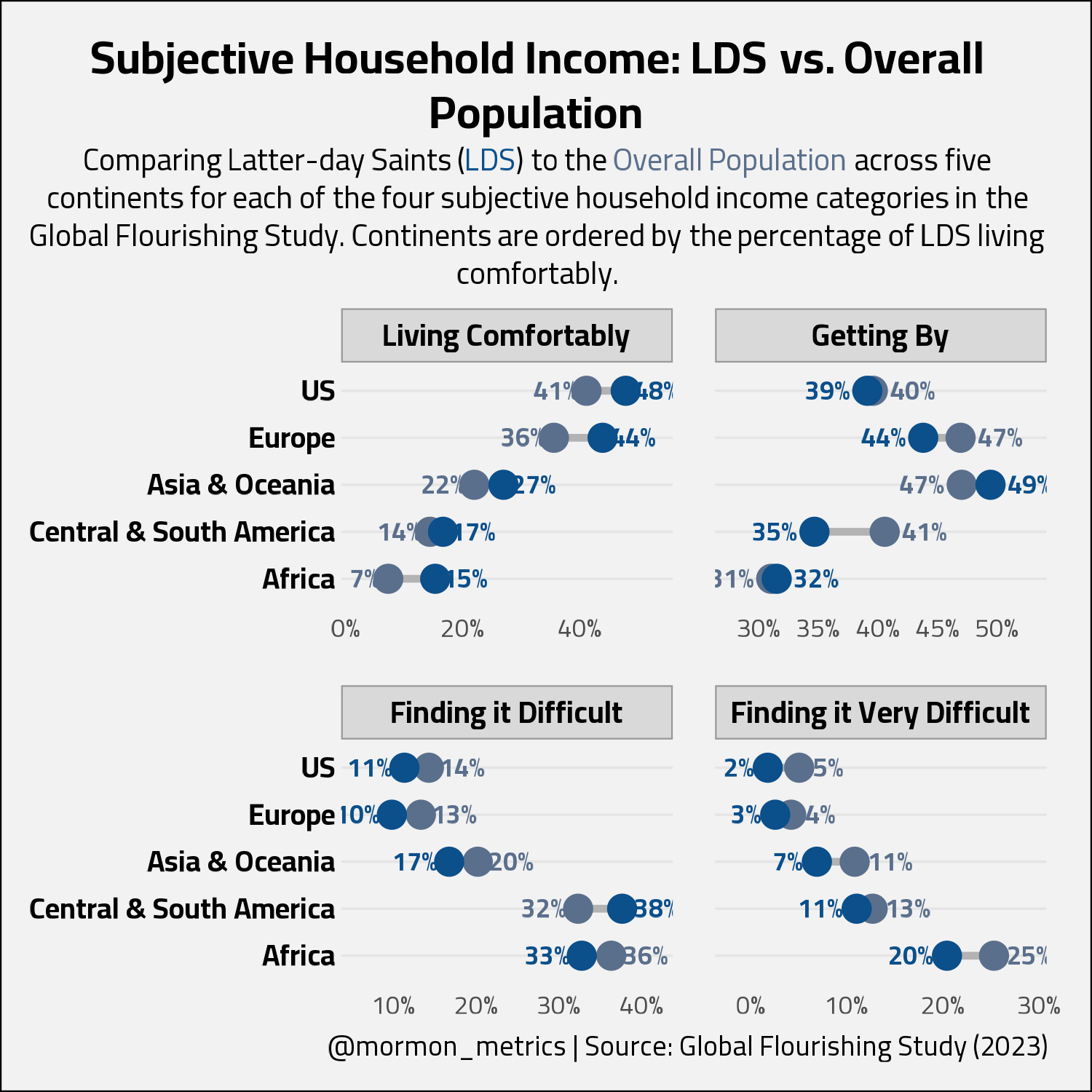
According to the sample, Latter-day Saints across almost every continent are more likely to report they are "living comfortably"—a subjective financial measure strongly correlated with overall human flourishing.1
Short methodological musings: Doing this kind of analysis raises a classic causal inference dilemma: What should and should not be controlled for?
Specifically, should we control for marriage rates and church attendance if LDS theology and culture actively encourage these behaviors?
In statistics, we have to decide if these variables are confounders (nuisance background factors we must hold constant to get an apples-to-apples comparison) or mediators (the actual mechanisms through which a religion produces flourishing).
The case for controlling (Marriage & Attendance as Confounders): If we want to isolate the purely psychological or theological “premium” of being a Latter-day Saint, we want to compare a married, active Latter-day Saint to an otherwise identical married, active Catholic or Protestant. Controlling for these factors lets us do exactly that.
The case against controlling (Marriage & Attendance as Mediators): If the primary way the LDS faith successfully helps people flourish is by successfully nudging them to get married and stay active in a tight-knit community, then controlling for these variables actually blocks the pathway of how the religion works. By “adjusting” them away, we are looking at a highly artificial counterfactual.
Ultimately, both models tell a story. When you remove marriage and church attendance from the model, the LDS “flourishing premium” reappears. But by looking at both the raw and adjusted numbers, we get to see both the structural benefits of the LDS lifestyle and how the theology holds up when those structural advantages are stripped away.
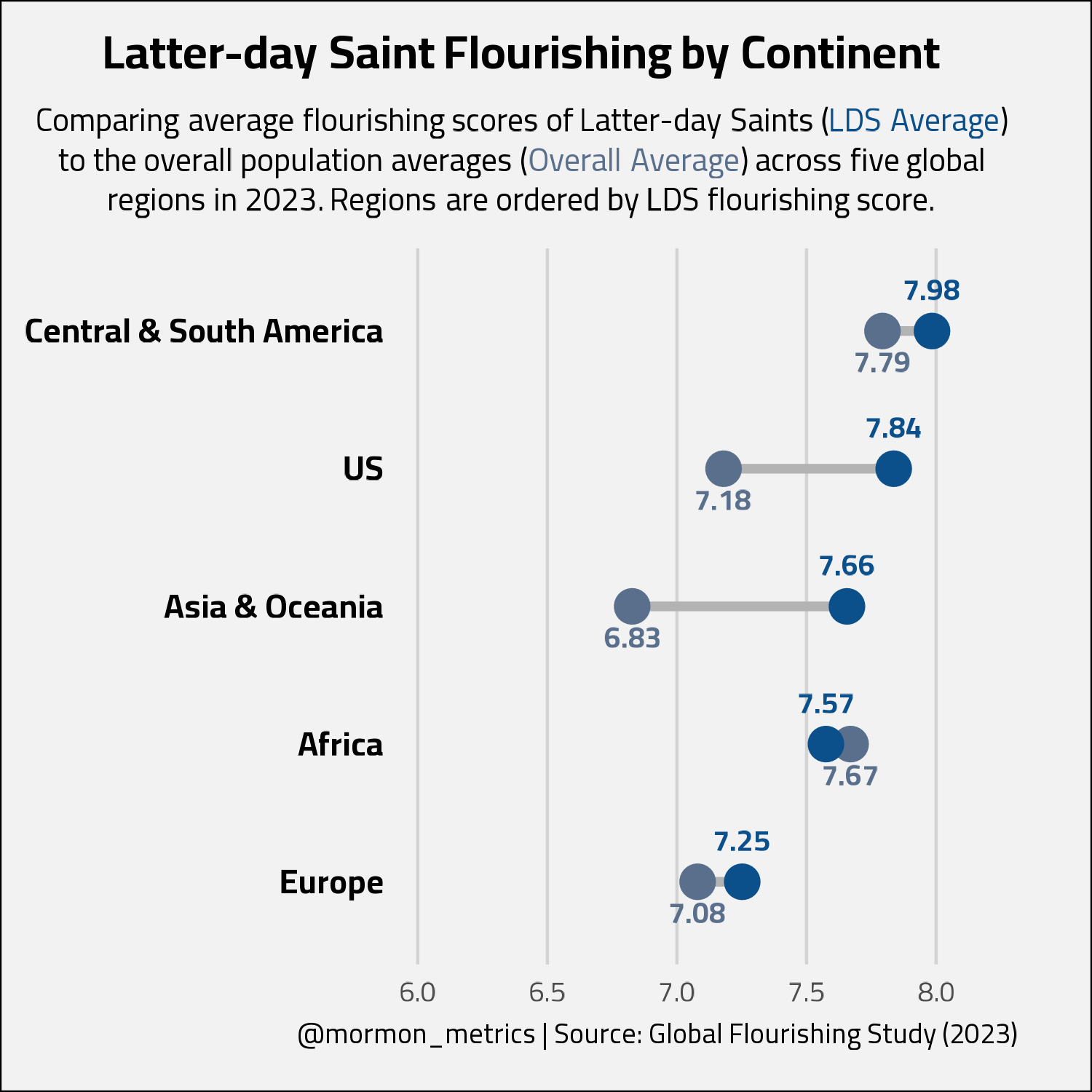
But, zooming out, all things considered and comparing it to the average person across continents (as you can see in the chart above), Latter-day Saints see a Human Flourishing premium. This premium is likely similar to other religions (especially protestant ones) as the global average is drug down mainly by religiously unaffiliated.
Now let’s look at the 5 flourishing domains. Where do LDS overperform? Where do they underperform?
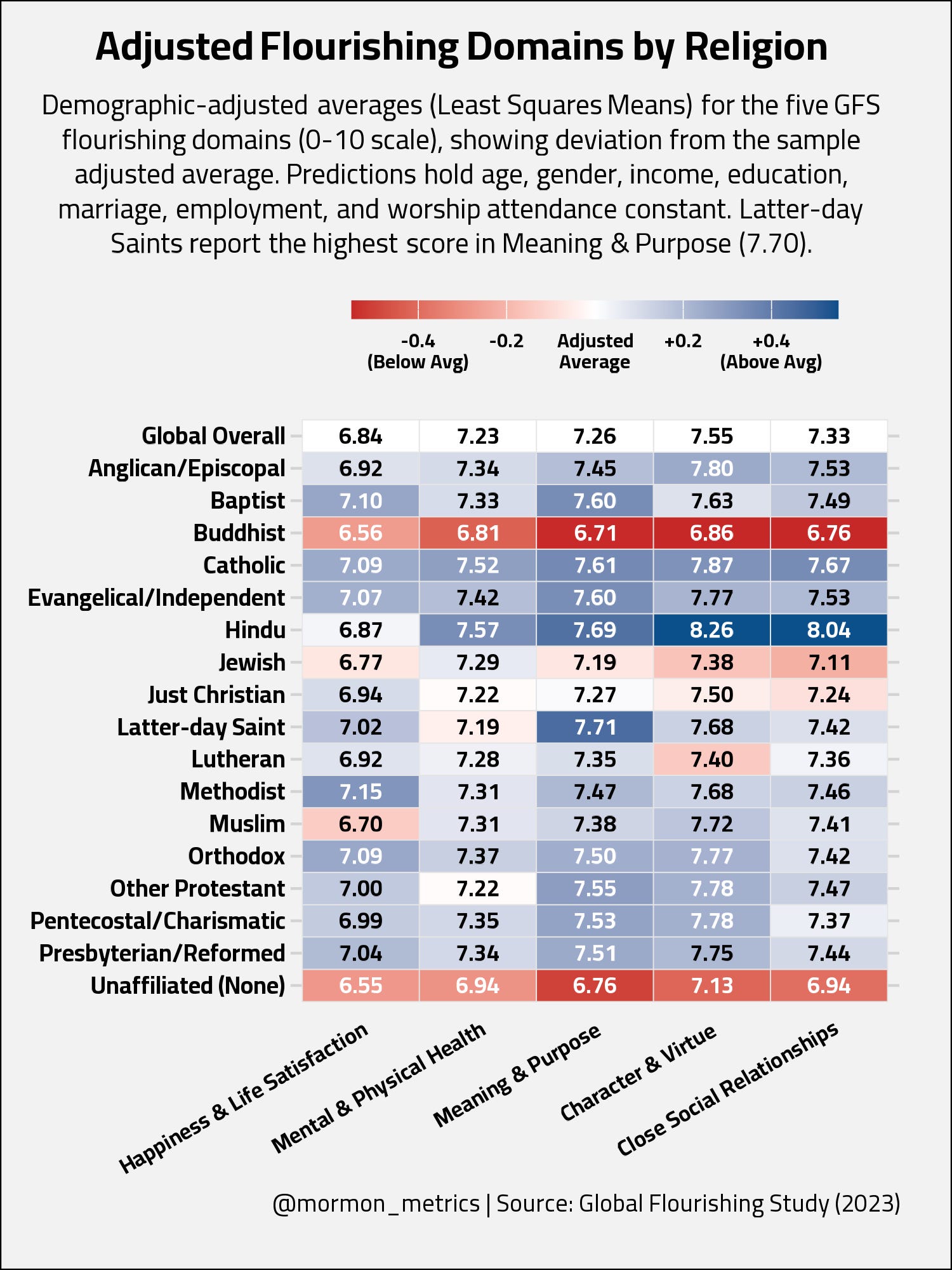
To save space, I just skipped to the demographically adjusted heatmap, but if you want to see the raw heatmap here it is.2 There are a few more steps in creating the demographically adjusted map which I detailed here.3
I find this heatmap pretty revealing…
Latter-day Saints score highest in the Meaning & Purpose domain compared to other religions controlling for demographic variables. This means LDS were more likely to answer highly on “Overall, to what extent do you feel the things you do in your life are worthwhile?” and “I understand my purpose in life.”
Latter-day Saints score third lowest across religions on the mental & physical health domain controlling for demographic variables. It is the third lowest religion (though quite close to some other religions), but meaningfully higher than religiously unaffiliated and buddhists. I imagine this is driven more so by the mental health measure rather than the physical health for LDS (I’ll explore the mental health part more next week in part 3)
It is quite shocking that Buddhists and religiously unaffiliated are low (if not the lowest) across each domain.
Conclusion
Without adjusting for demographics, LDS have a top 3 “flourishing” score across major religions.
When you do adjust for demographics, LDS are about average for a religion and similar to other protestant denominations. We see this drop likely because LDS have many married, church attending, comfortable income folks on average which are correlated with human flourishing.
Looking across the components that make up the flourishing score, LDS score the highest of any religion on the “meaning & purpose” axis and the third lowest across religions on the “mental & physical health” axis (more on this next week!)
Hope you enjoyed part 2 in understanding how Harvard/Baylors’s human flourishing index relates to Latter-day Saints.
Next week, let’s dive more into LDS mental health across continents using several relevant questions from the global flourishing study.
See you soon!
Code will be released in the last part.
I had to make a chart to check just to be sure haha
The unadjusted shows the same idea… meaning & purpose higher and mental & physical health lower
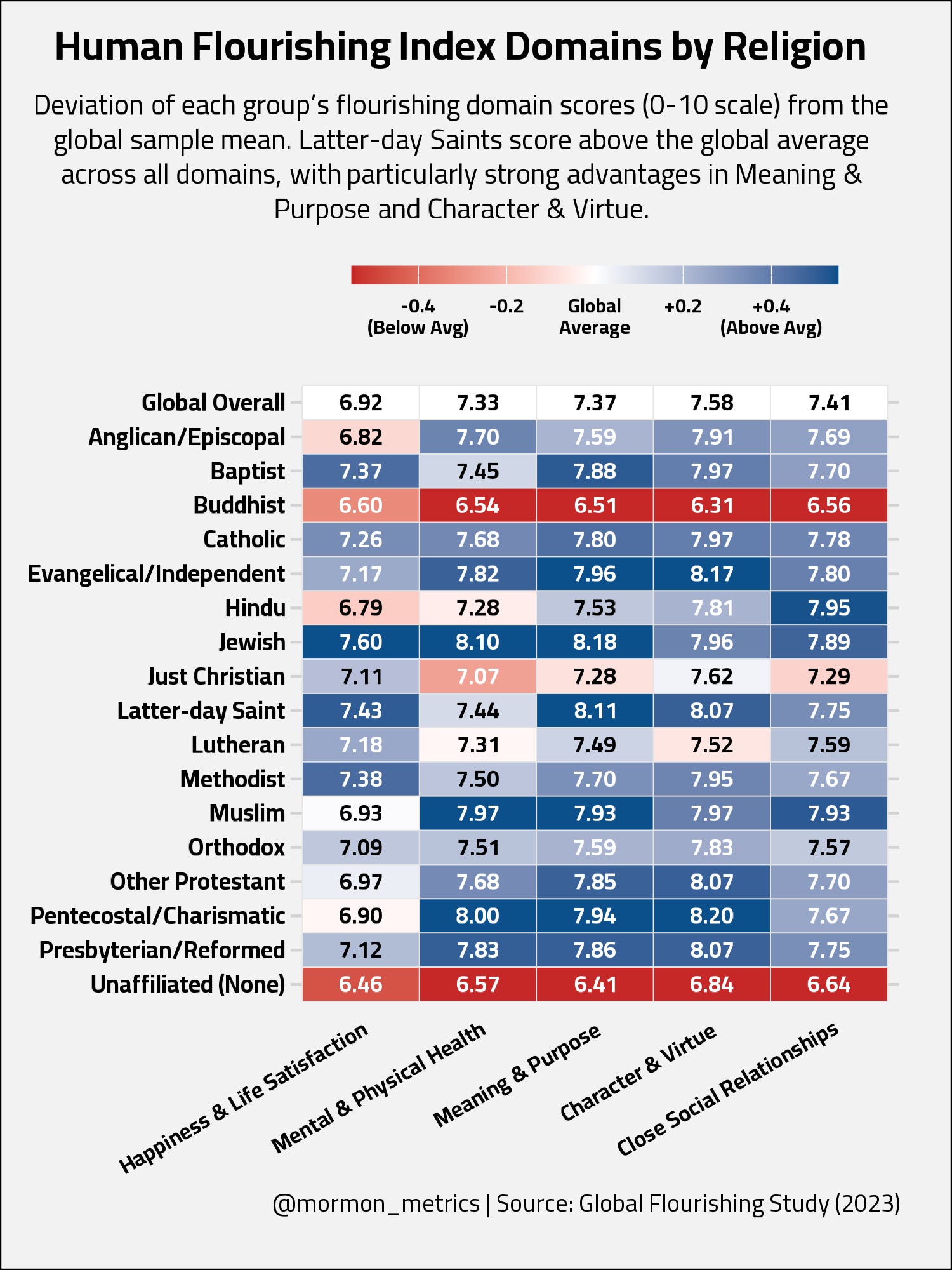
To isolate the unique relationship between religious affiliation and distinct flourishing domains, cell values report adjusted predictive margins (least-squares means) derived from five independent ordinary least squares (OLS) regression models (one per domain). This counterfactual framework holds all sociodemographic and geographic controls—including age, gender, subjective household income, educational attainment, marital status, worship attendance frequency, and continent fixed effects—constant at their overall sample means. Consequently, the displayed scores reflect the estimated flourishing levels of each group under a perfectly standardized, demographically identical global profile, effectively removing the confounding effects of structural and regional advantages.