
The Missing Mormon Political Gender Gap
Analyzing data from the Cooperative Election Study


Introduction
This past week, I got a question about trying to understand the young political gender gap among Latter-day Saints. Are young Latter-day Saint women liberalizing and young Latter-day Saint men shifting to the Republican Party? If not, what is going on?
I’ve talked about the Latter-day Saint leftward political shift in previous posts specifically identifying a generational gap in younger LDS moving away from the Republican party.
Let’s explore the gender gap (or lack of one).
It should be a fun one, let’s look at some charts.
Trump Era Generational Polarization
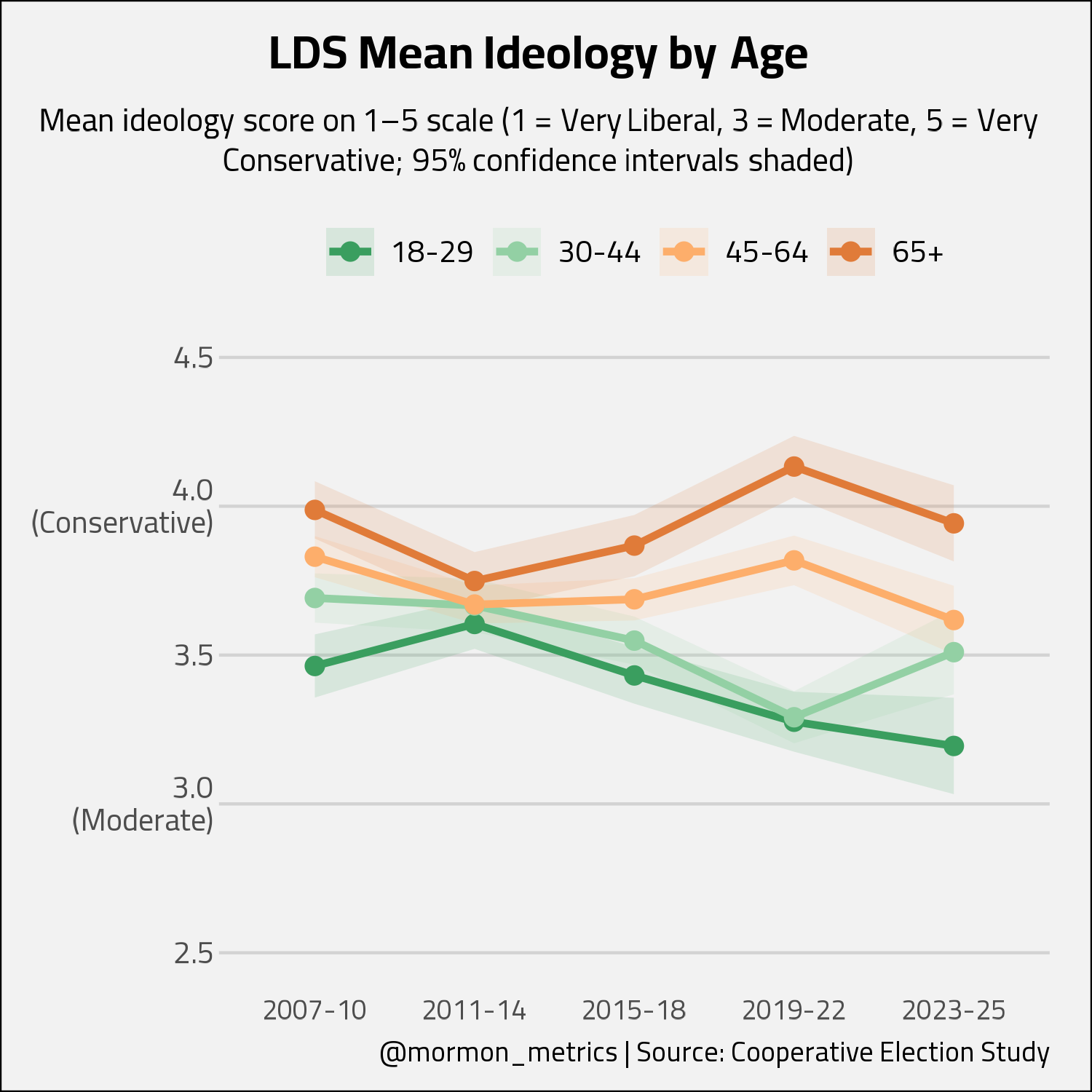
This chart tells a powerful story. Even prior to Romney in 2012, Latter-day Saints of all ages cleanly identified as conservative; however, in the Trump era we see a generational growing apart. Latter-day Saints over 45 continued to identify with the conservative label at similar rates in the Trump era (and perhaps even more so with the 65+), but the new younger generations of LDS are distancing themselves.
So now, what does this trend look like broken out by gender?
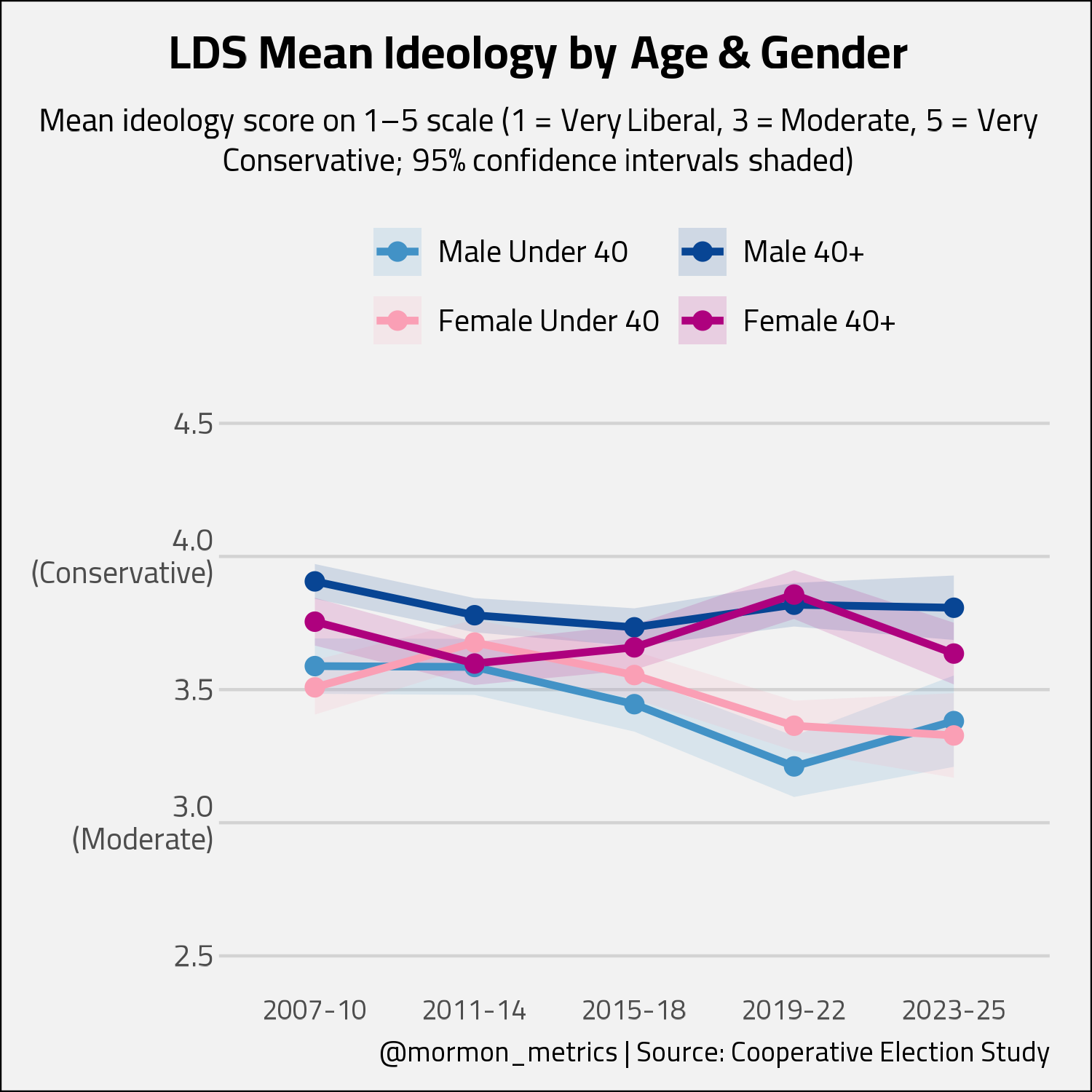
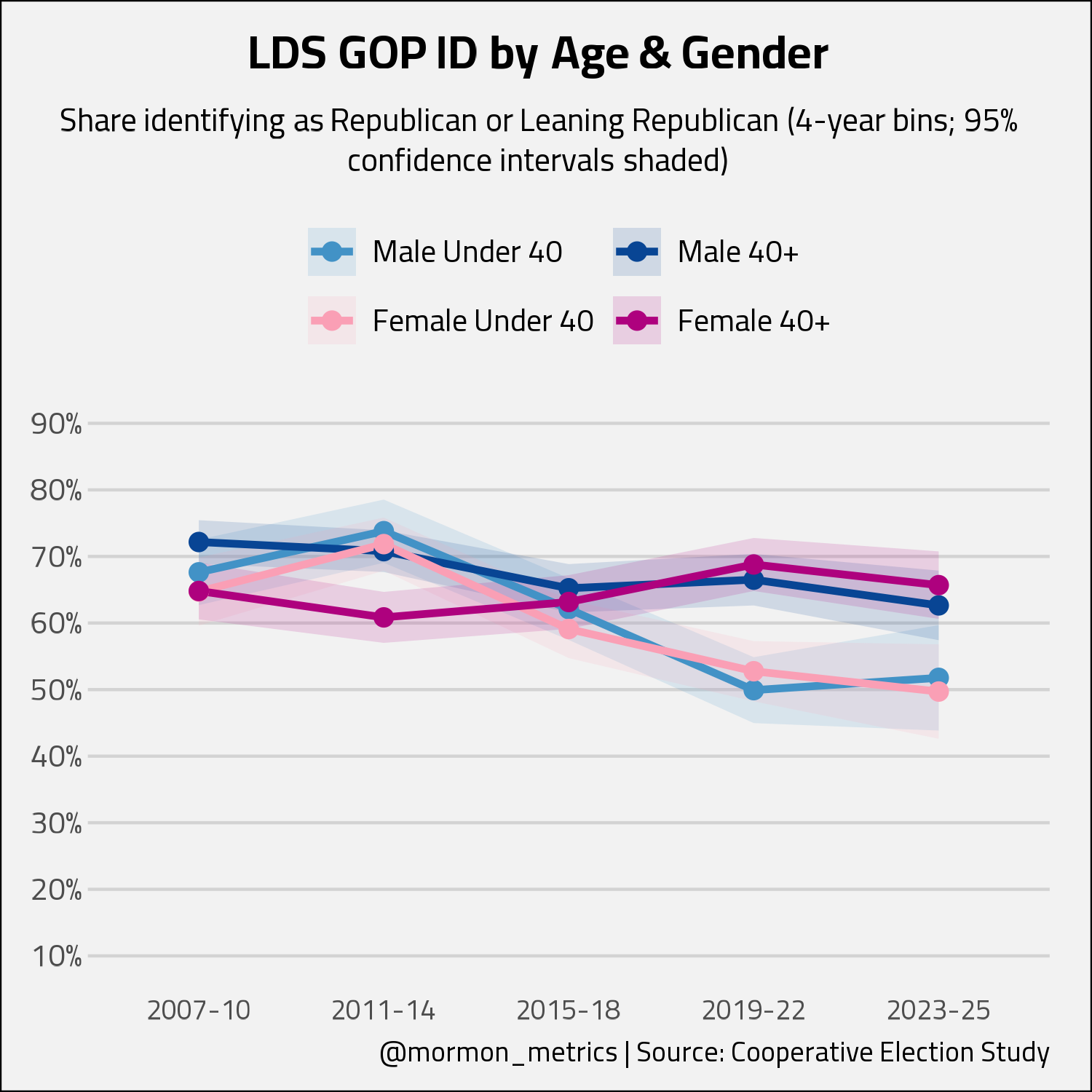
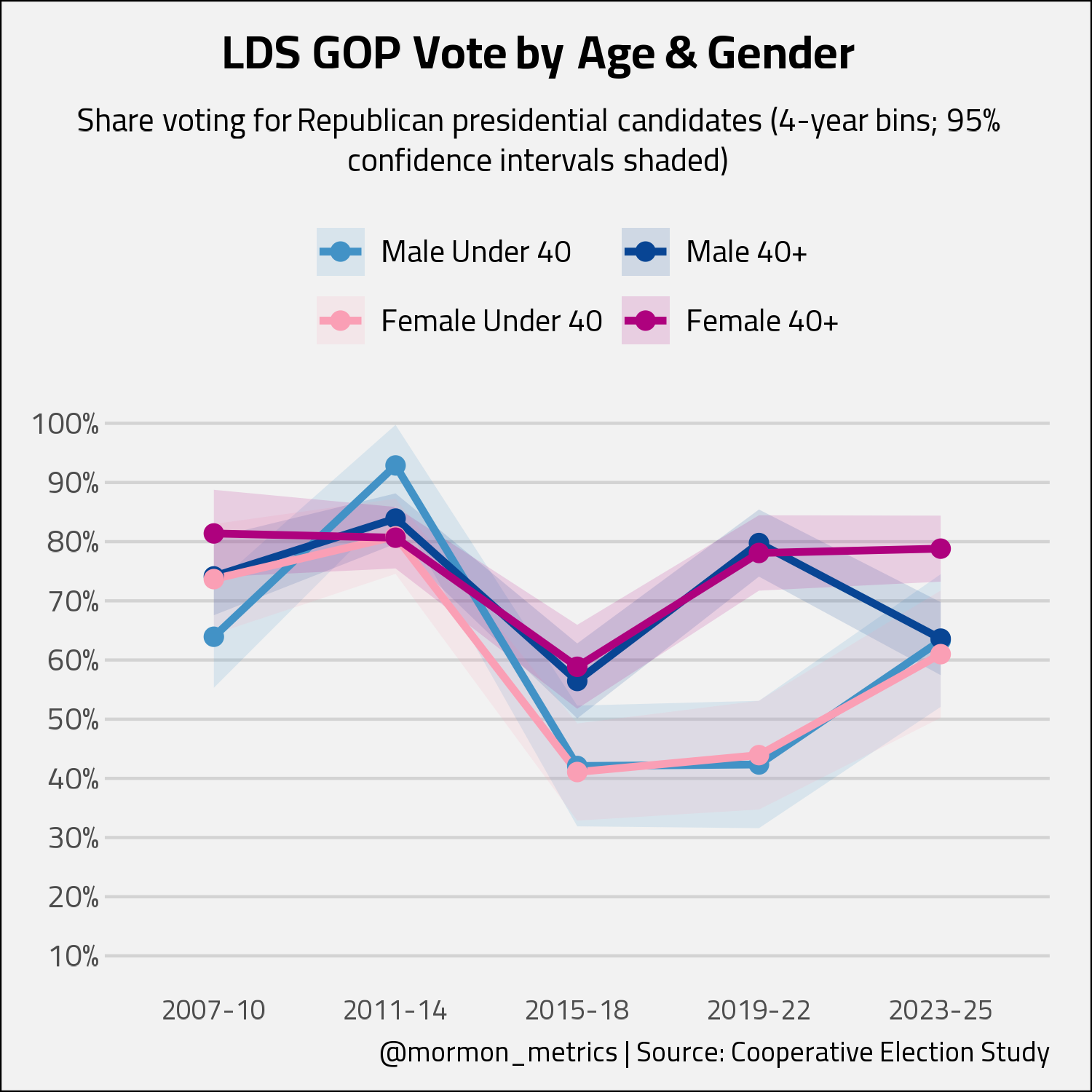
The gender lines in each age group hug each other very closely. As you can see, there is no clear ideological political gender gap — among young or old Latter-day Saints. The differences we see seem to be an artifact of the clear generational gap we saw above. There is also no gender gap looking at party identification1 and vote choice2 the past decade or more.
In the most recent data point (years 2023-2025 combined), there seems to be an uptick in young men associating themselves with the conservative label while younger women have steadily disassociated with it since 2014. There isn’t a statistically meaningful difference yet, but something we’ll keep an eye on in the future.
The Lack Of A LDS Political Gender Gap Is Interesting Because We See One Emerging In The Western World
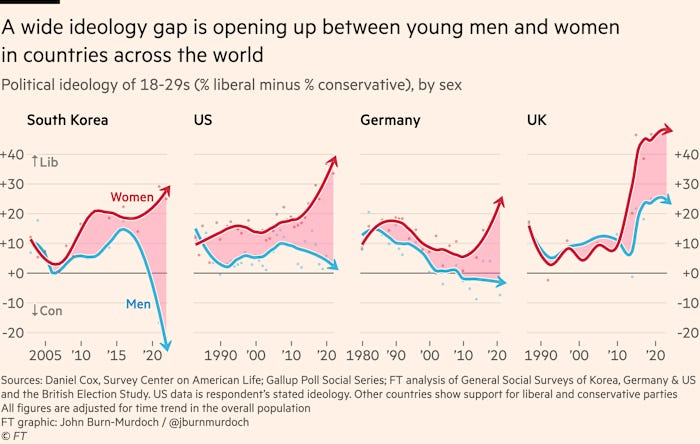
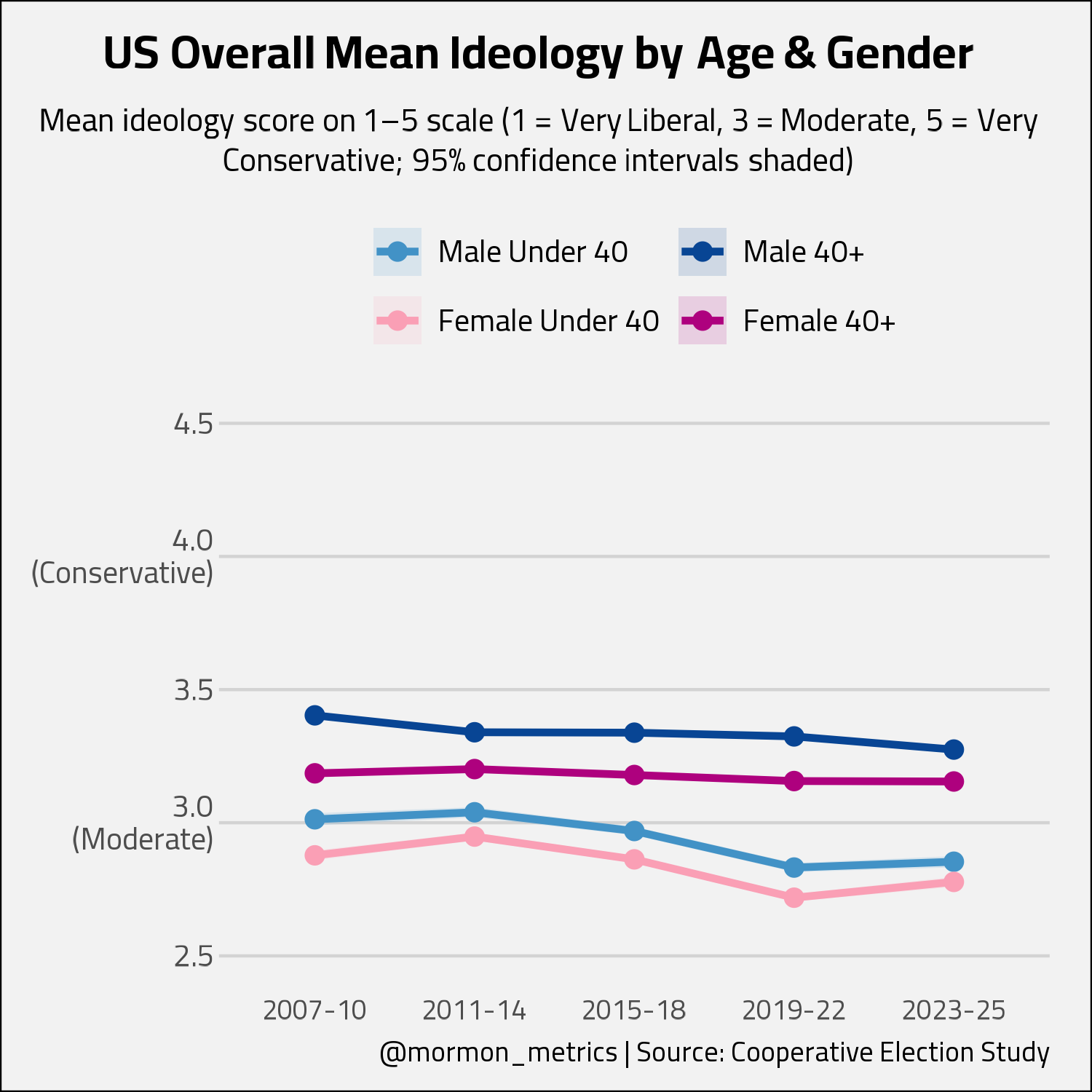
There is actually some debate about this point.34 Some surveys show gaps emerging and others like the CES do not show the same divergence. I created my own chart using the CES data for the US overall and am not seeing much of a gap, though there are statistically significant differences between young men and young women (young women being less conservative).5
But, let’s assume that we are seeing a growing young gender gap in the world and that we are not seeing a gender gap among Latter-day Saints. Why might this be the case?
Hypothesis: Do Singles Wards Bridge The Gap?
Over the past several years, we’ve seen a decrease in socialization among young people. Young people don’t hang out with each other as much as they used to (they also don’t drink, smoke, or have sex as much as they used to). They spend much more time online. Assuming a growing gender gap, perhaps a growing amount of young people are being radicalized online and diverging by gender. Perhaps the singles ward provides a space for young LDS to understand and build connections across gender in a way that keeps there politics in lock step even as they drifts further from the older generation.
What do you think about my hypothesis or this data? Let me know in the comments below.
Next week, I plan to map out the specific issues that separate the young and old LDS on political lines using 60 or so political/economic question in the Cooperative Election Study. See you then!
Code will be released next week and have both post’s analysis and charts.
Party ID by age X gender over time
Vote Choice by age X gender over time
FT article detailing worldwide political gender gap
Andrew Gelman expressing pause about the CES
Do these numbers include exmormons, or is this only people who chose LDS as their religious affiliation? Perhaps the reason we're not seeing as big of a gender gap if this is for self-identifyijg members is because young women are becoming more liberal and leaving the church, while some folks (perhaps young men are included) are becoming more radically conservative and leaving the church too.
I'm also not surprised that both younger men and women (including millenials) are both skewing more liberal. I've noticed that ward leadership and particularly bishoprics in the multiple units I've lived in over the last several years have been trending more toward empathy, understanding, and a love-one-another focused approach which tends to be associated with more liberal or progressive mormons