
The Impact of Two-Hour Church: What the Data Tells Us
Did two hour church meaningfully change existing trends?


Introduction
Recently there have been whispers of a new pilot program being tested: 1 hour church. If say, they implemented this in 2026, it would be 7 years after 2 hour church changed in 2019.
So a begging question of this potential policy change is… what happened when we went from 3 hours to 2 hours? Was church attendance affected? What about members personal spiritual habits? People’s feeling of religious importance?
Today we will look at charts exploring these questions; however, the short answer is at least in the data that is available we don’t see a meaningful shift from existing trends in the measures we look at today. Though if we had more statistical power maybe?
Charts
So as you will see in the charts, there is pre-existent trend predating the 2hour church policy change of declining LDS religiosity. The idea here is I wanted to see if the religiosity slope is different before vs. after 2018.
The main issue is that our n-size in the CES - while it is the best available - it still doesn’t give us stable estimates year over year. Its noisy. So in order to really see a change in 2019, the 2019 data point would have to be very low or high.
The other issue in this before/after type of analysis is that COVID happened in 2020! So how would we separate the difference between COVID effects vs. 2 hour church effects after 2020? Well, we can’t except the one variable data point for 2019.
But the good news is that COVID or 2 hour church didn’t seem to meaningfully change the pre-existing trends, so we wont have to worry about conflating the two.
I’ll just post all three charts I made showing Church Attendance, Religious Importance, and Prayer Frequency before and after 2019.
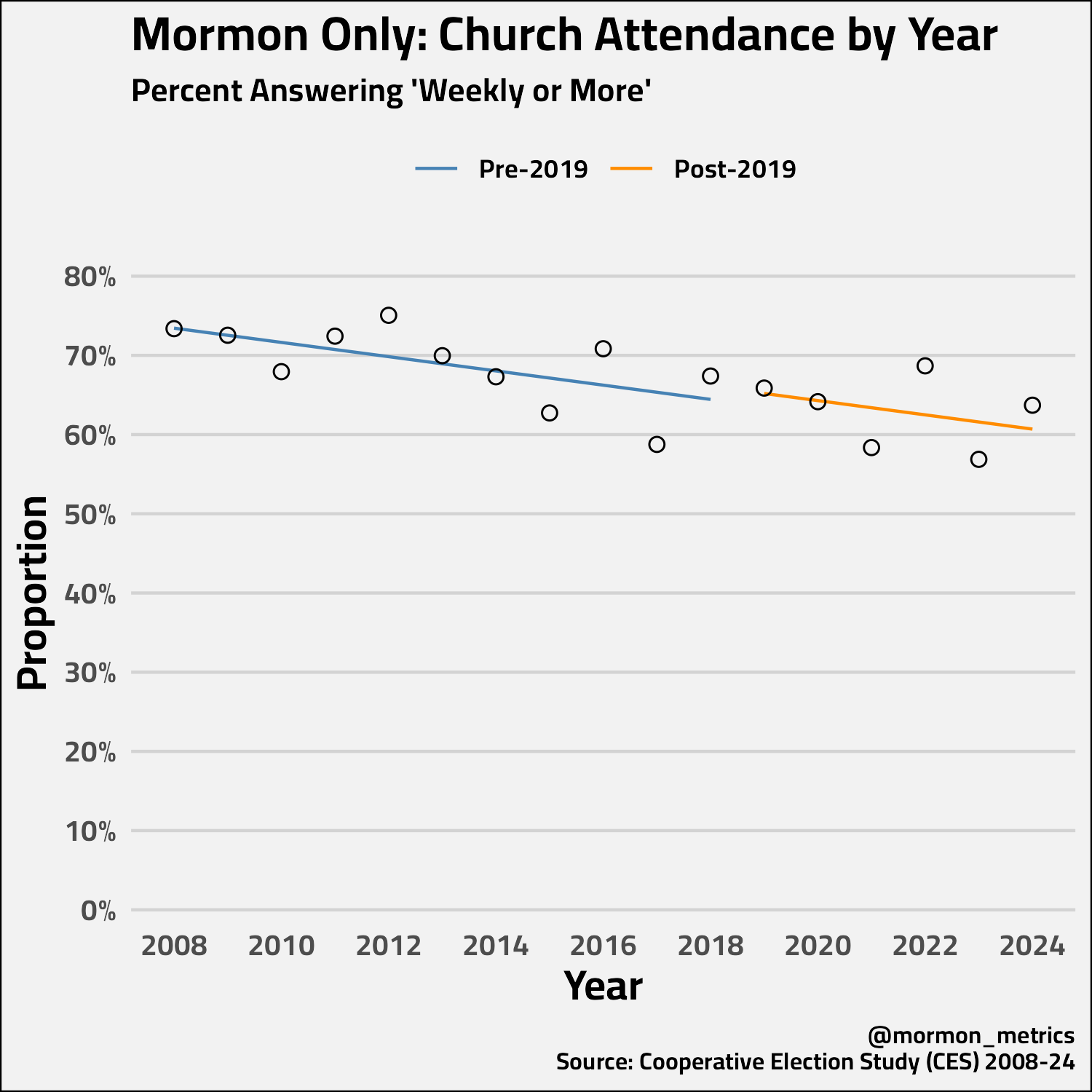
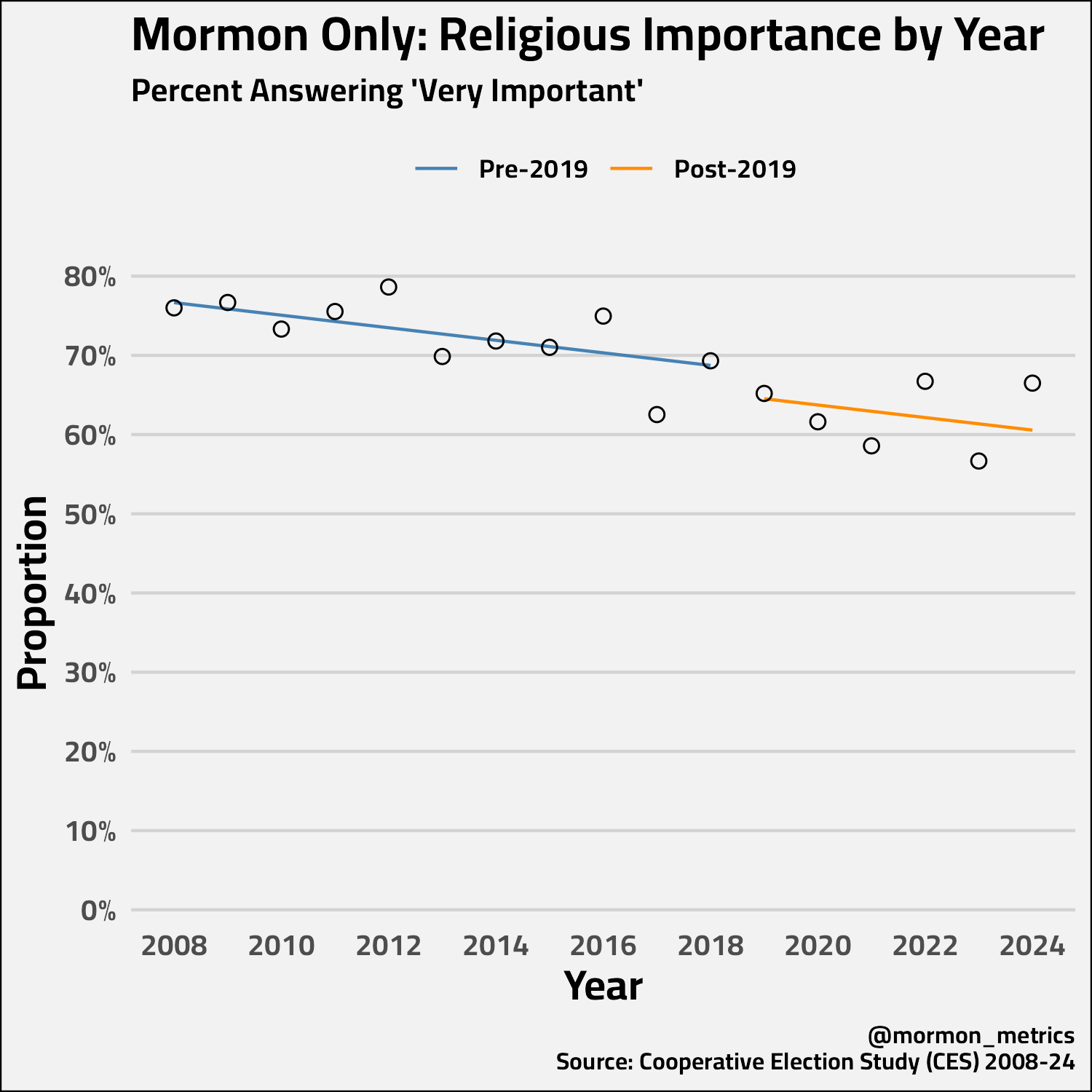
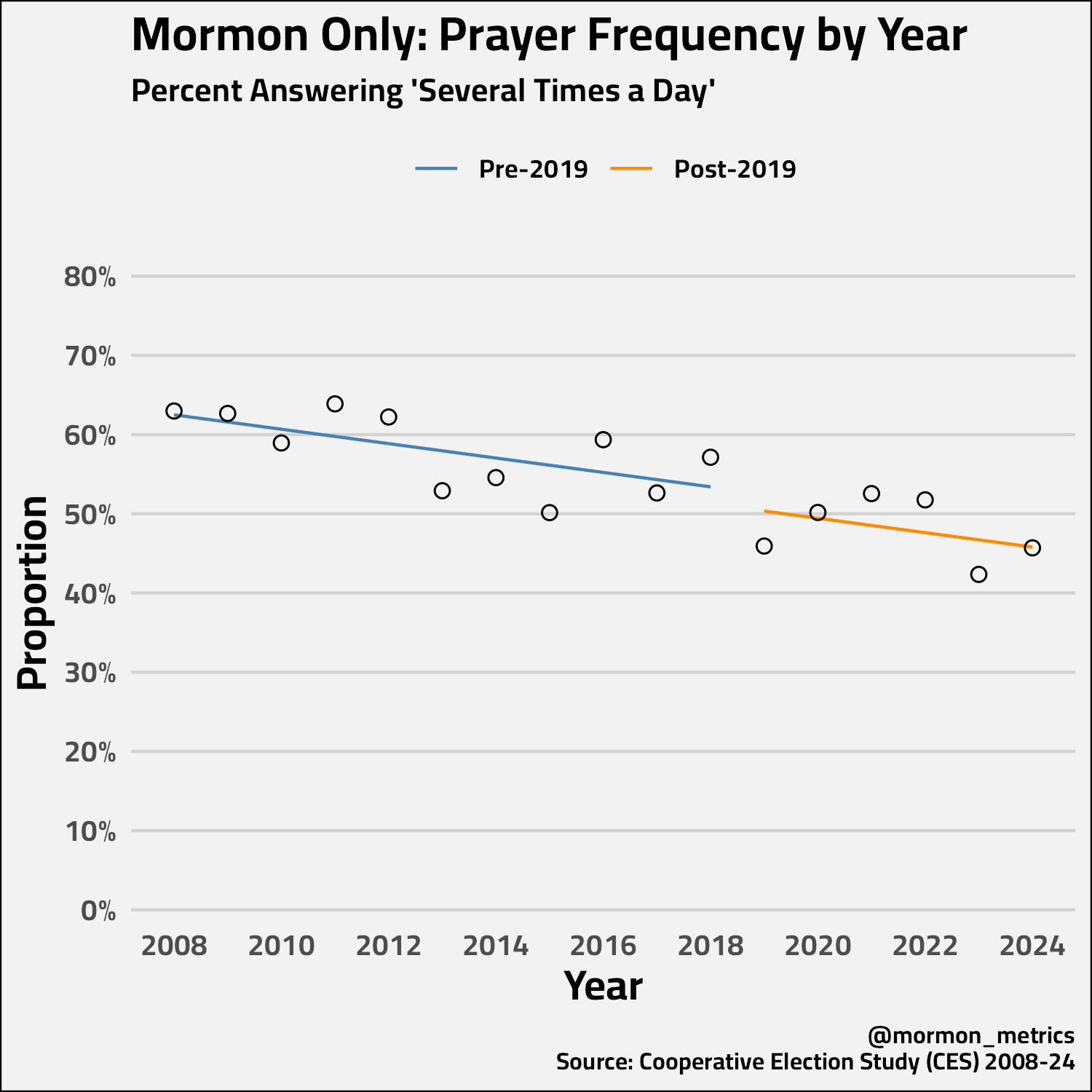
As I mentioned, you can clearly see a decline in each category signifying a general decline in religiosity among Mormons; however, the slopes of the lines before and after the policy change are nearly identical. I ran some statistical tests verifying that (in my code linked at the bottom) and none were statistically significant or close. The slopes are the same.
There also doesn’t seem to be a large or meaningful jump between the before or after periods across these variables.
Another thing to consider is what do you expect to happen after the policy change? Do you expect an immediate shift in religiosity or something more gradual?I kind of think that its something more gradual, so we may yet see a shift over time. Though, perhaps for church attendance it could have a more immediate effect.
Conclusion
So, what does the data say about the 2-hour policy change?
It did not seem to meaningfully affect the religiosity of members, and COVID didn’t seem to as well. There is a general trend of decline in religiosity among Mormons that does not seem to be meaningfully affected by either event (assuming without COVID and the policy change the trend would have continued to decline at the same rate).
But keep in mind, with more time and data points, we could still see shifts in the data as the 2019 and after slope could change..
Also, we really don’t know what a counterfactual world would have looked like, so if we assume existing trends would have continued in a world without the policy change and covid, then there is no meaningful change. But, things might have been different in a counterfactual world!
Let me know what you think about this analysis in the comments. Do you think the 2 hour church policy changed the religiosity of members? How? What do you think a possible 1 hour church policy change would look like?
This dataset is publicly available here and my code is available here.
One hour church would be an unmitigated disaster. I was originally pretty happy with the shift to 2 hour church (as a missionary at the time it made things more comfortable for people attending for the first time), but I've grown to rather dislike the change. I'm a YM advisor now, and it is tough only seeing the boys twice a month, and only teaching once or twice a quarter. I feel that while there hasn't been a significant decline in religiosity caused by the change, I would bet that there has been a decline in a feeling of community, even if small (and probably more pronounced among those that attend infrequently). There's less opportunity to talk with people in the hall, fewer chances for people who come late to participate, and fewer touch points between quorum and RS leaders. It won't ever happen, but I would be thrilled if we went back to three hour church.
By the way, I just discovered this blog and absolutely love it! This and Matt's Church Growth Blog over at the Cumorah Project are my Friday morning reading. Thanks for your hard work on this
I’m not a data scientist like you, but isn’t this simply correlation? Like, these aren’t predictably causal. I see you are considering a confounding variable of covid, and previous trend-lines, but to me this data really only shows one thing: that there are overall declines in attendance and religiosity. Which isn’t dissimilar to the overall trend in the US of people leaving religion ( which the pew research center has been tracking for decades.)
So what is causing these overall declining rates of religious attendance and decrease in religiosity? And are those the same factors as those in broader religious groups?