
New BYU Report: The Good, The Bad, & The Missing
My take on the working paper from BYU


Introduction
Happy 2026 everyone!
Thanks for following along with Mormon Metrics this past year. Our audience has more than 10X-ed from last year at this time. Last year, we started with 64 readers and today we have just about 1k. Here’s to another good year! 🍾🎉🎊
I have some pretty exciting things planned for this coming year, so I hope you stick around. The first of these things is that I am releasing my second report on January 30th or the last Friday of this month. More details to come, but its about temples.
Today, I’ll be discussing a working paper I read in the Deseret News just before the break with the news headline, “Latter-day Saints are retaining faith at uniquely high levels in a secularizing society” written by five BYU PhDs from the psychology department, religious education department, and the school of family life.
The Good: The Data on Devotion is Solid
Let’s start with where the report shines. The authors utilize the 2024 Pew Religious Landscape Survey to show that, statistically speaking, active Latter-day Saints are outliers in the American religious landscape.
The data confirms what we see on the ground:
Attendance: Latter-day Saints report the highest rate of church attendance of any religion.
Home Practice: 80% of Latter-day Saint parents pray or read scripture with their children—the highest of any group surveyed.
If the goal is to prove that active Latter-day Saints are highly engaged relative to Methodists or Catholics, the data supports it.
The Bad: Retention & The “Active Retention“ Metric
Things get stickier when the report tries to rank the Church’s retention against other faiths. In the executive summary, the report reads…
The Pew Religious Landscape Survey (2024) and the Spiritual Seismology Survey (2025) were used to examine national trends of Latter-day Saint retention. In these surveys, “retention” was defined as the percentage of those raised Latter-day Saint who continue to identify as Latter-day Saint in adulthood. Based on these two surveys, the retention rate today is approximately 50%. This rate is higher than all other Christian denominations, except Catholics who have a slightly higher rate.
This is factually wrong even looking at their own graph (figure 14) which has Orthodox Christians (a christian denomination) higher at 66% retention.
However, this is a table from Pew’s 2025 Religious Landscape Report which is the dataset they are using:
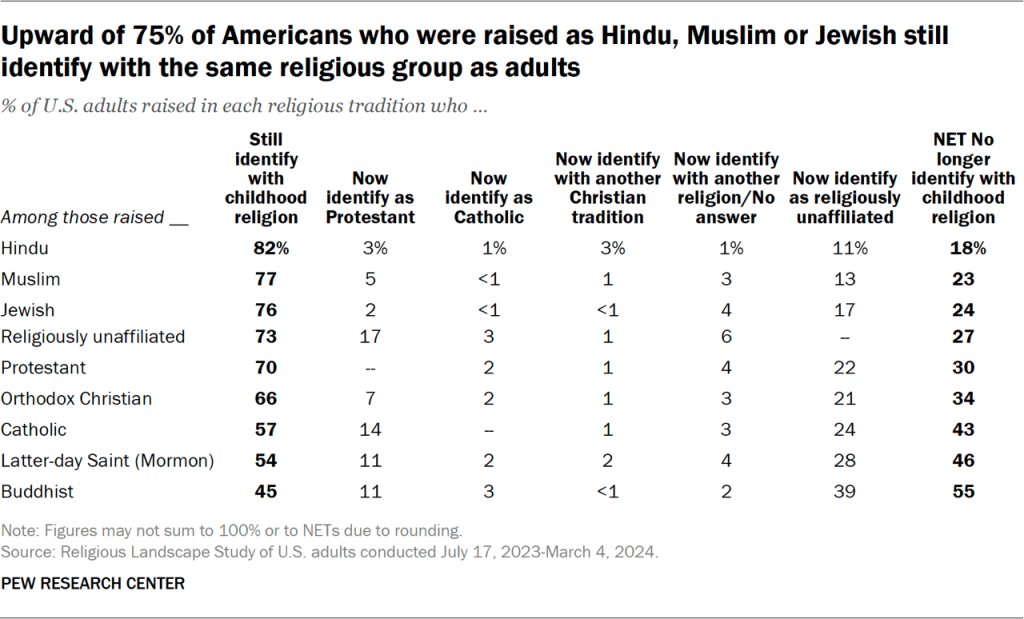
The Pew table shows all other religions have a higher “retention” (except Buddhists) than Latter-day Saints. Mathematically for the Protestant average to be 15 points higher, several individual denominations must have significantly higher retention than LDS. Grouping them by fragments makes a misleading comparison.
Update: As noted from one of the authors in the comments, the pew chart shows switching inside and outside protestantism where as the authors show switching in and out of protestant denominations (which may or may not still be within protestantism). So, I originally misunderstood the numbers here. See more of my and a contributor’s thoughts on this in the comments.
Additionally, the authors introduce a specific metric for “Active Retention,” defined as people who were raised in a faith and continue to attend services at least monthly as adults.
By this metric, Latter-day Saints rank #1 at 42%.
However, this metric effectively applies a Latter-day Saint definition of “faithfulness” to religions that function very differently. The report effectively penalizes groups like Jews (who have high identity retention but lower weekly attendance going from 76% to 18% from retention to active retention) by grading them on a curve designed to favor faiths with strong expectations around participation and lifestyle. It creates a statistical “home court advantage.”
The Missing: Sample Size & The "Black Box"
The most provocative part of the BYU report is the attempt to categorize former members into four types (e.g., “Faith Keepers,” “Faith Rejectors”).
From a data science perspective, there are two red flags here:
1. The Sample Size Problem Clustering algorithms are notoriously sensitive. This report’s typology is based on a subsample of only 527 individuals.
In my own recent report, The Mormon Typology 2025, I conducted a similar analysis with a sample size of 1,810—more than three times the size of this study. Even with that much data, I framed my typology as exploratory. To see this report draw conclusions about the population of former members based on less than a third of that data feels premature. There is also no cluster diagnostic stats or information for replication leading to my next point.
2. The “Black Box” Methodology The report lists their survey source (the “Spiritual Seismology Survey”) but provides no information on how these 527 former members were recruited. If the survey was distributed via BYU networks or church-adjacent channels, it would naturally over-sample “Faith Keepers” who still feel warm toward the Church. Unlike the clear methodology provided for the national datasets, the recruitment method for the SSS is not disclosed in the text. This is important information that should be shared before conclusions and news articles!
Update: One of the authors reached out to clarify that the 'Spiritual Seismology' dataset comes from political scientist Ryan Burge’s national survey. This is excellent news, as it indicates the sample is nationally representative and not, say, a convenience sample from BYU channels. I look forward to seeing this information in future versions of the report, but it effectively alleviates my concern here.
The “Real” Story: The Decline of the Devout Core
In this report they focus on aggregate averages (e.g., “LDS attendance is relatively high”), but do not discuss how the composition of the Church is fundamentally changing.
My analysis reveals an internal shift:
The Decline of the Traditionalist: According to the Mormon Typology Report 2025, in 2007, the Devout Traditionalist—the members doing the heavy lifting of practice and certainty of belief—made up 62% of the Church. Today, that share is 25%. I also did analysis of the Cooperative Election Study confirming this trend though the decline is not as drastic (52% → 39%).
The Rise of the “Cultural” and “Adaptive” Mormons: We are seeing more Cultural Mormons (now 27%) and Adaptive Believers (42%). These groups may still identify as LDS, but their engagement metrics are structurally different.
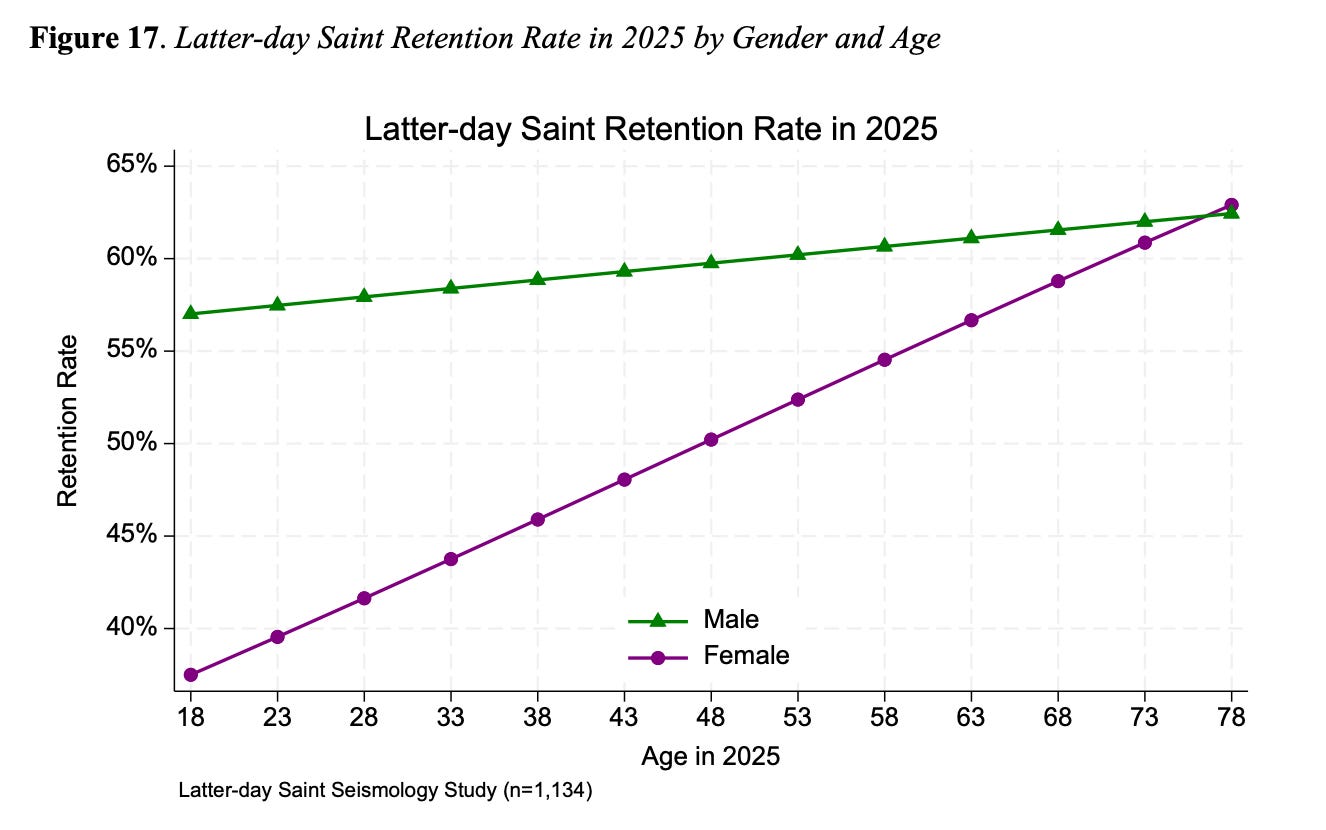
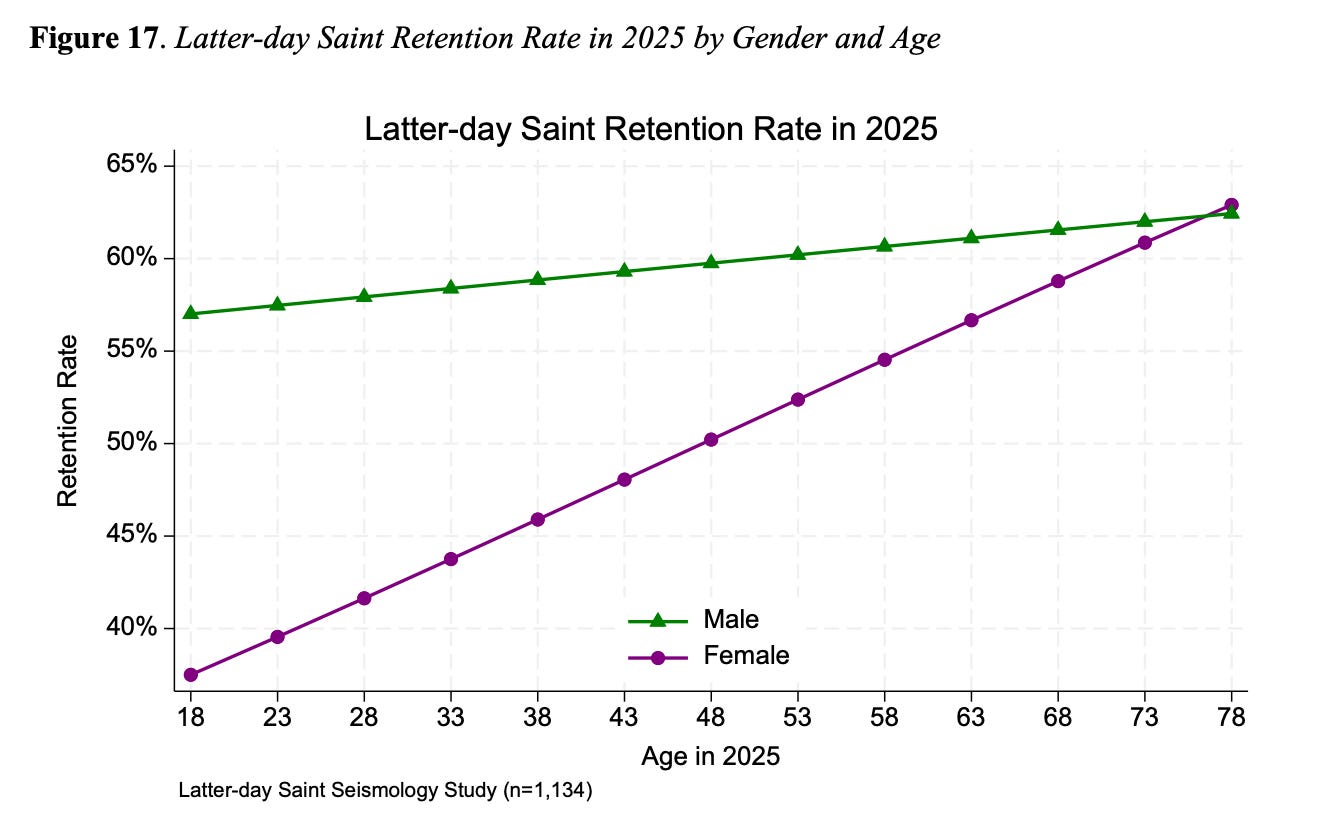
The Gender Nuance: Perhaps most concerning for future retention is the suggestive gender shift within the core. According to the Mormon Typology Report 2025, in 2007, the “Devout” category was majority female. Today, it has flipped to majority male. Women—historically the spiritual anchors of the faith—are changing in the modern age. Interestingly in this working paper, (pending more information on sampling, weighting, etc.) they show a gender gap in retention where young women appear 20 points more likely to exit than men. From my perspective, these important results should be highlighted as they help us understand a changing church membership and cultural landscape.
Conclusion
The BYU report is correct that the Church is still higher on many practice metrics compared to other religions as they have been for many years; and I support celebrating that continued win. But, “better than average” shouldn’t be confused with “stable” or “beating the trend.” For example, LDS orthodoxy could be declining faster than everyone else, but are still higher at this point in time since their baseline was so high! I would have loved to see more analysis comparing Latter-day Saints to the US religious average over time. Relative to the baseline disaffiliation and lowering belief, how are Latter-day Saints fairing? This, to me, is the more interesting story and analysis.
Perhaps after releasing my temple report the end of January, I will turn for better answers to those questions.
What do you think about my review? Do you think I was fair in the points I brought up? Do you disagree with me on anything?
Let me know what you think in the comments and I’ll see you next week!
Alex, thanks for replying to our report. You had some good points. However, this comment reflects what I think is a misunderstanding of the Pew report:
"Mathematically for the Protestant average to be 15 points higher, several individual denominations must have significantly higher retention than LDS. Grouping them by fragments makes a misleading comparison.”
If you go down two pages in the report you will see a table with all of the retention rates for the individual Protestant denominations as well as the average rate of 44%. It seems you assumed the 70% was an average of the individuals rates, but it is not. Rather, the 70% seems to count switching from one Protestant denomination to another as retention within Protestantism, if that makes sense.
I think you are being over-critical. (I read the article but not the report itself.) The article does address the decline in retention, mentioning the headwinds. It’s balanced and not all roses. Their attendance-weighted retention metric may not be of interest to all faiths, but it does provide a window into the data that is relevant from a certain perspective, and says something useful about the data, so I think it’s fair. They were clear about what they were doing and didn’t just try to sneak in a new definition of “retention”, for example, which would have been unfair. On the clustering with a small sample size - at least they do mention the sample size rather than bury it, and I’m glad they went ahead despite a small sample, as the results do shed important light on an interesting phenomenon. (Same story as your analysis.) I wasn’t bothered by the concerns you mentioned.