
Religion Gender Gap Among Mormon Young Adults
What is going on with the young adults?


Introduction
This last week, I read a piece from the New York Times about youth and religion in the US. The premise is while traditionally women are more religious in several metrics than men, the youngest generation was showing the reverse: men being more religious than women.
I was curious what this looked like for Mormons. Are young Mormon men in the rising generation more or less religious than women?
Data
The Cooperative Election Study (CES) is one of the only surveys that has a large enough sample sizes to look at subgroups of a small proportion of the US population. And, even so, I had to combine waves of this survey!
For those interested in the sample sizes in the charts below, I include this table looking at the weighted count of Mormons age 18-30 across 3 time periods in the CES.

Charts
Before looking at young Mormons, let’s first get a sense of the religious gender gap in the US population overall.
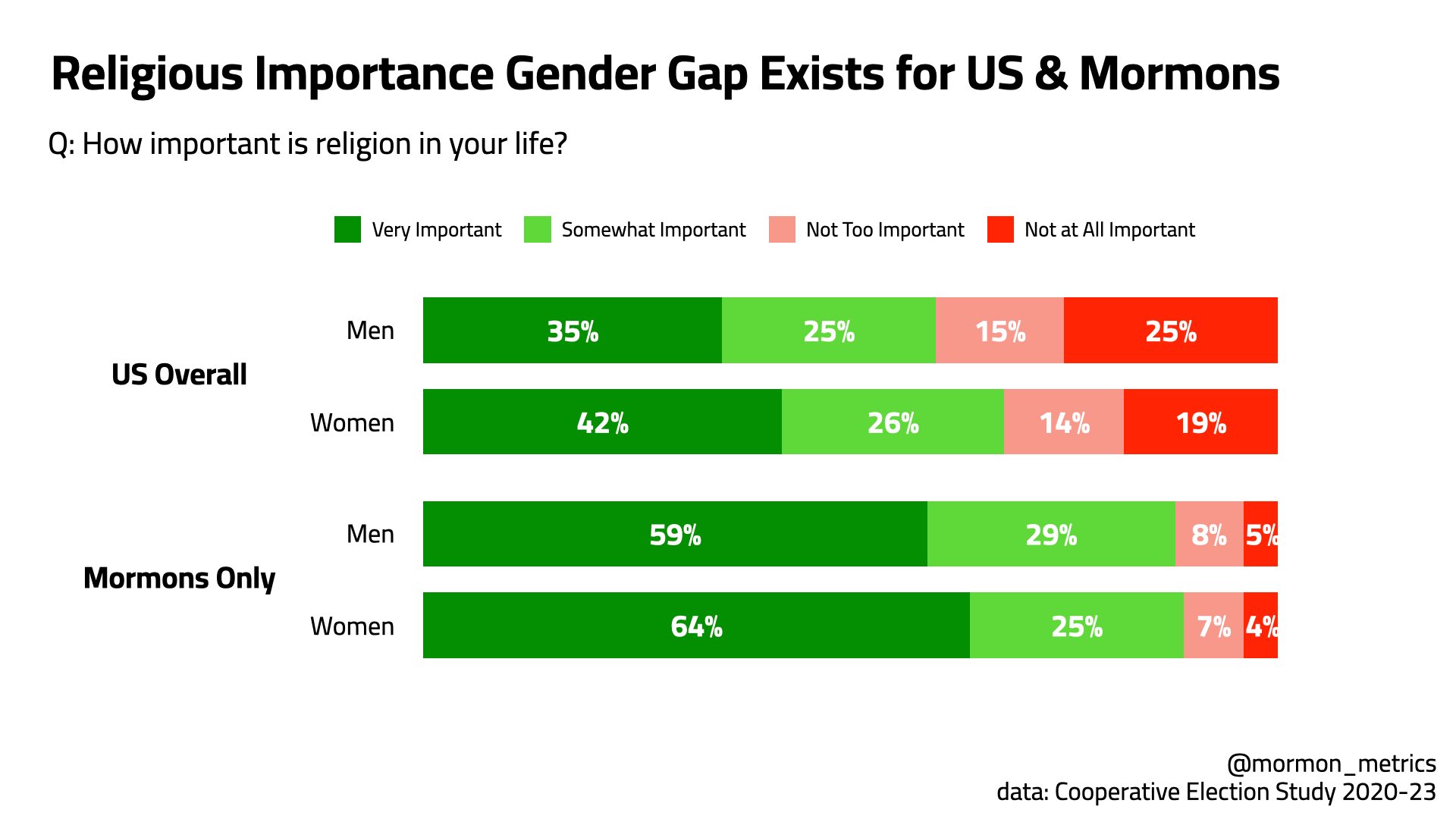
Notice…
Both Mormons and the US overall have the gender religious gap. It is not HUGE, but it exists. Women are more likely to say Religion is “Very Important“ than men in both groups by 5pts for Mormons and 7pts for the US overall.
Mormons more likely to say religion is “very“ or “somewhat“ important in life than the average person in the US. Unsurprising, because the average US number includes people who identify as non-religious and Mormonism is a religion!
Now let’s look specifically at the Mormon young people age 18-30…
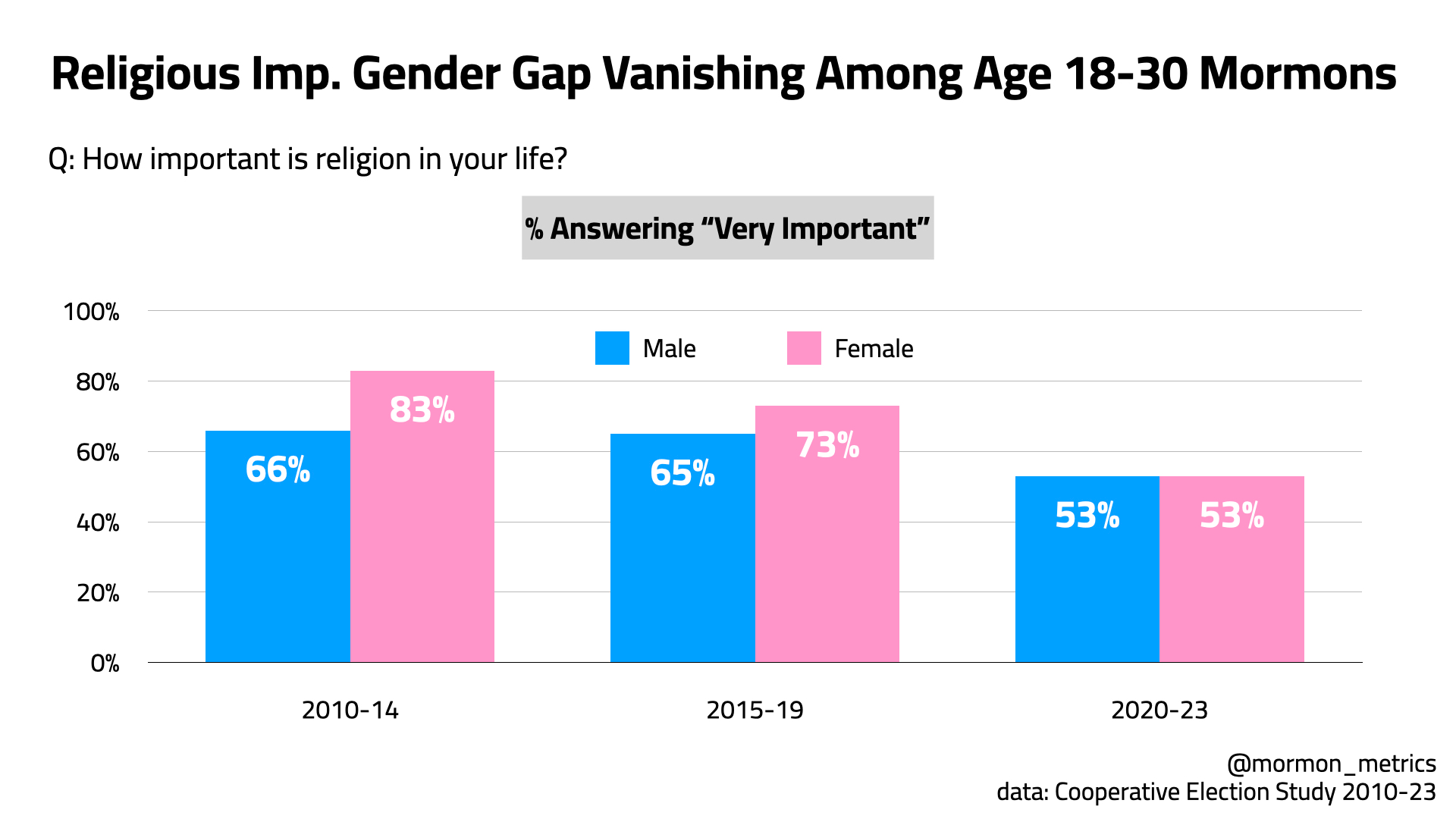
For the youngest group, we see an above 15pt gender difference in religious importance, but in the latest data 2020-23 this gap is non-existent! Also note that for both genders fewer young mormons say that religion is “Very Important“ in their life.
Let’s now look at another perspective on someone’s religiosity, church attendance.
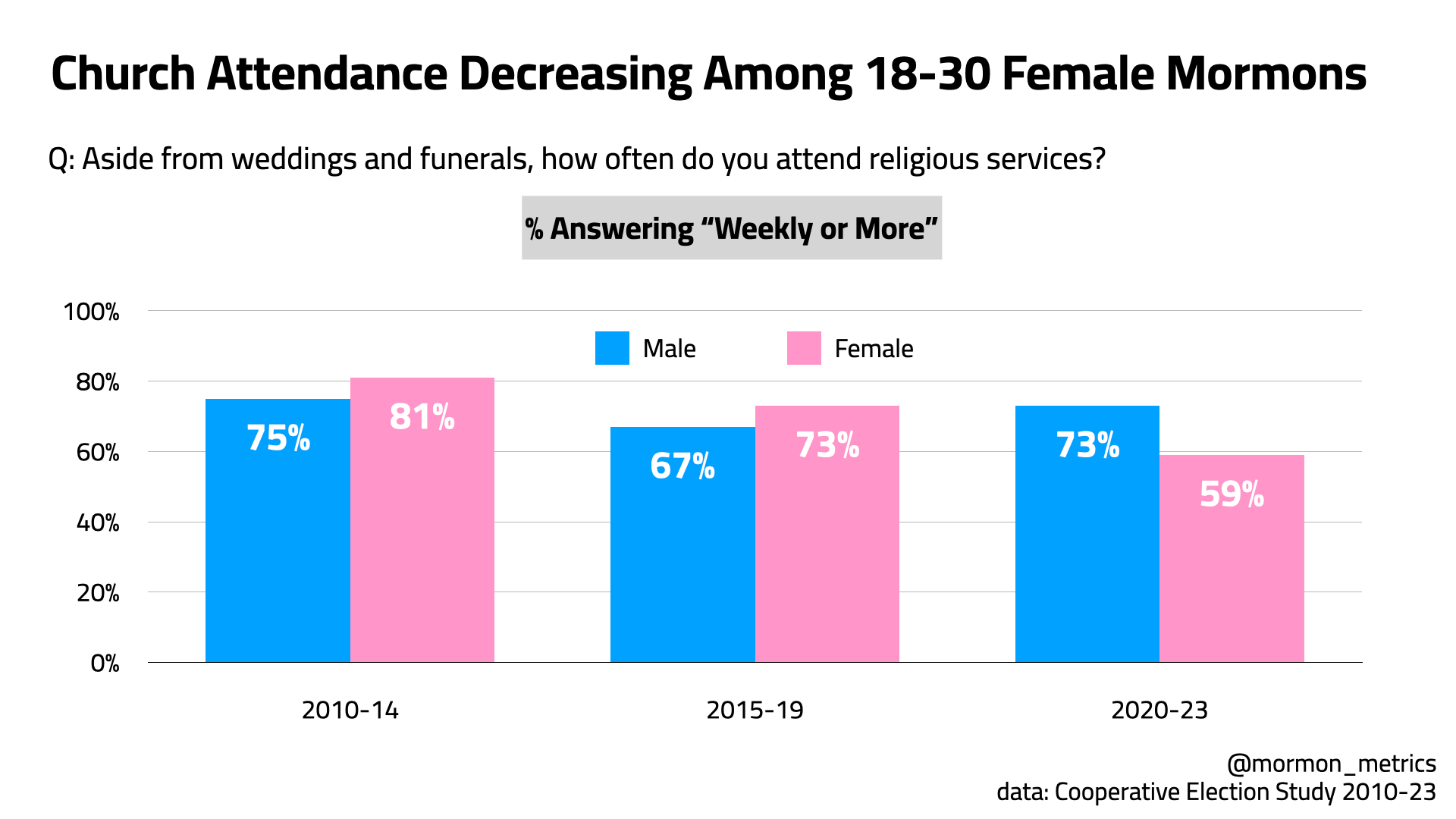
While it doesn’t seem that young Mormon male church attendance has significantly changed, we see a decrease in young female Mormon church attendance. In our first time period, women who identified as Mormon were more likely than men to attend church “weekly or more“ than men. Now, self-identifying young Mormon women are less likely to attend “weekly or more“ than their male counterparts.
I would love to dive into more questions looking at these breaks, but these are the only two relevant religious questions asked on the CES survey which is more focused on politics.
The latest data is too sparse to break up any further, but would love to see a break looking at single vs. married young adults by gender. I may yet explore single vs. married young adults in another post.
Conclusion
To me, the data is suggestive of a disappearing religious gap between young male and female Mormons and perhaps even a reversal (time will tell). Women are just as likely as Men to say that religion is “very important“ in their life which has not been traditionally true. Also, young mormon women are less likely to attend church weekly than mormon men which is a reversal from the recent past.
Discussion
Have you seen this trend among young adults in the church today? What is your personal experience?
Until recent decades, culturally and socially, many Mormon youth were being raised in a semi-isolated bubble. Furthermore, the gap between the general religious perspectives and secular and legal perspectives regarding women’s roles and rights was much smaller. Then, the internet, globalization,…It is understandable that, today, a higher proportion of young females are dissenting/disengaging/disbelieving/distrusting Mormonism’s teachings and practices about their identity and role. What is a woman to love about a religion that claims the authority to give blessings to her own children, the authority to preside in meetings, to judge others (disciplinary councils), the authority to guide and decide for the whole (ward bishoprics, stake presidencies, and on up to “higher” leadership authorities), the authority to baptize a person that they have taught and loved with all their heart, and on and on, that such authority only belongs to men? What is a woman to love about a religion that continues to cling to these teachings and practices?? What is a woman to love about a religion that in essence says “no” and “you can’t” and “women not allowed” on so many levels?? For many women, this Mormon reality at best feels weird, nonsensical, and antiquated, but, in many cases, feels much worse—a denigrating and painful (and unnecessary) experience in the face of what they enjoy in their broader culture and society—a culture and society that believes in women’s abilities, that lets them choose their ambitions, that legally grants and protects her equal rights, and that does not disallow any work or leadership role. In general, “our” culture and society has figured out that our society is still okay—even better—when we stop limiting women’s identities and roles, when we stop denying women opportunities of all educational and growth and leadership experiences. I know my comment here is in essence a rant, a rant offering up a partial explanation for what the data is saying. Your articles are dispassionate presentations of “the facts” as revealed by “interesting data”. I have a degree in statistics and appreciate your approach and your offerings!!