
Just Released: "The Temple Premium: Fact or Folklore?"
Do LDS temples change home prices? I analyzed 42 temples and 15 years of Zillow data to find answers!


If you live in the Intermountain West, you have heard the rumor. It is whispered in ward foyers and included in real estate listings: “Buy now! The temple is coming!”
For decades, a persistent folklore has circulated among Latter-day Saints and investors alike: the announcement of a new temple guarantees a 10–20% spike in neighboring property values. To the faithful, it is a spiritual blessing on the land. To the speculative investor, it is a sure-fire arbitrage opportunity. To the “Not In My Backyard” (NIMBY) critic, it is a looming crisis of traffic and lighting devaluing the area.
But my data doesn't support either conclusion.
For the last few months, I have been working on the largest-ever econometric analysis of temple housing markets. We looked at 42 temple locations announced since 2011, analyzing 15 years of Zillow data to separate the signal from the noise.
The results are in. And they are going to upset the conventional wisdom on both sides of the aisle.
The “Illusion” of Growth
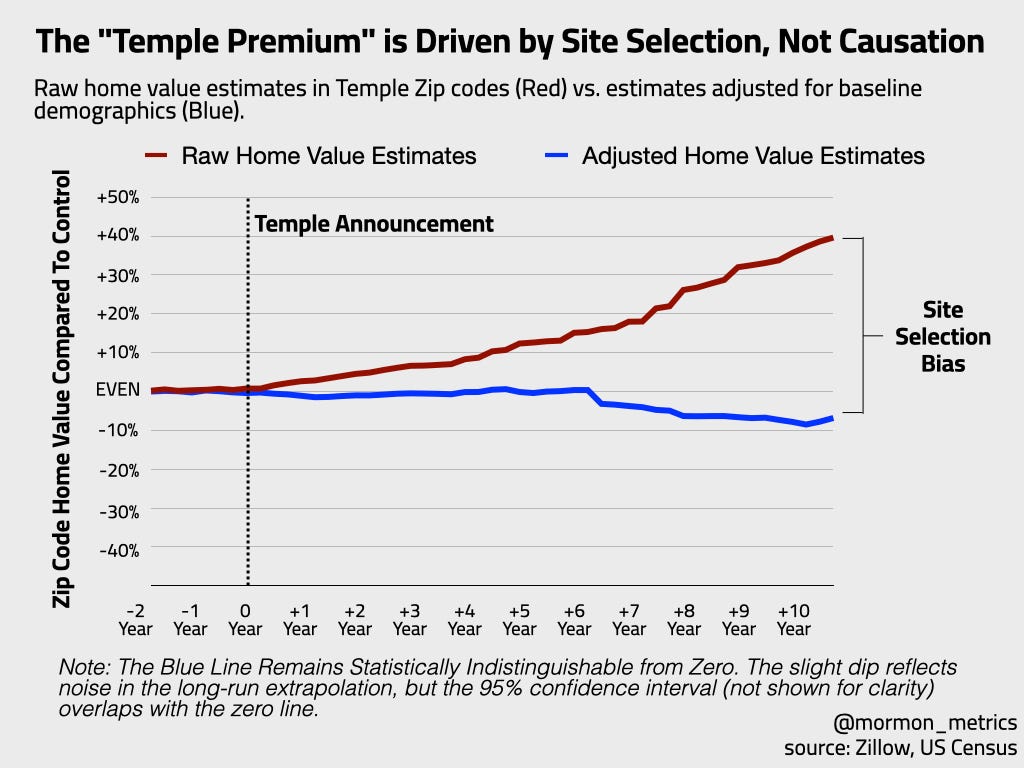
If you look at the raw data, the folklore looks true. Home values in temple zip codes do perform well after an announcement—often trading at a 22% premium over the national average over time.
But correlation is not causation.
When we applied a Staggered Difference-in-Differences (DiD) model to control for the neighborhood’s pre-existing trends, the “Temple Premium” vanished.
The Red Line (Raw Data): What realtors see. Prices go up.
The Blue Line (Causal Effect): What happens when you control for baseline demographics. Flatline.
The “Winner’s Profile”
So, why do prices rise if the temple isn’t causing it?
Selection Bias.
Our analysis reveals that the Church acts as a rational economic agent. They do not build temples in random locations that subsequently boom; they identify neighborhoods that are already winning.
Before a temple is ever announced, the chosen zip code is already:
35% Wealthier than the average zip code.
69% More Educated (Bachelor’s degrees).
447% More Populous.
The Church doesn’t create the real estate wave. It surfs it.
Bad News for NIMBYs, Bad News for Speculators
This report contains a “Null Result” that creates a fascinating dilemma for ideologues:
To the Critics: There is no evidence that temples destroy property values. The “nuisance effects” of traffic and lighting appear non-existent in the housing data (at least at the zipcode level)—even in “Mission Field” areas like New York where LDS density is low. While immediate neighbors could experience localized nuisance effects, our data confirms these are not severe enough to drag down the broader zip code.
To the Investors: There is no “free lunch.” The premium you see is priced in by the fundamental quality of the neighborhood (schools, safety, jobs), not the steeple. If there is an effect, it is more modest <=5% and not detectable in the model.
Read the Full Report
This isn’t just a blog post; it is a full 30+ page data journalism report. In the full PDF, I break down:
Zion vs. The Mission Field: Does the effect change in Utah County vs. Westchester County? (Spoiler: It doesn’t as far as we have power to tell) .
The Methodology: A “Plain English” guide to how we isolated the variable.
The Implications: What does this mean for urban planners, home buyers, economists, and sociologists?
Code & Statistical Appendix: Yep, we have that, too. A special treat for the data nerds among you. Replicate the models yourself with our step-by-step guide + code.
👇👇👇
Click here to download full 30+ page report.
As I have done in previous reports, I may update the report based on feedback and publish additional versions with new insights and/or improvements.
Excited to hear your thoughts!
Author’s Note: This project was born out of a desire to bring rigorous data to cultural questions. If you find this valuable, please subscribe and share. If you think rigorous analysis like this would be useful in your organization, please send me a note at contact@bassempirical.com.