
Pt2: Which Ex-Mormons Are Moving Right?
Analyzing the three waves of the Pew Religious Landscape Study


Introduction
Last week, we found that according to the 2024 Pew Religious Landscape Study, Ex-Mormons were the most likely to be Republican among all childhood religious leavers, and that they have steadily moved toward the GOP over the last decade. Read the full analysis below:

Today, let’s explore why this might be the case. More specifically, let’s find the type of Ex-Mormon driving this rightward shift.
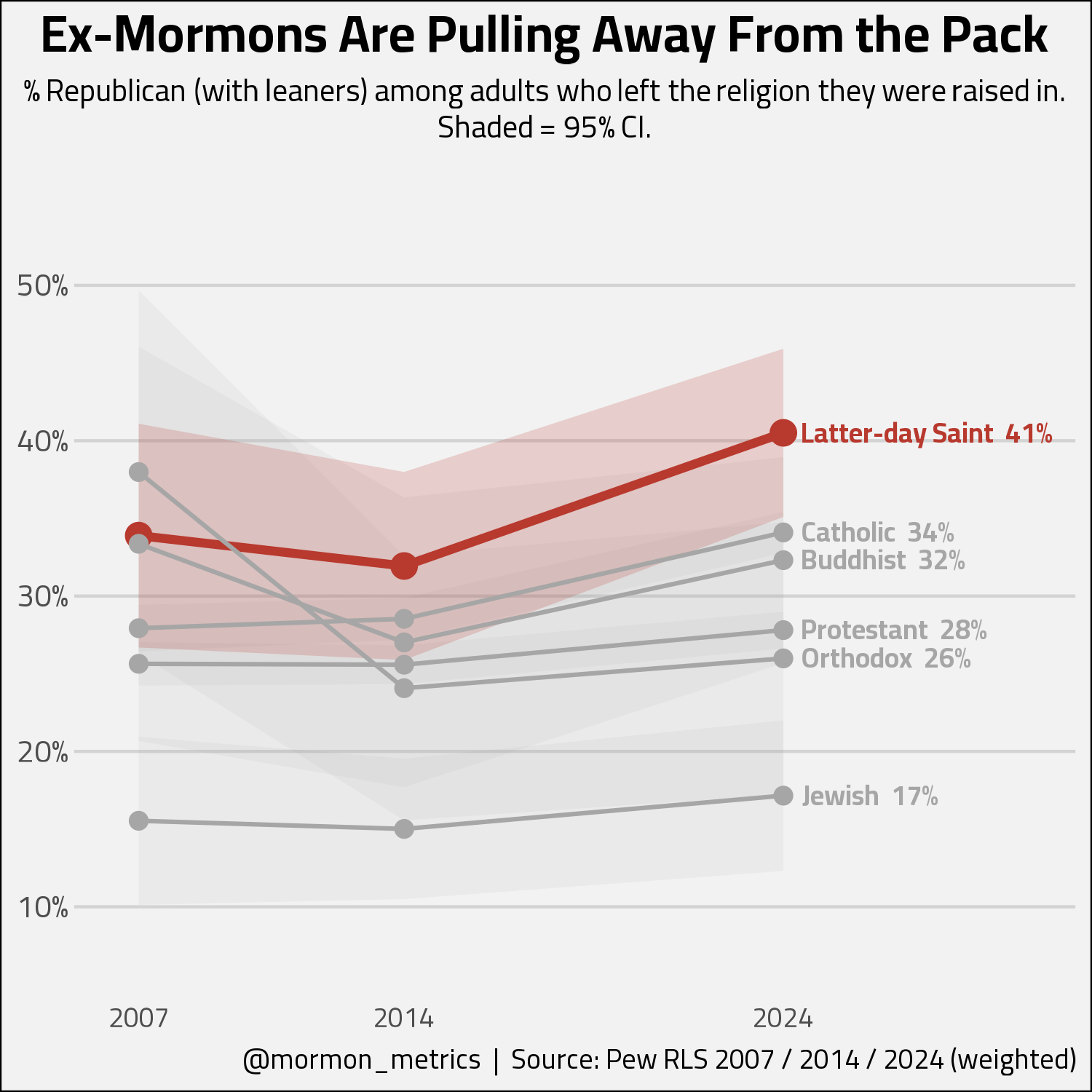
Ex-Mormons are meaningfully separating from other religious leavers in the most recent data point. But as it turns out, there isn’t a massive, insular "gotcha" that redefines how we think about Mormonism's unique theological footprint. Instead, this rightward shift seems to be an artifact of macro political and demographic forces.
Ex-Mormons Are In The Shadow Of A Political Realignment
One of the largest dividing lines in American politics today is educational attainment, and the alignment of these groups has transformed dramatically over the last twenty years.
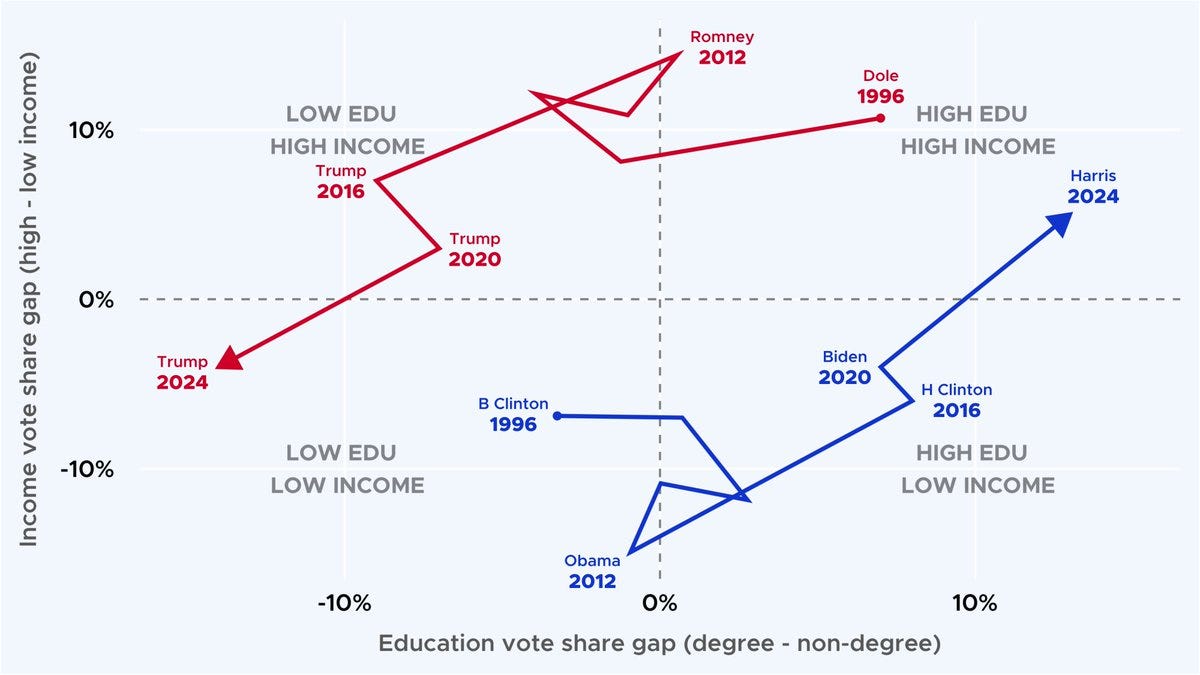
As highlighted by Patrick Ruffini in The Intersection newsletter, the non-college working-class voters who anchored the winning coalitions of Bill Clinton and Barack Obama now form the backbone of Donald Trump's coalition.
How does this relate to Ex-Mormons?
On average, adults who leave the LDS faith are more likely to fall into this non-college demographic than those who stay.
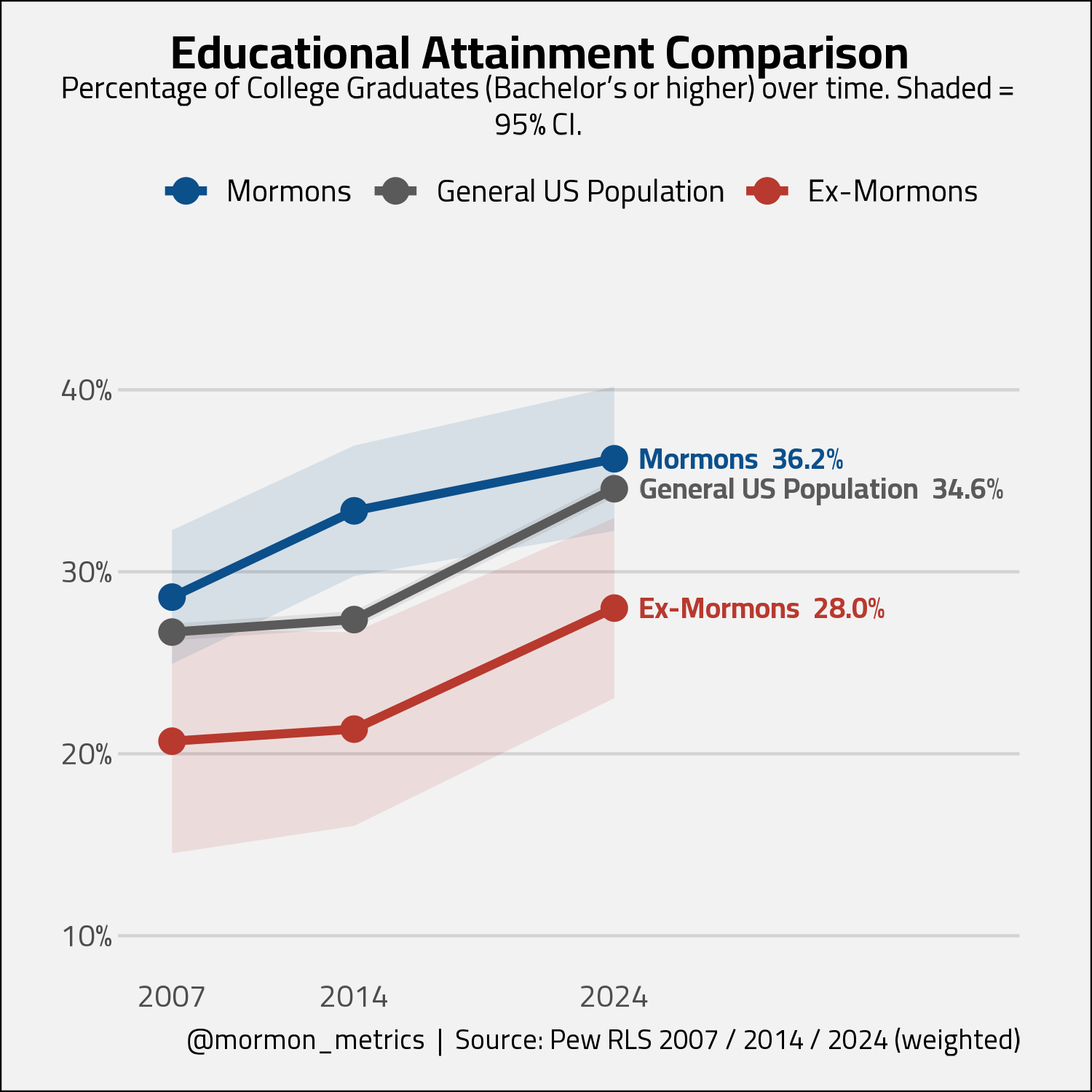
Latter-day Saints maintain a higher proportion of bachelor’s degrees than the general population (a gap that widens even further when filtering strictly to active members). Consequently, the population exiting the church is disproportionately non-college educated.
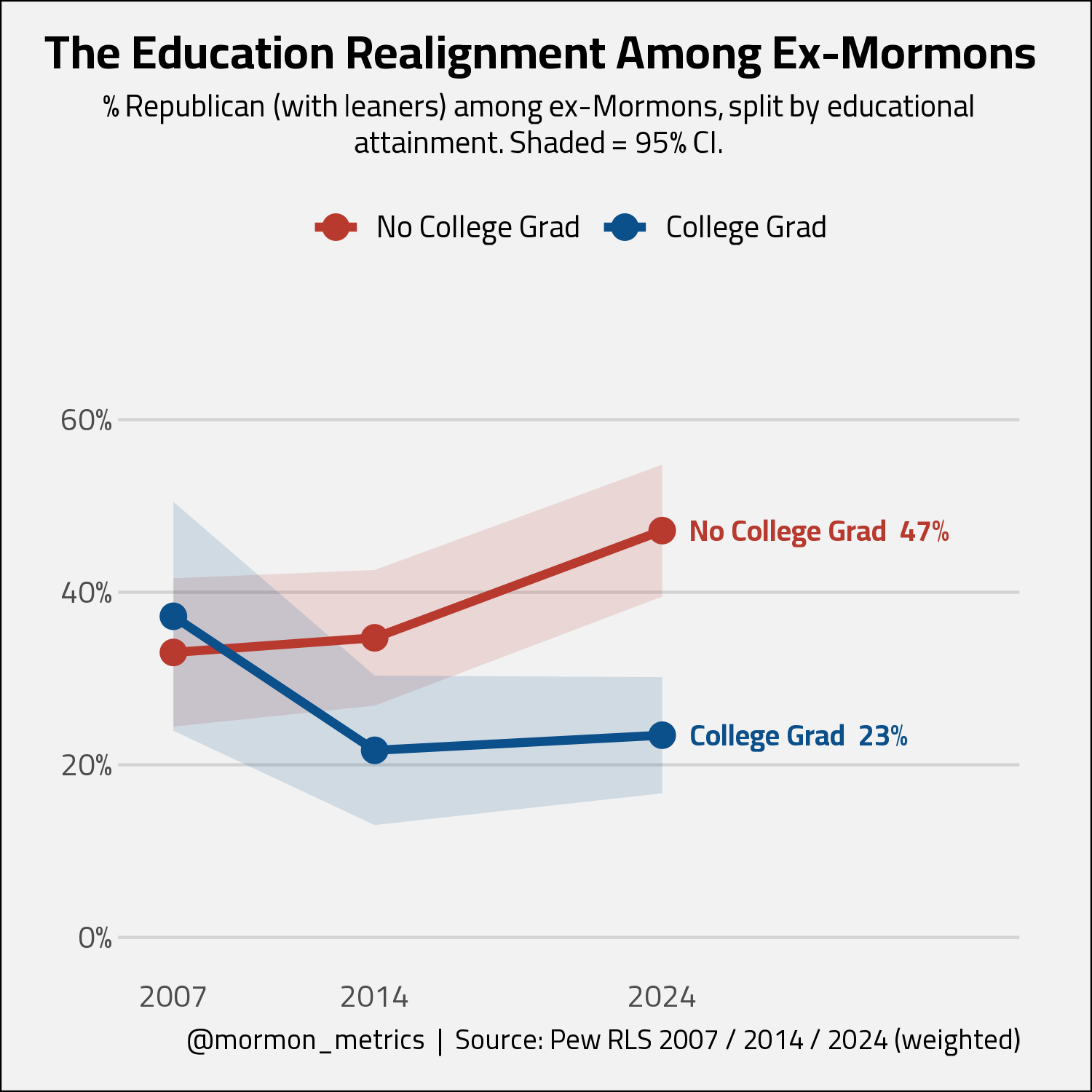
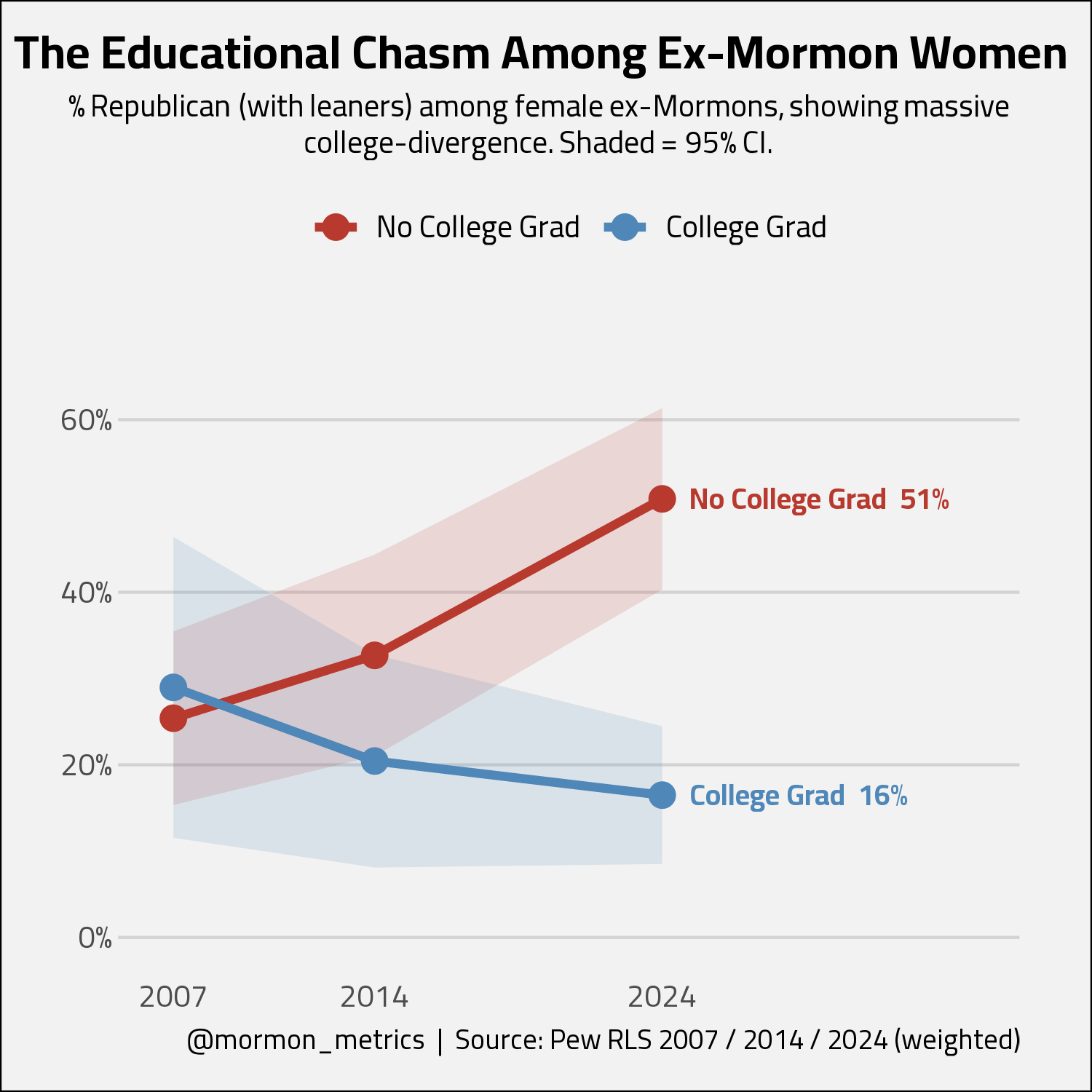
Non-college Ex-Mormons have increased in their identification with the Republican Party, while college-educated Ex-Mormons have dropped. (Fascinatingly, sample sizes get thin when cutting the data this finely, but early signals suggest this contrast is at its absolute steepest when filtering strictly to women).1
The Micro Anchor vs. The Macro Gravity
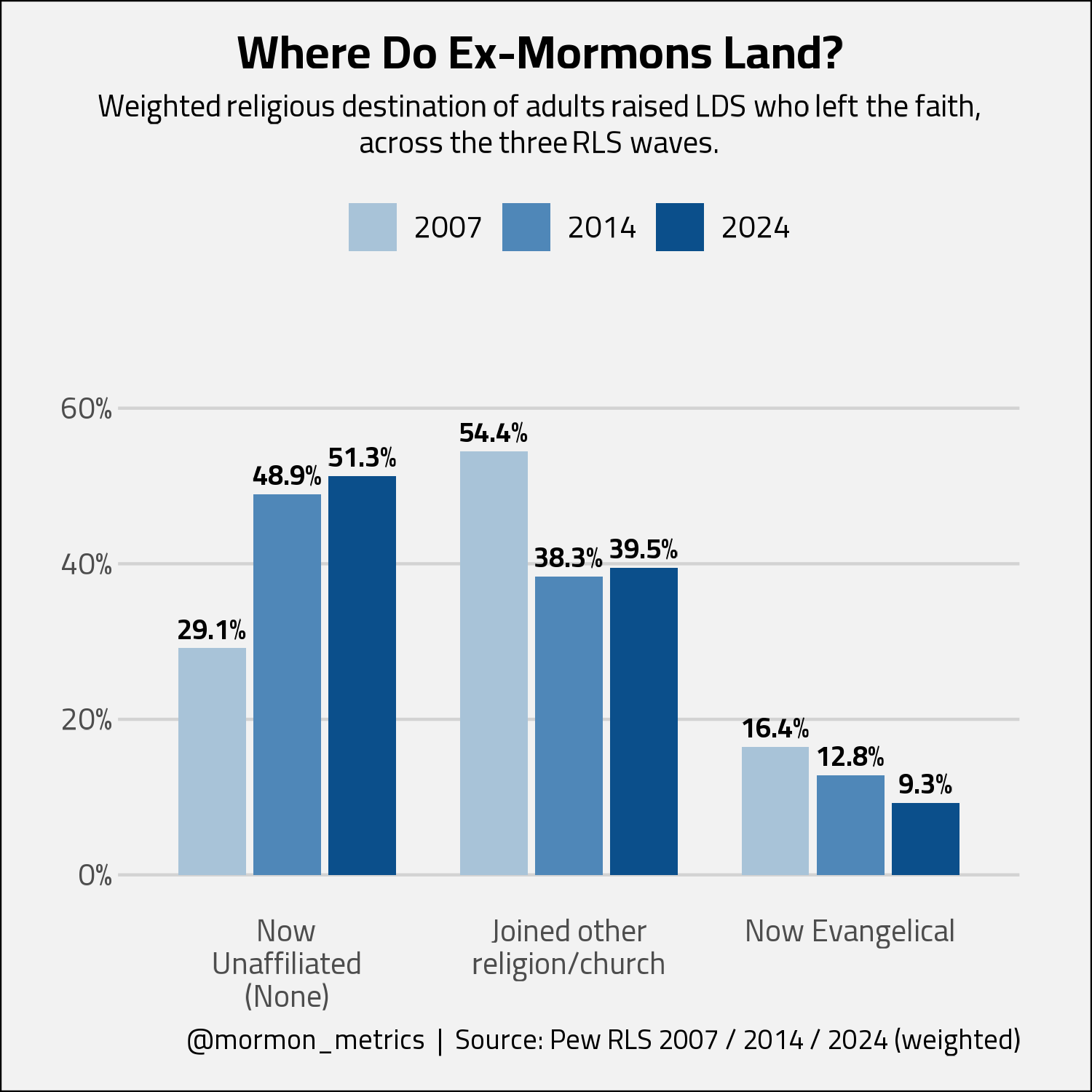
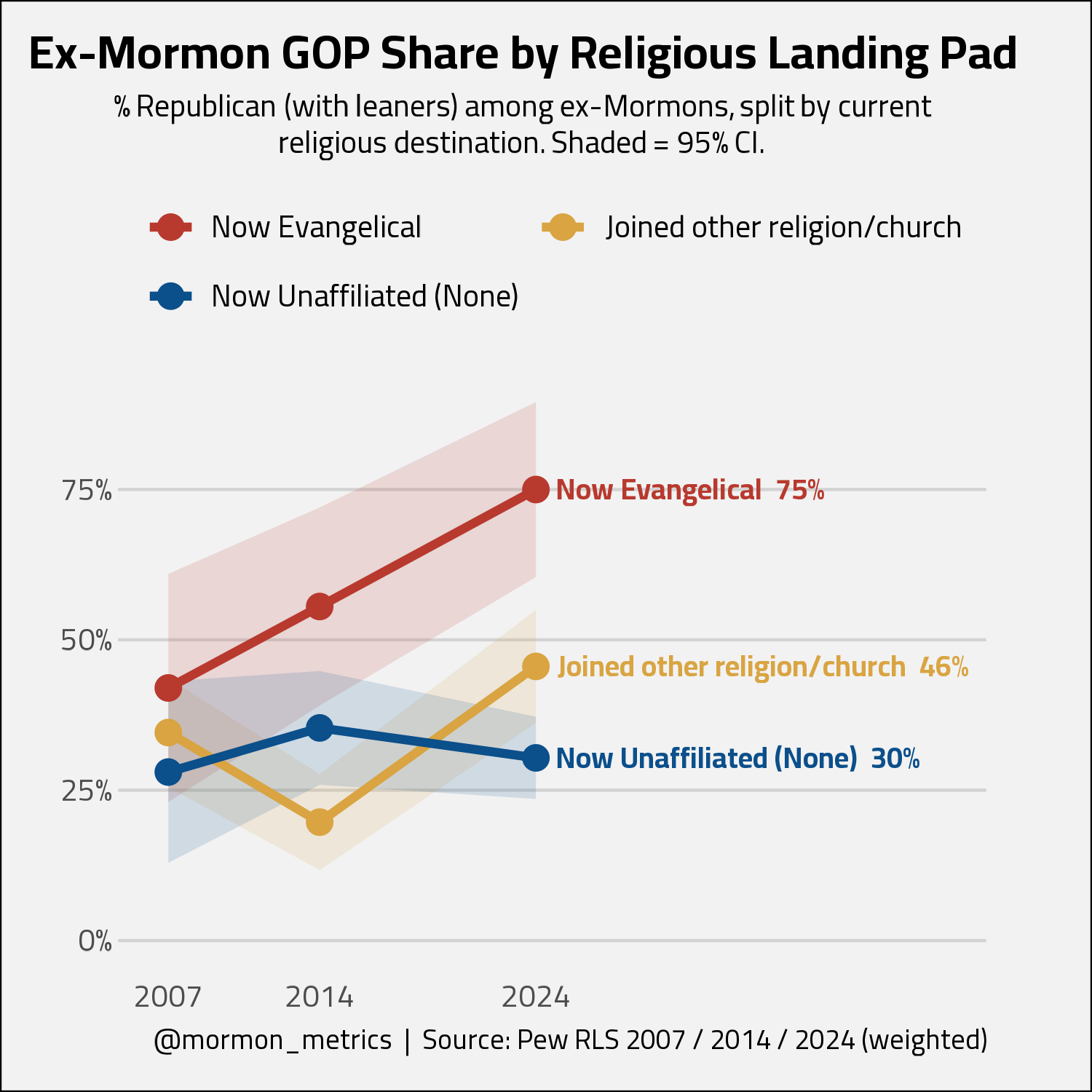
Another political change in the last 20 years is the solidifying of the Evangelical Christian Republican base. So, what about the Ex-Mormon-to-Evangelical pipeline? While the data shows that fewer Ex-Mormons are joining Evangelical churches with each wave—with the vast majority opting to become religious "nones"2 — the minority who do transition to Evangelicalism are also shifting heavily to the right.
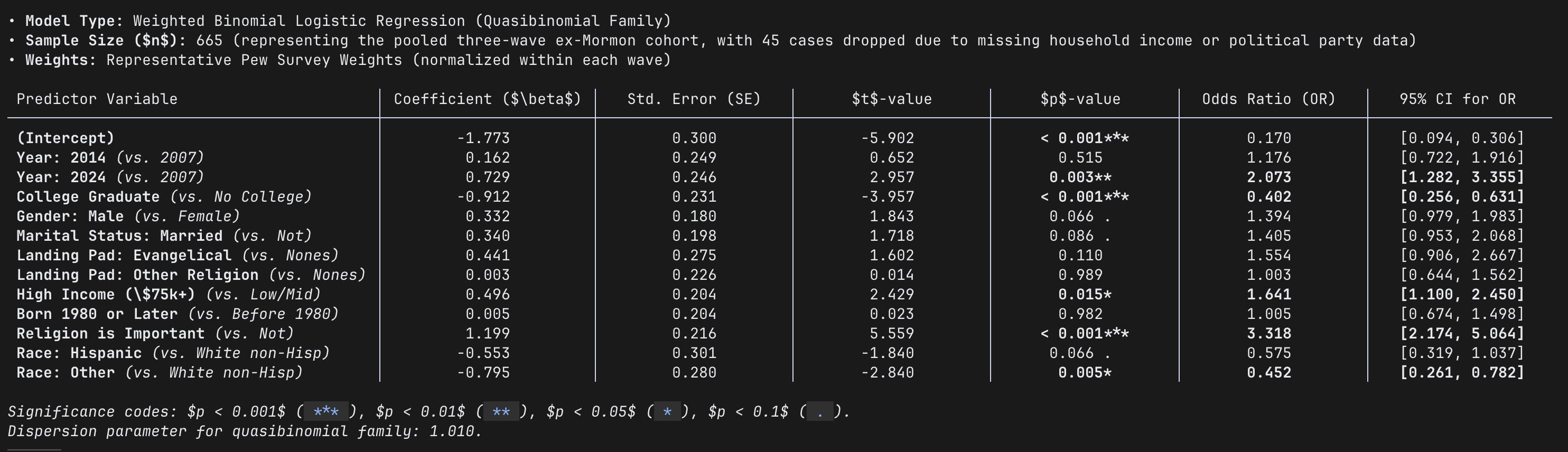
When we look at a regression model to see which variable actually wins the individual horse race, the statistical receipts show that personal religiosity is the single strongest predictor of whether an individual Ex-Mormon is a Republican.3 Holding all else constant, an Ex-Mormon who maintains personal religious devotion (like converting to Evangelicalism) has more than three times higher odds of being a Republican than one who secularizes.
So how do we reconcile these two findings?
Think of religiosity as a micro-level anchor and education as macro-level gravity. Maintaining a deep religious faith acts as a powerful anchor that keeps an individual leaver firmly in the GOP column. But once an Ex-Mormon undergoes the secularization process and cuts that anchor loose, they may shift into the default gravity of their demographic profile. Because nearly three-quarters of Ex-Mormons do not hold a college degree, the current of the modern working class pulls the aggregate group steadily to the right.
Conclusion
Ultimately, the rightward shift among Ex-Mormons is a demographic one. When people leave the LDS Church, they don’t enter a political vacuum; they are swept up into the same macro-forces reshaping the rest of the American electorate.
As the GOP increasingly becomes the party of non-college working-class voters, and the Democratic party becomes the place for college graduates, the ultimate political destination of an Ex-Mormon has less to do with the doctrine they left behind, and more to do with the degree they hold and whether they still consider themselves religious.
What do you think? If you are an Ex-Mormon, does this educational divide match what you see in your own social circles? Let me know in the comments.
As always, the code for this week’s analysis is available here.
Ex-Mormon women with a college education are significantly less likely to be affiliated with the Republican Party.
For those interested in which "other religions" in this chart they join: in 2024, the top destinations were (1) Mainline Christian, (2) New Age/Spiritual Religions, (3) Non-Christian world religions, and (4) Catholic.
In a logistic regression predicting Ex-Mormon Republican affiliation, high religious importance (OR ≈ 3.32, p < 0.001) and lacking a college degree (OR ≈ 2.49, p < 0.001 are both highly statistically significant, independent predictors.
This tracks very closely with many people I know. I might add, it seems in my experience greater education allows one to deal better with nuance and contradictions in church history and doctrine. Education reduces binary thinking.
Great post!
I appreciate these thoughtful breakdowns so much! Thank you!