
What Is Happening In Europe?
Charts of Mormon Church growth trends by region


Introduction & Data
Over time in General Conference, the Church of Jesus Christ of Latter-day Saints released overall membership data yearly. More recently, there has been a few more stats released like overall number of temples, congregations, and family history centers. However, what is not released over time is membership data broken down by country or region.
When I was looking at the church stats website this time, I realized that they included some historical regional growth data by region. So, I wanted to write about it here. The figures in today’s post are screenshots from the stats page of LDS.org.
Congregations vs. Membership Records as a Measure of Growth
As I have mentioned before, membership is a difficult measure of growth because many members stop attending church and associating with their Mormon identity, but will not remove their records because they may not know about them. These “members“ are still counted on church records, but are not Mormons in every other sense. Though I had trouble finding what happens to less active records when researching, I did find one article that says member records are removed at age 110 if no news of death has been received. This article is from 2005, so maybe things have changed since. I was not able to find anything else, so if anyone knows better of this and has sources, please send!
With the member count being bloated, another way to look at membership is by congregations. Most recently announced in 1 December 2023, for a ward, there must be 20 active, full-tithe-paying Melchizedek priesthood holders. So, in other words, there is a minimum floor of active members for each congregation which could be a useful measure for growth. Because if congregations are decreasing, it is suggestive that active members are also decreasing and vice versa. So, for these reasons, I’m going to pay more attention to congregations in the graphs below.
Chart
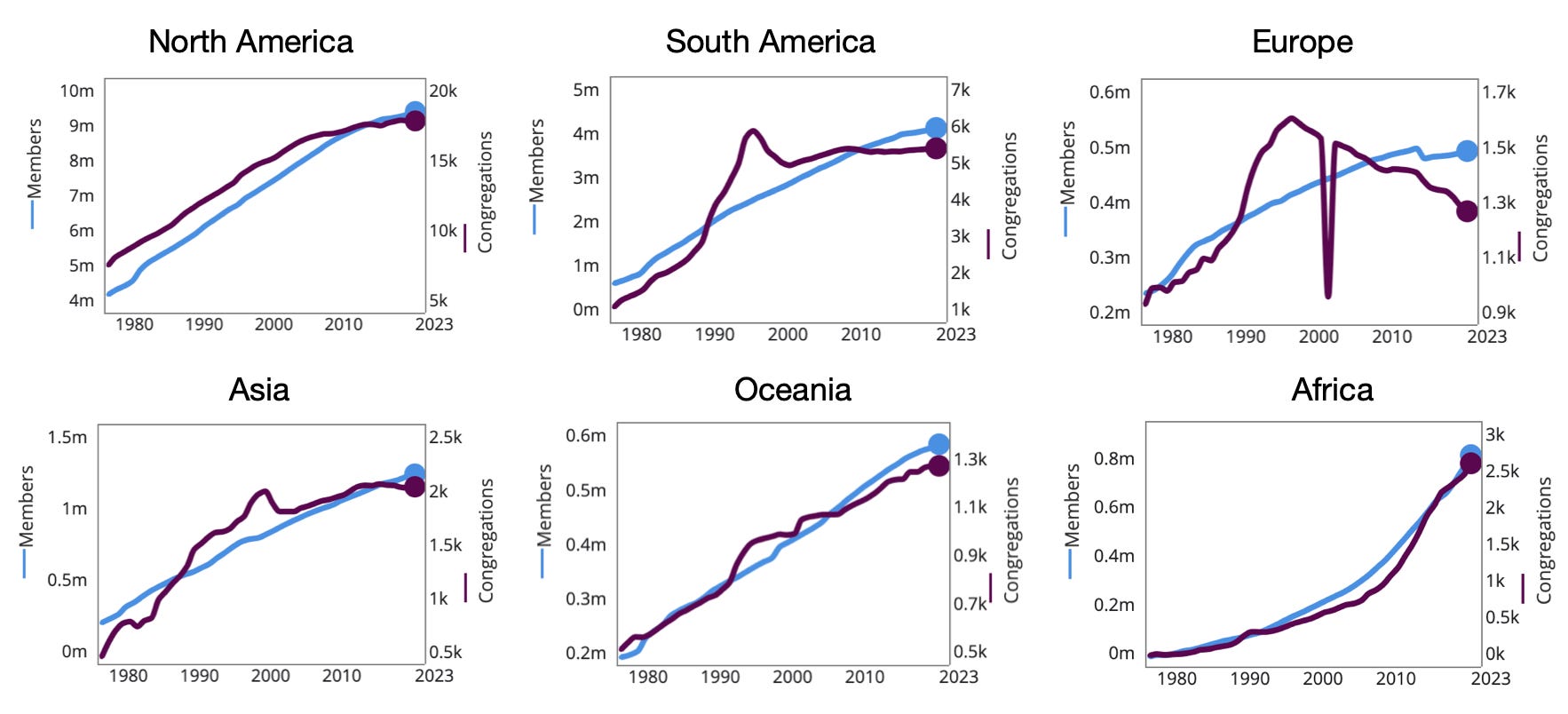
The light blue line is members and the purple is congregations. A few takeaways:
Europe! While member count seems to be leveling out, congregations which peaked in the mid 90s have starkly decreased. The outlook for Europe is not good.
We see strong growth in Oceania and Africa with congregations and members increasing pretty strongly over time (perhaps the rate of change has decreased a little in the last few years).
Membership and congregations are tapering off at different rates in most regions the last few years. To be fair, I’m not so sure how much of this is an LDS problem, but more of a “world losing interest in religion” problem.
In summary, different regions perform pretty differently overall with some tapering off common across all continents recently. The regional differences do not surprise me because of another fact I know: different regions have different levels of religiosity.
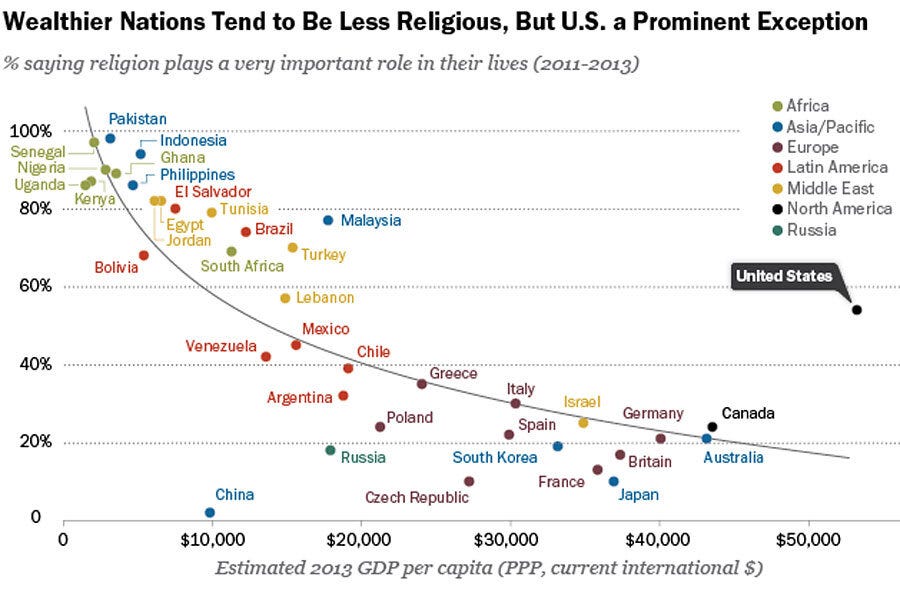
Just a quick chart showing how as nations get more wealthy, their members become less religious. But, there are also clear regional divides in religiosity (and wealth).
And, it makes sense that regions with high levels of religiosity will have more growth in Church membership because people are probable more open to joining and staying in a religion.
Discussion
What regions do you think will perform better or worse in the future? How do you reconcile the regional differences?