
Part 2: Gender, Education, And Leaving The Church
First look into the model I built predicting those who leave the Church


Introduction
Most people have a loved one who has left the church. This is article 2 in a 4 part series exploring people who leave the church. Stay tuned the next few weeks where I discuss more findings from a statistical model I built predicting mormon leavers. Next week, I’ll specifically look at how marital status & singleness plays into this conversation.
If you haven’t read the first one, here is a link:

So, what do you think from the title? Do you think men or women are more likely to stay or leave? What about more formally educated Americans? Let’s discuss.
Though first, let’s talk about methodology1. I won’t get bogged down in the details right now (that’s what appendices are for!), but I want to highlight a few important notes:
We are dealing with correlations not causal relationships. The method I used is great at controlling for certain factors to understand the impact of a particular variable of interest which is more informative than a crosstab cut, but is still not causal relationship.
This model only looks at those who self-report being born in the church. It compares those who still identify as Mormon vs those who now have stopped identifying. So keep in mind, we are not looking at converts in this analysis.
This data is from 2014. While I would love to work with more recent data (notable things have happened the last 10 years!) to get more robust estimates in my model, I decided to work with a bit older data in favor of a larger sample size.
Charts
I first wanted to look at how a person’s sex affects whether someone leaves the church. There was a small difference where males were 1% more likely to leave than females, but this is not practically significant.
When we look at education, there is a statistically significant2 decrease in probability of leaving as formal education increases. This means that if a person who is born in the Mormon church obtains a graduate degree, they are 9 percentage points more likely to still identify as Mormon3 than someone who only obtained a high school degree or less other things held equally.
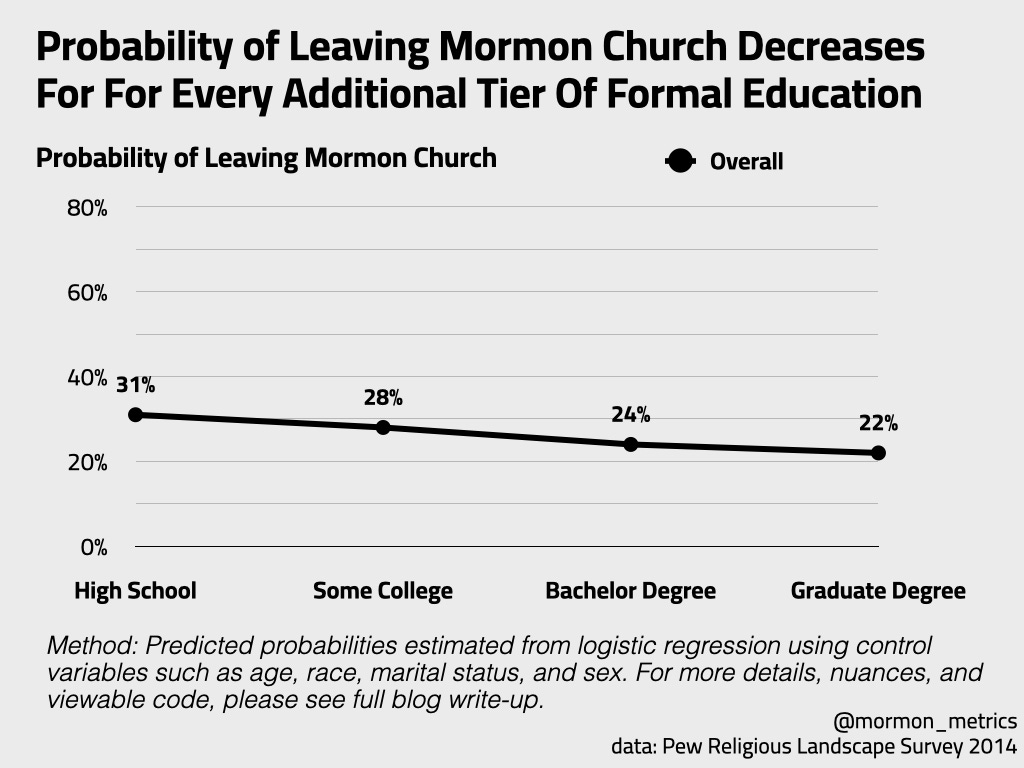
This actually tracks with some other people’s findings on how education affects religiosity. For example, Ryan Burge finds that church attendance is correlated with higher formal educational attainment consistently in the past 10 years of the Cooperative Election Study.
At this point, I was curious how other factors might affect educational attainment and leaving the church. When I tested a person’s gender, I found an interesting result
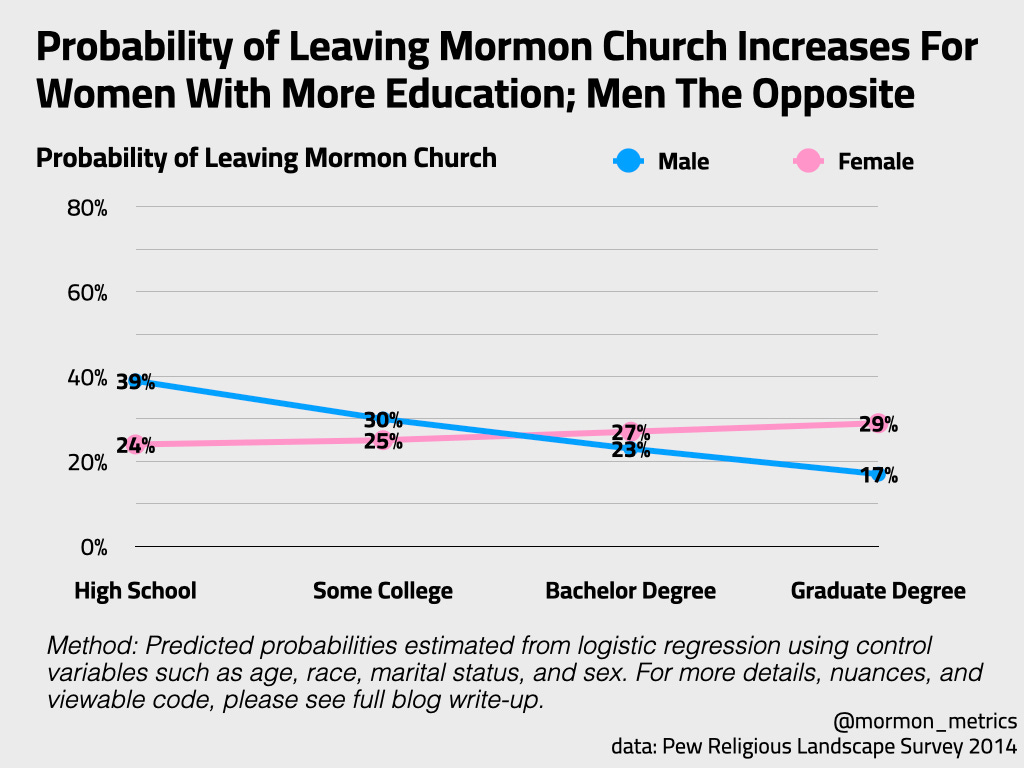
.The relationship between leaving the church and educational attainment is moderated by a person’s sex.
The less formal education a man gets, the more likely he is to leave the church (high school 39% leave VS. graduate degree 17% leave)
However, the opposite is true for females. The more formal education a female gets, the more likely she is to leave the church. The increase is modest (24% to 29%), but differs significantly from the male-education line which declines sharply. This is a statistically significant difference.
I was suspicious there might be a non-linear relationship because I know there are a lot of “some college” females that also identify as Mormon. So, just to double check my model, I plotted things out and find the same relationship when comparing the two groups.
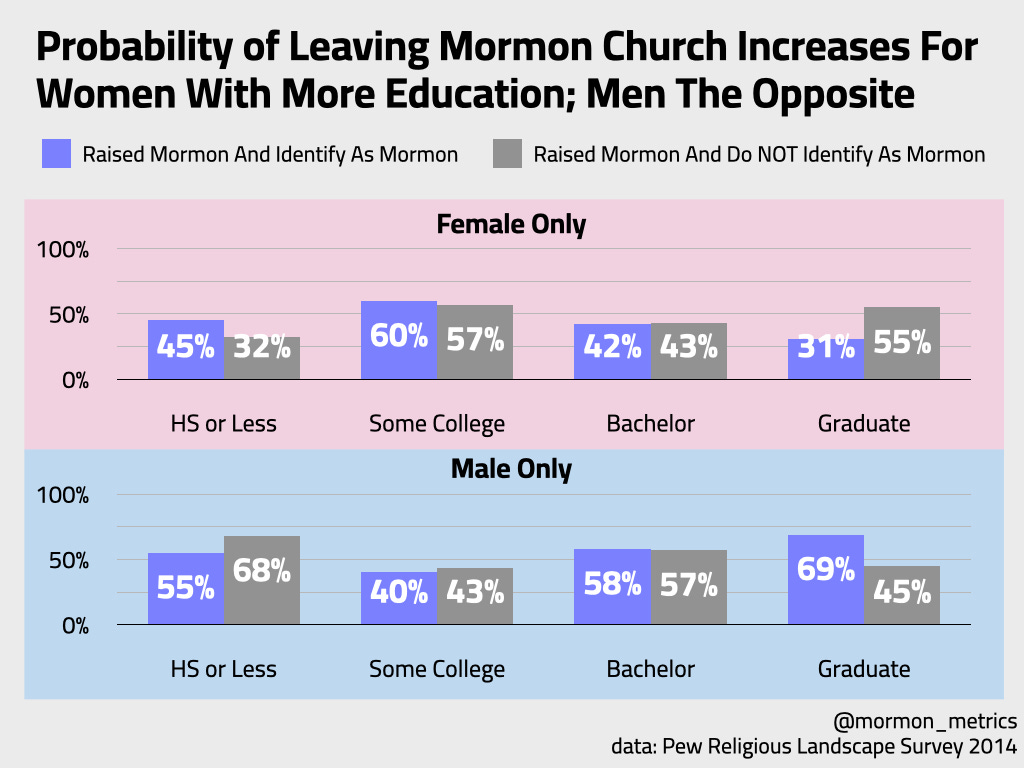
Sure enough the relationships hold, but more so for the bookends than the middle. For females, only 31% of stayers have a graduate degree compared to 55% of leavers. And for females, 45% of stayers have HS or less formal education level versus 32% of leavers. On the other hand, 69% male stayers have graduate degree vs. 45% of male leavers. 55% of male stayers have HS or less formal education level vs. 68% for leavers.
What do you think of this relationship? Can you see evidence of this in your personal experience? Any other thoughts?
Stay tuned for next week where we will discuss how marital status and singleness relate to the probability of someone leaving the church.
As I mentioned, this is a 4 part series. I will be using a few models in this series. I will include all of the code and a full statistical appendix when I release part 4 of this series.
I am using a 95% confidence level. This means I am 95% confident that as a person’s education increases it affects them leaving the church.
I use “not identifying as Mormon any more“ and “leaving the church“ synonymously in this article.