
Does College Make Mormons Liberal? Does BYU?
Looking at a large survey of college students by FIRE


Introduction
My article and my next one are about trends and ideas around mormon college students - especially at BYU. Next week, I’ll look at the “BYU effect.” How does attending BYU affect mormons church activity vs. attending a non-church-affiliated school?
The politicization of education is a very relevant to the past few years.
Recently, JD Vance said “We have to honestly and aggressively attack the universities in this country.“ Since Trump came to office, government funding has been cut/reduced to many of the US’ universities as part of this attack. The reasoning is that formal education has created liberal strongholds in their eyes.
You don’t have to look far to see ideological breaks by education. The more formal education you obtain, the more likely you are to identify as liberal.
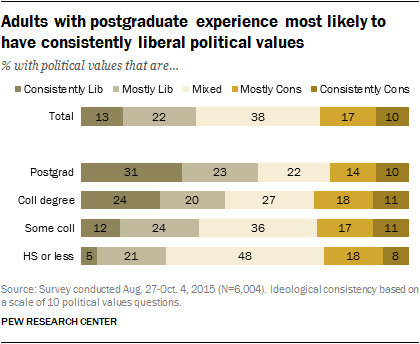
I try to be neutral and am not going to dive into arguments one way or the other, but given a recent dataset from the FIRE organization and their massive sample of ~62k college students, I wanted to dive into two questions:
Do more students become Democrats as formal education increases?
Is this relationship also true at one of the most Republican universities in America, BYU? And, what about Mormons at other universities?
Charts
Well, first let’s test one of my assertions. Is BYU actually one of the most Republican universities?
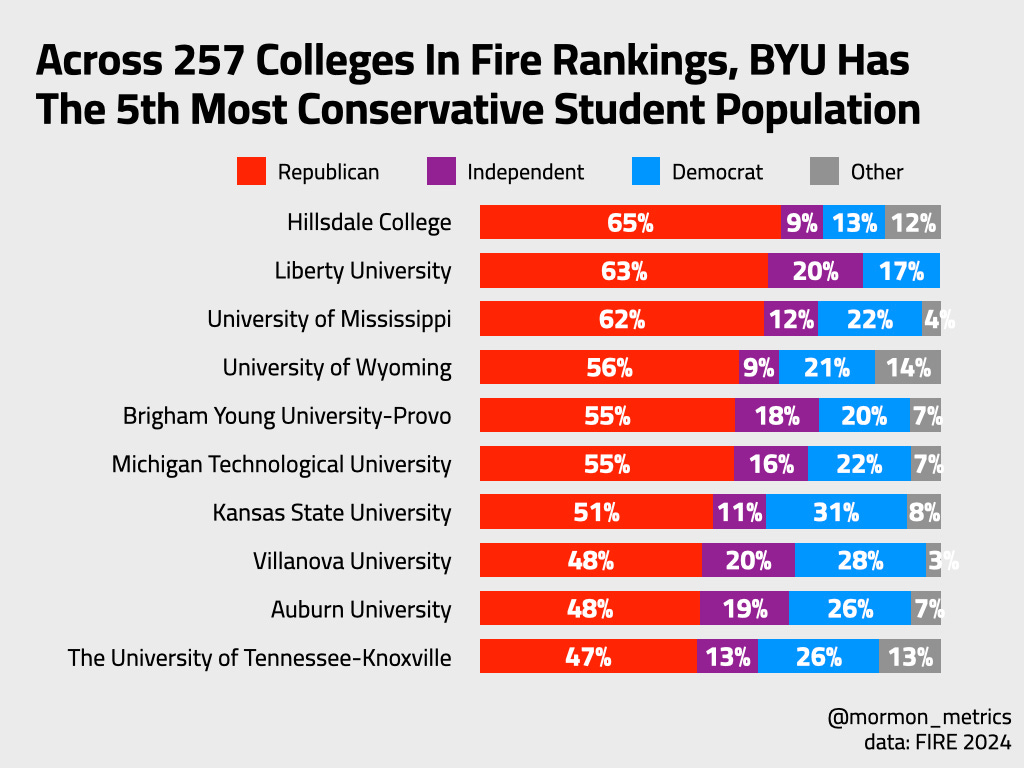
Of the 257 Colleges measured, BYU has the 5th most Republican student population. I am actually not familiar with Hillsdale college, but the other three seems like they would be quite Republican.
Note that I wasn’t able to find BYU-I and BYU-H in the dataset. But I did find Utah State and University of Utah which both had notable Mormon sample sizes.
Do BYU Students Get More Liberal?
To answer this question truly, we would want to take a group of people and randomly assign them to college or not and see how their parties changed before and after 4 years. Obviously this is not feasible, so we have to try and answer another way.
For a rougher estimate, we can just look at how college year affects party identification. If college truly makes people more Democratic, then we should see a shift the longer someone is attending.
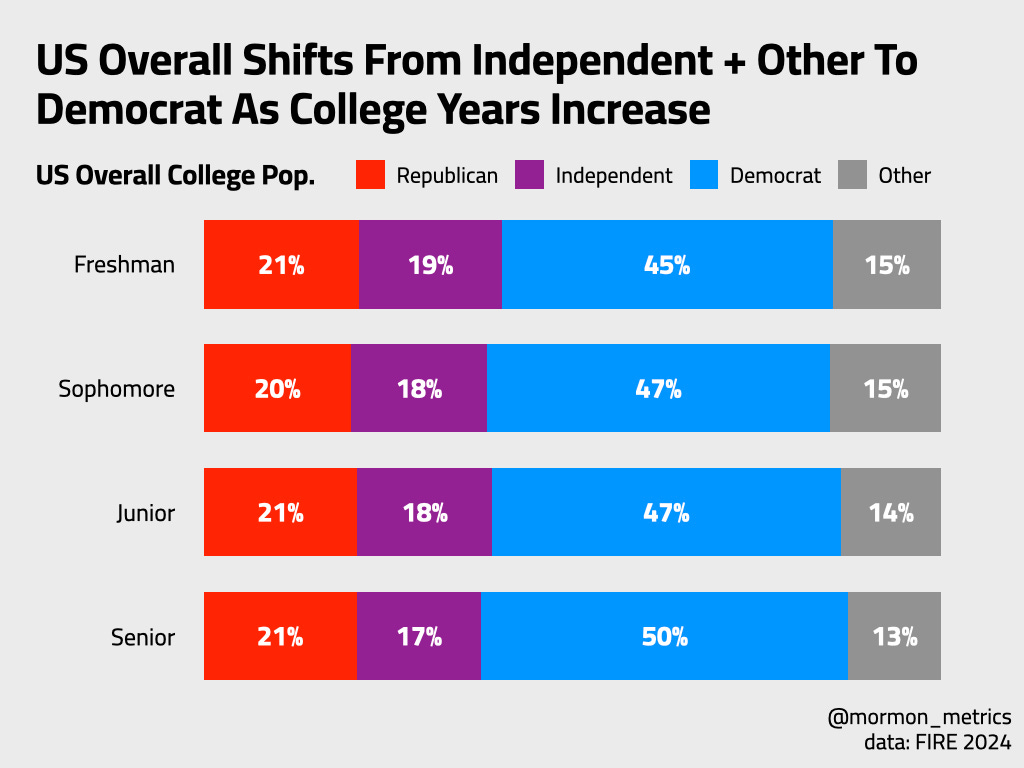
Looking at the overall numbers, we don’t see much movement only a slight shift toward the Democratic party where students move from Independent and Other to Democrat, but the Republican number stays constant.
Notice that most students coming in overwhelmingly already identify as Democrat.
Now let’s look specifically at BYU students…
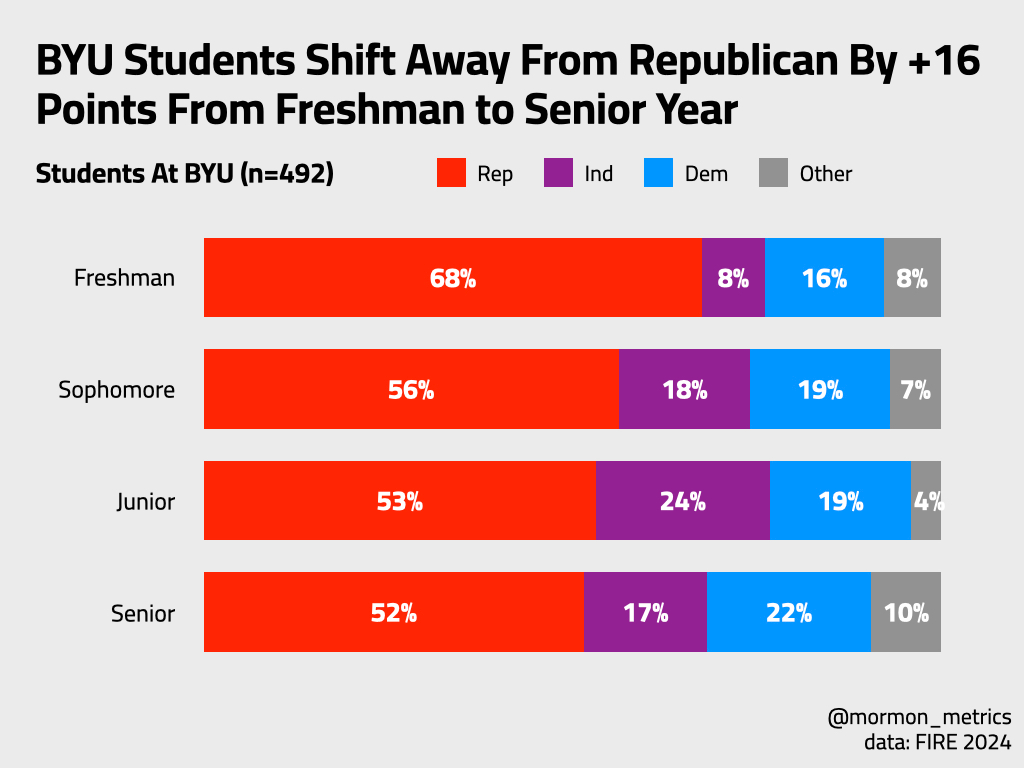
So does BYU move students to the left? The answer is YES - there is a 16 point shift away from the Republican party at BYU and it is statistically significant. There seems to be a Freshman bump that is quickly sorted into the Independent and Democrat parties. Note according to this chart, more BYU students shift to Independent than Democrat.
Also look at the HUGE difference in partyid in the US overall compared to BYU. The average college is MUCH more democratic than BYU. The parties are essentially reversed. Instead of 20% Democrat, the US overall is 20% Republican and so on.
Another interesting thing is how stable the overall college population is. There really isn’t much movement aside from a few Independent points over to Democrat as you go from Freshman to Senior, but we see a much more movement for BYU.
Now let’s look at the break of Mormons at BYU vs. Mormons at Other schools…
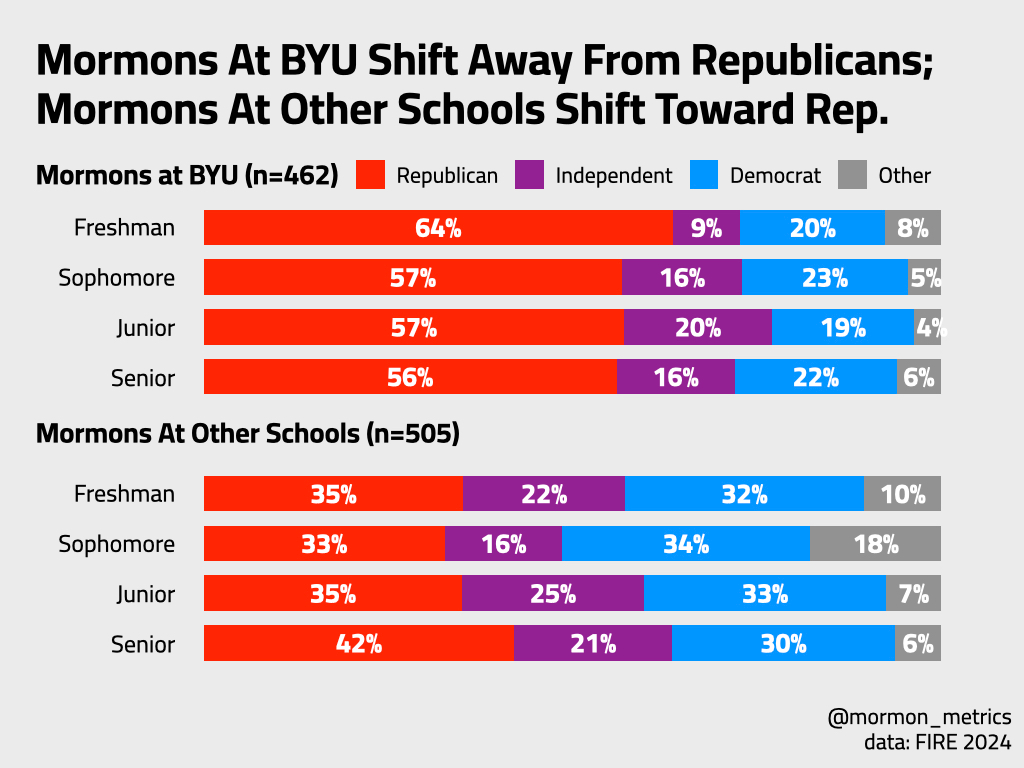
Here’s a fun headline… Mormons at BYU shift democrat, but Mormons attending other schools shift more Republican!
Why might this be the case?
Well, my theory is that perhaps in a college student’s search for uniqueness and individuality, they are pushed to disaffiliate from the majority political party. Since the college population overall is very Democrat, Mormons at other universities are pushed Republican. And, Mormons at BYU (5th most republican university in the sample) are pushed Democrat. I don’t have numbers to back this theory up; these are just my personal thoughts. Do you better theories about this?
Does Major Matter?
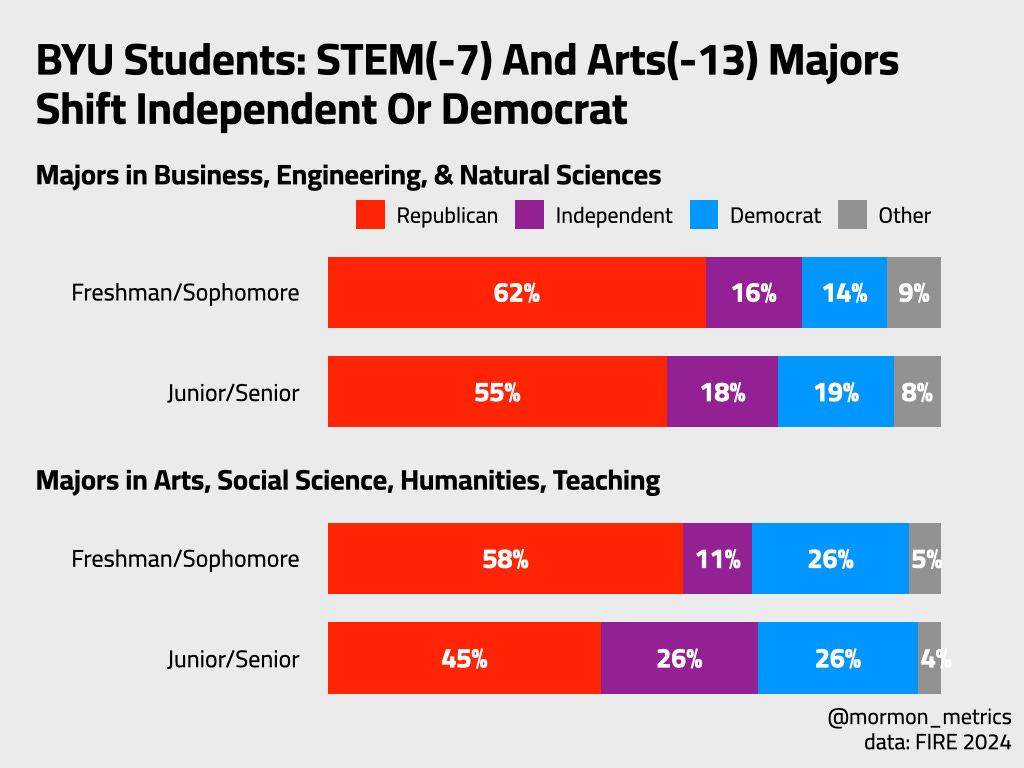
The difference is not statistically significant for Business, Engineering, & Natural Science Majors though if we had more sample it might be. For Arts, Social Science, Humanities, & Teaching, it is a statistically significant difference at the 90% confidence level.
While I would love to look at each major individually, our sample size just isn’t big enough. To help mitigate our sample problem, I collapsed the majors into two broad categories: STEM vs. Humanities and collapsed the years 2 and 2. Obviously, not all majors fit so neatly into these two categories, but hopefully it give an broad idea of whats happening.
The takeaway is that both types of majors move away from the Republican party though the humanities majors have a bigger shift.
Does gender matter?
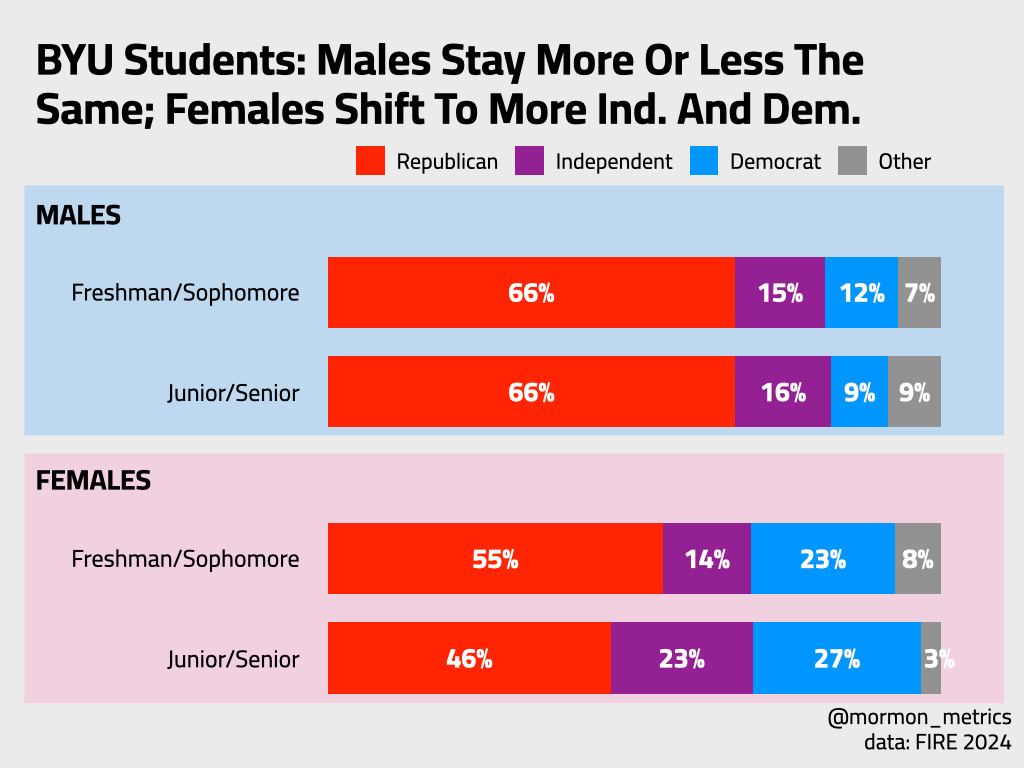
In our sample, men stayed stable over time and women changed to be more Democratic and Independent.
I wanted to understand which female majors in particular were moving so I created another table to answer my question.
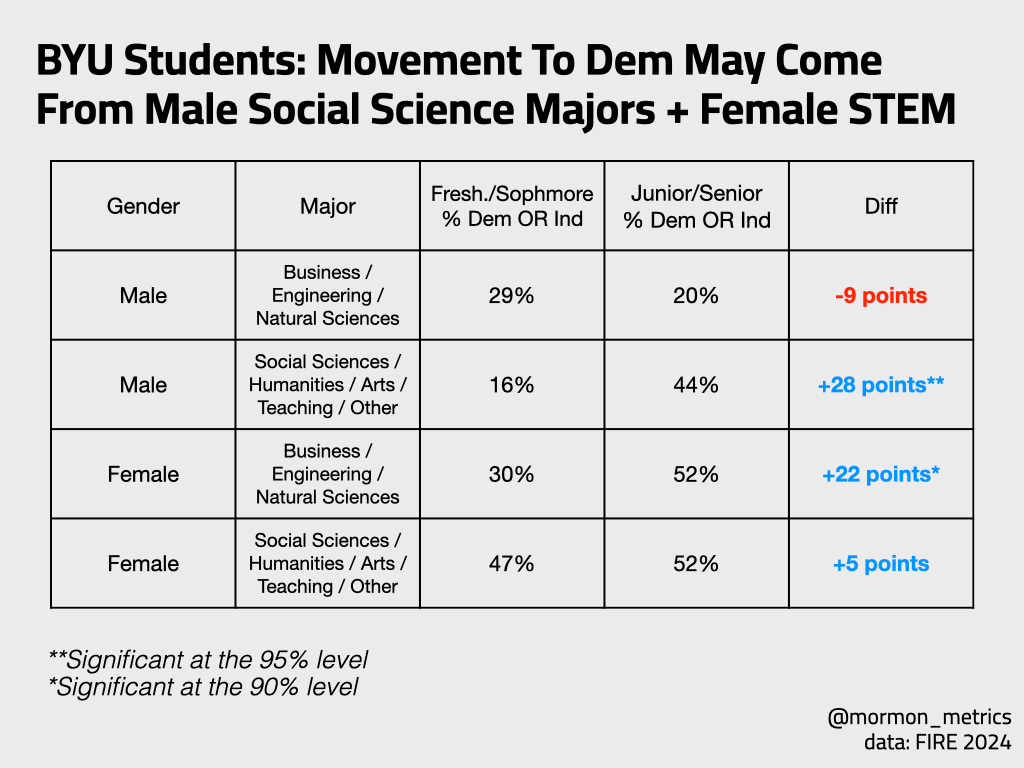
First, we didn’t see any movement in the graph before this among males and here we see a lot! What is happening? Well, it seems BYU Males are moving more Republican in STEM and BYU Males are moving strongly Democrat and Independent in Humanities, but there just isn’t as many BYU Males in Humanities (I checked and 75% of males are in STEM vs. 25% in “Humanities”). So, the male movement cancels itself out in this dataset.
The most interesting thing to me about this is… the movement toward the Democratic party among females may not be truly driven by Humanities-like majors “liberalizing“ women. Many BYU Women Humanities Majors already identified as Democrats coming in and only moved a meager 5 points which is not statistically significant. The real movement seems to be from females in STEM-like majors moving Independent and Democrat +22 points! Helpful fact: 47% of BYU women are in STEM-like majors VS. 53% of BYU women in Humanities-like majors, so much more evenly split compared to the men.
If this is true that STEM women are the biggest movers, why? Why do BYU STEM men move right and BYU STEM women sharply left?
Feel free to share thoughts and theories. Is this just a blip in the data or is there really something to the liberalizing BYU women in STEM?
Next week, I’ll examine church attendance through the school years by major, gender, etc. See you for Part 2!
Code is available here.
Love the scrambling of the standard narratives.
One not-mentioned potential factor is women experiencing discrimination in STEM fields, and becoming more liberal as a result. "Women in [technical field]" groups tend to be large and active, and to promote a narrative of solidarity which many people find compelling.
Amazing and unexpected data! Comparing the larger shift in numbers for BYU overall by year with the smaller shift for LDS at BYU, can I conclude that the non-LDS at BYU are shifting Republican to Democrat at a much higher rate than the LDS students?