
Now Lets Predict Who Converts Mormon
Combining Pew Religious Landscape To Predict Mormon Converts


Introduction
Well at this point, we’ve had a decent look at active and less active members. So, now let’s look at converts!
Here is a link to the leavers analysis if you have yet to see it:

I would have included this in my previous analysis, but I honestly didn’t realize I had the data for converts. It makes sense, right? If we have the break of people who grew up in the church, we also have the people who didn’t grow up in the church - the converts!
This, of course, is not going to be a perfect measure of converts. In a perfect world, we would have survey data on converts the year that they join. For example, a person who converted at 18 may say that they were raised with no religion, but they are now 50 years old taking the survey and they look and act very similar to a person raised in the church. So this is a caveat to this analysis… We don’t know when they joined - only that they say they were raised a different religion. Also, remember this is just data in the US. Not outside.
Charts
First, let’s get an overall picture of the converts that identify as Mormon in the survey. How big is this group?
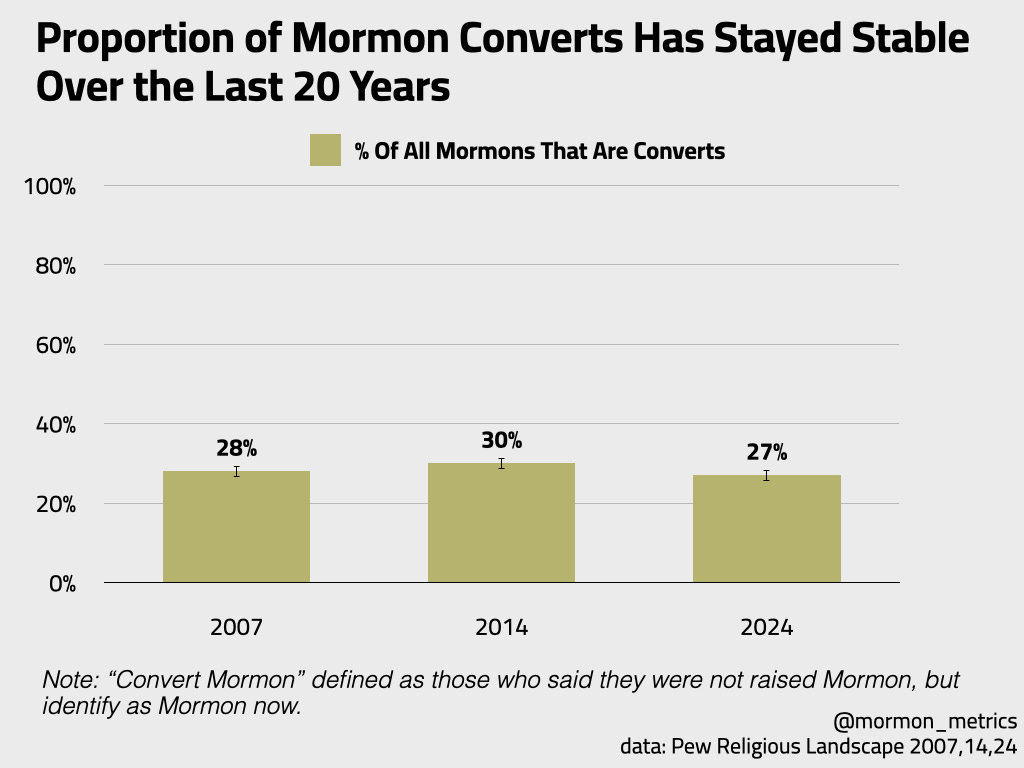
We see the proportion of converts has stayed quite stable the last 20 years. There are likely more converts than this 27%, but perhaps some have gone less active don’t consider themselves Mormon any longer.
In the chart below, there were only ~150 converts, so to boost the sample size and give us better estimates, I decided to combine the 2024 wave and 2014. With both samples, we have 350 converts.
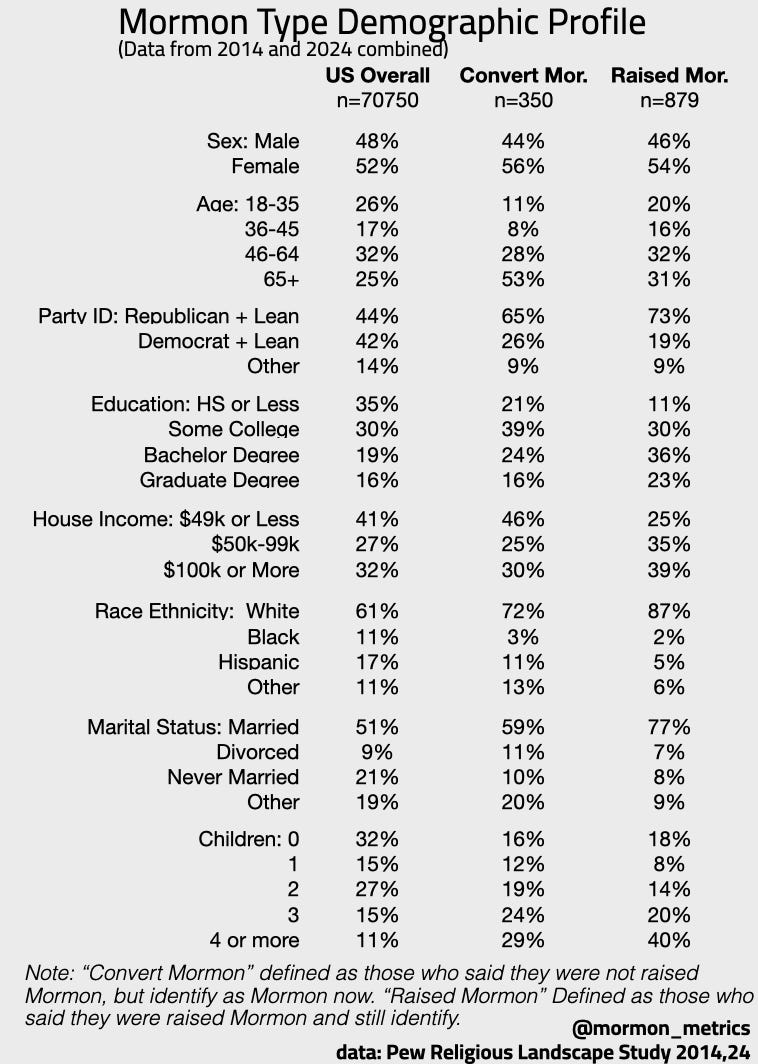
Let me point out a few things I noticed…
There is a large age gap. Older people are more likely to be converts. Unlike the other demographics, the converts are older than both the Mormon population and the US population.
In other ways, the convert population seems to be a mid point between the US overall and the raised Mormon group. Race, marital status, and education are examples of this.
Converts, while middle of the road in education, seem to be lower earning than both the US population and those raised Mormon.
When looking at number of children and Party ID, converts tilt much more toward the raised Mormon population than the US overall. People generally don’t change political parties very often, so to me this suggests that Republicans are more likely to convert.
One thing I would have loved to look at more, but Pew doesn’t release the data yet (could be personally identifiable) is a state breakdown. For example, if someone lives in Utah are they more likely to be a convert? After a certain amount of time, Pew will release this data for the 2024 dataset. Maybe I’ll revisit the question at that time.
I did run a model for predicting converts and made a few charts. Though, the findings aren’t terribly different than the crosstabs above (with the exception of this first one below). Even so, I'll go over what I found.
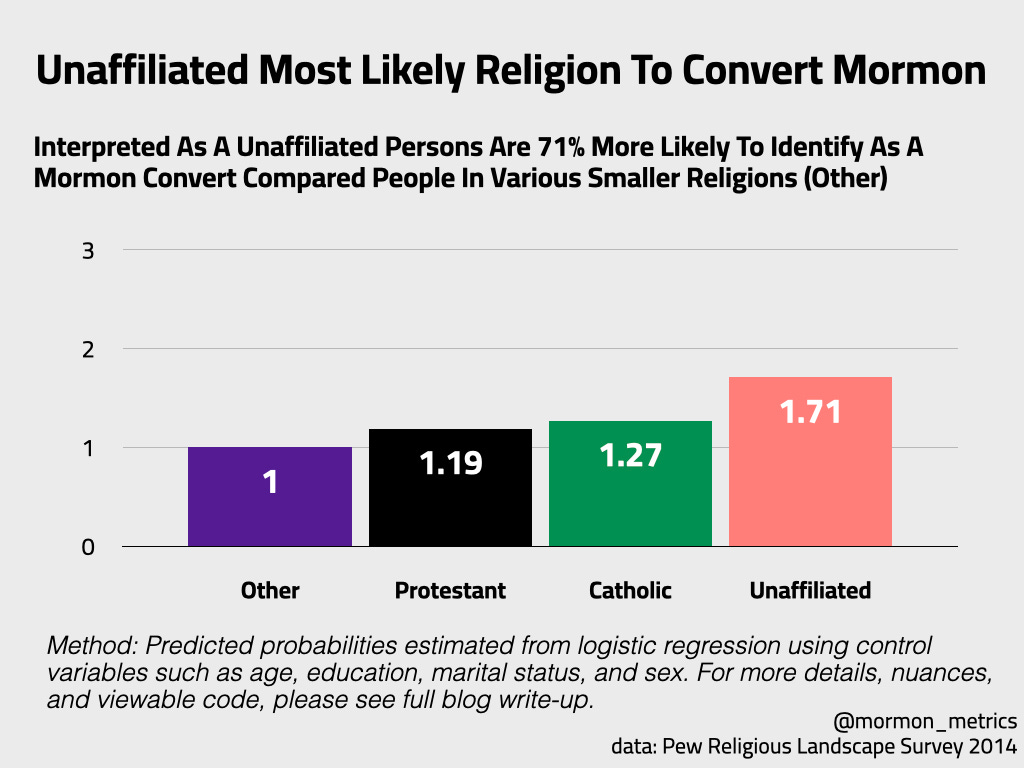
Methodological note for those interested: These are ratios because I thought it was the best way to visualize the relationships. Because there are so few Mormon converts in the sample, the dependent variable was unbalanced (vs. the 60k+ that did not convert to Mormonism) and in order to get a good read on people who convert and don’t convert, I downsampled the non-converts to be equal with the converts. This made the predicted probabilities much higher than they would have normally been and I didn’t want to be misleading by reporting the modelled probabilities, so I transformed them into ratios. This way we can still see the relationships, but don’t get distracted by the probability number (e.g. 50% of unaffiliated are modelled to convert Mormon which is obviously not true. The actual probability is like 0.05% or something).
I did look at former religions and found that controlling for other factors Unaffiliated individuals have the highest probability of joining the church as converts. This is actually good news for Mormons! This group has been growing in the US population the last 20 years.
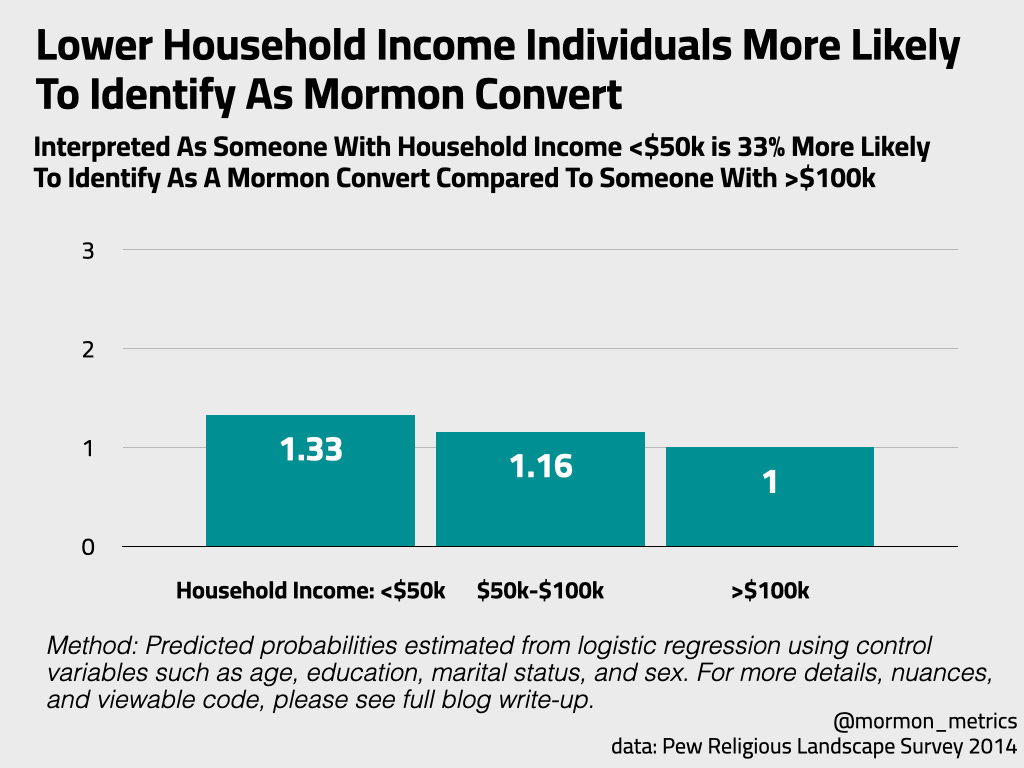
I will note that all of the relationship depicted in modelling charts are statistically significant relationships at the 95% confidence level.
As we saw in the crosstabs, lower incomes are more likely to be converts.
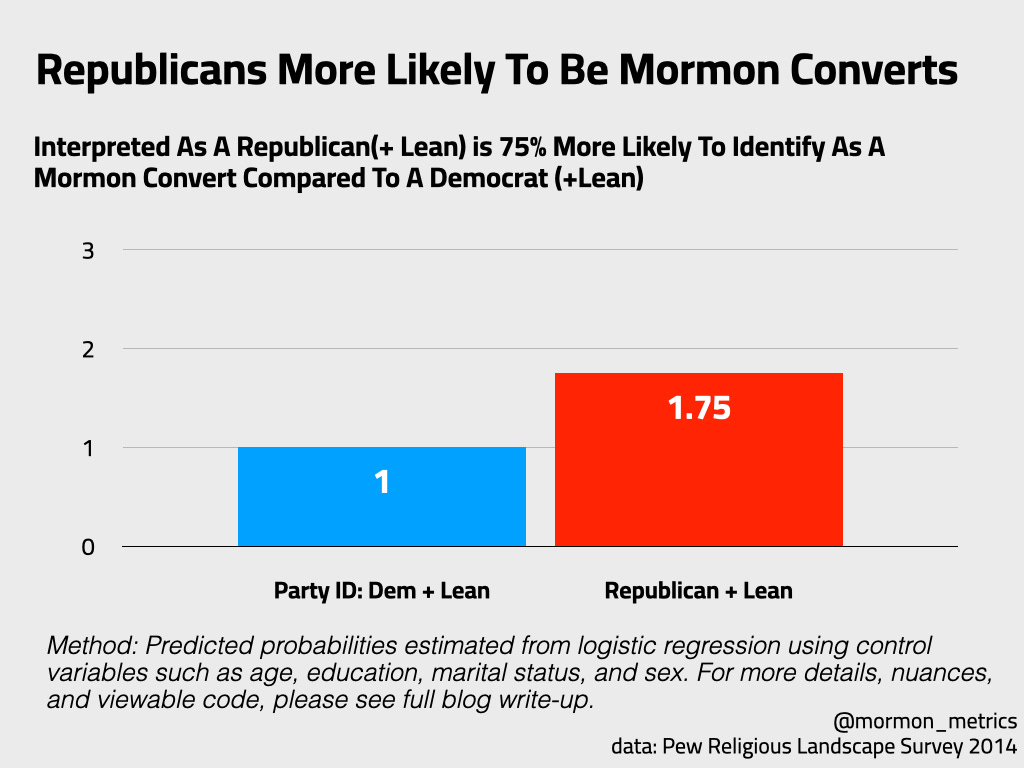
Party is a big influencer with 75% higher chance of identifying as a Mormon convert if you are Republican.
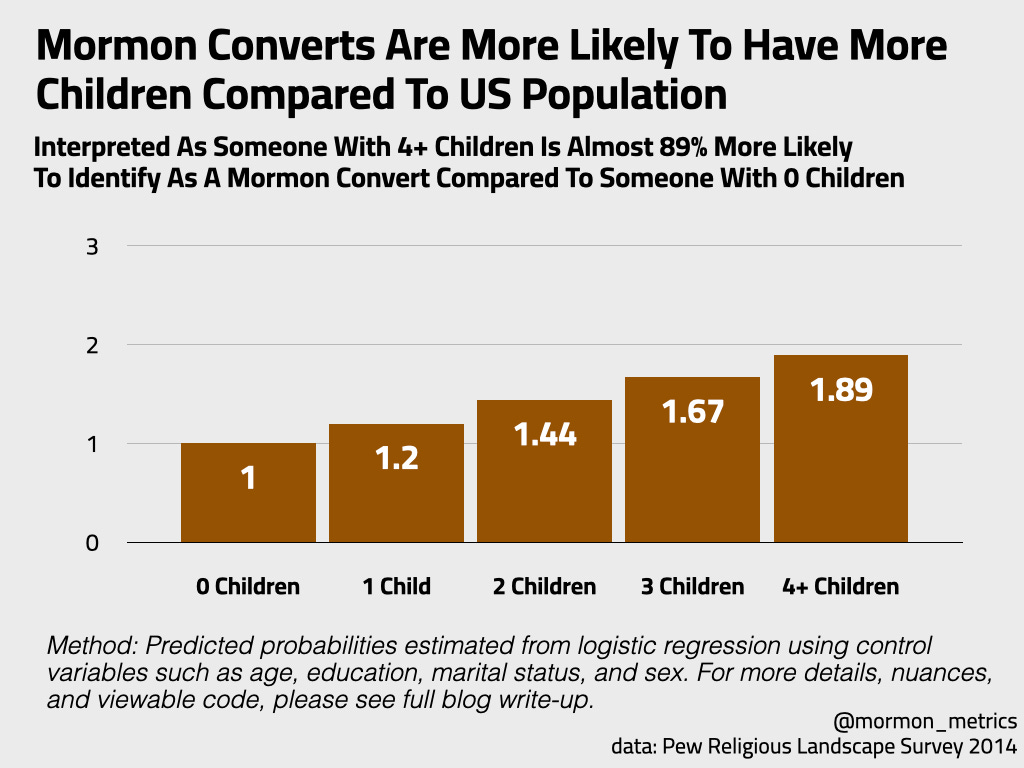
The last chart I’ll show is a break by number of children. The more children you have the more likely you are to be a Mormon convert. This is unsurprising to me as bigger families can find easy community in the Mormon church. Also, children are known to be associated with higher church attendance etc.
One variable that wasn’t significant in the model was the age variable. We did see an old convert sample, but when controlling for other demographic factors age didn’t play a role.
Conclusion
So what do I get out of this?
The convert population is a midpoint between the US population and the Raised Mormon population in many ways.
There is some evidence that converts look a lot like “raised Mormons” being much more republican and having bigger families than the US population. In other ways, maybe less so (i.e. lower income).
One encouraging thing (and surprising) for Mormons in this data is that unaffiliated people are the most likely to join the Mormon religion. Mormons and unaffiliated have an interesting relationship. Mormon leavers are most likely to join the unaffiliated group and the unaffiliated are the most likely group to be Mormon converts.
Any of you have theories on why this might be?
Code available here.