
Mormons Move
Looking at Mobility Data and Latter-day Saints Using the General Social Survey

Introduction
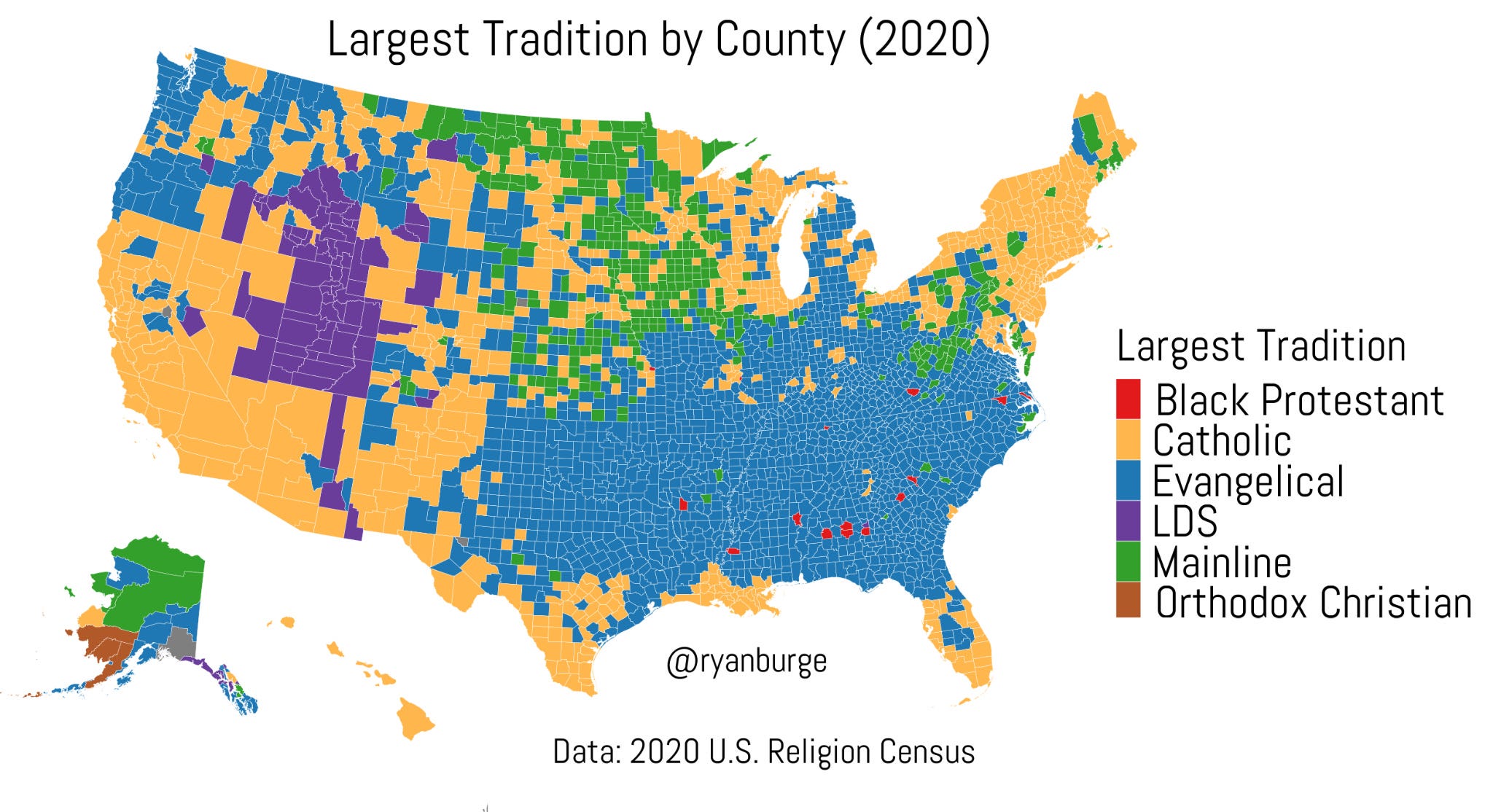
If you asked an American to guess which religious groups in this country stay closest to where they grew up, the intuition runs in one direction: Catholics in Boston and Pittsburgh, Lutherans in the Midwest, Baptists in the South, Mormons in Utah. Each tradition seems anchored in a denominational geography that has barely shifted in a century. Of all those groups, Mormons might be the most place-bound of all — specifically thinking about the historic gathering doctrine to the Mountain West heartland.
The data doesn’t say that. By the General Social Survey’s standard migration measure — comparing where someone lived at 16 with where they live now — Latter-day Saints are among the most likely Americans to have left their home Census region and now live in another. They’re more mobile than Presbyterians, substantially more mobile than Catholics, Lutherans, and Baptists, and statistically indistinguishable from the groups most likely to move in the country: Jews and Episcopalians.
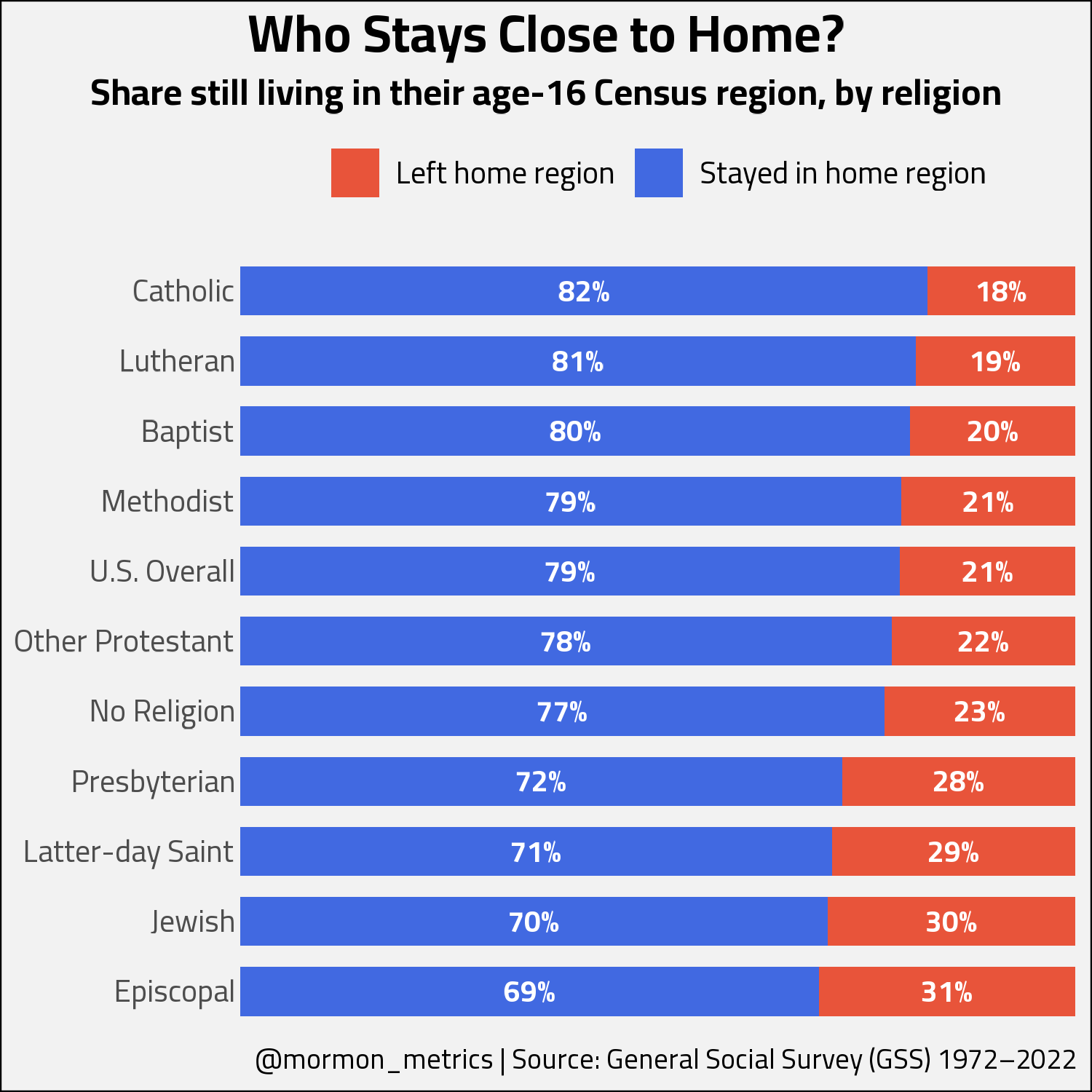
29% of LDS respondents in the GSS now live in a different Census region than the one they lived in at 16. The U.S. average is 21%. Mormons are eight percentage points more mobile than the country at large, sitting alongside Jews (30%) and Episcopalians (31%) at the top of the religious mobility distribution.
It isn’t an education artifact
The obvious skeptic move is to explain this away by composition. Mobility correlates strongly with education — college graduates move for school and jobs at higher rates than non-graduates do. If LDS members had unusually high college attainment, their mobility might just be tracking that, not anything distinctive to Mormonism. Jews (52% with a bachelor’s degree or higher) and Episcopalians (43%) are exactly the kind of high-education groups that should look mobile for non-religious reasons.
That explanation doesn’t survive the data.
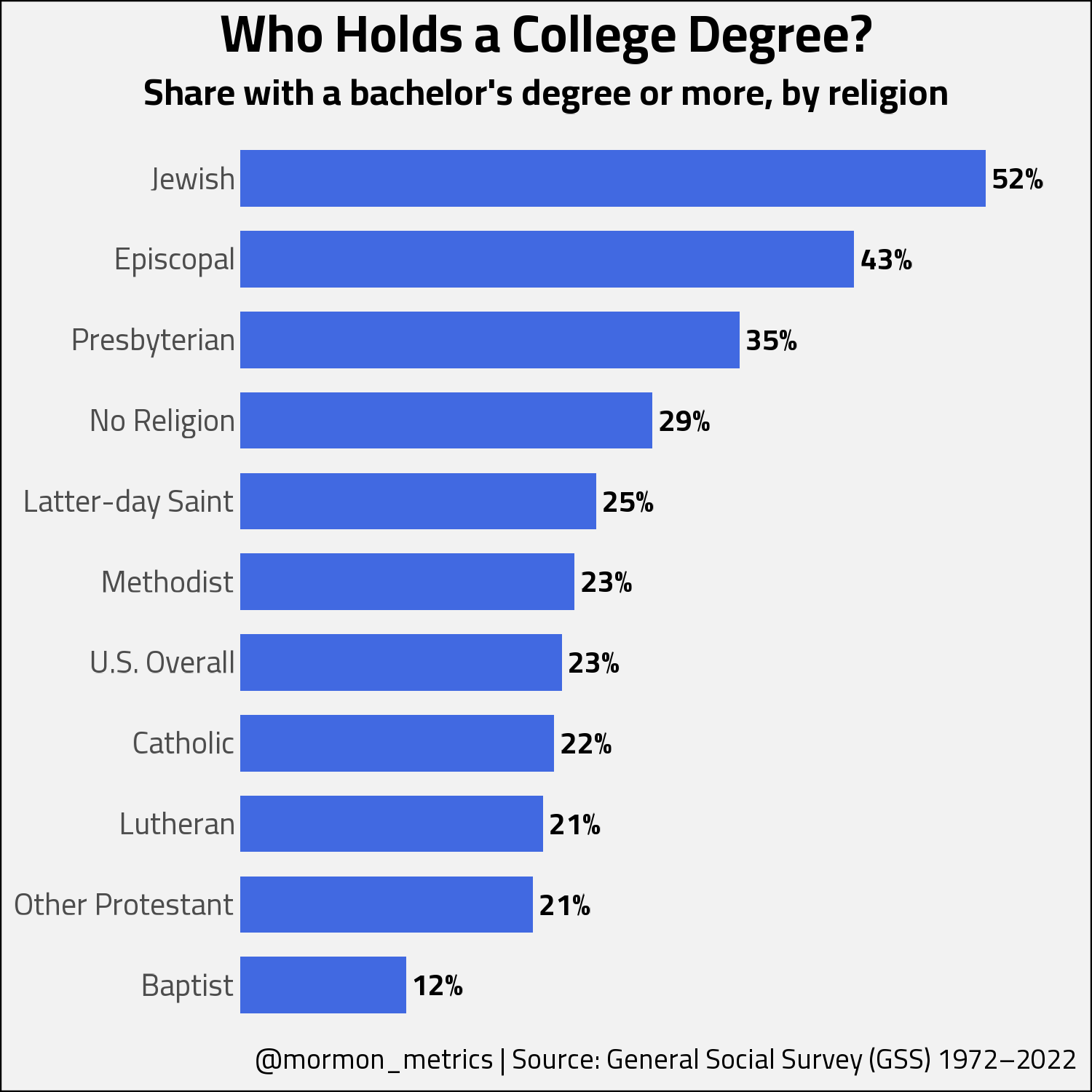
25% of LDS respondents in the GSS hold a bachelor’s degree or higher. The U.S. average is 23%. That’s a two-point difference. It can’t explain an eight-point gap in mobility. By their education profile alone, LDS members should look like Methodists or Catholics on the mobility chart — instead they look like Jews and Episcopalians.
Something specifically Mormon is producing the mobility pattern. The most plausible candidate, and the one the maps below support, is the Mountain West itself — a cultural-religious center of gravity that pulls LDS members across the country into and out of one specific corridor with unusual force.
The mobility runs through one corridor
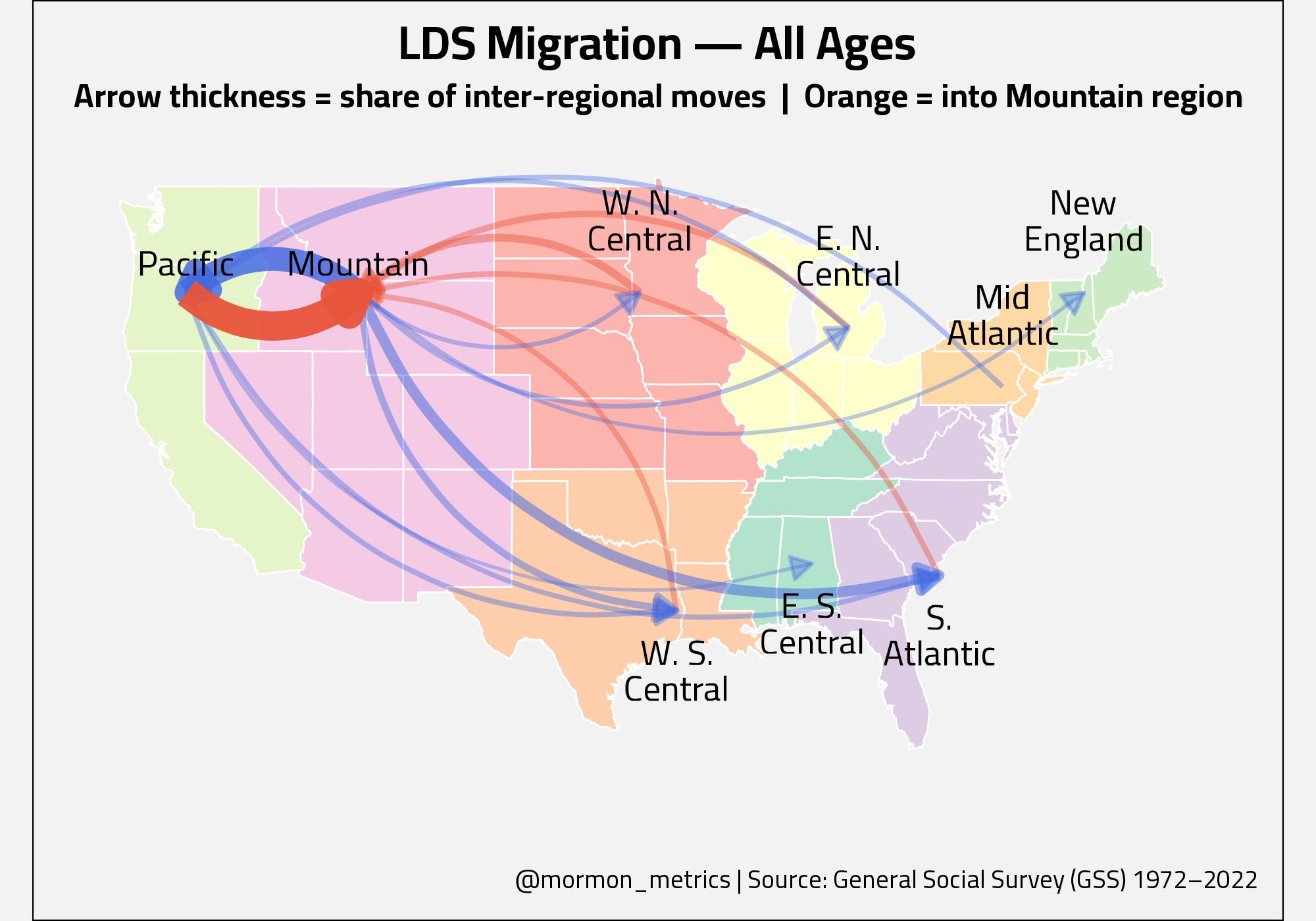
When you look at where LDS members actually move, the picture is dominated by a single channel: the Pacific–Mountain corridor. California, Oregon, and Washington feed Utah, Idaho, and Arizona at a rate that dwarfs every other inter-regional flow on the map. The orange arrow from the Pacific into the Mountain region is the single thickest line in the data. The blue arrow returning from Mountain back to Pacific is the next-thickest. Other corridors — Mountain to Texas, Mountain to the Southeast, Mountain to the Plains — exist, but they’re a clear tier below.
This is what makes LDS mobility distinctive even within the high-mobility religious cluster. The movement isn’t dispersed across a network of destinations. It’s concentrated in one east-west channel between the Pacific Coast and the Mountain West, with a handful of secondary flows.
As a side, there is an often touted proportionally higher LDS presence in DC and in our map above the thickest outflow arrow from the mountain region (other than the pacific) is to the region where DC is.
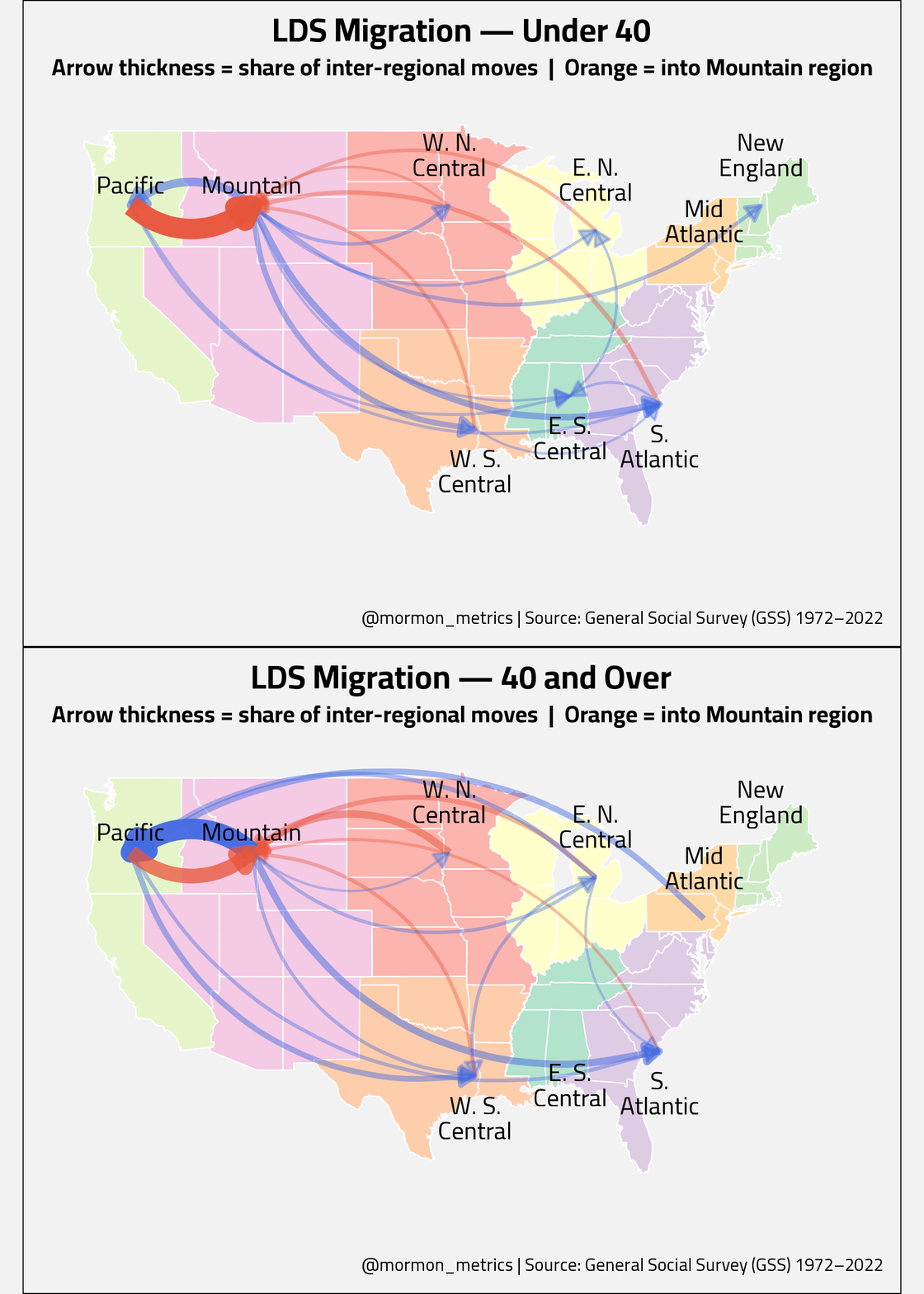
The movement to and from the mountain region is not mysterious. The Mountain region contains the LDS cultural and religious heartland, the church’s headquarters, and two of the largest LDS-affiliated universities in the country (BYU-Provo and BYU-Idaho). The Pacific region contains the largest LDS diaspora outside the heartland. Movement between the two is a structural feature of how American Mormonism works. In the gif above, you can see younger LDS are more likely to have moved to the mountain region (particularly from the western coast) showing movement likely driven by folks going to school, but there's more going on as well with the younger group moving.
The pattern holds across education
It would be tempting to read the Pacific → Mountain inflow as mostly a BYU story — young members from the West Coast diaspora moving to Utah for college, with most of the corridor’s volume explained by the LDS higher-ed system. The education-split maps don’t support that.
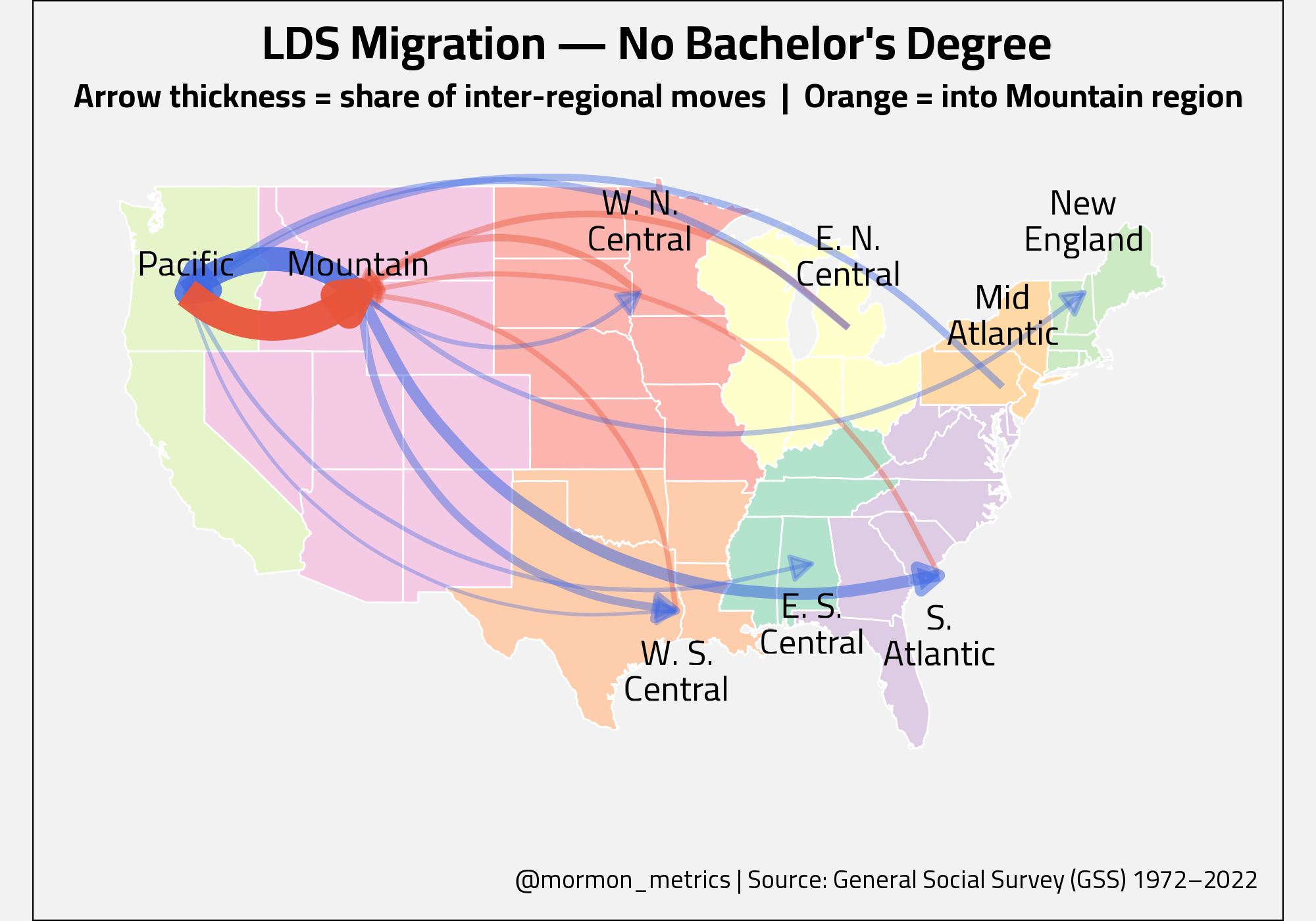
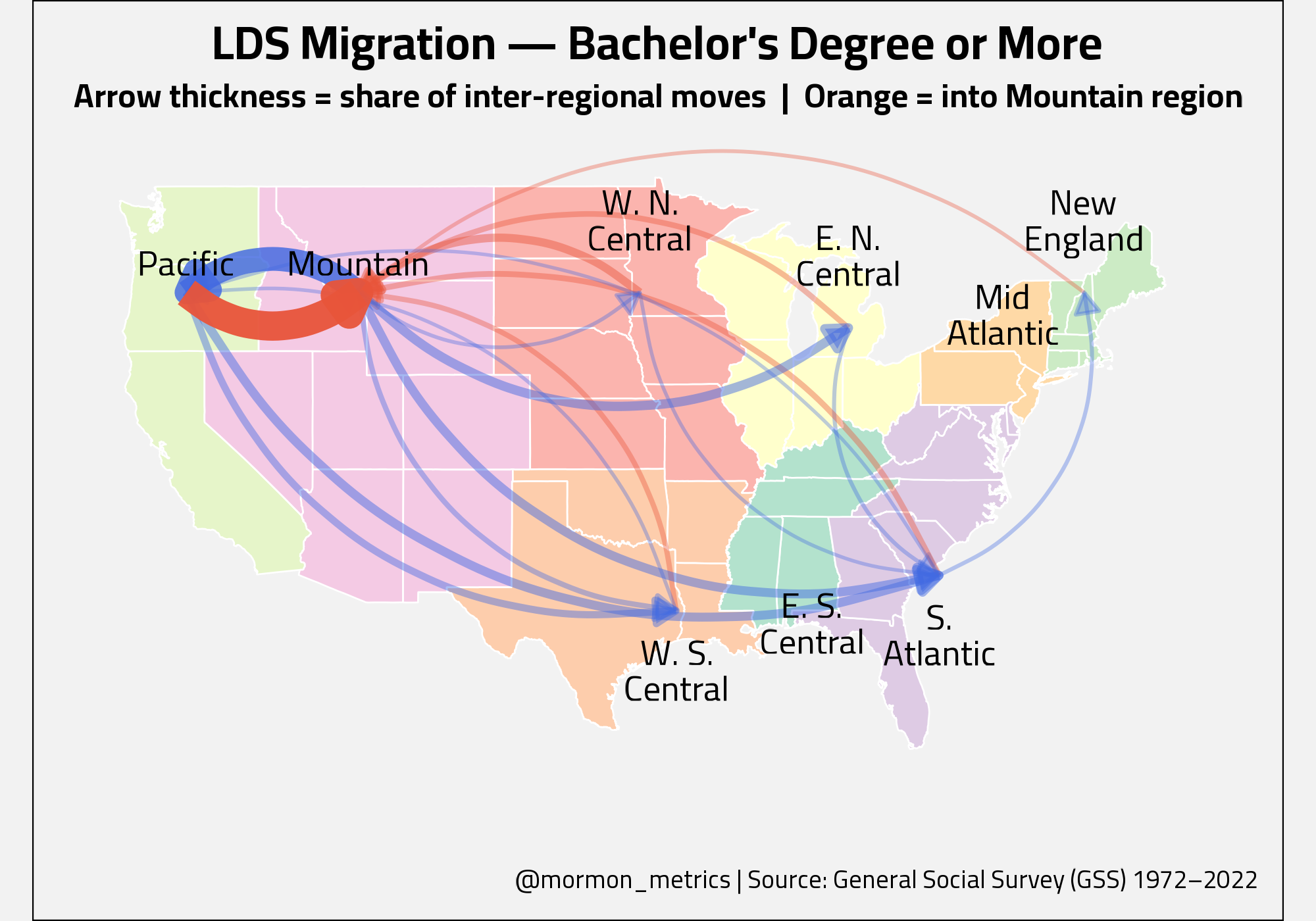
The Pacific → Mountain inflow is thick in both groups. The outflow pattern from the Mountain region — back to Pacific, to Texas, to the Southeast, to the Plains — also looks broadly similar across the two maps. LDS members move into and out of the Mountain region from California, Oregon, and Washington at comparable rates whether or not they hold a bachelor’s degree. Whatever is pulling members westward is operating across the educational spectrum, not exclusively through the higher-ed system.
That’s a useful clarification on its own. It means LDS migration into the Mountain region isn’t best understood as an artifact of religiously-affiliated higher education. It’s a broader cultural-religious pull operating across the educational distribution — some mix of marriage migration (my number one theory), family relocation, post-mission stays, convert moves, parents following adult children, and yes, college migration, but not college migration alone.
Caveats worth naming
A few honest notes before drawing conclusions:
The GSS doesn’t ask why anyone moved. Reading the Mountain corridor as a “gathering” rather than a generic mobility pattern is an inference from the direction and magnitude of the flows, not something the variable itself confirms. Other interpretations are available, though most of them would still locate the Mountain region as the center of the pattern.
The nine Census divisions are coarse. The Mountain region bundles Utah with Arizona, Nevada, Colorado, and Idaho. The gathering interpretation is strongest for the Utah- and Idaho-anchored share of the Mountain flow, weaker for the rest of the region.
The education maps pool all ages. The “no bachelor’s” group includes current college students who haven’t graduated yet — a 19-year-old at BYU shows up here, not in the BA+ map. That likely inflates the no-BA Pacific → Mountain corridor somewhat. The headline finding — that the corridor exists in both groups — almost certainly holds, but the precise comparison of the two maps comes with that asterisk attached.
What the data says
Take the findings together. American Mormons are unusually mobile by U.S. religious standards. That mobility is not an education-composition artifact — LDS members are only two points above the national average in college attainment, but eight points above the national average in inter-regional mobility. The mobility runs heavily through a single corridor connecting the Pacific Coast to the Mountain West. And the corridor is stable across education levels: members move into and out of the Mountain region at comparable rates whether or not they hold a bachelor’s degree, which means the gathering can’t be reduced to a college-migration story.
A majority of LDS members still live in the region they grew up in, and Mormonism’s geographic identity is genuinely anchored in the Mountain West. But the share that has left is unusually high. Nearly one in three LDS members lives somewhere meaningfully different from where they grew up — a rate several points above the U.S. average and substantially above every major Christian denomination in the GSS.
Do you have thoughts and theories about Mormons and migration? Share them below!
Edit: I had an ask about how the general population moves out of the pacific region vs. how LDS move out of the pacific region. I thought more of you might have this question (everyone always talks about the “california exiters”) so adding a little blurb at the end.
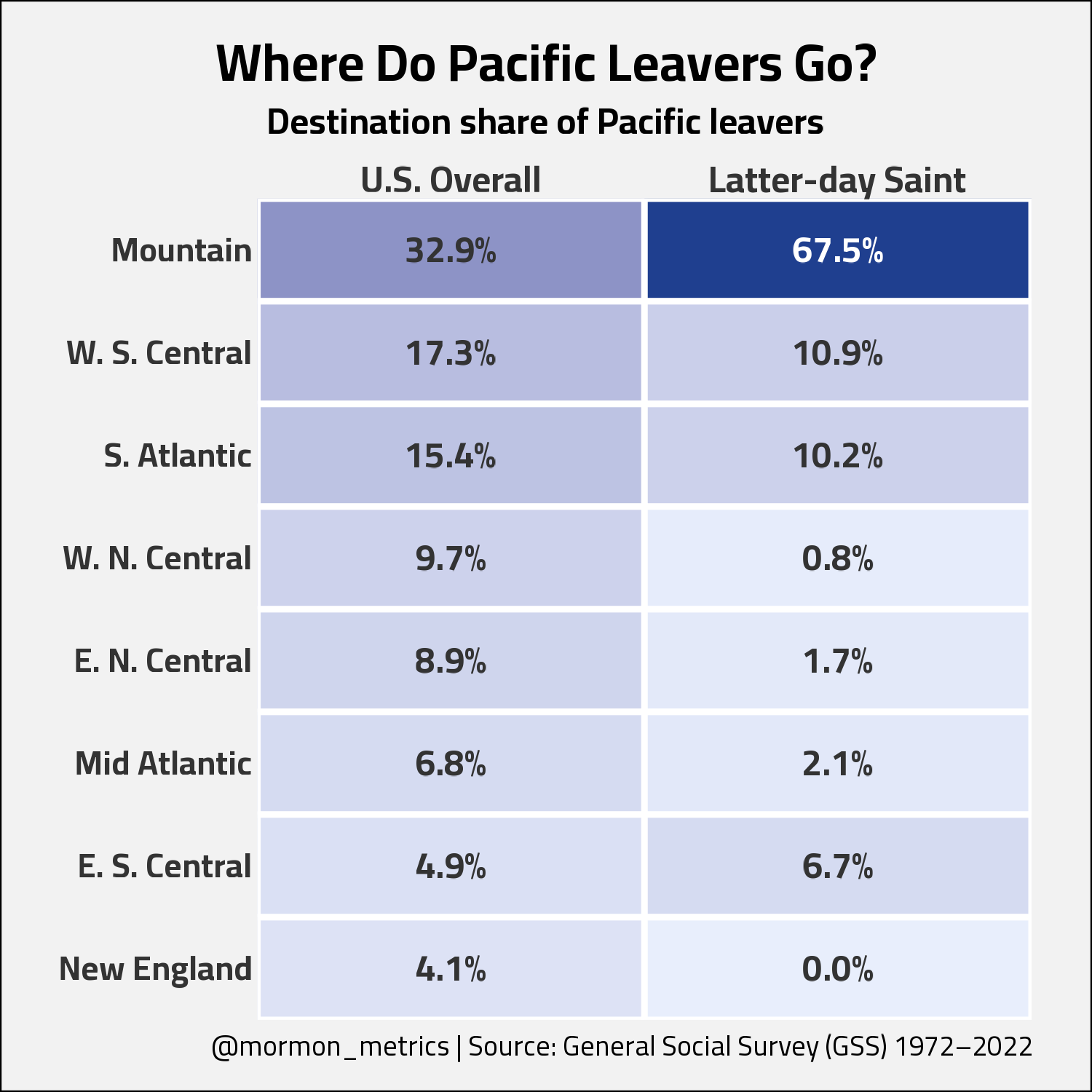
What I found is it is common for Pacific region migrators to more to the Mountain region, but LDS are much more likely to migrate there from the pacific region.
Data: General Social Survey, pooled 1972–2022. Sample restricted to respondents identifying as LDS for migration maps; all religious groups for the comparison bar charts. Migration measured as Census division of residence at age 16 vs. current Census division. Education cut: bachelor’s degree or higher vs. less than bachelor’s.
.
Well, these arrows predict me perfectly.
Awesome stuff Alex! Those migration maps are really cool!