
Mormons Are Now Politically Closer to Catholics Than Evangelicals
A new analysis of 60,000 US respondents reveals the "Religious Right" is fracturing—and Mormons are drifting toward the institutional center.

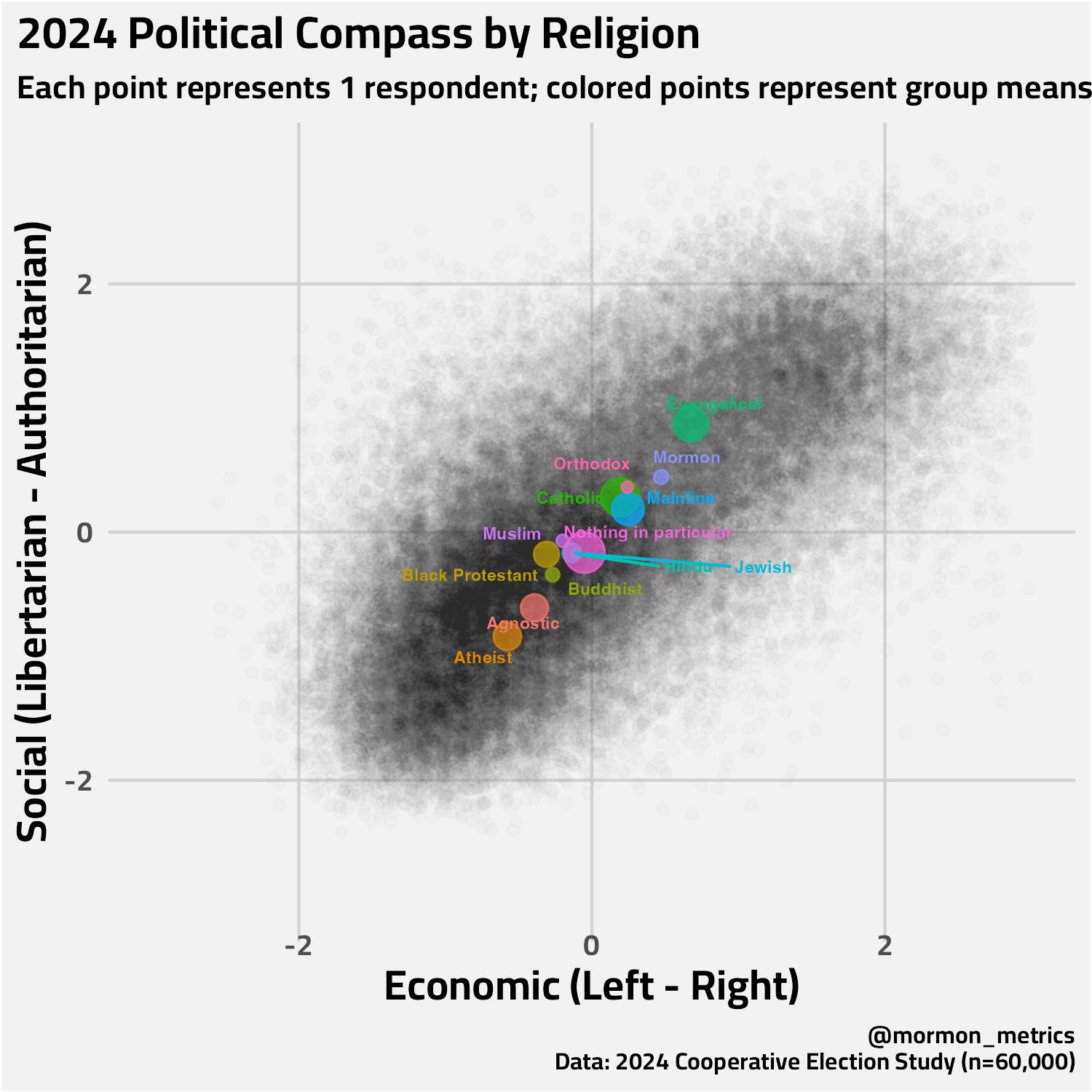
Introduction
So, you’ve probably seen a political compass floating around online. I view it as an attempt to move beyond simply Republican and Democrat dichotomy and see more nuance in political beliefs. The beliefs are divided onto two axises: Social and Economic. Social refers to positions on social issues (should we legalize marijuana? abortion?) and economic is exploring preferences on government size and economic regulation. An individual is then placed into 1 of 4 quadrants: Progressive(bottom-left), Conservative(top-right), Populist(top-left), and Libertarian(bottom-right). I am always supportive of projects like these that dig deeper. You can take a political compass test and find your own placement on it.
My question was what if we try and plot the US electorate on a political compass using survey data and then find the average respondent by religion using the most recent, highest powered data available. So, that’s what I’ll be writing about today.
I’ll list a few takeaways upfront…
In 2024, the avg Mormon is ideologically closer (with respect to politics) to the avg Mainline Protestant or Catholic than the avg Evangelical Protestant as seen in the political compass chart.
There are more than twice the progressive Mormons vs. progressive Evangelicals. Progressive Mormons are more likely to be younger and more likely to be female.
Zooming in on the conservative quadrant, Mormons are more likely to be religious libertarian and establishment republicans than populist republicans.
Method
I divided 66 political questions asked in the 2024 Cooperative Election Study (n=60,000) into social or economic attitudinal categories. I recoded each question to point in the proper direction, then I averaged and normalized them by the two dimensions. I plan on writing at least one more post using this data at which point I will release all the code and variables I used. If you are curious about the questions before then, feel free to peruse around the 2024 CES questionnaire and if its a political attitudinal question, I most likely used it.
To find each religious mean, I used a weighted average of both dimensions by religion.
Charts
Overall Talking Points
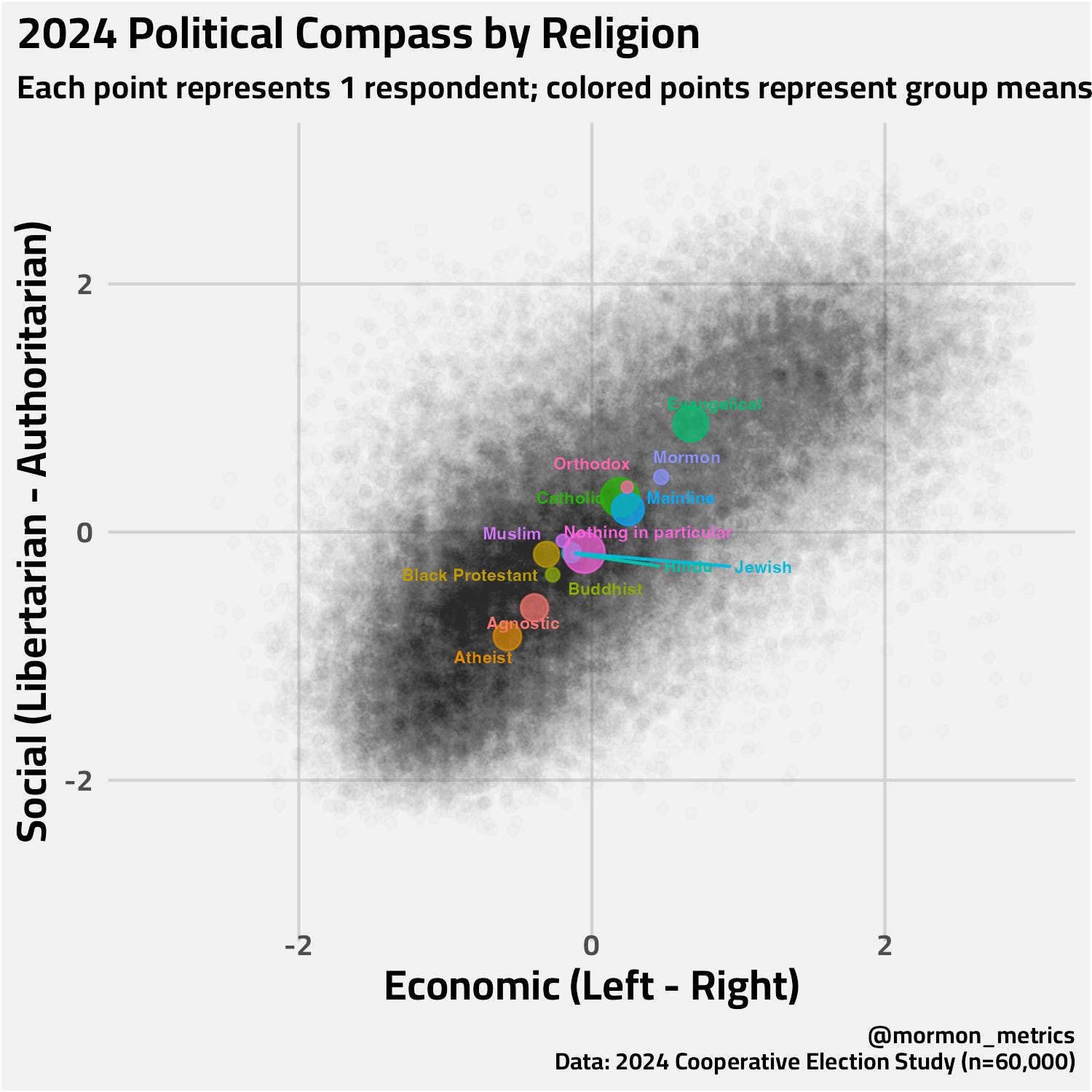
As you can see, politics differs by religion(!) with Evangelical Christians on one end of the spectrum and Atheists on the other.
As I pointed out previously, Mormons on average in 2024 are closer ideologically to Mainline and Catholics than to Evangelicals. I plan on exploring other years in another post to confirm this has changed over time, but my impression is that Evangelicals and Mormons used to be very similar, but now are distancing.
Another interesting finding is a clear relationship between our two axes. If you have more social authoritarian views, you are also more likely to economically right views. I interpret this relationship as evidence for political polarization in the modern age. If people didn’t feel shoved into one of two parties, perhaps this relationship wouldn’t be as strong.
Now let’s break down the 4 quadrants by religion
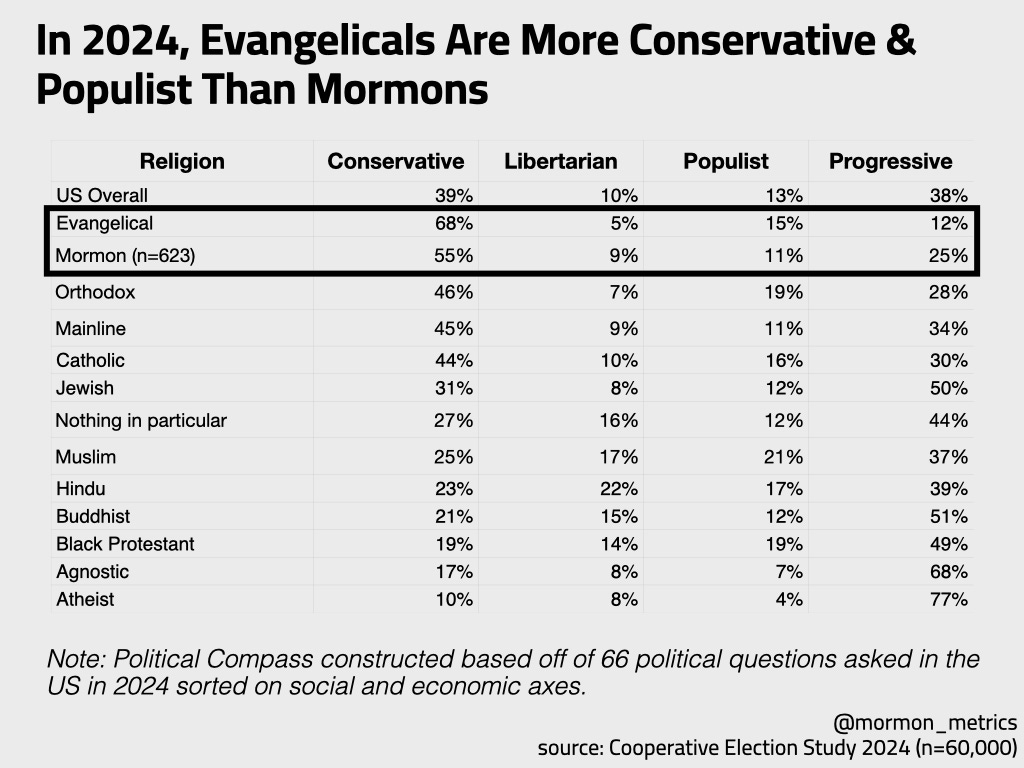
Interestingly, breaking things down, Mormons are about twice as likely to be in the Progressive quadrant than Evangelicals. As I have written about before, there is a growing group of Mormons identifying as Democrats which I have interpreted as political sorting in the Trump era.

Our data suggests that Mormons are slightly less likely to be in the populist quadrant than the US Overall and Evangelicals.
Next, I was curious about how groups broke out demographically across quadrants. I note nsizes in each group and only divide each demographic group once to have better estimates.
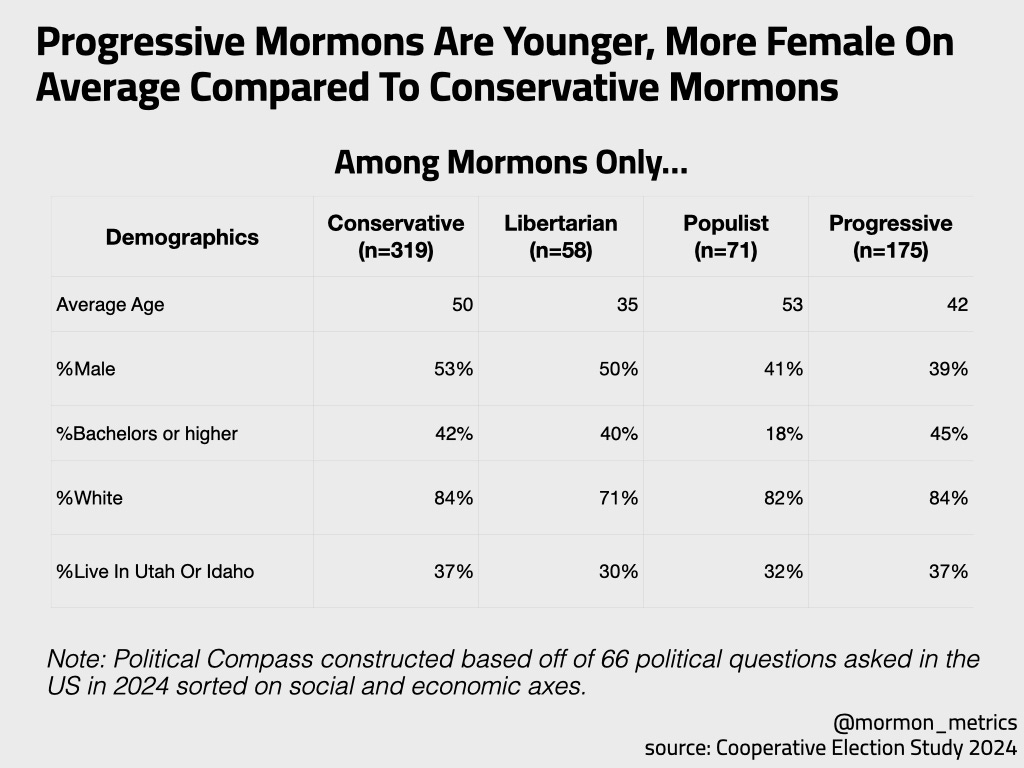
Notably, I found that Progressive Mormons are more likely to be female and have a lower average age compared to the Conservative group. Interestingly, the ‘Ideological Fringes’ (Populists and Libertarians) are slightly less concentrated in the Mormon Corridor than standard Conservatives or Progressives. The Jello Belt appears to be a moderating force, keeping members in the traditional partisan lanes.
Conservative Subtypes
I had a subscriber ask me about the prevalence of libertarians among Mormons, so I wanted to talk about this for a second.
Libertarian Mormons are about as common as in the US population. But, I believe there are more than one type of libertarian…
In the libertarian quadrant, I might suggest this group is called “secular libertarians” who want minimal government intervention in economics and socially. Legalize gay marriage. Small government.
However, I thought perhaps there is another related type of libertarian hiding in the conservative quadrant that I might call the “religious libertarian.” They don’t hate rules; they just hate the State making the rules. They believe order should come from God, family, and the Church—not Washington D.C. Perhaps they oppose legalizing gay marriage defending religious freedom, yet also want a small government so the church has room to breathe. Essentially, politics and positions that feel more like Mike Lee than a classical libertarian.
To try and capture this nuance, I further divided the conservative quadrant into a few subtypes:
Standard GOP - While the factions get the attention, the ‘Standard GOP’ voter—who might like Trump’s judges but hate his tweets, or like Romney’s character but hate his vote on impeachment—is still the dominant force (51%).
High Populist GOP - The intent was to find the Trumpers. This group is defined as having low trust in Election Results and supporting the US-Mexico border wall.
High Establishment GOP - The vibe for this group is Romney Republicans. They trust in institutions and have more interventionist foreign policy mindset. They are defined as high trust in elections and supporting sending weapons and military support staff to Ukraine.
Finally, the High Religious Libertarian - as mentioned above thinking of Mike Lee for this group. Fiscal hardliner who wants to slash federal involvement. I defined this group as opposing an infrastructure spending bill (for construction and repairing roads and bridges) and opposing medicaid expansion.
These definitions are obviously very rough versus a more formal analysis, but I think they work decently to sketch things out.
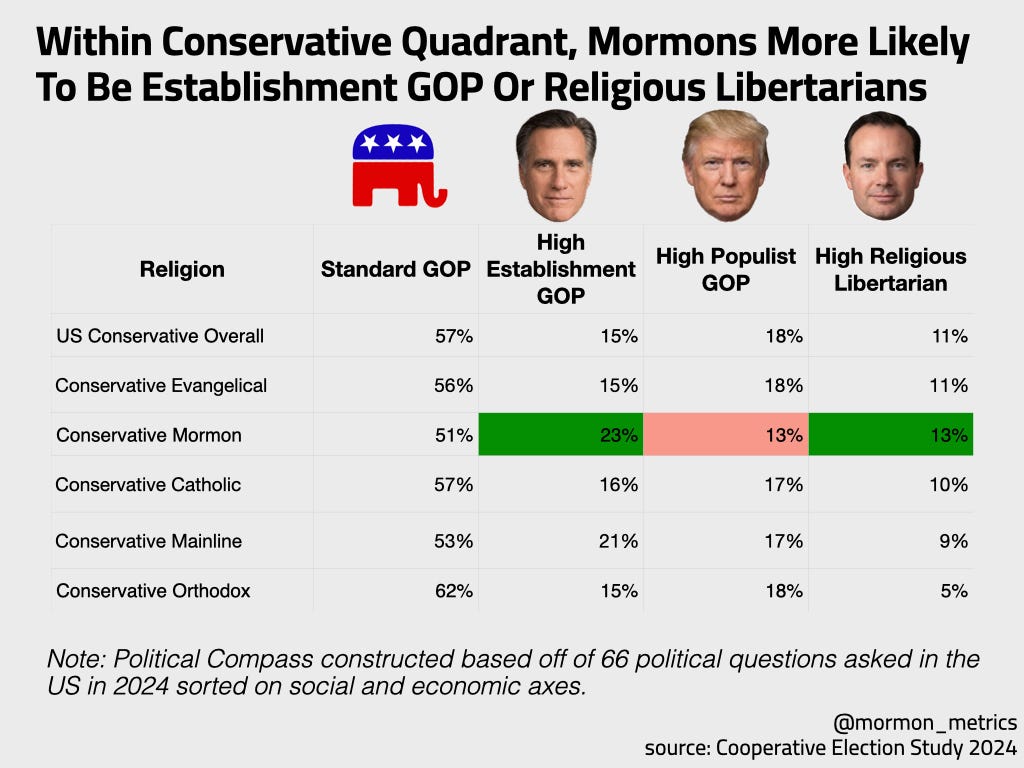
When we break things out this way, we can see that Mormons are less likely to be considered High Populist GOP in our standard definition and more likely to be considered High Religious Libertarian or High Establishment GOP.
But, that wraps things up for this post.
I am planning on exploring the political compass trends over time in coming weeks, so be sure to subscribe as I dive in more in depth in coming weeks. Has the political compass position of Mormons changed in relation to other religions the last 20 years?
What do you think of this analysis? Do you feel like this is helpful in understanding LDS place in politics? Is there anything that surprised you? Are you interested in analysis like this? What am I missing?
Feel free to share your thoughts below and see you next week.
Hey Alex, this is why I write my book! Thank you for providing the data I needed!
Great work! The irony for me with being most closely related to the Catholic Church… Makes me chuckle to watch the church become more and more like them because growing up that organization as known as “The Great and Abominable Church”!