
Mormon Political Drift is the Symptom. Religious Decline is the Cause.
Looking at LDS clusters over time on the political compass.


Introduction
I have previously written that, in the Trump era, Latter-day Saints are less likely to identify as Republican and more likely to identify as Independent and Democrat.
But why?
Are the most devout LDS moving away from the Republican party?
Are the less active members who still identify as Mormon moving leftward?
Is something else happening?
Our post today will shed some unique insight into this topic. Let’s dive in!
More Political Compasses
I’ve been diving deep into these political compasses in my recent posts if you hadn’t noticed. To catch you up after the break, here are some insights from my previous political compass posts which provide helpful context for this post:
For this first one, I plotted each religion on a political compass constructed from 66 political and economic questions. Interestingly, Mormons in 2024 are closer to Catholics than Evangelical Christians.

For my next one, I made 5 political compasses for each of the past 5 presidential election years. You can clearly see Mormons and Evangelicals who used to be ideological twins drifting apart. Mormons toward the center and Evangelicals rightward.

But, what happens when we breakout Mormons by their typological clusters over time using insights from the Mormon Typology Report 2025? We can’t directly replicate the clusters since the Pew Religious Landscape data (from the original report) has richer religious questions than the Cooperative Election Study (political compass data) BUT we can try… So in this post here are how the groups are defined:
Devout Traditionalist (maxing out every religious indicator) - Says religion is “very important” in their life. Attends church weekly or more. Prays several times a day.
Adaptive Believer - The 'Middle' member. Attends monthly or more, but doesn't max out every single orthodoxy box.
Cultural Mormons - Attends church once or twice a year, seldom, or never.1
And, when you plot them over time, there actually isn’t much change.
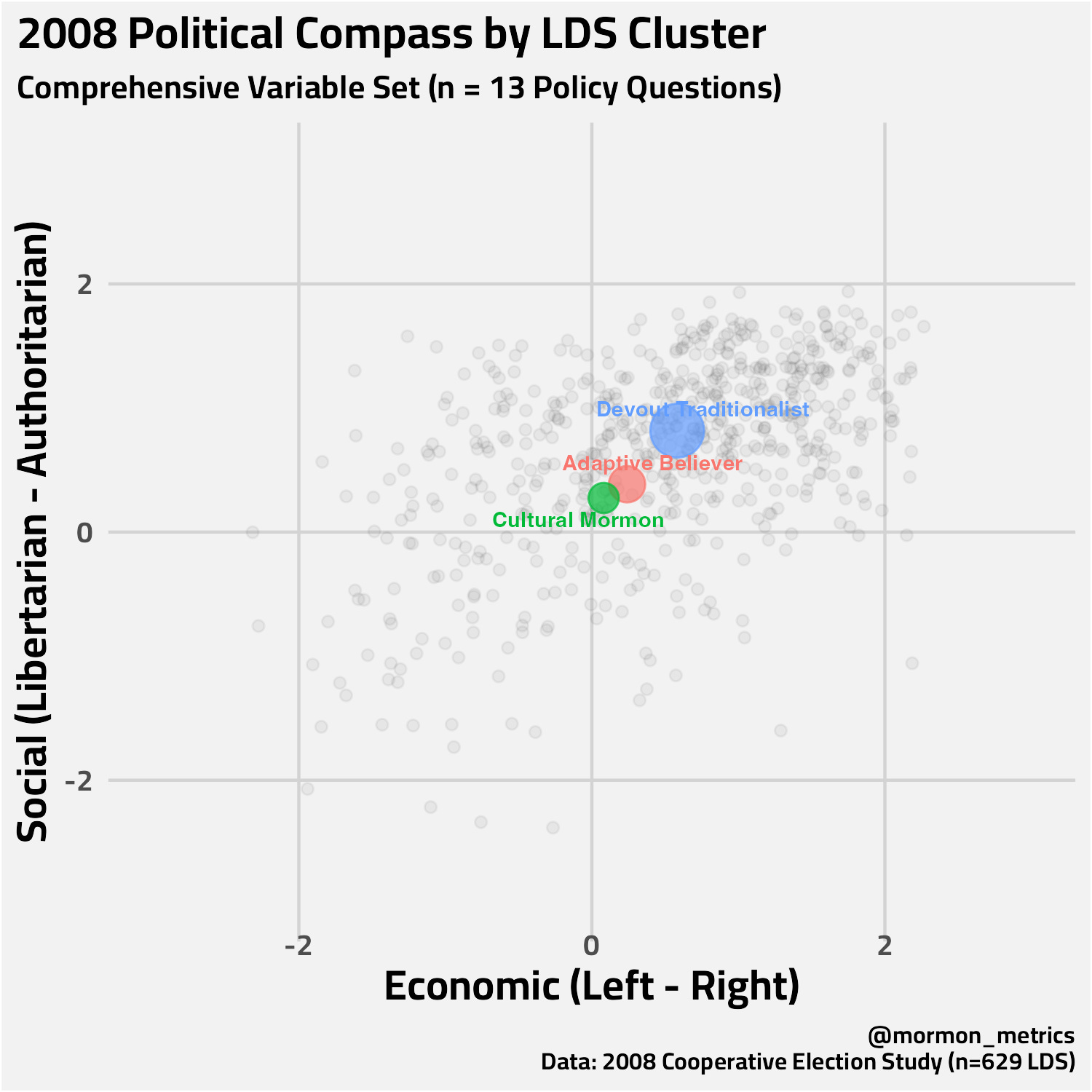
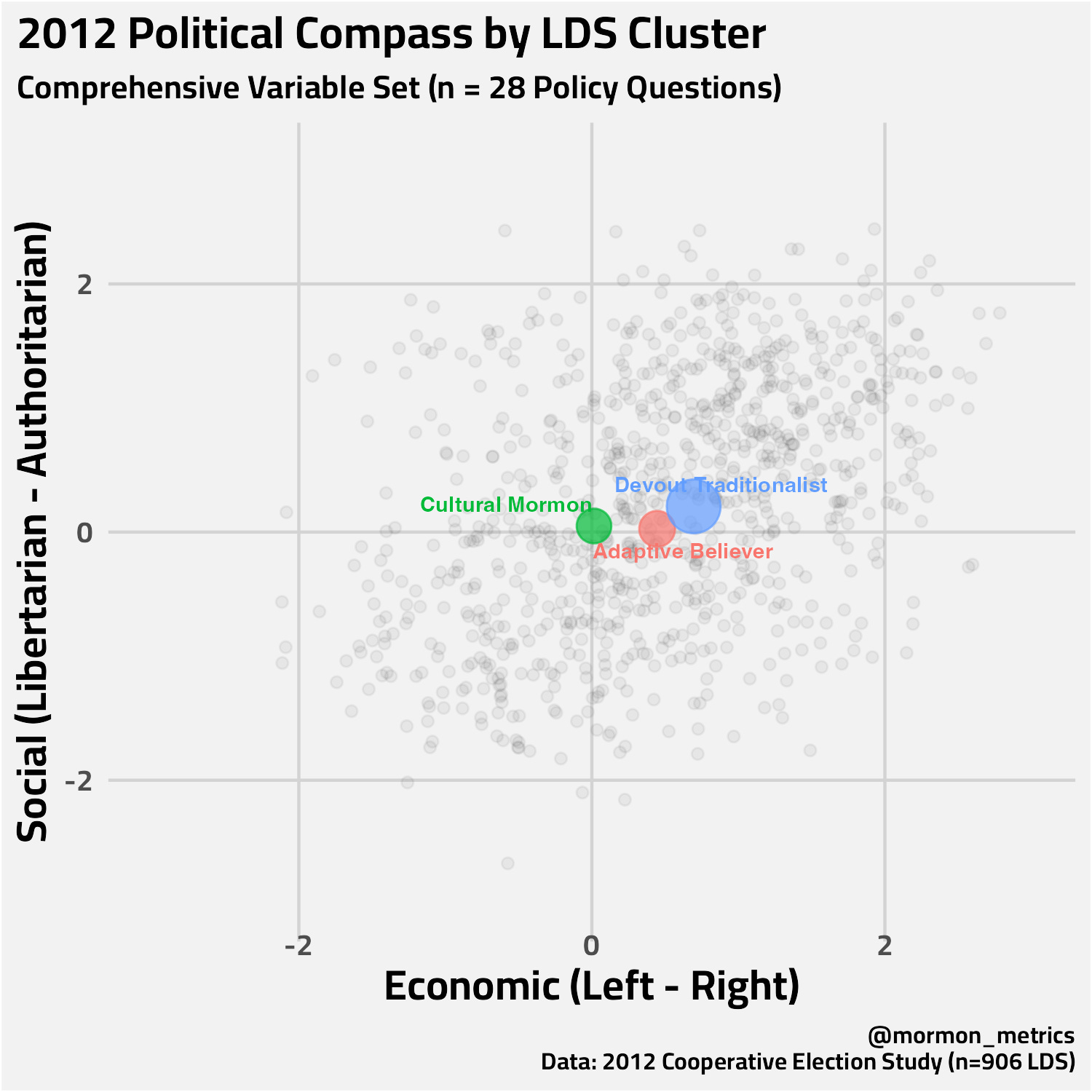
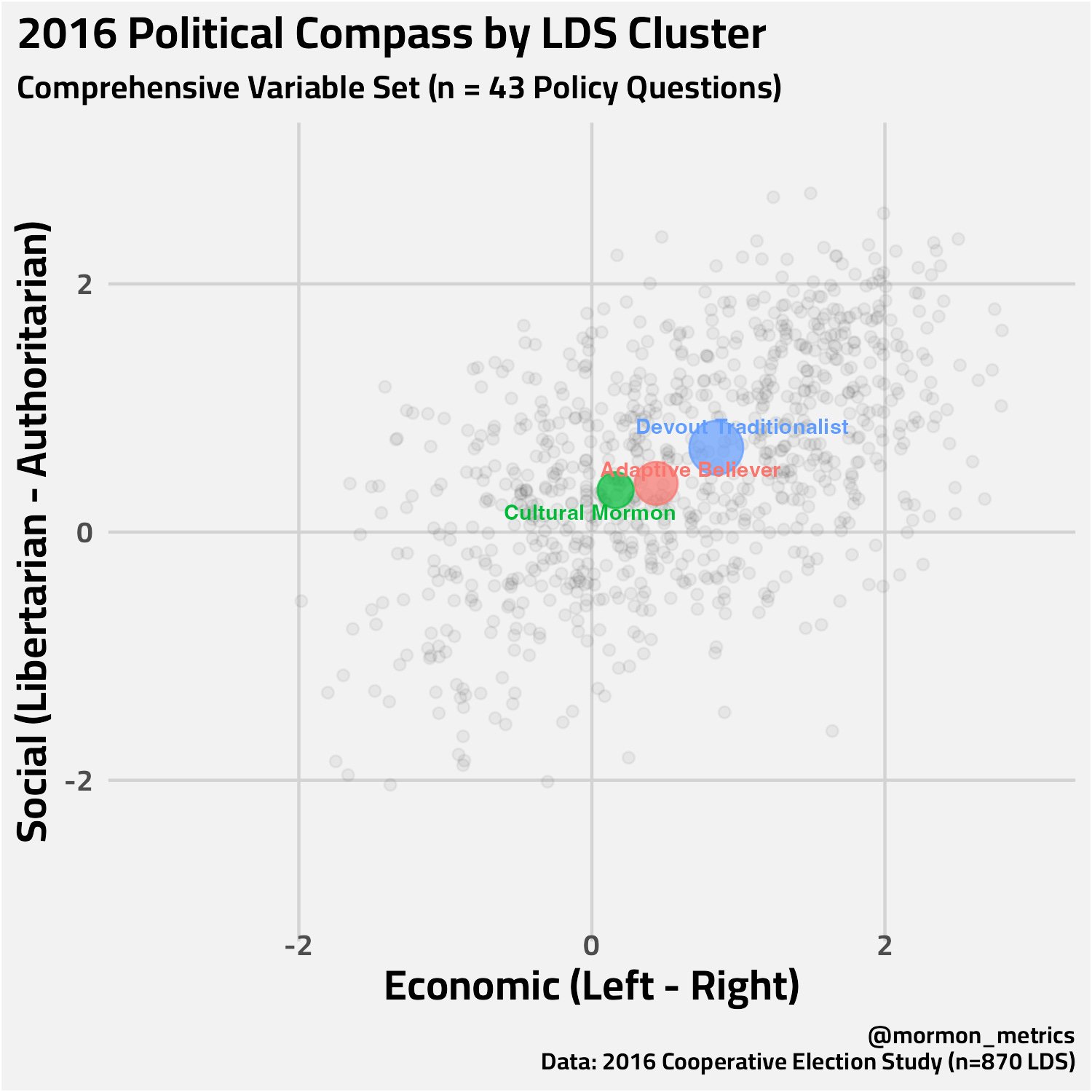
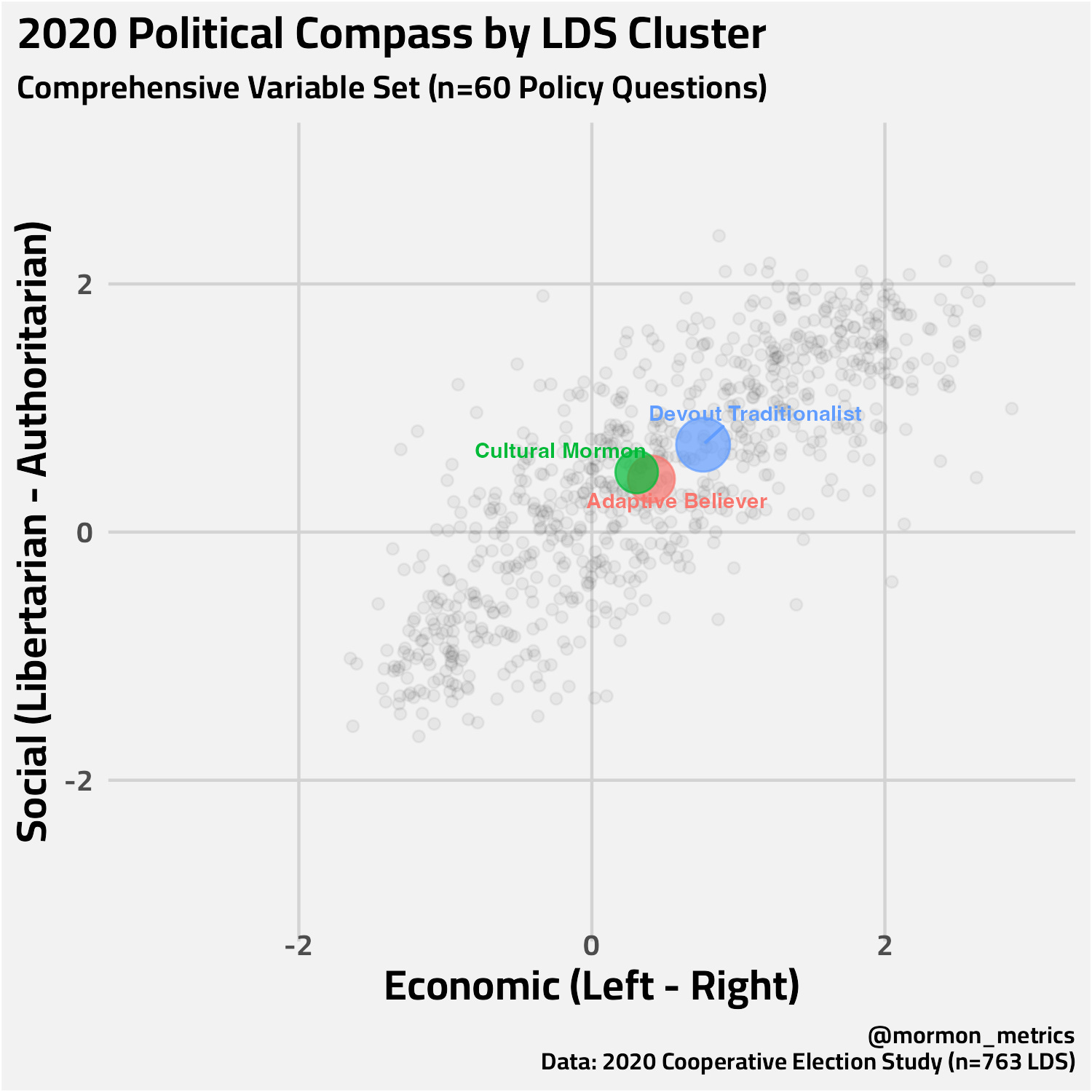
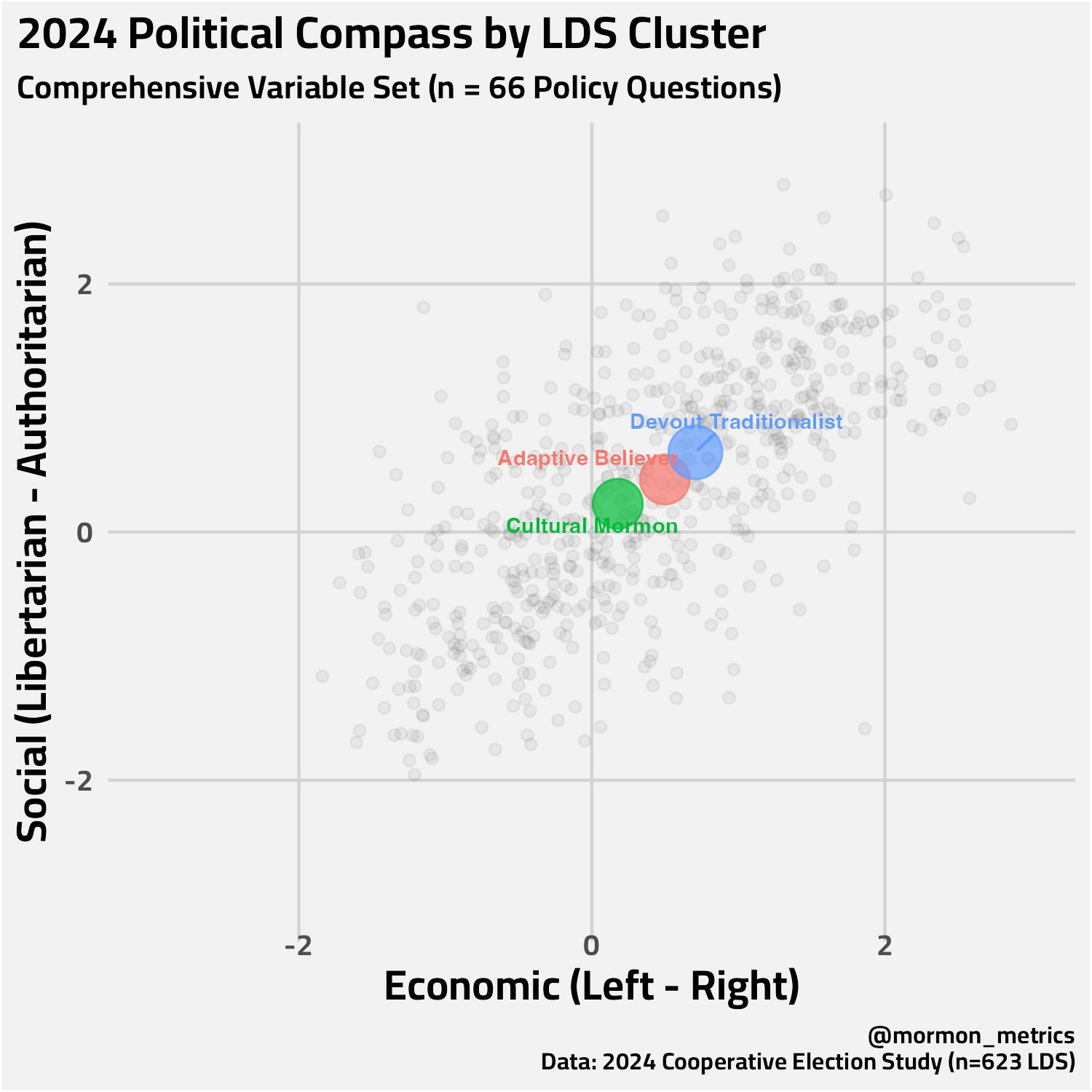
Looking through these, you can see some movement here and there. Some years the adaptive and cultural groups are closer together; sometimes they form a diagonal line. The Devout and Adaptive groups remain firmly in the conservative quadrant, while the Cultural Mormons consistently hover near the absolute center. But, compare the first (2008) and the last (2024) political compass. They seem nearly identical with one important difference: the size of the dots (which is proportional to the size of the group). In other words, the average political position of these groups has not changed much over the years, but the number of people in each group has changed!
Let’s plot out how the size of LDS clusters has changed over time.
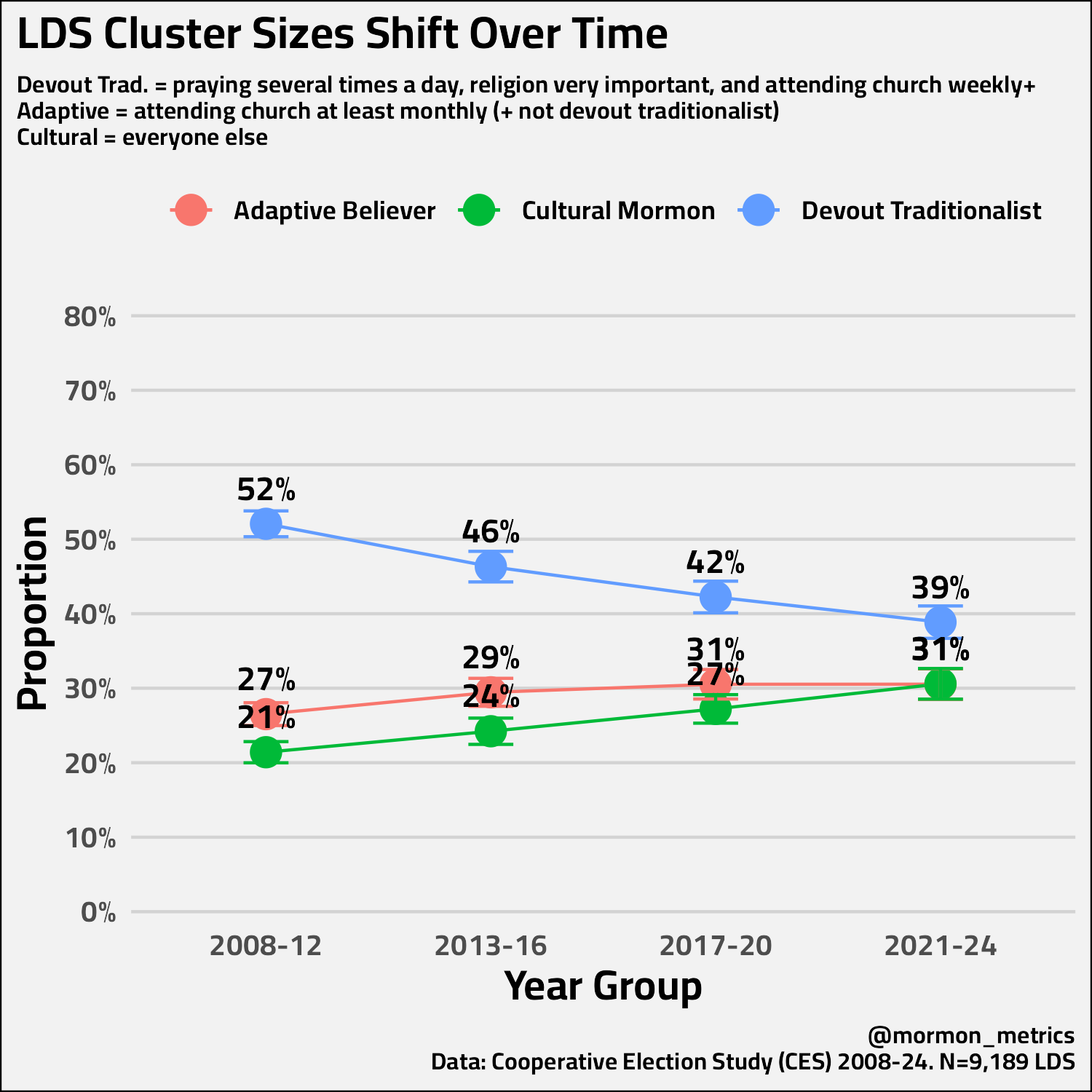
If you’ve been reading Mormon Metrics, you know I’ve tracked the decline of the ‘Devout’ block before. But looking at these compasses, you can actually see that demographic shift in action. The reason the political center of gravity is moving left isn’t because the ‘Devout’ circle is moving—it’s because the ‘Devout’ circle is shrinking. The data shows the 'Devout' bloc has shrunk from a 52% majority in 2008 to just 39% today, while the cultural and adaptive groups have gone from a combined 48% to 62%.
So, this analysis suggests that the political shift among Mormons is not due to one group becoming more liberal or more conservative, but rather secularization changing the size of each group and groups with less religious intensity (which lean less Republican) gaining members proportionally.
What do you think of this analysis/hypothesis? Is it plausible to you? Am I missing anything? Is there anything more you would like to see? Let me know what you think below.
Next week, I am planning revealing more details about my forthcoming report on temples releasing two weeks from today on January 30th. See you then!
Code for this post is available here. I also have a google sheet tracking each question used in the political compass analysis, so you can get a sense of how these axes are constructed across time (a total of 198 questions across years!)
Note: In-betweeners are not included in this analysis as one of their defining traits was the only group to question God’s existence and there are no questions asked about that on the CES. However, you can assume that the In-betweeners are lumped in with the Cultural Mormons as both groups have lower religious practice.
As a devout lifelong member of the church in the UK, I feel I am merely an observer, having a tacit association with the church in the US. Here we have devout members openly voting left of center, with an extremely small minority openly supporting hard right/alt-right views similar to moderate Republican views, let alone MAGA, though it would be great to see actual statistics to confirm that impression. As previously commented, the cognitive dissonance I endure as a member of an American church which predominantly supports Republican values, and appears to flirt with Christian Nationalism is torturous, especially acknowledging Article of Faith 11, and the doctrine of agency, which I was raised to believe was a core tenet of our faith.
From where I live in SLC (which you know well since you served with us as a missionary), there is a large representation of highly-educated, devout, left-leaning members of the church. I don't know if that is a quirk of SLC East side or not. What I have observed is that left-leaning members who stick around get a lot of practice in cognitive dissonance, in thinking through areas where they differ from official church policies or from prominent church leaders, and in finding ways to manage that. The LGBTQ policies and events of the past ten years have pushed some of these people out, but many have found ways to remain in church activity and belief despite the challenges. I think the pandemic and the rise of MAGA are pushing some of our right-leaning members into those spaces of cognitive dissonance and conflict with leaders (remember President Nelson asking us to wear masks to church!, or church statements on rooting out racism or immigration policies), and I suspect they are not as experienced in navigating them (and possibly their personality types and worldviews actually make that type of gray-zone thinking more difficult for them). I don't know if you have any data about that, but it could partially explain the shrinking "highly devout" category and the leftward shift, since the highly devout left-thinkers have already had many challenges to their faith over the years so may be a relatively stable demographic.