
Is BYU A Healthy Brand?
Hint: Data Is Encouraging IMO


TL;DR BYU is well recognized brand nationally where opinions are more polarized than the average university, but not overwhelmingly so. Additionally, BYU seems to have better branding than Mormonism.
Introduction
Previously I have written about the types of people that don’t like latter day saints and found that, in the US, people are nearly twice as likely to have a negative opinion of Mormons than a positive one (though a majority either do not have an opinion or do not recognize Mormonism).

But, what about BYU? Does this negative relationship transfer to BYU as an institution? Is BYU healthy as a brand?
Data
I used to work as a data analyst at Morning Consult, a market research and political polling firm. They conduct large tracker surveys daily tracking most large brands - among these brands is BYU.
Recently, they announced beta testing for a new AI tool essentially acting a data analyst using their data. I have been messing around with this and will share a few charts with you.
Charts
They track 10 different metrics for BYU and other universities, but we will only focus on the three below:
Awareness: Whether people are aware of the brand or institution at all.
Favorability: How favorably or unfavorably people view the brand or institution.
Admired Employer: Whether people would be proud to work at the brand or institution.
For each metric, you can ask about several demographic breaks. I explore a few of these in the post, but there is a lot more available through the link if you are interested in exploring this topic more.
I chose these three metrics because you can think of them as a funnel of sorts… first, you become aware of BYU. Then you develop an opinion favorable or unfavorable. Then, if you have a strong positive opinion, you may feel “proud to work at the institution.” So, let’s start with our first metric…
Awareness of BYU
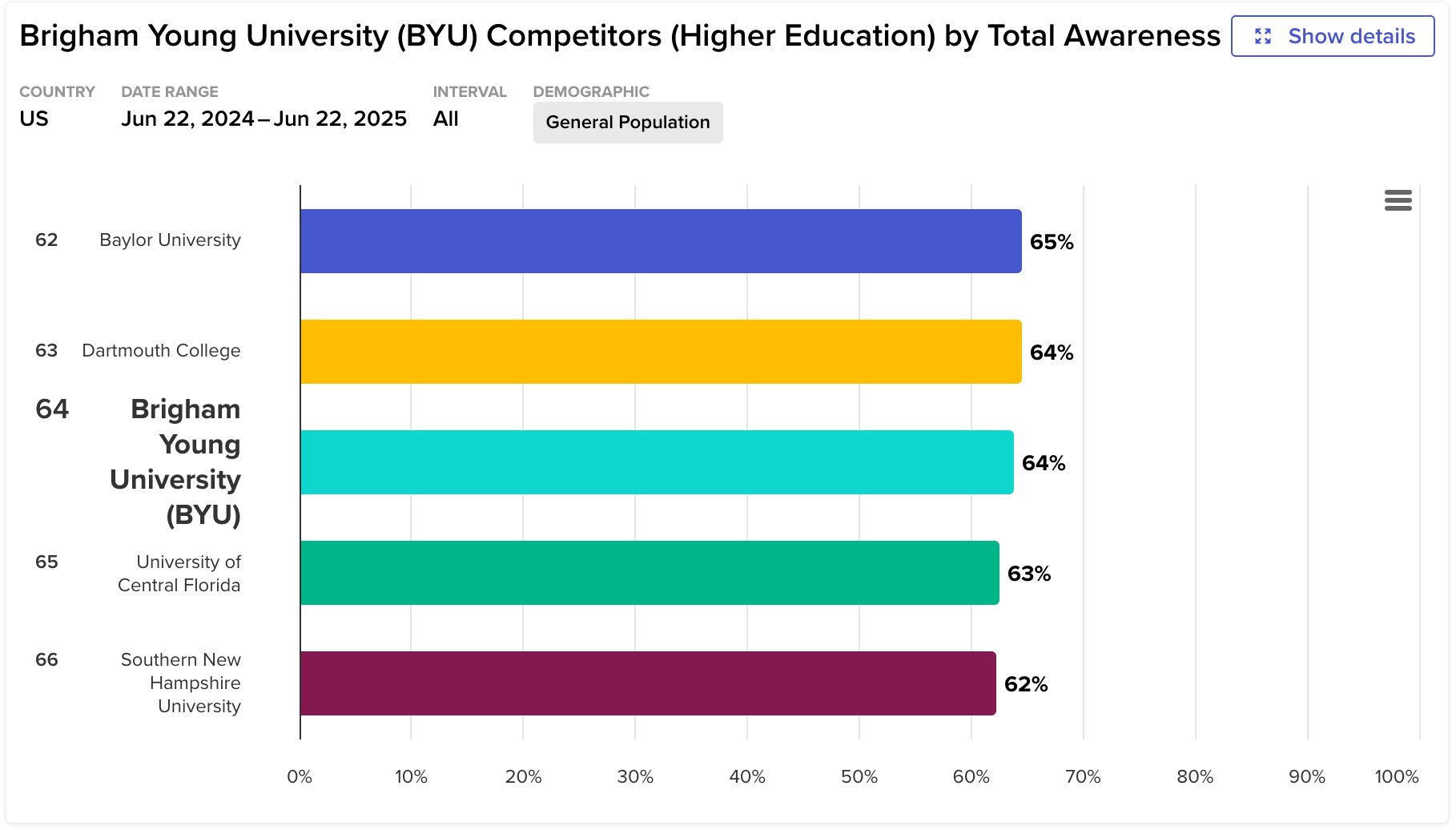
The chart above seems reasonable to me… around 1/3 US respondents do not recognize the brand of BYU. Looking at whether people recognized Mormons or not from the study I linked above, 17% (~1/5) didn’t recognize the Mormon religion. So the religion of Mormonism is more recognizable than the brand of BYU.
The awareness of BYU is similar to other strong university brands like Baylor, UCF and more obscure ivy leagues like Dartmouth.
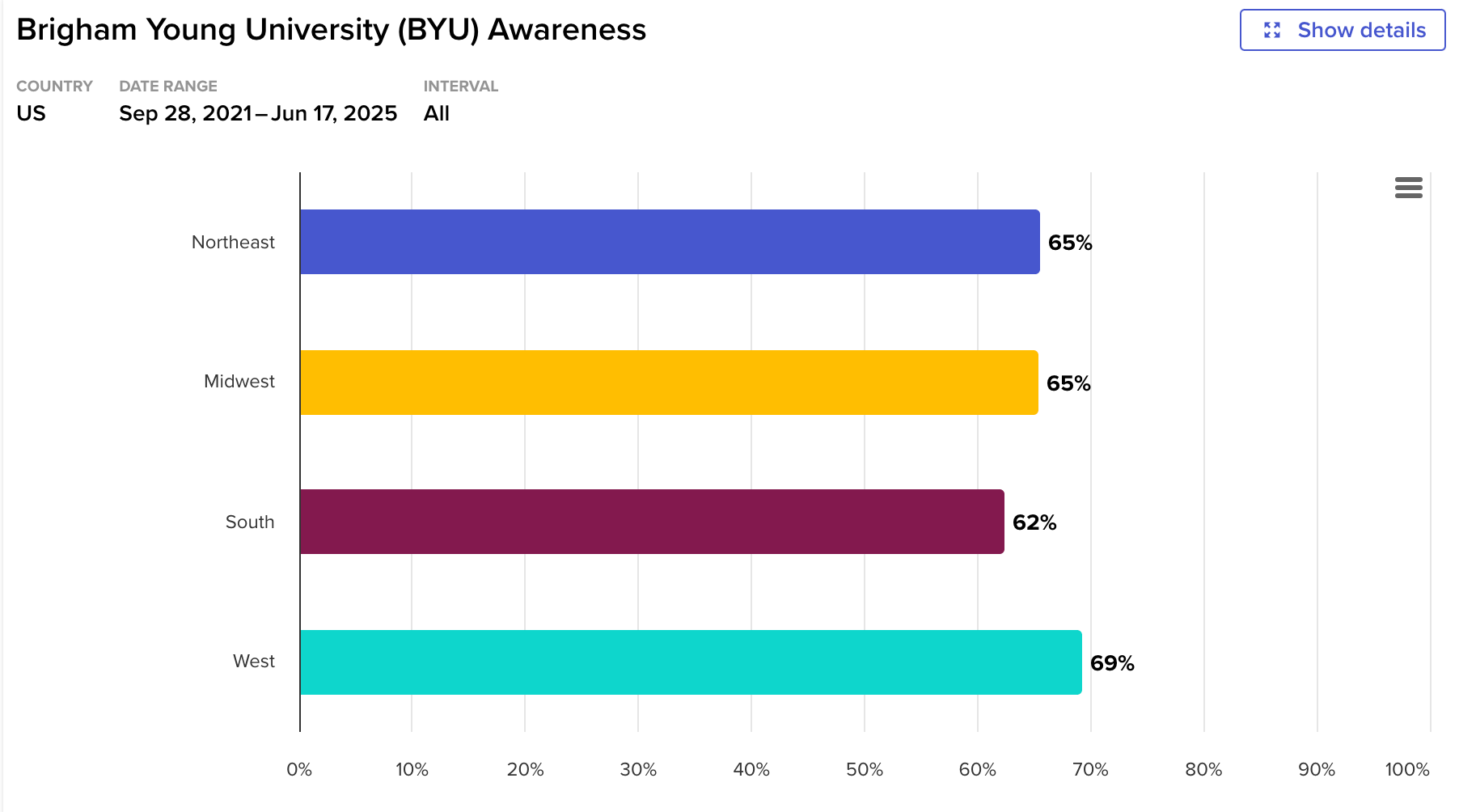
As you might expect, more people are aware of BYU in the western region than the others, but the gap really isn’t very large.
Favorability of BYU
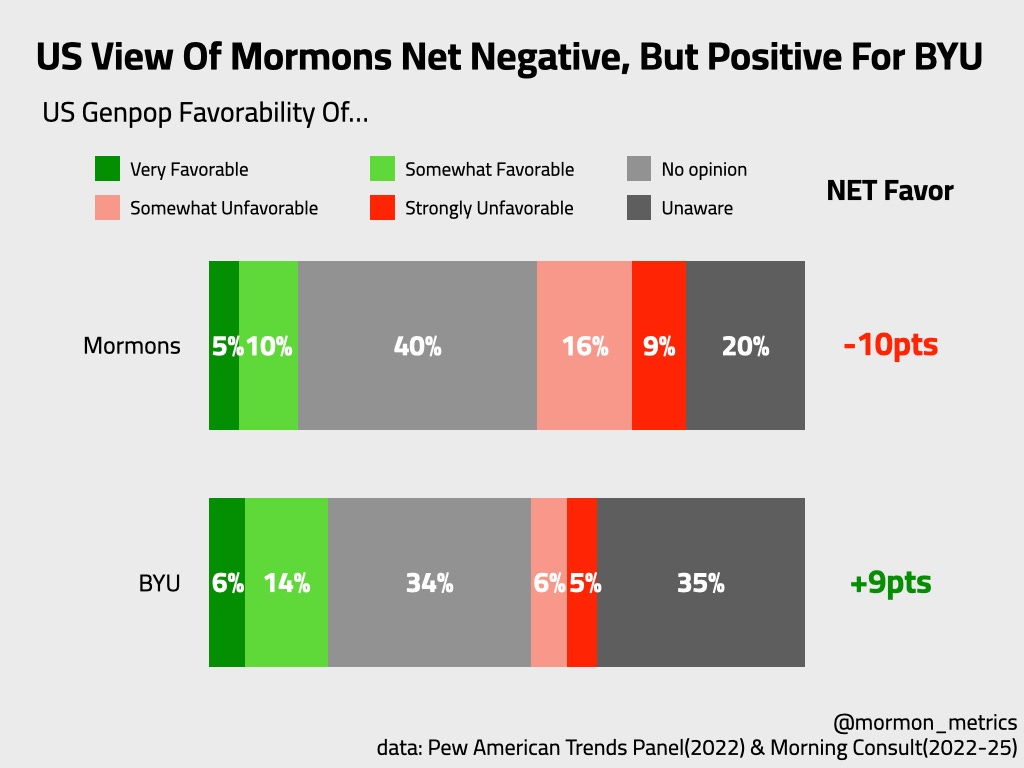
BYU has more people saying “unfavorable” than many universities, but the critics are not crippling with BYU at NET(%favorable - %unfavorable) positive +10 points! From this chart, the American population is divided into thirds with BYU….
1/3 have never heard of BYU
1/3 have heard of BYU, but have not opinion
1/3 have heard of BYU and have an opinion and these people’s opinion as NET positive +10.A net favorability of +10 points is significantly better than the net favorability of Mormons which is around -10 points. This seems to suggest that BYU has a significantly better brand than Mormonism.
In the chart below, I show the top 5 educational institutions net favorabilities for comparison.
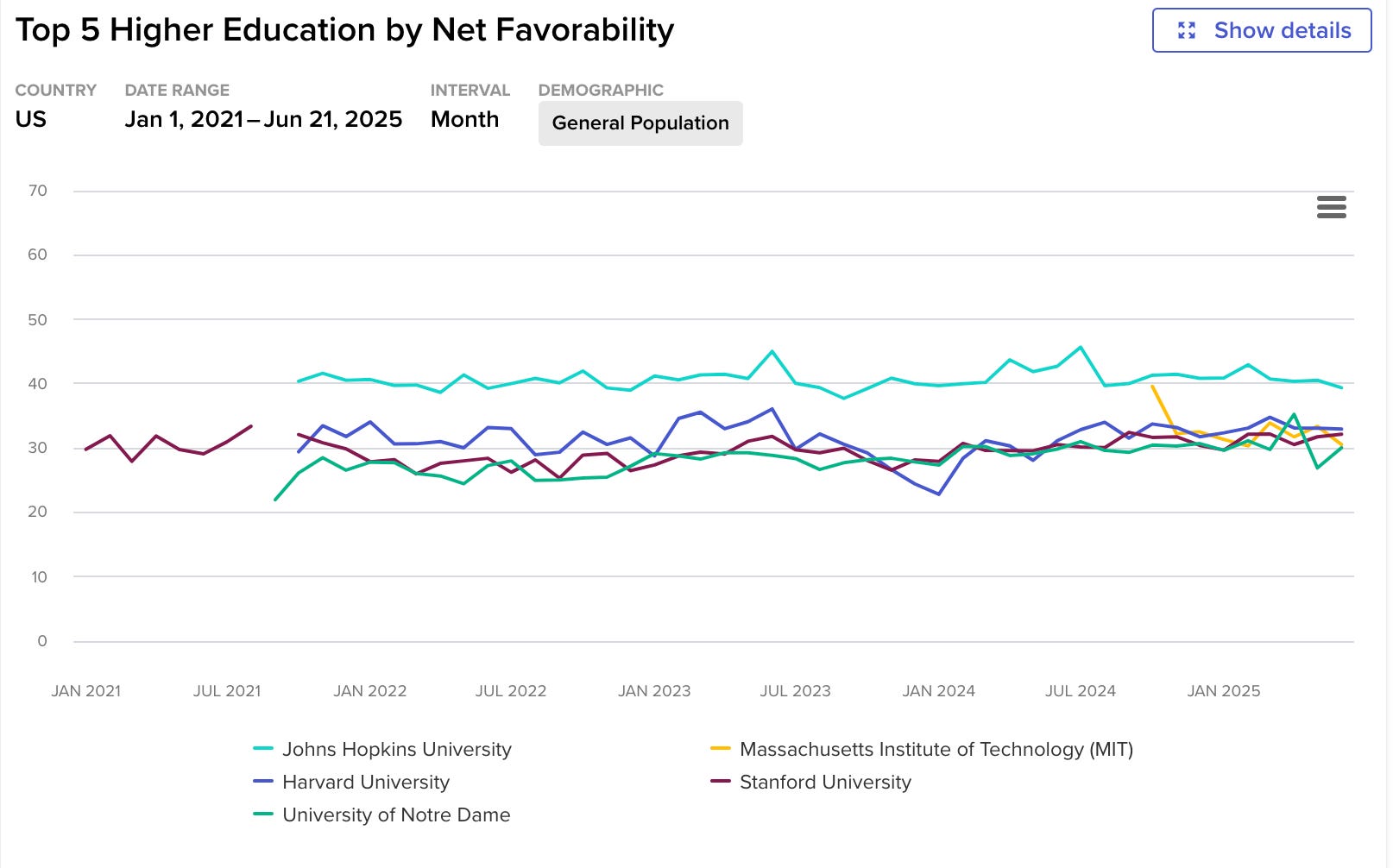
BYU lags behind the most favorable universities by 20-30 points. Schools like Harvard, Stanford, and MIT sit in the +30s and +40s range.
So, what schools have a similar level of favorability to BYU?
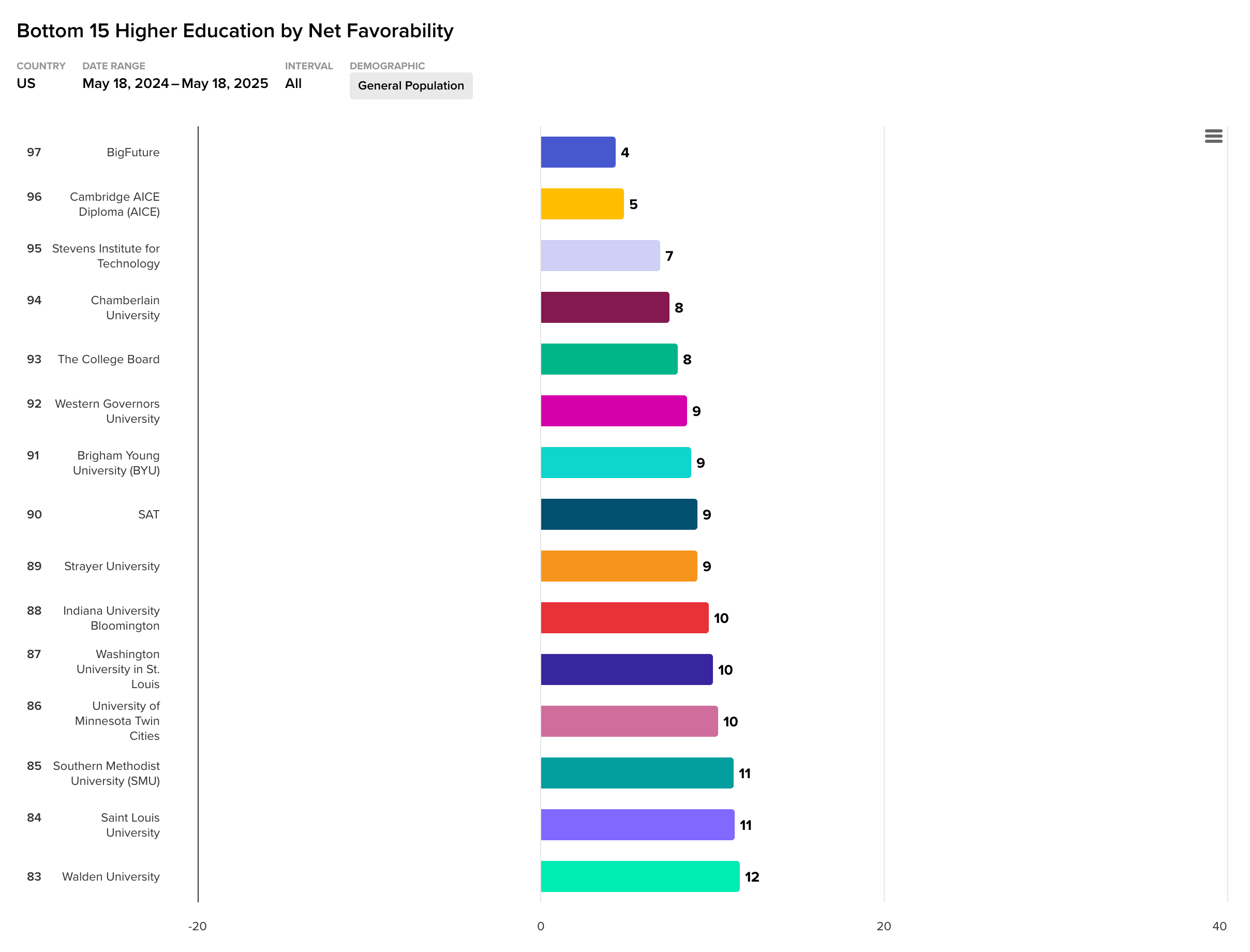
When looking at favorability scores, BYU is on the lower end of the 97 educational institutions Morning Consult measures (#7 worst) next to Steven Institute of Technology, Chamberlain University, and Western Governors University. Though, while not as high as most universities measured, BYU’s net favorability score is not far from big names like Washington University of Saint Louis, Indiana University, and University of Minnesota Twin Cities. So, the favorability scores may not really be terribly concerning; though there is room for improvement.
Are there demographic differences in who is favorable toward BYU?
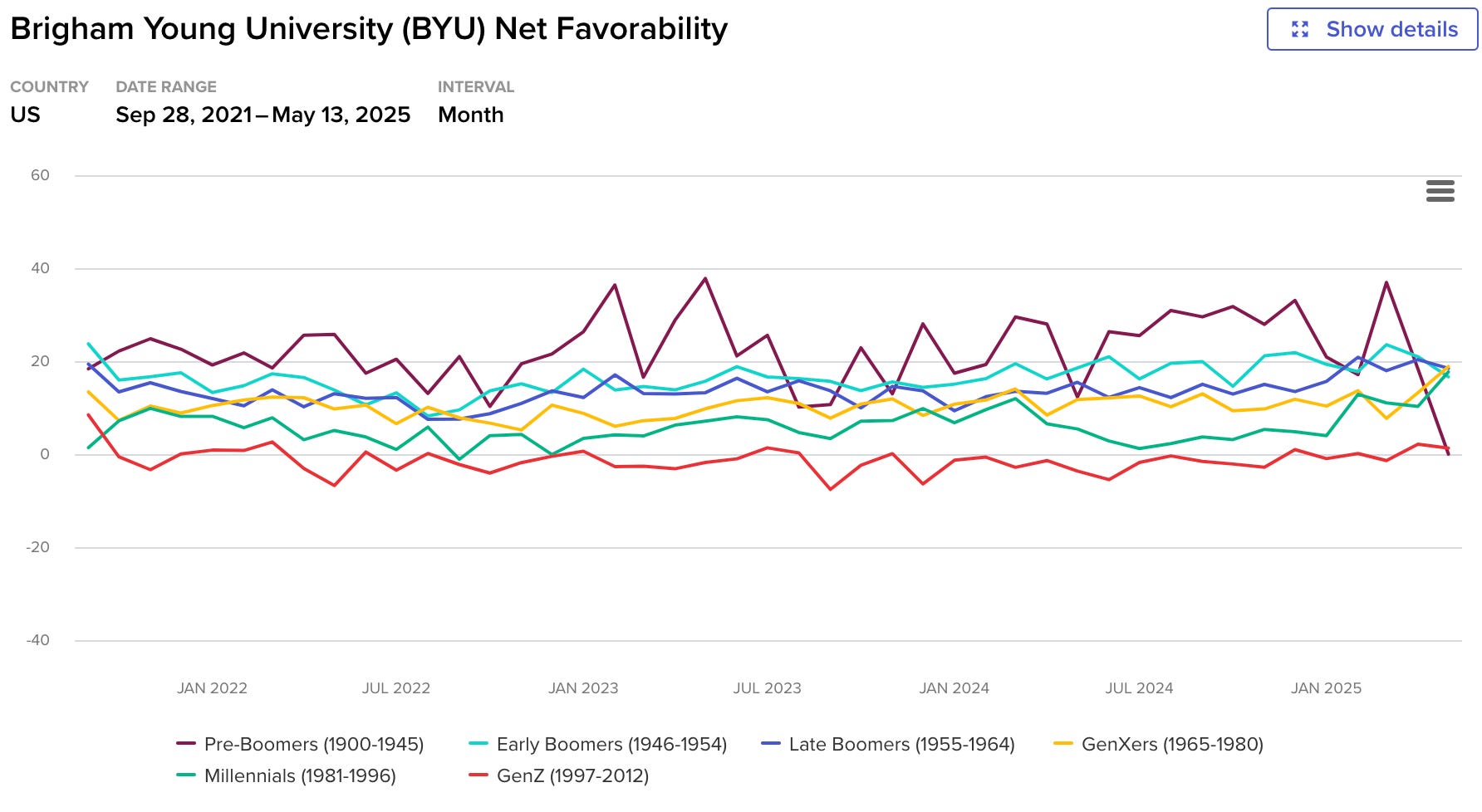
There are generational differences in favorability with older generations being more favorable than younger ones, but older folks being more aware of BYU likely affects this.
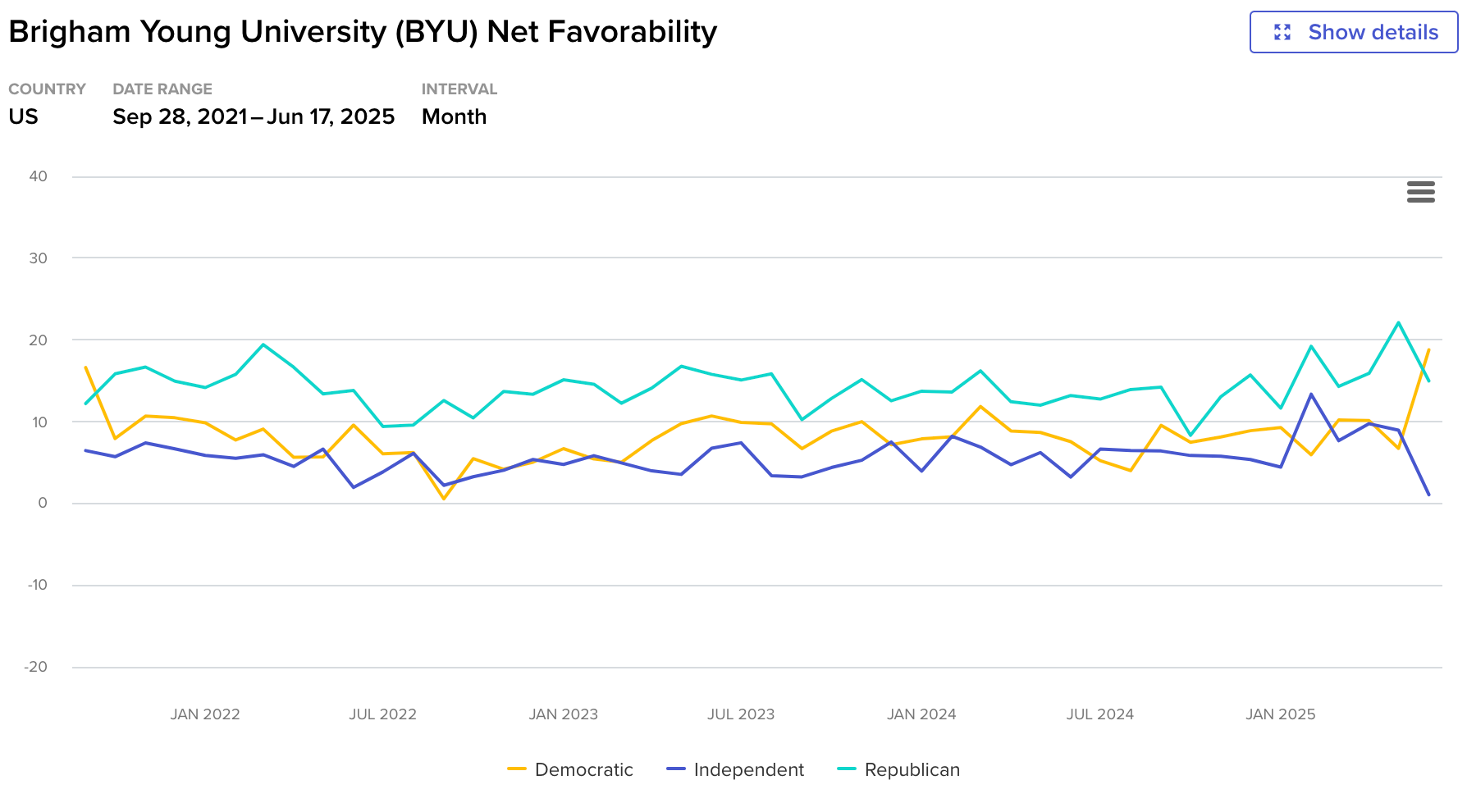
We see some divisions among party lines with BYU being more favorable to Republicans than Democrats. Though, note Democrats remain net positive to BYU even if only slightly.
Is BYU an admired employer?
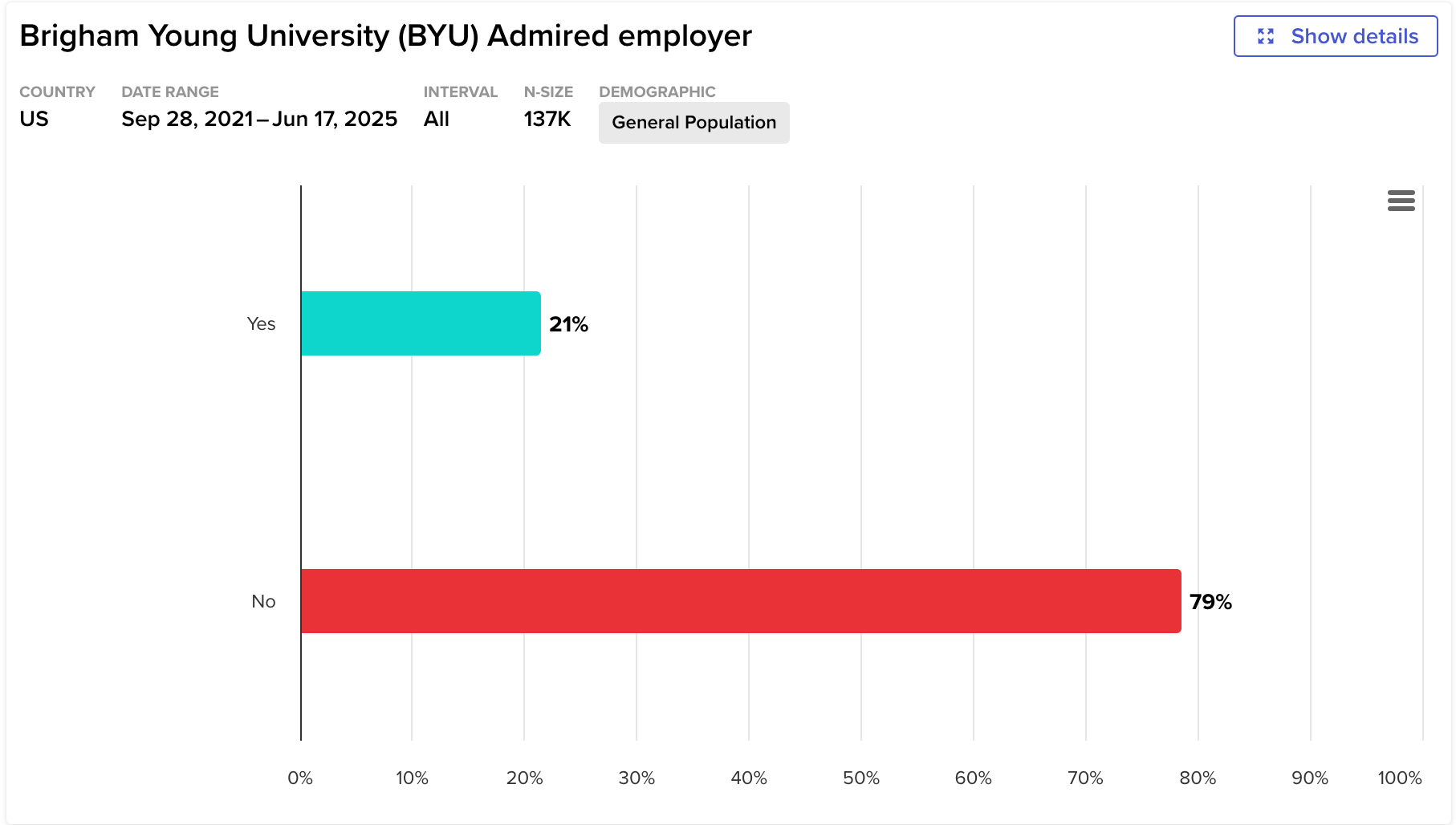
Not really, at first glance.
This question is asked of people who say that they are aware of BYU. Among those aware of BYU, only 21% say that they would be proud to work at BYU.
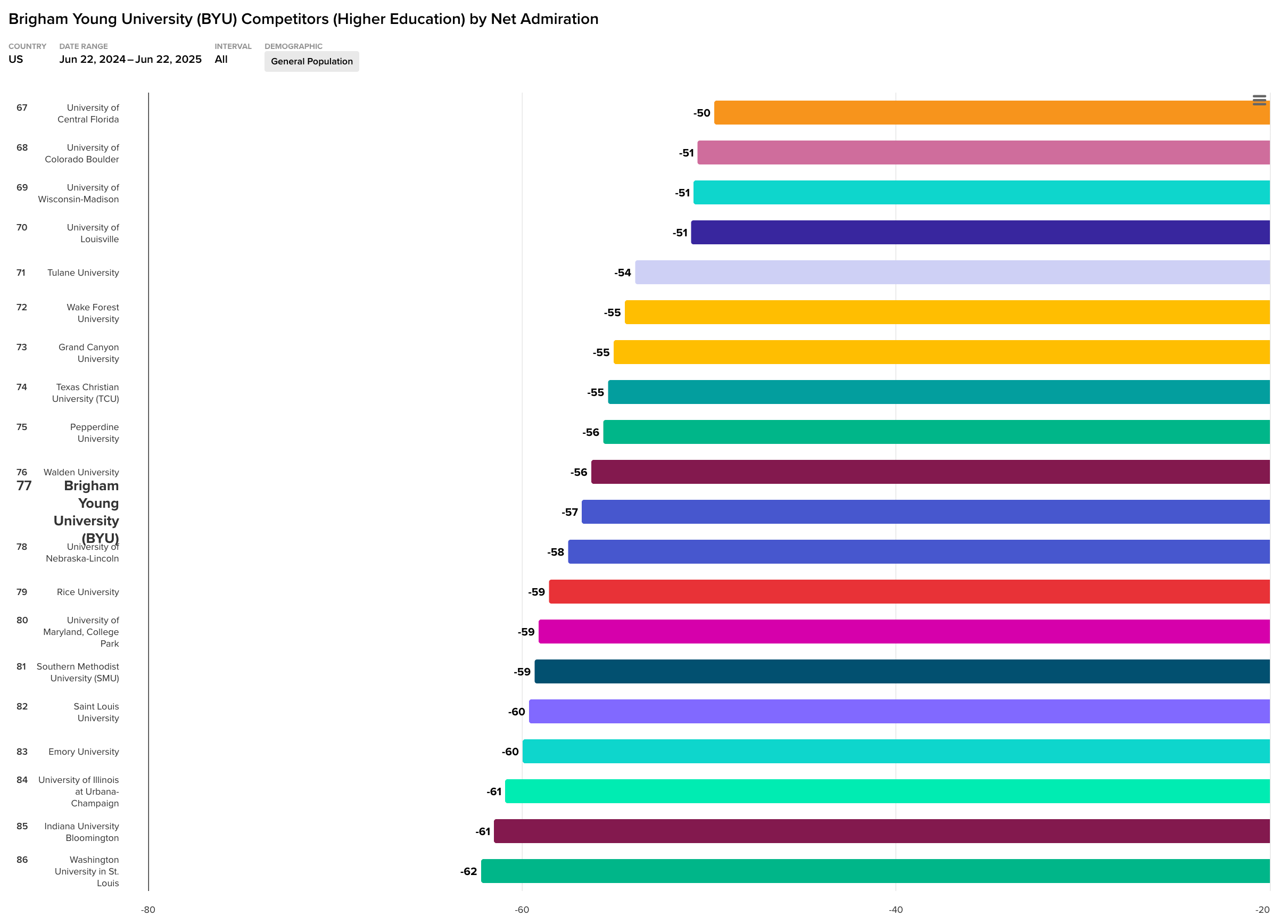
When you look at BYU compared to other universities, the picture really doesn’t look bad. BYU’s net admiration is even higher than some strong brands like Rice, Emory, and the University of Maryland, College Park.
To me these last two metrics (favorability and admiration) signal a polarizing audience for BYU, but not a stifling one. BYU has a sizable amount of admirers who would be proud to work at BYU rivaling strong education brands, yet falls behind on their favorability comparing some of the same universities indicating more dislike. The dislike is not overwhelming though with the net favorablity score sitting at +10, but still is low for a well-recognized educational institution.
Conclusion
Wrapping things up…
BYU is a nationally recognized brand similar to other large universities like Baylor or Dartmouth; though not as well recognized as universities like Harvard.
Looking at favorability, BYU has a larger number of both favorable and unfavorable opinions than many universities, yet is NET positive +10. This is a much better brand than Mormonism which is NET negative -10, but BYU’s NET favorability is lower than many similarly recognized universities.
Although favorability has room for improvement, BYU has a sizable amount of admirers even more than some strong brands like Rice and Emory. But, there is much to be gained - currently ranked #77 out of 97 total educational brands tracked.
👉👉👉So my verdict? BYU is average to below-average health. Well recognized with more polarized opinions compared to other collegiate institutions, but not cripplingly so. BYU (+10pt favorability) also seems to be a much better brand than Mormonism (-10pt favorability) which is encouraging.
Let me know what you think. Do you agree with my assessment? Would you add anything?
Makes sense, I know that a lot of employers are hesitant to recruit from BYU, especially based outside of Utah, since a good chunk of people end up wanting to move back to Utah.
I’d say as far as competence of grads, BYU grads are highly regarding especially in the business world.