
Affiliation With Religion Declined In US, Now Proselyting Is
Examining how often religious Americans & Latter-day Saints share their religions with others


Introduction
“Every Member a Missionary” - a phrase you have likely heard before if you’re reading this newsletter.
Latter-day Saints generally report higher church attendance at baseline. Do they follow through on other more uncomfortable parts of their religion - like proselyting? Has the rate at which they proselyte changed over time?
Additionally, how do they compare with other religions on member proselyting?
Let’s find out today!
TL;DR All religions including Latter-day Saints aren't proselyting as much. Our study specifically focuses on everyday member sharing - so not talking about LDS FT missionaries (which have increased the last 5 years)!
Charts
Who are the most active proselyters?
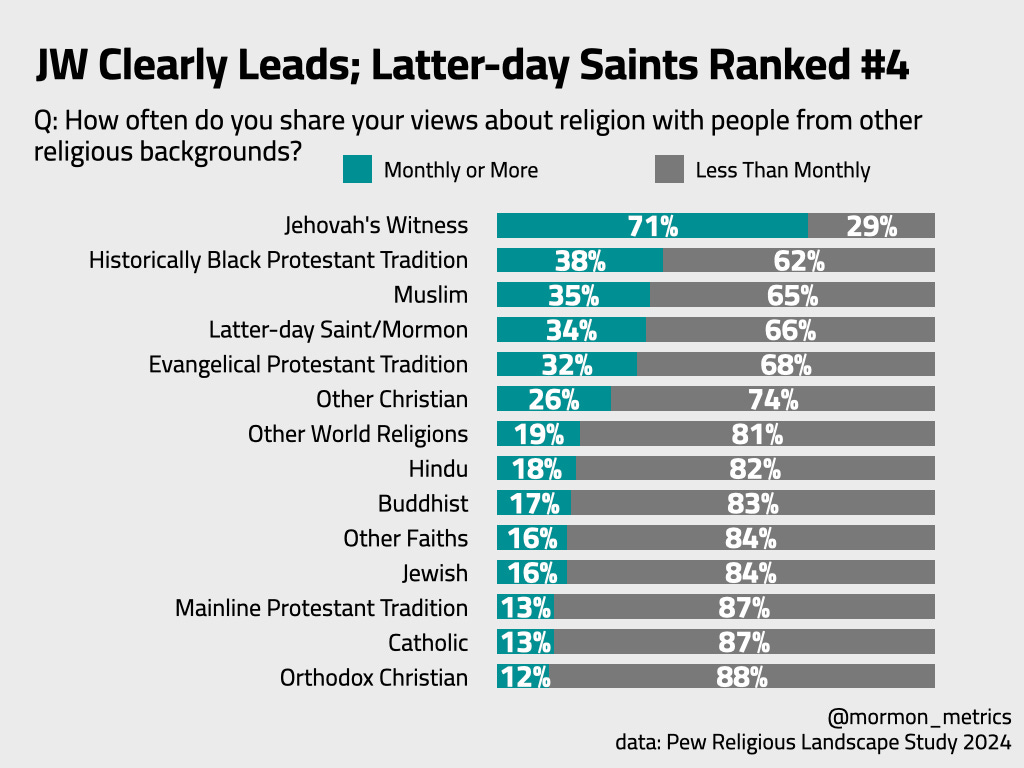
Well, I’m not sure what I was expecting when I charted this. I knew Jehovah’s Witness would be high, but wow! They really blow everyone out of the water.
Though I don’t show it above, there is a response for weekly or more. 64% of Jehovah’s Witness respondents report sharing weekly or more! For context, the next highest is Black Protestant with 25% sharing weekly or more. Latter-day Saints have 14% sharing weekly or more and most everyone else is in the mid-to-low single digits.
So, latter-day saints are no where near as active in member proselyting and Jehovah’s Witness and instead are more similar to Evangelicals and Black Protestants. This rate of proselyting is still likely higher than the average religion though.
I will note this likely doesn’t include full-time missionary service. People responding to this survey are likely everyday non-fulltime-missionary latter-day saint members are sharing compared to everyday members of other religions.
Latter-day Saints have the well-known two years of full-time voluntary proselyting in the formal clothing like dresses and white shirts and ties.
Are Everyday Latter-day Saints Proselyting More or Less Over Time?
While the number of full-time missionaries increased the last 5 years, are members sharing more?
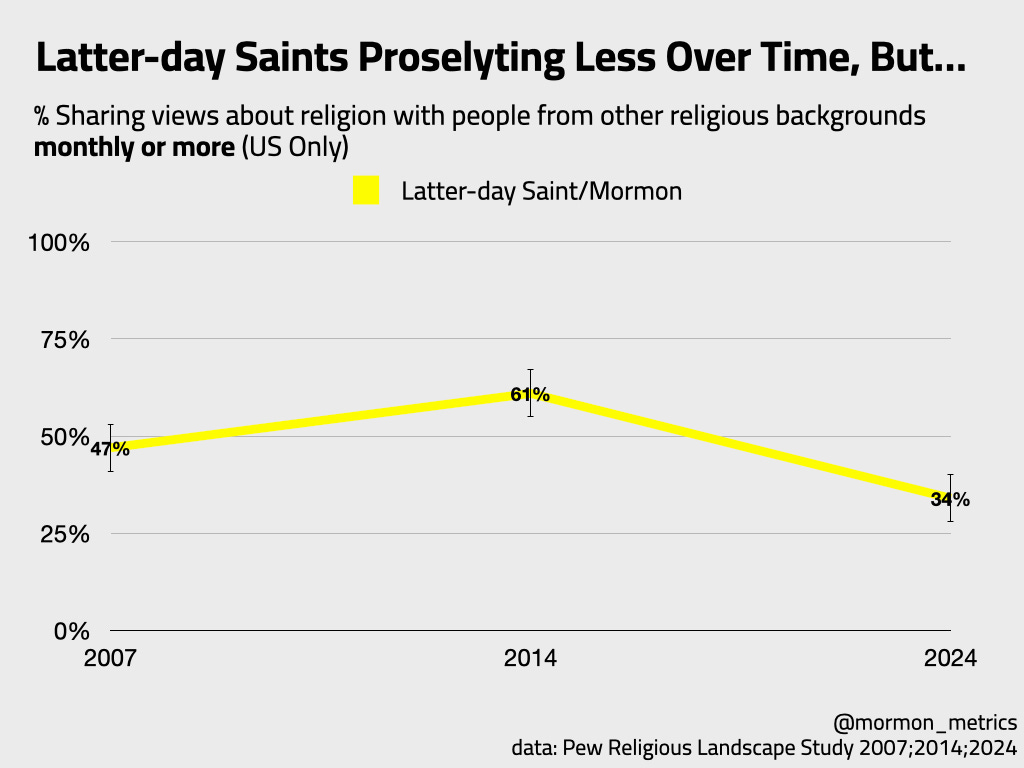
I will mention that Pew had a callout saying to there were different survey modes between 2007/14 and 2024. The earlier versions were done by telephone where as the new version was collected online and on paper. Even with this difference, I do not think that this large decrease would all be the result of a different survey mode, but nevertheless something to keep in mind.
From 47 in 2007 to 61 in 2014 which is not nearly as drastic as the large drop (-27 points) from 2014 to 2024 in members sharing their religion monthly or more.
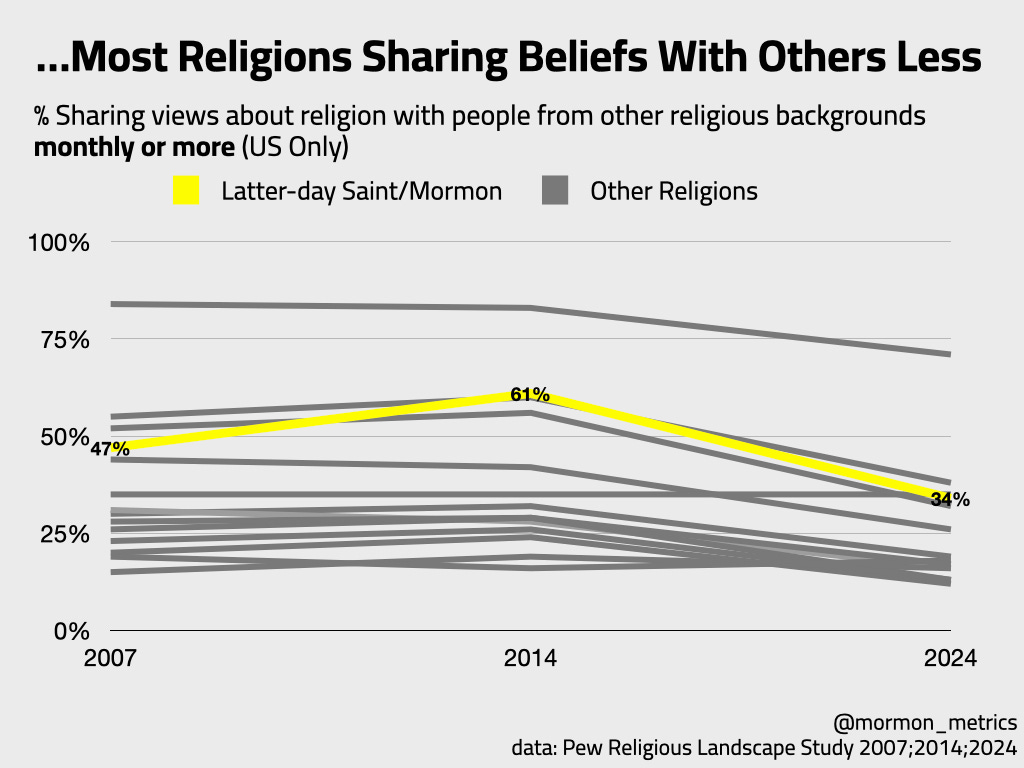
Interestingly, this trend is similar in other religious groups in the US population.
Are people becoming more hesitant to share their beliefs with others? If so, why?
What latter-day saint demographics and more likely to share?
My first thoughts went to region. Are people in the Jell-O belt different than those outside? What about members in blue states? Are members in blue states less likely to share?
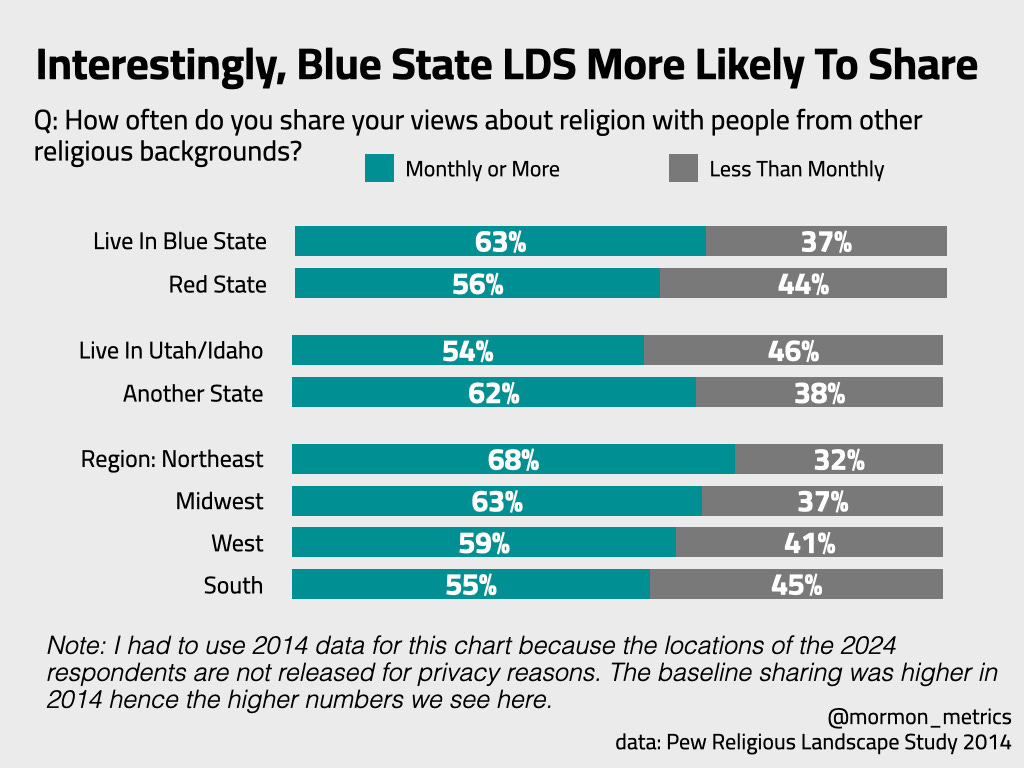
I was surprised to see that members living in Blue states were more likely to share than Red states. I originally thought that perhaps people in blue states would be less likely to share since being a democrat correlates with not being religious and perhaps you would be less likely to share to those not interested in religion. But, seeing the south on the bottom of the chart makes me wonder if members are worried about religious tension from passionate bible-belters and are therefore more hesitant to share. As I continually bring up, being religiously non affiliated is the most common religion that joins the church. If anything, this chart just raised more questions than answers for me. Curious on others thoughts on this.
As I mentioned in the caption of the above chart, because Pew has yet to release the location variables in their public file, we cannot tell how the regions changed from 2014 to 2024. I think this will be an interesting piece of the puzzle in understanding the decline in religious sharing. So stay tuned on a revisit when that data is released.
Additionally, I wondered about our usually demographics suspects: age, gender, and others. Are there differences there?
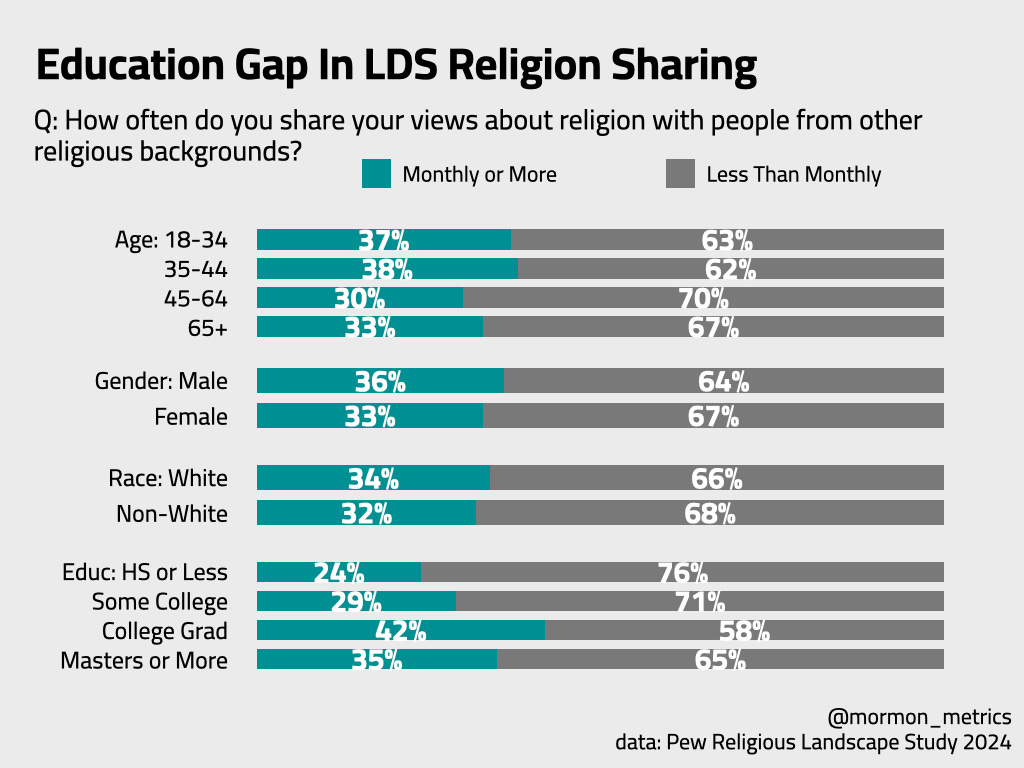
There really aren’t large differences in most demographics. The largest difference is by education: 24% those with HS or Less share monthly vs. 42% of those with only a bachelor degree. There is also perhaps a small age gap where younger people are more likely to share than older, but nothing much else to note.
Conclusion
So my takeaways…
In 2024, Latter-day Saint members are not sharing their religion as much from 61% sharing monthly or more in 2014 down to 34%. A large drop! However, this drop is not only affecting Latter-day Saints, most religions saw a similar drop. It seems like perhaps people are not talking about religion as much.
Jehovah’s Witness members clearly proselyte more often than other religions. Latter-day Saint proselyting was similar to Evangelicals and Black Protestants which is higher than the average religion with 34% of members sharing their beliefs with others not of their faith monthly or more.
Interestingly, members in Blue states share their religion more often than members in Red states. And, northeast members share more than members from the south. I hypothesized that this might be from members afraid of bible belt backlash and arguments from sharing though i’m not really sure. To really understand these differences we will have to wait until the location data is released for 2024 since we are currently using 2014 location data.
If something resonated or you found it interesting, like and share the post! Also, like I mentioned in the article, I would be interested to hear others thoughts and opinions about some of this content. Is this what you expected? Why are there regional differences in member gospel sharing?
See you next week!
Code available here. Download these publicly available datasets on Pew’s site here.
It really shouldn't be surprising that Jehovah's Witnesses lead in proselyting. They say it's not a requirement, but it's so highly encouraged that until just recently they had to report their hours.
https://apnews.com/article/jehovahs-witnesses-proselytizing-policy-change-2d1320da659a8a3dae4b136b55882e19