
General Authority Gender, Race, Ivy Education & Bonus Charts
Pt 3 of General Authority Representation Series


This is part 3 in a 3 part series on current LDS Leadership and representation. Here is a link to last week’s if you haven’t read it and here is part 1.
Today, as promised, I’ll show charts on gender and race. Also, since I received a lot of interesting follow-up on my last two posts, I included some bonus charts answering some follower questions. My code for all three posts and the dataset as well is linked at the bottom. Since the variables were summarized by AI based off of the General Authority summaries on the church website, mistakes are possible. If you see a mistake, please message me and I’ll update the dataset and charts accordingly.
Charts
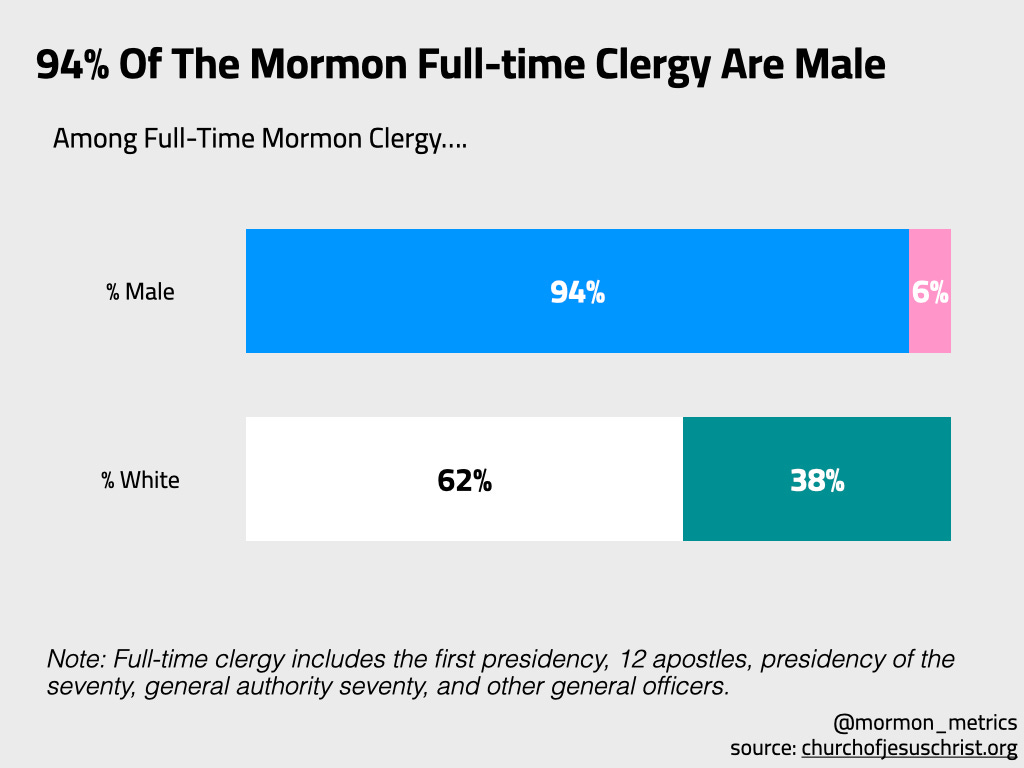
To no one’s surprise, there are more male than female full-time clergy — though perhaps it is helpful to see visualized in a chart.
As far as race goes, I actually think the church’s leadership is pretty racially balanced given the current membership population and I’ll talk about this more at the end of this post. But you can see a similar chart from a different angle in my first post where leadership representation by world region actually lines up pretty well with membership records. And, World birth region, of course, correlates with race. Though it’s true, the leadership likely skews white.
Now for a few IG follower and substack subscriber questions…
How are the the graduate degrees broken down? Can we get a closer look at that?
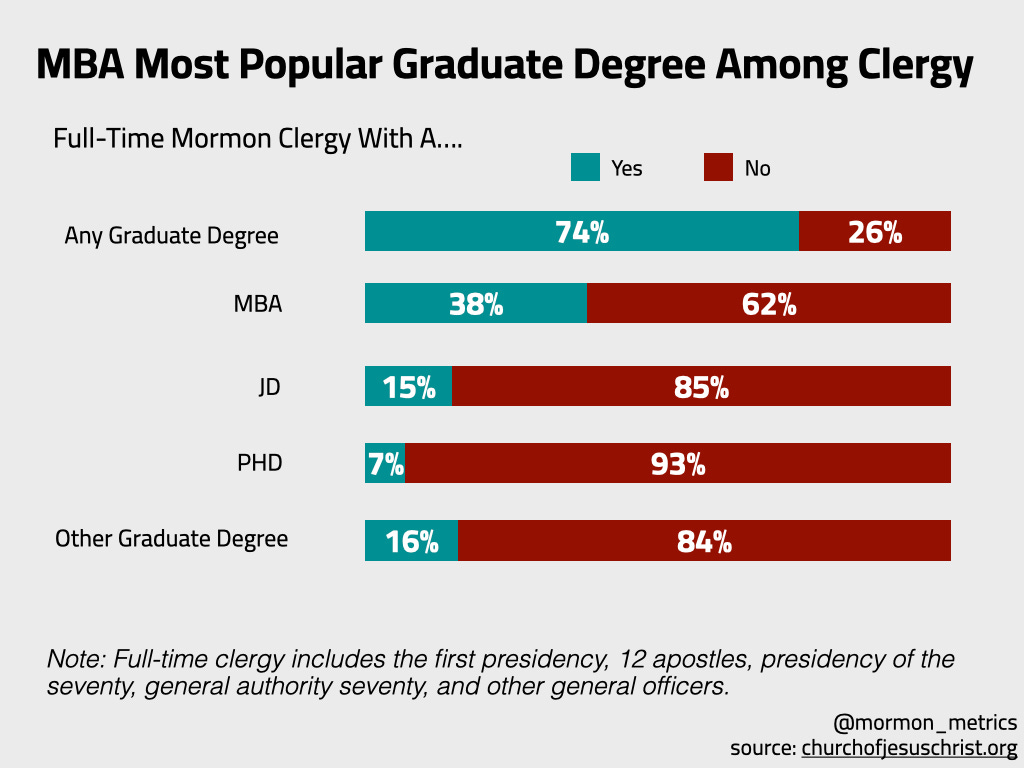
MBAs by far are the most popular degree among Full-time General Authorities followed by a JD. A fair amount of general authorities also have PhDs which I found a bit surprising. Here is another way to think about this chart…
3 in 4 General Authorities have a graduate degree
2 in 5 General Authorities have an MBA
1 in 7 General Authorities has a JD.
What about Ivy League education? I believe general authorities are more likely to have an Ivy League education, correct?
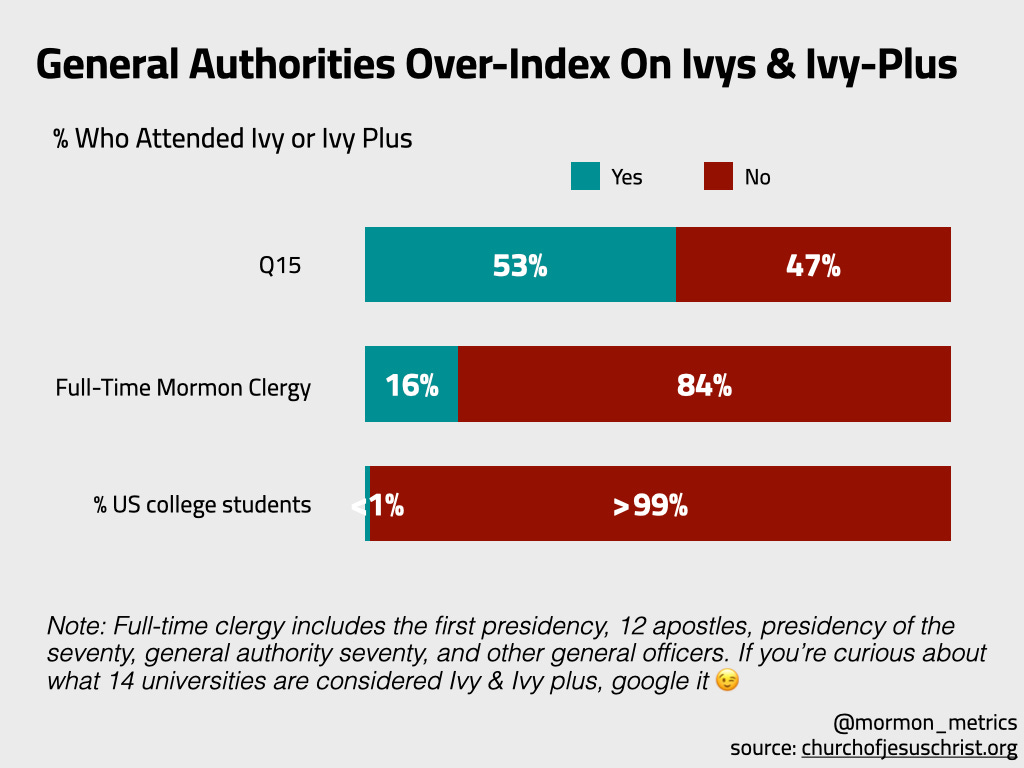
Yes, they are. Half of the Q15 have Ivy or Ivy-plus education. Full-time Mormon clergy are also more likely to have it.
More than 1 in 2 of the Q15 have Ivy or Ivy-plus education.
1 in 7 Full-time General Authorities have Ivy or Ivy-plus education
It obviously is difficult to find statistics on the proportion of LDS with an Ivy League degree, but for context of all US college students, less than 1% are enrolled in an Ivy or Ivy plus institution. And about 36% of the US population age 18+ have ever completed a college degree. Comparing to the world mormon population, I think it’s safe to say General Authorities also over-index on prestigious education degrees.
Are General Authorities More Likely To Attend BYU? How does it compare to University of Utah? (Alright no one actually asked for this question, but here is the data.)
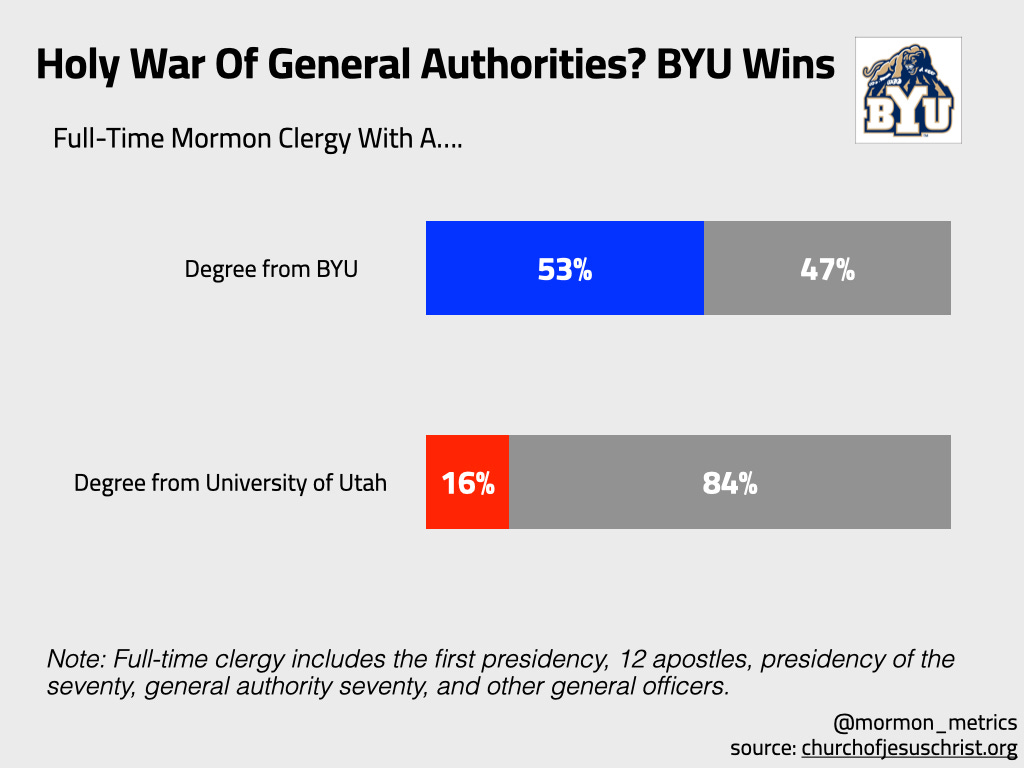
In retrospect, I would have included other Utah and Idaho universities as well like UVU, Utah State, and BYU-I, but I am writing this on the Holy war weekend.
Alright one last question and chart…
How does regional activity rate compare to leadership representation?
The idea here is that if you look at the active membership population, it is more representative of the leadership than just looking at all the people on church records. For example, perhaps Central and South America have lower activity rates which is why they under index on leadership.
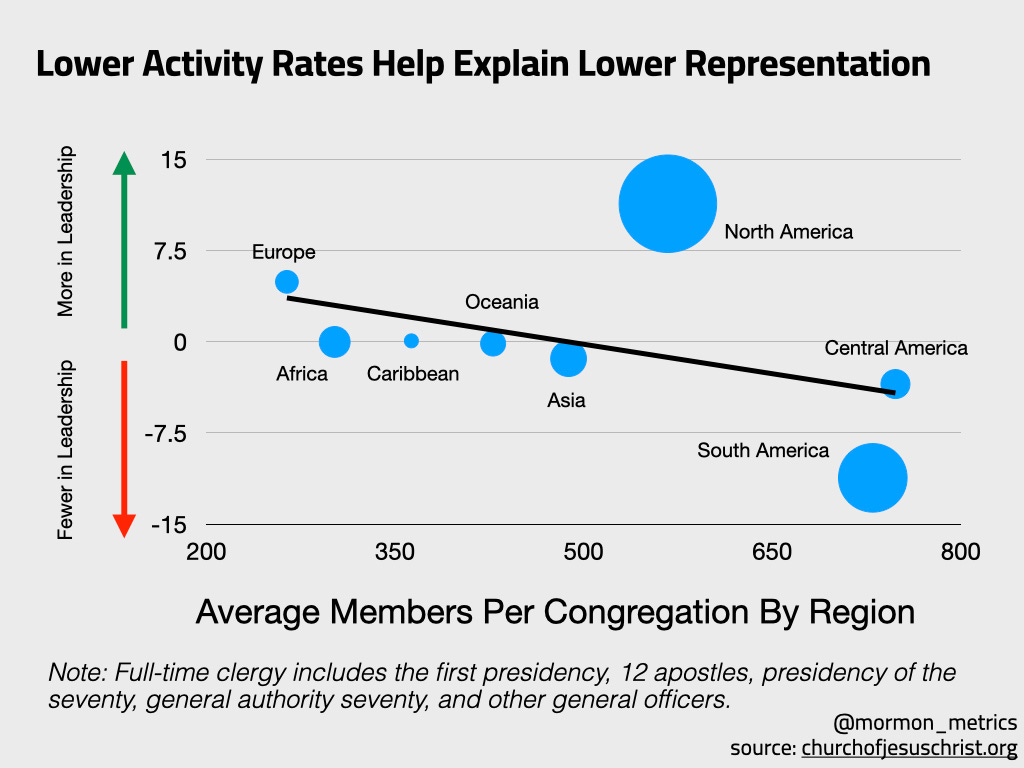
Sure enough, Central and South America have many more members per congregation (rough measure of activity) than several other regions. This suggests that the leadership disparity may not be as large when looking at Latin America.
Interestingly, North America has has a lower activity rates, yet still is the most proportionally represented world region. Though, I assume Mexico is bolstering the Average Members per Congregation numbers.
Conclusion
Thanks for tagging along for the 3 part representation series. Here are a few of my overall takeaways from the analysis…
Regionally, the Mormon Clergy Leadership are pretty close to representative. While probably a bit more white, I think racially the Mormon Clergy Leadership is fairly close to racially representative. We can see a correlation between regional activity rates and regional leadership representation which is also a good sign.
94% of full-time Mormon clergy are men.
General Authorities are much more likely to be educated at the graduate level (74% vs. 11%) and while I don’t have Ivy league numbers of the general Mormon population, probably general authorities are much more likely to have an Ivy League or Ivy Plus degree.
Is this data what you thought? Do you have any thoughts or comments?
As promised, the code for this post is here and here is a downloadable link to my dataset. Let me know if you see any errors, and I’ll update my charts.
This is good stuff; thanks for doing the work.
Data is so much more valuable than assumptions.
A few other readers have already mentioned language as a potential factor and I saw a comment about Europeans being more likely than South or Central Americans to have some Engliah proficiency.
Is there available data that shows Engliah proficiency around the world that would allow a comparison between all non-North American countries?
I would be fascinated to see Africa, Pacific Islands, South/Central America compared.
I wonder how much this will evolve as the leadership becomes more diverse still, especially when it comes to “elite” educational institutions. I don’t anticipate the education level to diminish, but I could see the diversity of educational institutions either becoming more varied or even more BYU-centered; especially as as BYU pathways is facilitating education for so many in other areas of the world.