
Does Garment Wearing Have A Gender Gap?
The answer is yes and no.


Introduction
TL;DR we see more evidence of a young adult gender religious gap (in garment wearing, today); though, we have yet to see how recent garment update may affect this.
If you are an at least somewhat online person in the mormo-sphere, it should be no surprise that more people are talking about garments. From an announcement this past October that the garment would be changing to the new garments now being sold in some places outside the US, there has been some chatter.
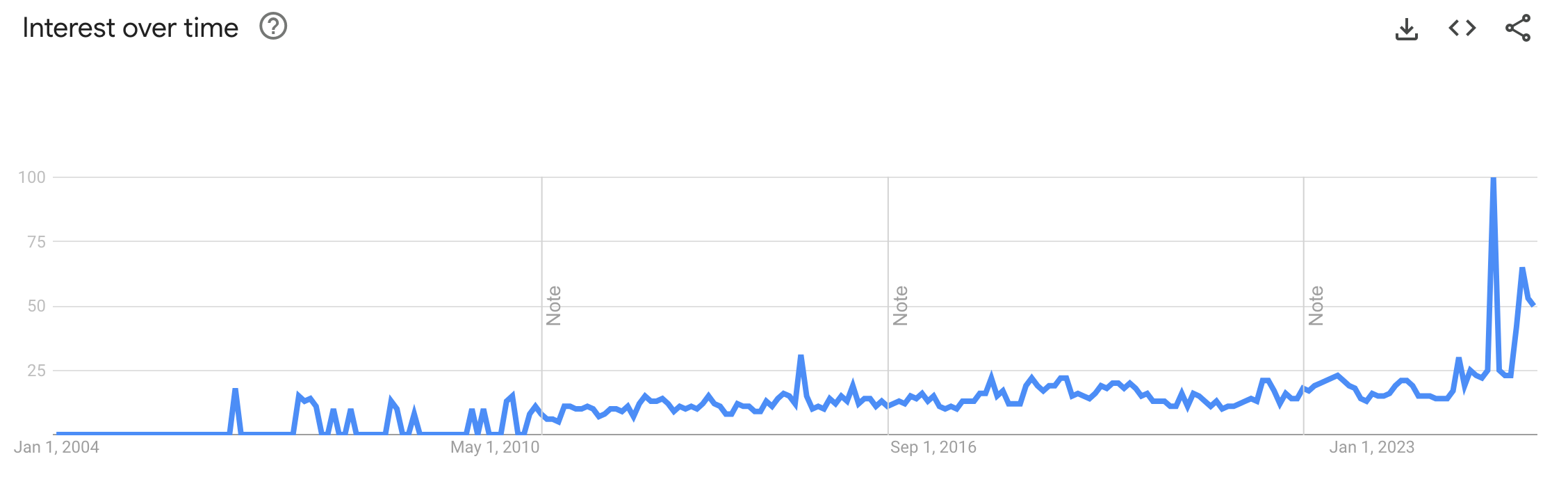
We can see the first “garment“ google search spike in October 2024 for the announcement and the next spike since they have gained online traction after being released - even the NYT picked up on this trend with a Deseret News response and you don’t have to go far to see influencers posting new garment-friendly outfits.
Also, the second season of Secret Lives of Mormon Wives released and in the first episode they showed a link with the title “younger Mormons now see garments as optional” saying they have revolutionized the Mormon church. Though, we will leave that right as it is.
Has garment behavior changed since the release?
Surely it will take time to tell the true effects of the above question. First, many US people have not gotten/may not get the new garments due to them being sold only in “hot/humid places.” And, once they get them, it may be an immediate change for some and a gradual change for others when/if they get the option for the updated garments. Then, after that, we will need a survey with a garments question, so it will likely take years to find out 🫤 (unless there is some other way to tell that I’m not thinking of).
Previously, I wrote about 2022-3 data from the Next Mormons Survey 2 (which has yet to be fully released). Today, we have 2023 data from the National Current and Former LDS Survey (B. H. Roberts Foundation) with a few breaks on garment wearing gender and age. In the future when another Mormon survey comes out fielded post 2024, we can use this data as a “before the garment update” reference point.

Charts
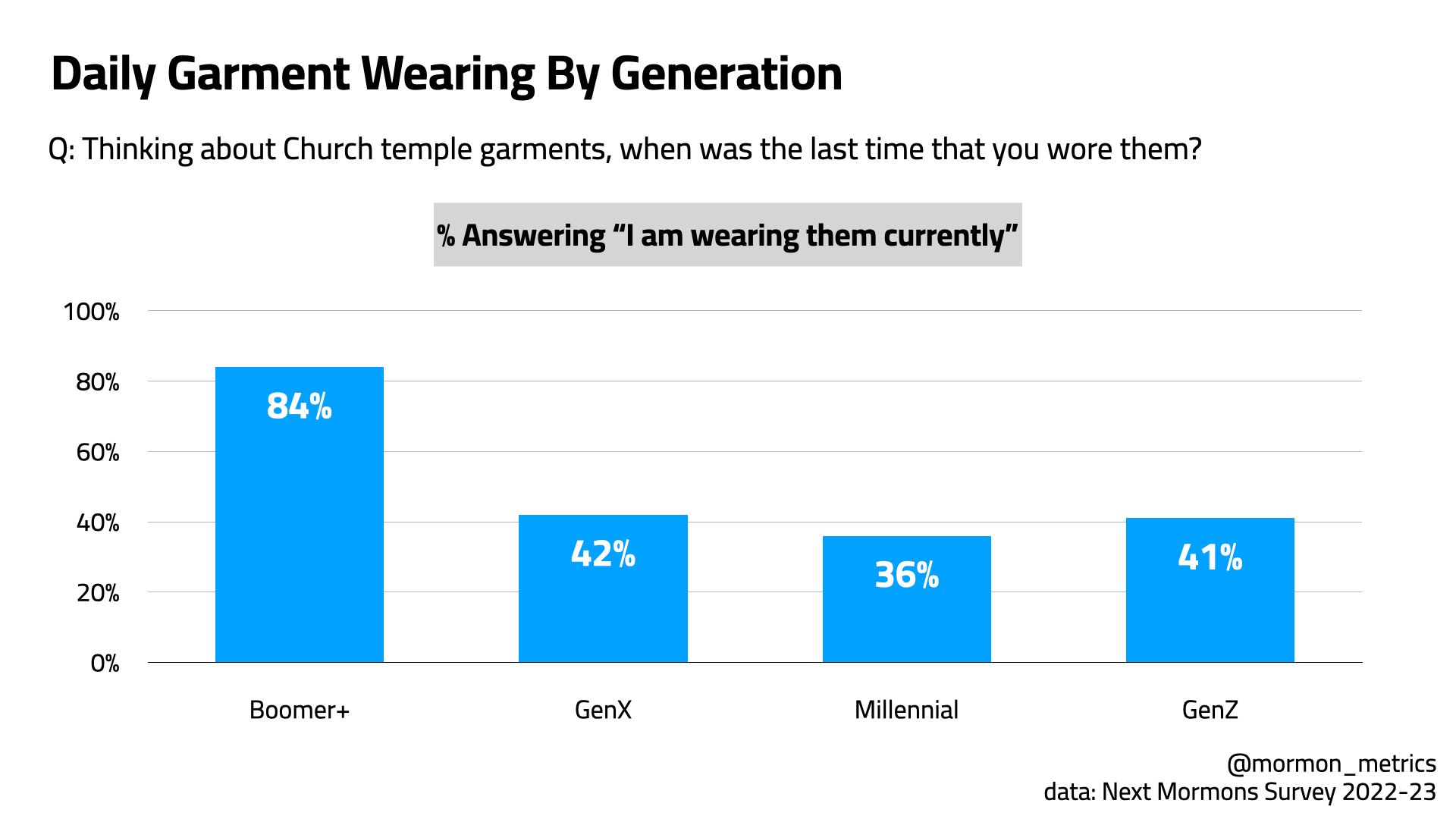
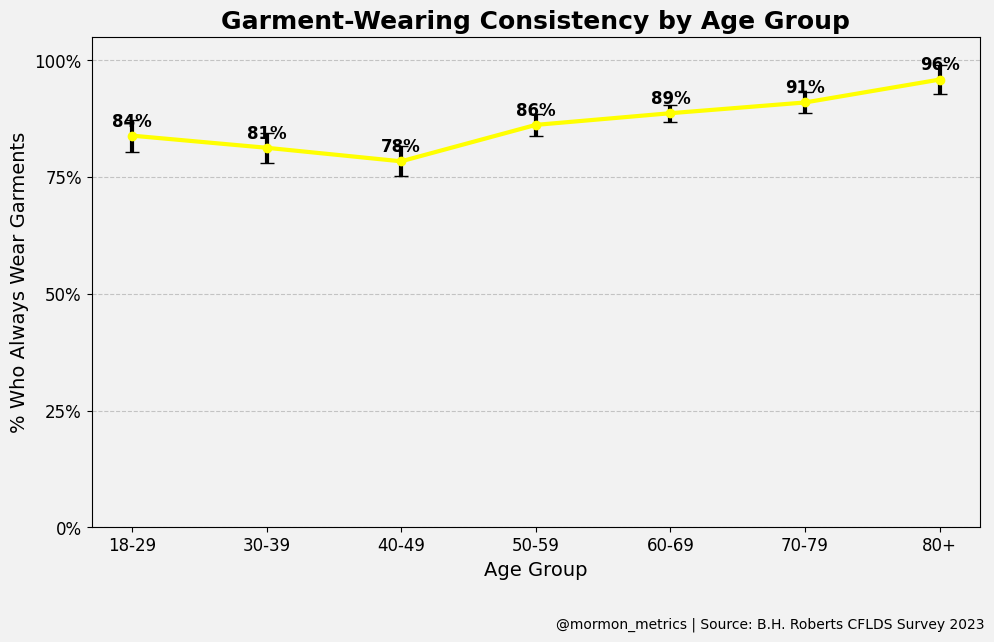
First, let’s talk about a key difference between the survey question in the NMS2 and the CFLDS. In the NMS2, the researchers asked if the respondent is “currently” wearing garments vs. for CFLDS they asked something to the effect of “how often do you wear garments?”
The differences in how respondents answer these question tell us something important. First here is the “are you currently wearing garments”
Now here is the “How often do you wear garments”…
Methodological note: the survey mode is different CFLDS using mailer + facebook recruiting VS NMS2 using internet panels which has some effect, but likely not at the level of difference we see between these charts.
Directionally, we see a similar relationship: younger groups are less likely to report wearing them, but look at the gap between the two datasets! Every age group reports wearing them currently at a lower rate than “if they always wear them.” Interestingly, the gap is much larger for younger generations. For Boomer aged people, we see 90s% vs. 84%, but for the other generations its 80s% vs. 40s%. So, ~5% among older gap to ~20% among younger!
To me this is suggestive of a more lax interpretation of “always wearing the garment” in the younger generation vs. the older one. Most younger generations perceive themselves as wearing the garment similar to older people in both groups 80s and 90s% saying “always.” But, in practice, “always” wearing your garments may have a different meaning between generations (85% older wearing them currently vs. 40s% younger).
Is there a gender difference in garment wearing?
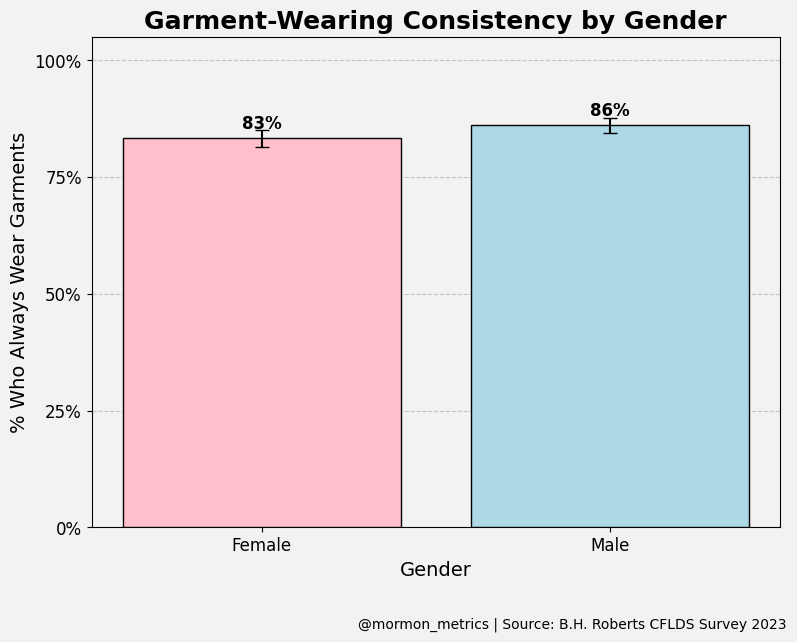
As others have written, no - at least in aggregate. But, what if we break it down one step further looking at gender and age…
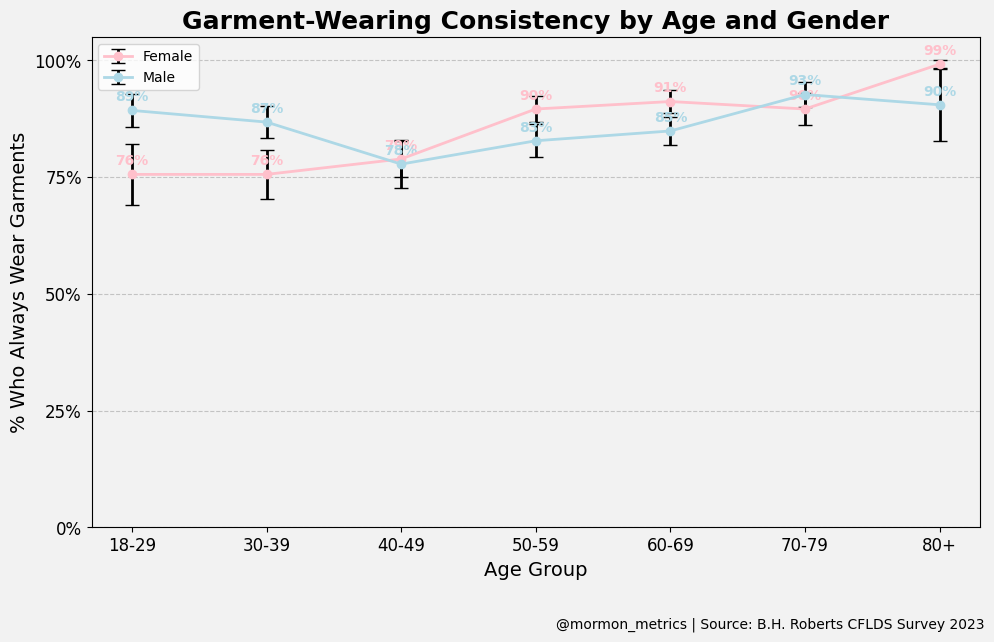
Let me point out a few things here…
First, let’s look only at women. Younger women are statistically less likely to wear garments always compared to older women.
Looking only at men. Men do not appear statistically less likely wear garments always by age.
And now age & gender, we see more evidence for our Mormon young adult gender religion gap. Young men are more likely to report “always” wearing garments compared to young women. There is not a clear (statistically significant) division for older men and women, but our best estimate suggests that older women seem to report wearing “always” more than men.
One caveat I will note is this question was asked only of endowed members, but there is likely a meaningful group of young adult women 18-30 who have not served missions or married yet will be endowed in the coming years. Its possible that this group could believe differently and change our estimate of young adult women 18-30. So, keep that in mind in interpretation for both how members interpret “always“ wearing and in self-reporting garment wearing.
Conclusion
Let’s summarize a few things…
There is likely a different interpretation of “always” wearing your garments between young and old. Older are much more likely to be “currently” wearing garments though young and old report “always” wearing at similar rates.
In aggregate, we don’t see a statistically significant gender gap; however, breaking things down by gender and age, we see young women are less likely to wear garments compared to young men while older women are similar if not more committed than older men in garment wearing.
Like I mentioned above, both of these findings are assuming young unendowed women (who may be endowed soon) behave similarly to young endowed women.
I am quite excited about future releases of survey data 2025+ to answer more questions.. Did the garment change reduce the young adult gender gap in garment wearing? Stay tuned for answers - though it might be a while before we know.
Let me know what you think in the comments if I missed/overlooked anything or if you have thoughts you want to share 🙂.
See you next week!