
What Careers Do General Authorities Choose?
Pt 2 exploring Mormon Leadership Representation


This is part 2 in a 3 part series on current LDS Leadership and representation. Here is a link to last week’s if you haven’t read it. Next week, I’ll talk about gender/race and look at a few follow-up questions from subscribers like… Is there a relationship between regional activity level and regional leadership representation?
Are full-time general authorities more likely to have gone to college? What about to grad school? Are full-time general authorities more likely to have chosen careers in certain sectors?
Today, we’ll look at these questions. Though I neglected to include it last week, for anyone interested in my dataset I wrote a footnote on my process of scraping and utilizing AI to create it which I will fully release next week: code, data, and all.1
As a reminder, I focus only on the 152 Full-Time general authorities which includes the first presidency, quorum of the twelve, general authority seventy, and other general officers.
I would have used an international survey of Mormons if I had one, but the US Cooperative Election Study sample is the largest and best public resource we have!
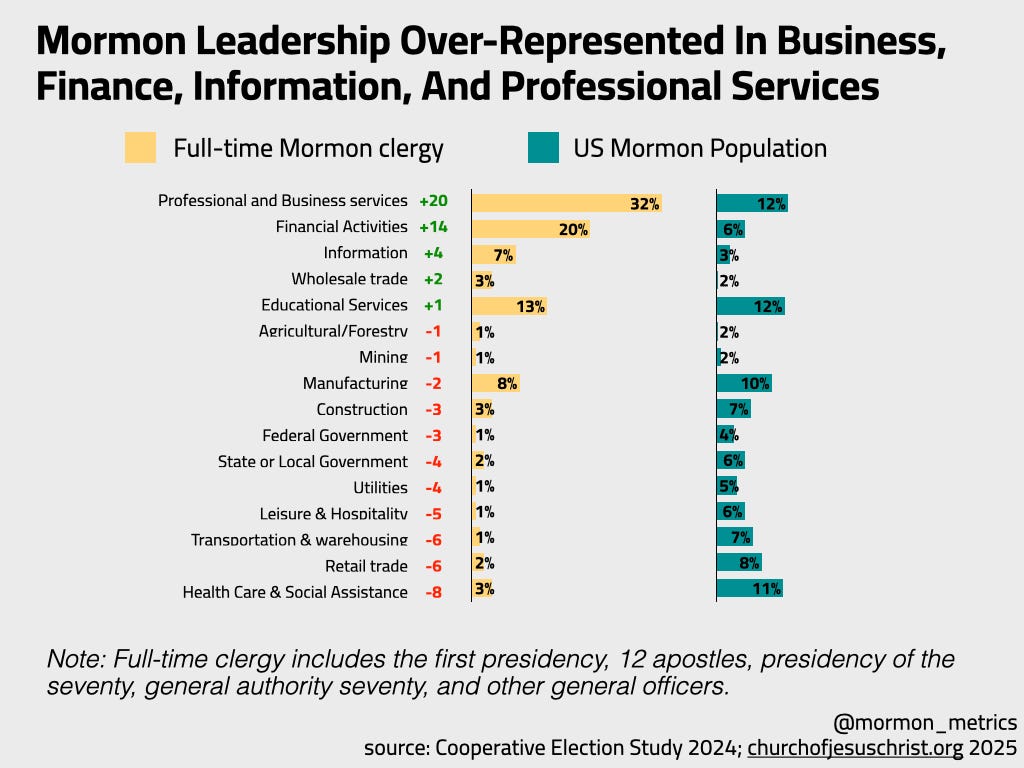
Let’s first look at how the 152 general authority leadership breakout into different careers. The cooperative election study has a question about which field you work in, so I asked AI to summarize each General Authorities career (given their bio) using the same categories as are asked in the CES.2
The industry types are sorted by careers most over-represented to careers most under-represented by general authorities.
Topping the list, general authorities are most likely to have careers in business, finance, and information. I also assumed “professional services” included things like law, but let me know if you think differently.
At the bottom, we are less likely to see general authorities in leisure/hospitality, transportation and warehousing, retail trade, and health care and social assistance.
Personally, I was surprised by the low proportion in “health care and social assistance.” Perhaps it is more rare than common for there to be a health professional prophet and to have at least one more in the current quorum of the twelve (I'm thinking of Elder Renlund).
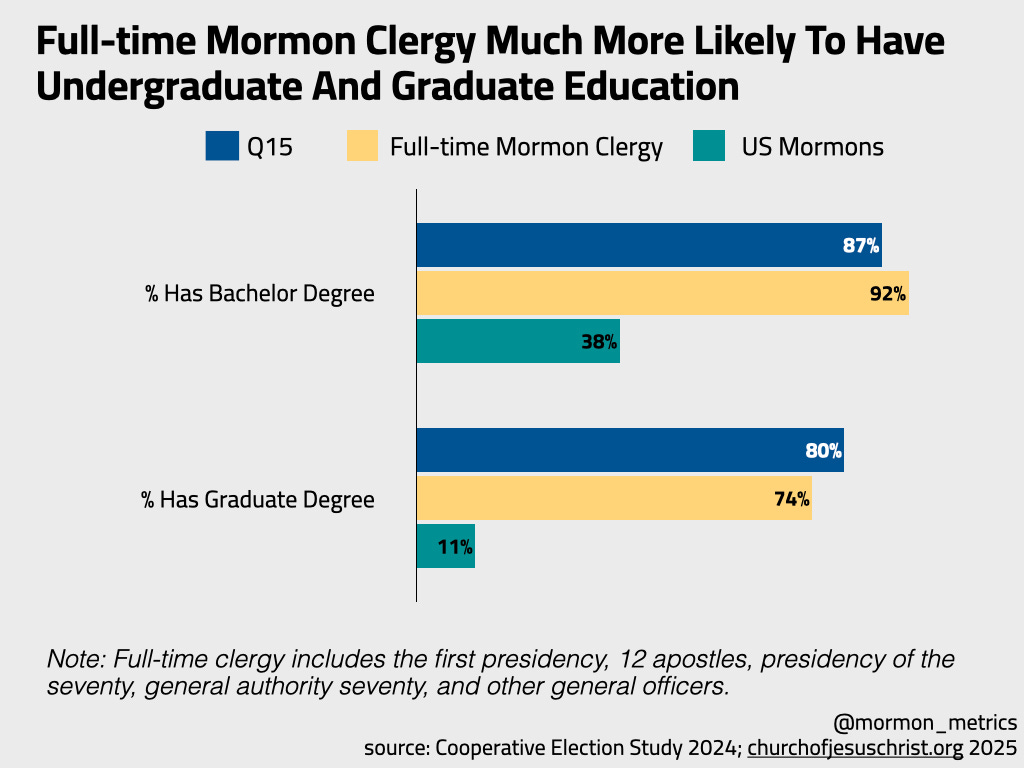
Edit: I updated this graph after I was informed that Elder Rasband started, but did not finish a bachelors degree. Later, he received an honorary degree from UVU, but never formally finished. So, I updated the numbers on this chart to reflect that.
Looking at education, there is very sharp difference between education in the US Mormon population (which is likely to be more formally educated on average than the overall Mormon population) and of the Full-time Mormon Clergy. The Q15 are also very likely to be formally educated and more likely to have a graduate degree than the Full-time clergy.
To my surprise, there are two apostles without a bachelor’s degree (to my knowledge; please correct if I am wrong) and that is Elder Patrick Kearon and Elder Ronald Rasband. Kearon worked in several countries for Nestle and eventually ran his own communications consultancy, but I could not find any record of bachelor or graduate level education. Rasband started, but never finished a bachelor’s degree at the University of Utah. He was later awarded an honorary degree at UVU.
So, what do you think of this data?
Are you surprised by general authority over-representation in fields like business, finance, and information? Why do you think this is the case?
Did you know about the difference in education level by leaders? Do you think education is important for church leadership?
Feel free to let me know what you think. I know these can be sensitive topics, but I’ve always been impressed by the respectfulness and quality of the comments I receive. So, thank you and excited to hear your thoughts!
The data in the charts this week is from two places: 1. the first source will be familiar to readers from the latest wave of the Cooperative Election Study and 2. I scraped information from the church website where each of the 152 full-time general authorities have a bio describing several life facts including birth date, education, career choice, former callings, birth place, etc. After scraping the webpages, I used AI to summarize the text and create categories. Looking through things matched up pretty well, but errors are possible. Hence, in the next post, I will release my dataset and code where anyone can look and double check AI’s work. If there are discrepancies found, I will update my posts accordingly.
There was one hiccup in this process where some people in the CES (17% of Mormons) selected “other services,“ but AI did not classify even one general authority as “other services.“ I assumed that for edge case careers, respondents would select “other services” while AI just picked a relevant category. Perhaps there are “other services” or perhaps some respondents didn’t want to think too hard about where their job fit and decided to pick “other services.” I decided to set the other services as NA in the CES for this reason to hopefully get a more apples-to-apples comparison, but this is a limitation.
Great analysis, Alex. Something I think would be interesting to drill down on is whether there has been a change in over- or under-representation over time. I'm sure it would be difficult to find the datasets to answer this, but I'd be very interested in the result.
A bit of a side note, but just thinking through the scriptures, I'm not sure prophets have ever been a representative sample: Moses — raised by Pharaoh; Sons of Mosiah — princes; Alma Sr. — priest and counselor to the king; generational prophets — all throughout the scriptures; Moroni — chief general. This is obviously anecdotal evidence, and there are of course outliers (Joseph Smith, Christ’s Twelve Apostles).
I also think dividing up business and professional could be useful. I would like to see business and law split. An MBA or even PHD in Business seems a very different preparation from law school.