
Concerning Garments
Assorted Data Points Given Recent Change


Introduction
Yes, this one was supposed to be a political post, but did you hear? There was a garment update! And, whenever there are changes like this, I like to share relevant data points to the discussion. Also, don't worry the political posts are still on their way…
The garment redesign was specifically for “hot and humid“ areas and essentially doesn’t cover as much on the shoulders which has been confirmed by the church.
Data
Today, I am pulling data from the work of Jana Riess from a recent Religion News Service article and from her book The Next Mormons. Also, I look at the corpus of all LDS general conference text for a quick search.
Charts
Modesty and garments to me are connected. Members, particularly women, find clothes that need to cover up their garments. You don’t have to cover up your garments, but leaving them partially exposed might look strange or draw unwanted questions. There is a theological argument that modesty and garment-wearing are independent principles, but in a practical sense there is a relationship… If garments were no longer required, members would likely take more liberty in clothing styles meaning it would likely affect how members practice the principle of modesty. Hence, the connection.
So, how have words like “modesty“ usage changed over time. While we can’t see all the words spoken in young women classrooms, we can see what they say in General Conference. And, “modesty“ has been mentioned significantly less.
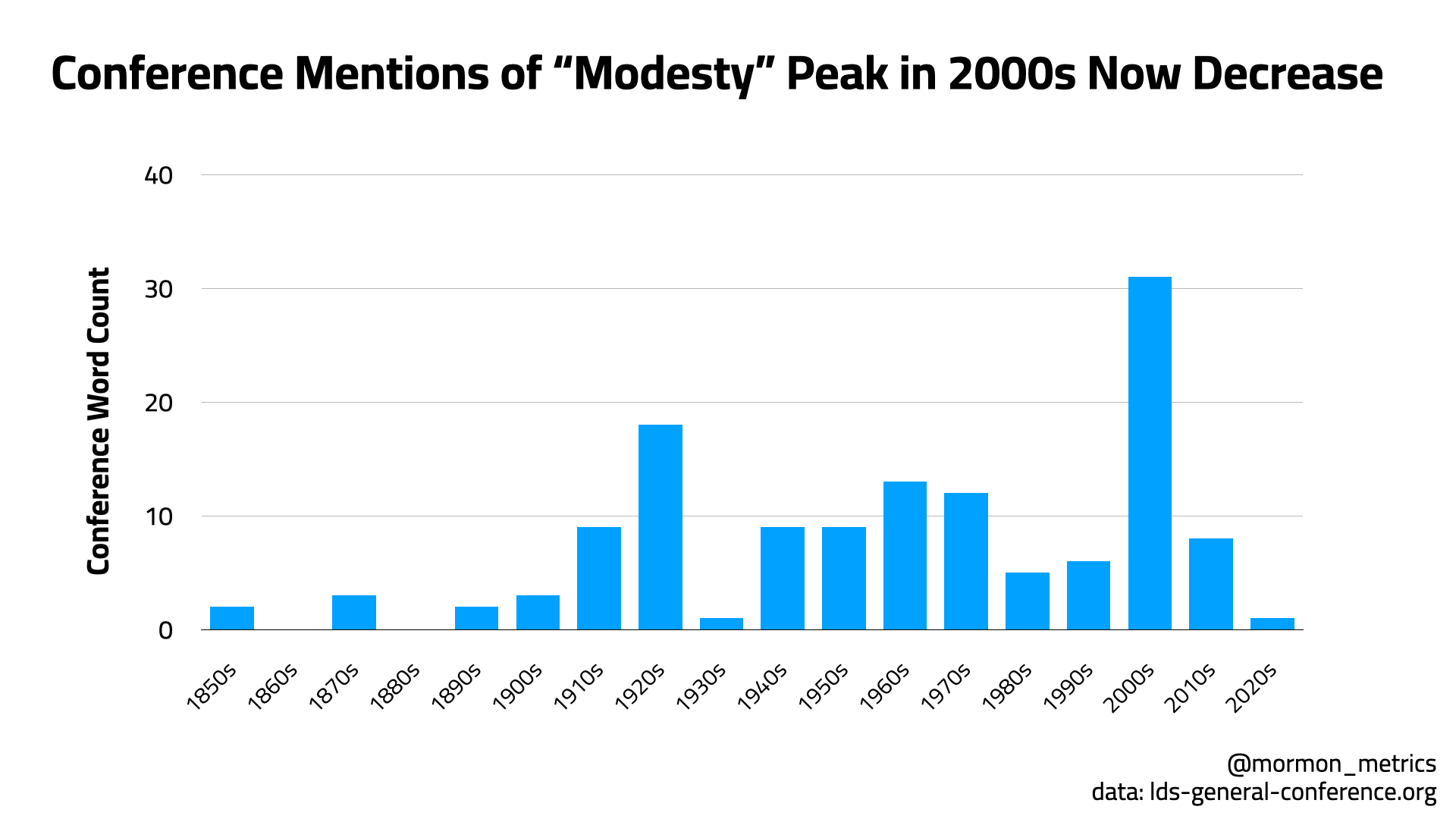
We see modesty peaking in the 2000s, decreasing significantly in the 2010s, and since 2020 “modesty“ has only been mentioned once in General Conference. Perhaps, this is suggestive of a change in focus.
Now, let’s look at some behavior data about Mormons and Garments.
The first chart looks specifically at garment wearing. Respondents who were endowed in the temple were asked if they were wearing garments at the time of taking the survey.
Side note: They could have asked “how often do you wear garments” to answer this question, but it might be subject to social desirability bias. In other words, they may report wearing them more often than they actually do because it is more socially acceptable to wear them. I think the researchers made a good choice in asking do you have them on “currently“ which is a more straightforward question and answer.
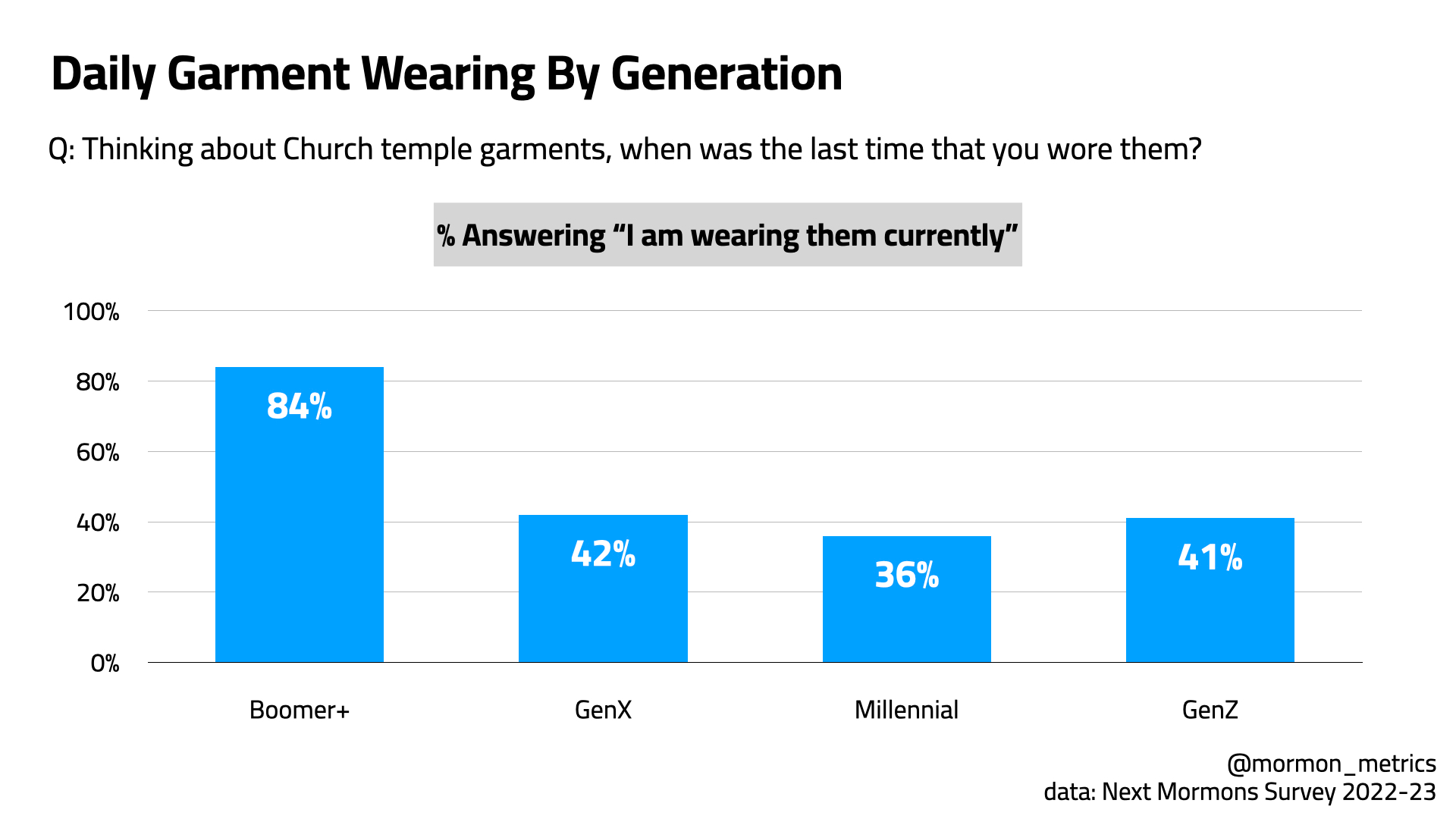
There is a big age gap. Boomers are twice as likely to wear garments than any other generation.
What also stuck out to me about this chart is that there really isn’t a huge difference between Millennials and GenX. I expected a more gradual shift in the data, where GenX would be 60% or something similar. Perhaps something happened in the GenX generation that changed views on garment wearing and has stayed consistent since.
When asked about when it is OK to remove garments, we see another generational gap.
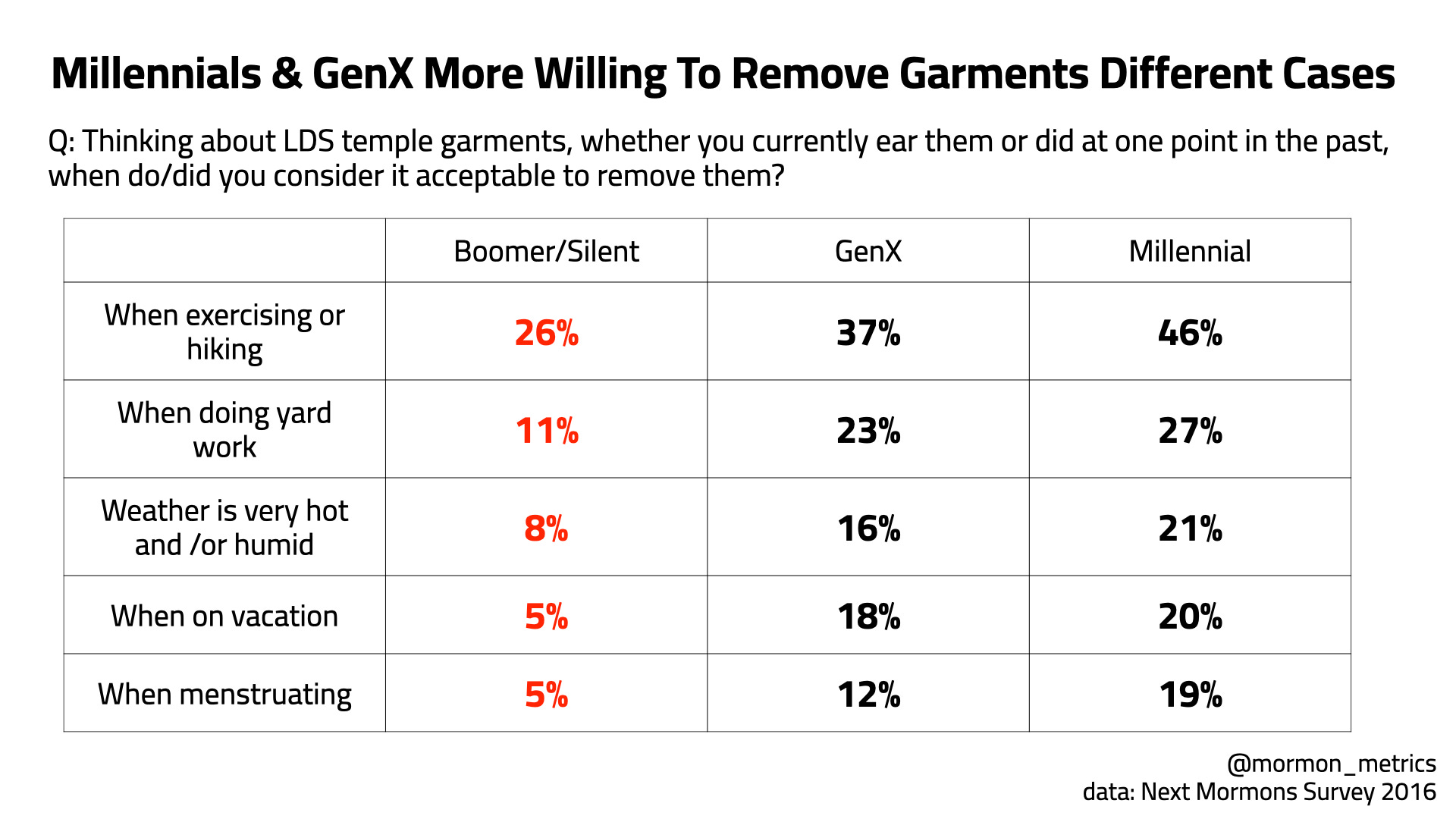
GenZ wasn’t included since the survey was only from 2016 and there wasn’t a large enough sample of endowed GenZers.
Boomers are much less likely to think its OK to remove garments than the other two generations. Also, notice again how much closer GenX are to Millennials than to Boomers.
Conclusion & Discussion
The recent garment change could have been inspired by at least two trends.
“Modesty“ - which is connected to garment wearing - is not focused on as much as it used to.
Younger members (GenX, Millennials, and GenZ) are not wearing garments as much and find more scenarios socially acceptable to remove them.
What, in your opinion, has caused this generational gap?