
What Are Mormons Opinions of Other Mormons?
Comparing In-Group Opinions of Mormons vs. Other Religious Groups


Introduction
Growing up in an active Latter-day Saint home, I often heard other members say that the latter-day saints had tight-nit and a close community. Looking back on my childhood, I felt close to other congregation members and I believe this is true. Having served a mission in Salt Lake, I heard complaints about members being too tight-nit to the point of exclusion of non-members. Before writing this post, I didn’t have much of a sense if my religious community experience was personal to me growing up in Mormonism, or if members of other churches felt similarly.
In the past, we looked at how other people feel about Mormons (see link below). Today, I want to look at how Mormons feel about their own group, and how this compares to other religious groups.

A lot more data than I have here is needed to understand this topic, but what I have today adds to the discussion of religious community and in-group religious attitudes in the US. So, let's dive in.
Data
Pew Research releases most of their raw survey data files to the public after they have reported on it. This means that we can dive into the nitty-gritty and the details of the data from their reports. I’ve written about this particular dataset before. If you are interested in more details on this survey, view here.
Charts
Our first chart looks at the In-Group Favorability of 6 different religious groups. As seen in the chart below, In-Group Favorability is defined as those who answer “very“ or “somewhat“ favorable to the religious group they identify as.
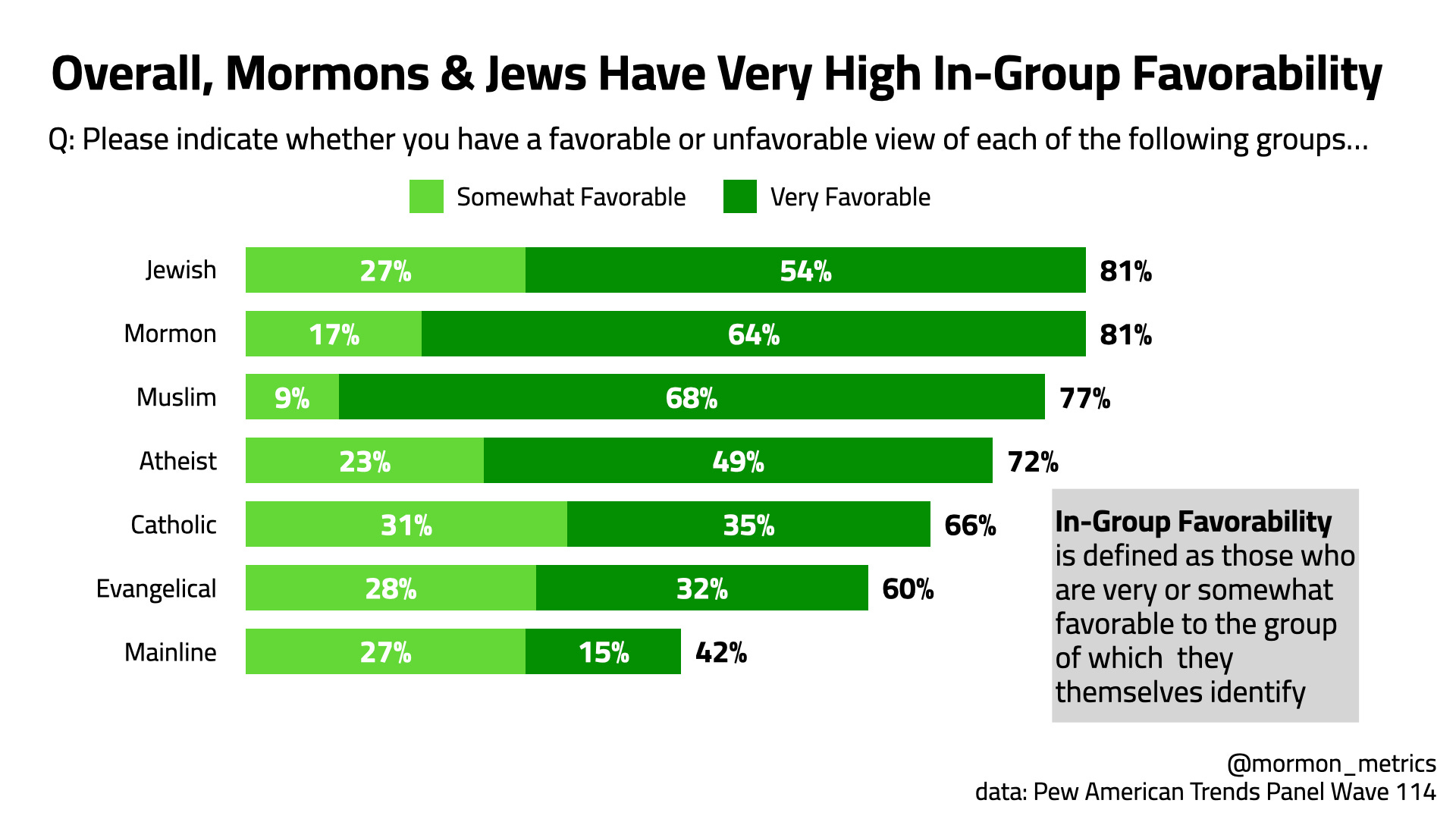
Interestingly, in-group favorability varies by religion. For example, Mormons and Jews have nearly double the in-group favorability of Mainline Protestants - 81% of Mormons and Jews are favorable to their own group! Also, look at the proportions saying “somewhat“ vs. “very“ favorable. Proportionally, there are a lot more Jews, Mormons, and Muslims indicating stronger opinions saying “very favorable“ than mainlines or catholics saying “very favorable.”
To me, this indicates that #1 Mormons feel strongly positive about their community. And #2, there are other religious groups who feel similarly strong as Mormons to their respective religious groups (e.g. Jews and Muslims). Perhaps these religions could have a similar feeling of community.
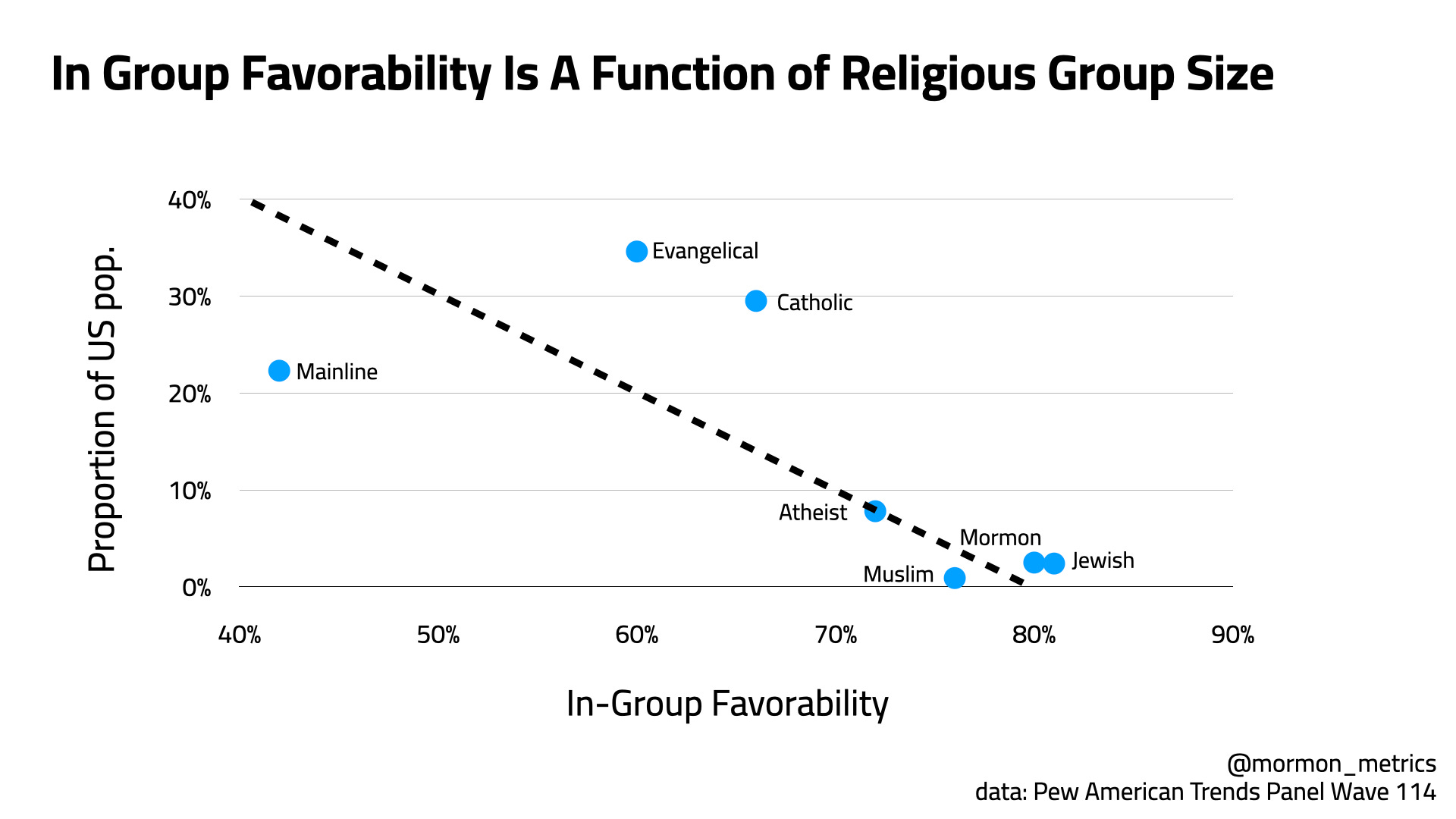
As you may have been thinking, Yes, in-group favorability is negatively correlated to the proportional group size in the US. So, members of smaller groups tend to have stronger positive opinions of their group.
One problem with this analysis is it doesn’t really get at the community in these religious groups - only their opinions of their group. For example, atheists have strong positive opinions of their group, but I can’t think of a national “church“ or community in the same way for atheists as other religions. Let me know if I am wrong here for anyone who knows better than me!
I would guess people who have strong positive opinions of a group they are a part of may be correlated with feeling strong community, but I am not sure as each group is probably different in gatherings and in feeling of community. I would love to see survey data asking questions about people’s religious community and friendship.
My analysis complements this chart by Ryan Burge:
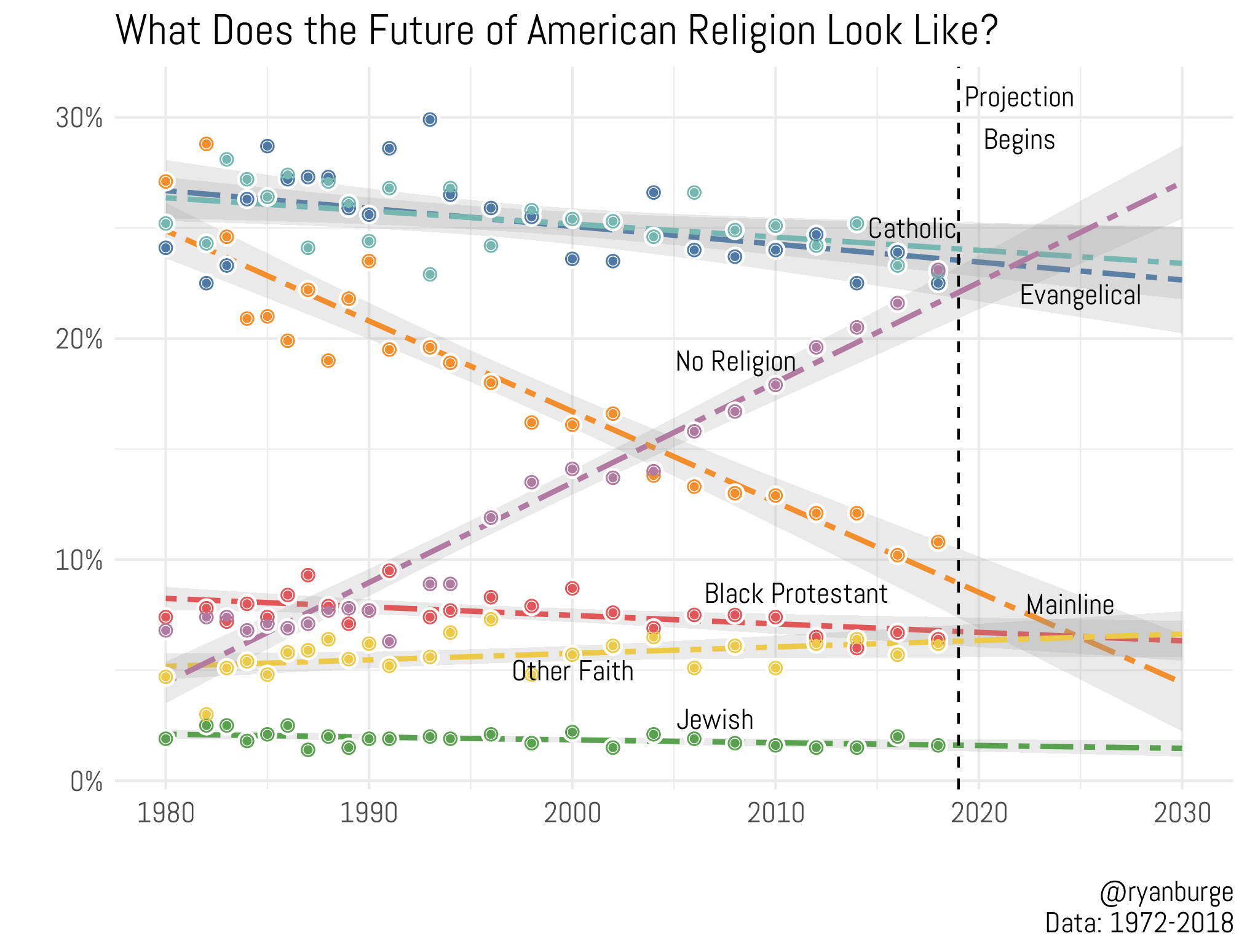
The chart is showing the rise of “No Religion“ Americans and decrease of some religions especially mainline protestants. Before, we saw mainline protestants had the lowest in-group favorability, so perhaps the two are related. In-group favorability could be indicative of the health of a religion - at least with respect to membership. Mainline Protestants have the lowest relative favorability and significantly decrease in membership in the chart above. Catholics and Evangelicals have lower in-group favorability and are decreasing in membership a little bit. Mormon, Muslim, and Jewish groups are high in-group favorability, and are flat or increasing in membership. The takeaway could be high in-group favorability doesn’t necessarily increase a religion’s membership, but lower in-group favorability is correlated with a decrease in membership over time.
Discussion
Do you think other smaller religions offer a similar community to members as Mormons?