
Are Latter-day Saints More Likely To Travel?
Looking at data from Pew's American Trends Panel


Introduction
As with many of my posts, this post is inspired by a previous Ryan Burge post looking at travel across large US religions here. He did not include numbers for Latter-day Saints because of the low n-size (n=58 of the total 3,576 sample; click here for the study). However, as with many of my posts, I think having a heuristic/fuzzy answer is better than just simply no answer at all.
Theoretically, we should expect Latter-day Saints to travel more on average because of missions which would take some out of the country who may not leave otherwise, but let’s see what our charts say.
Charts
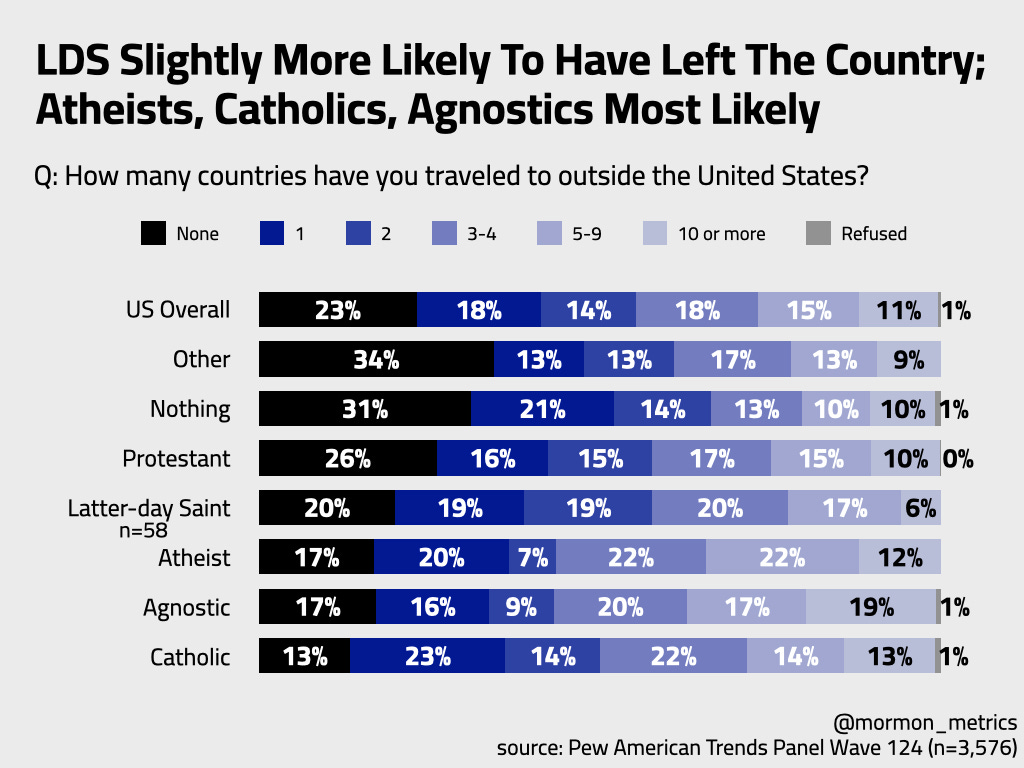
Looking at the data, Latter-day Saints are directionally more likely to have traveled, with 20% having visited no foreign countries compared to 23% of the U.S. overall. With our small sample size, there is no real detectable statistical difference between these numbers, but it represents our best heuristic guess.
This aligns fairly closely with my perception. If a mission was a massive driver of international travel, we might expect the “1 country” bucket to be significantly larger than the rest. However, it’s important to remember that many missionaries originating from the U.S. are assigned to domestic missions.
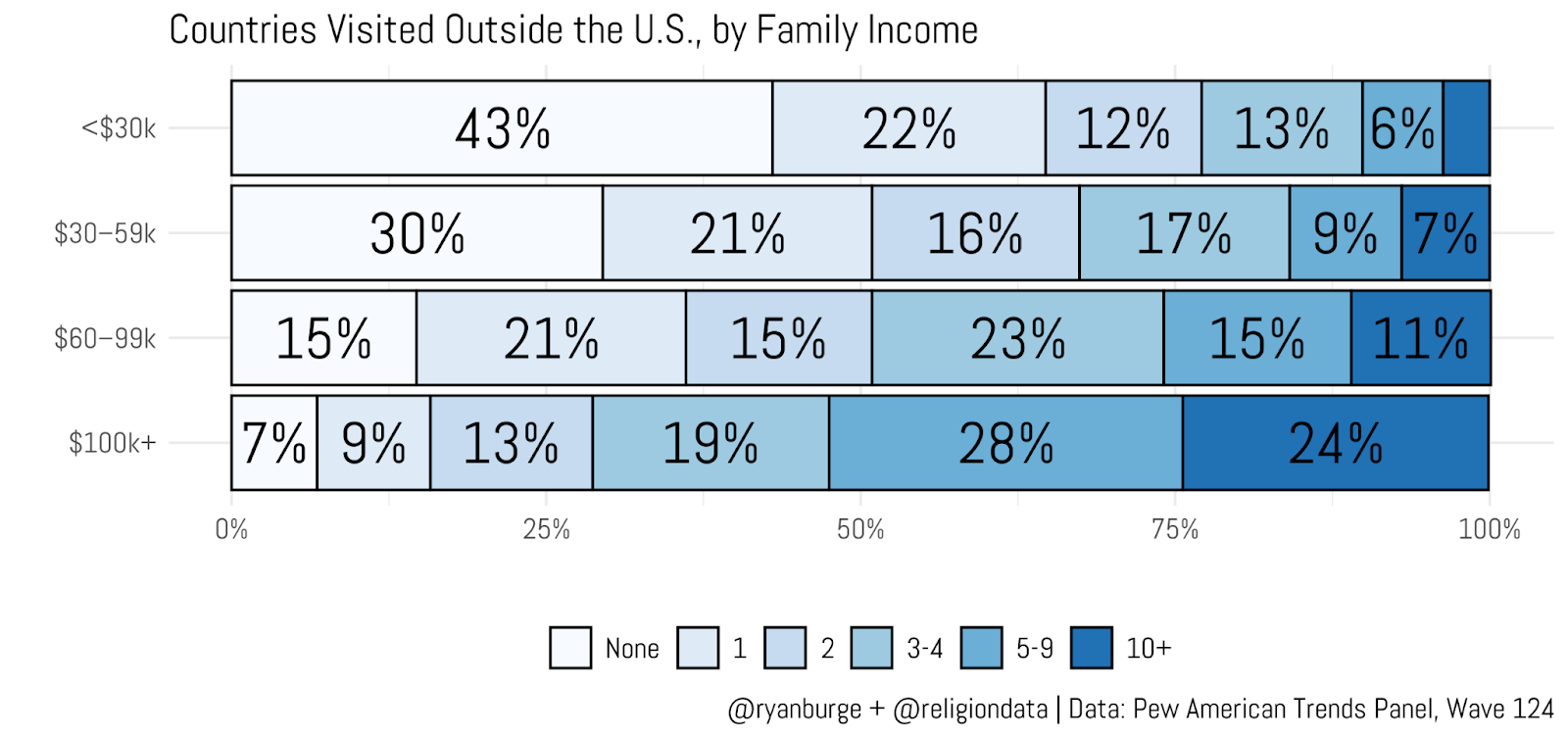
Another reservation I have with the mission=more traveling theory is the wealth factor. As Ryan described in his post, wealthy people are generally more likely to travel. Furthermore, those who haven’t traveled are highly likely to say they want to (see chart below)—leading us to infer that financial constraints are the primary barrier.
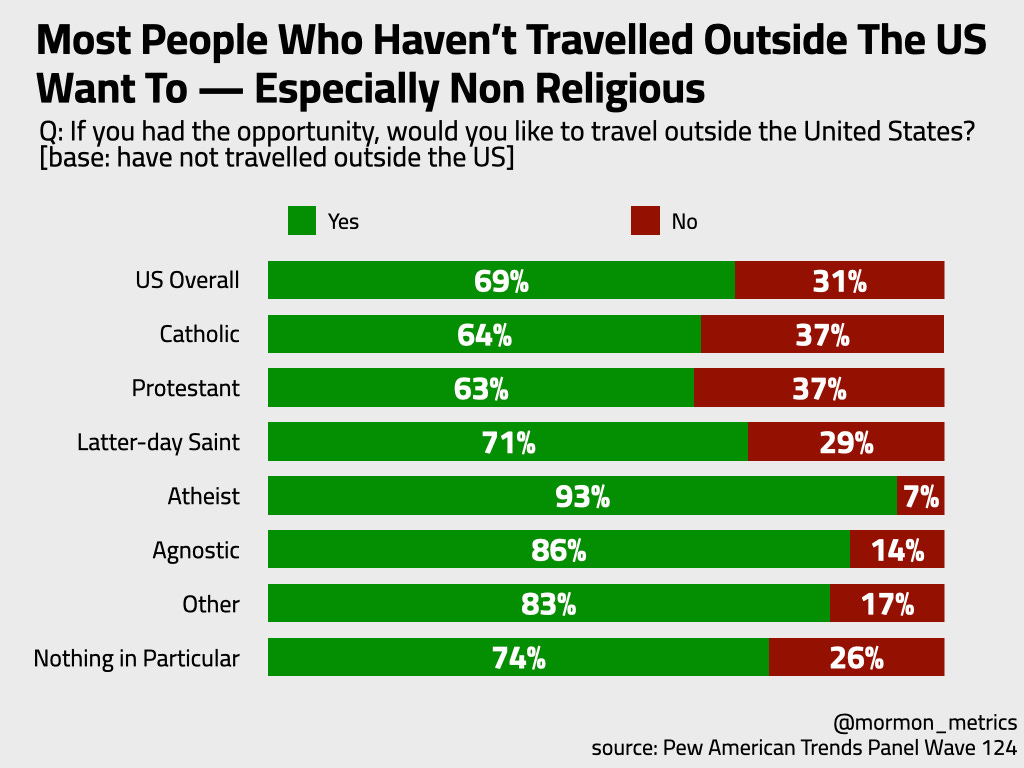
While the modern Church structure ensures that lower-income individuals can serve via ward or general missionary funds if they cannot afford the monthly cost, the opportunity cost is a different story. Young adults from poorer backgrounds might feel more financial pressure to enter the workforce or support their families rather than taking two years off, making them less likely to serve. I'm curious to hear your thoughts/experiences or if someone has more concrete data on this topic.
What’s Next?
Next week, we are tackling a massive question: Are Latter-day Saints beating the secular headwinds?
We’ve already established three baseline facts:
Religious orthodoxy in the U.S. overall is experiencing a macro-level decline.
LDS orthodoxy has declined over time.
As a snapshot in time, LDS remain notably more religious than other groups (echoing recent BYU research).
But here is the real test: is orthodoxy declining faster or slower for LDS compared to other religions? Pinning down a perfect, causal answer with observational data is notoriously tough, but I’ll be diving deep into the numbers we have to see what the trendlines actually show.
See you then.
Code for this post is available here.