
April 2026 General Conference Stats: Record Baptisms, But The Birth Problem Persists
Let's look at some trend charts over time


Come back next week for an exciting release of a new dashboard I’m building out with the latest data that I think will resonate with many folks here.
With the 2026 April General Conference just passing, we have the 2025 statistics to dig into. If you don’t want to get bogged down in the analysis, the TLDR?
The missionary story just got even better. The structural problems didn’t go away.
Convert Baptisms Hit An All-Time High
I’ll start with the headline number, because it deserves to be the headline.
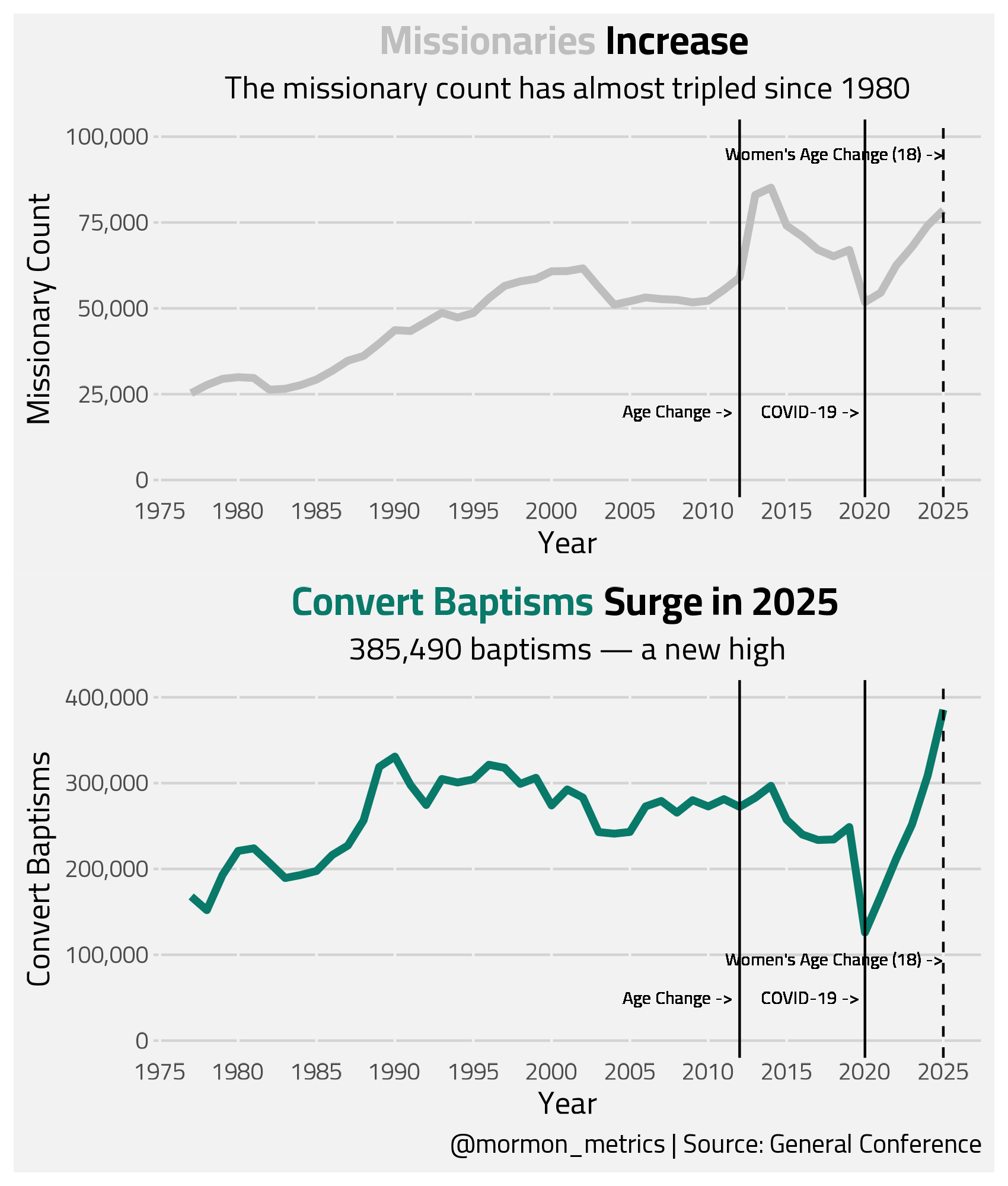
In 2025, the church recorded 385,490 convert baptisms — a new all-time high. To put that in perspective, this surpasses the previous peaks from the early 1990s and represents a continuation of the post-COVID recovery I noted last year. We now have four consecutive years of significant convert baptism growth, and the trend line is pointing in a very good direction.
Missionary count also continues to climb, now surpassing 75,000 — nearly triple what it was in 1980.
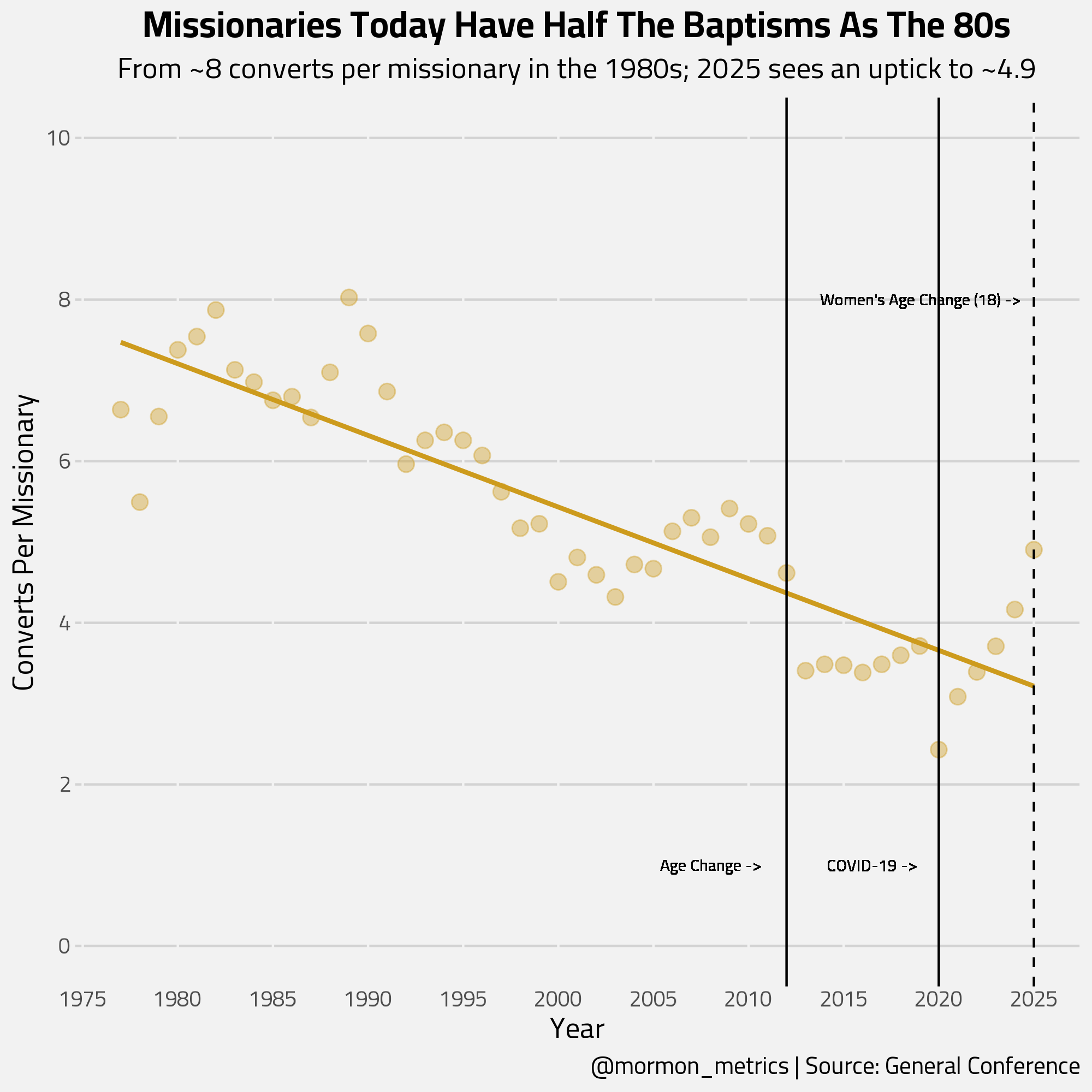
One chart I find particularly interesting is the converts-per-missionary metric. Yes, today’s missionaries are still producing roughly half the baptisms per missionary compared to the 1980s (~4.9 vs ~8). The long-run secular decline is real. But 2025 shows a notable uptick from the trend — the best per-missionary productivity since before COVID and the first age change. That’s encouraging signal, not just noise.
What To Expect Next: Another Age Change Bump
Before moving on from the missionary story, it’s worth flagging something that will almost certainly shape the next few years of data.
In November 2025, the church announced another missionary age change. If the previous age change in 2012 is any guide — and I think it is — we should expect an increase in missionary count over the next 1-2 years as a new cohort of eligible missionaries enters the field ahead of schedule. Last time, missionary count jumped from roughly 55,000 to nearly 90,000. We won’t see as large of increase as last time of course since it only affects women going from 19 → 18 instead of both genders and larger age intervals, but we should expect an increase none the less.
The flip side of that surge may be predictable too. When the missionary population expands rapidly, converts-per-missionary tends to drop. The infrastructure, training, and teaching pipelines don’t scale instantly with headcount. We saw exactly this dynamic play out after 2012: total baptisms held relatively steady while per-missionary productivity fell off a cliff for several years before gradually recovering.
So the 2025 uptick in converts-per-missionary (~4.9) may be short-lived. Next year’s chart may look different.
The Problems Haven’t Gone Away
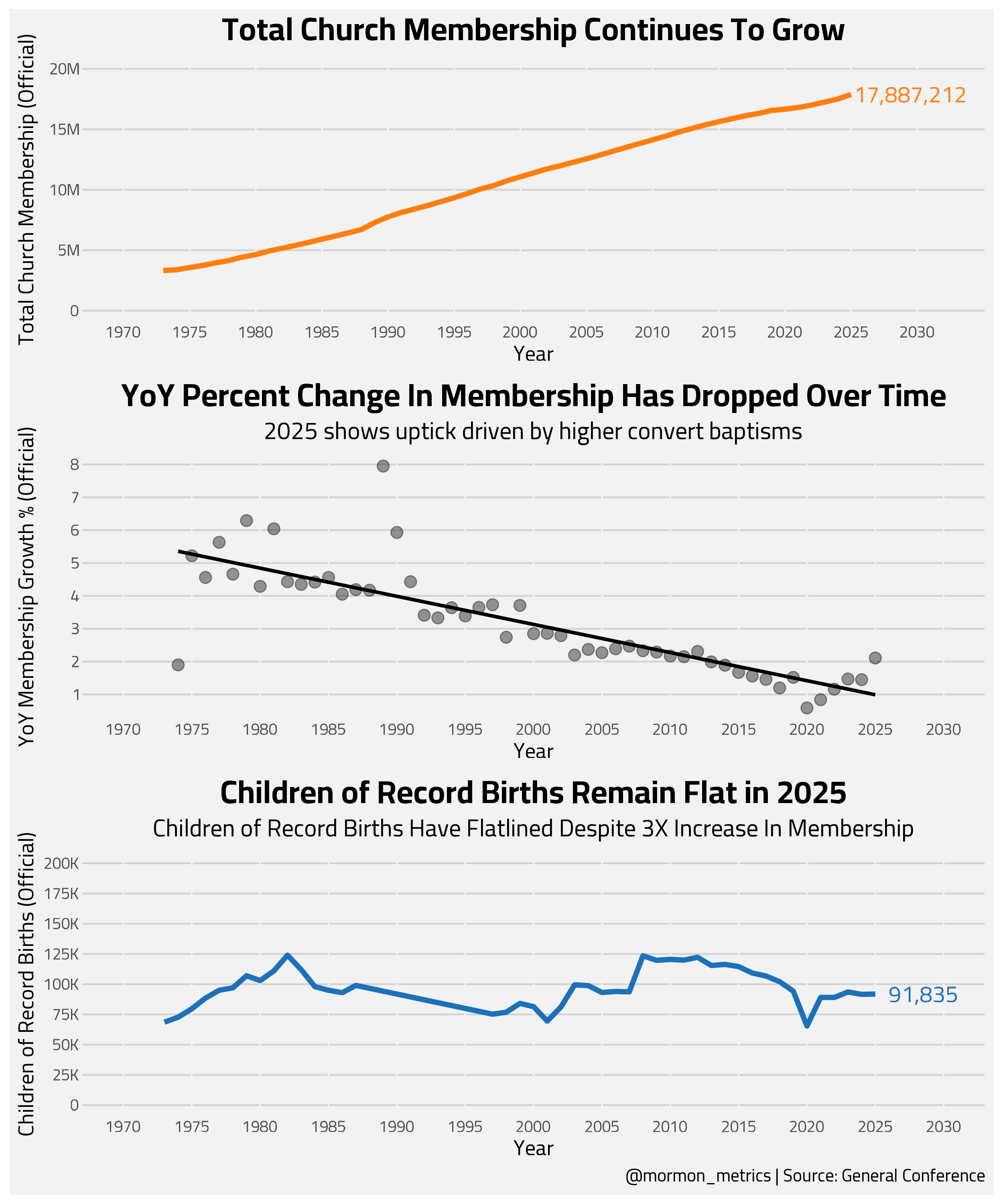
The membership number keeps growing (now at 17,887,212), and YoY growth ticked back up in 2025, driven by those record baptisms. But the YoY growth rate chart tells a sobering longer story: from ~6% annually in the 1970s-80s, the LDS church is now growing at roughly 2%, even in a banner baptism year.
Children of Record births remain essentially flat at 91,835 — almost exactly where they’ve been for decades, despite membership roughly tripling since the 1990s. It is an uncomfortable reality to learn that in 1980 (& 5Mil members) Latter-day Saints were seeing more actual total number of births than in 2025 (& ~18Mil members).
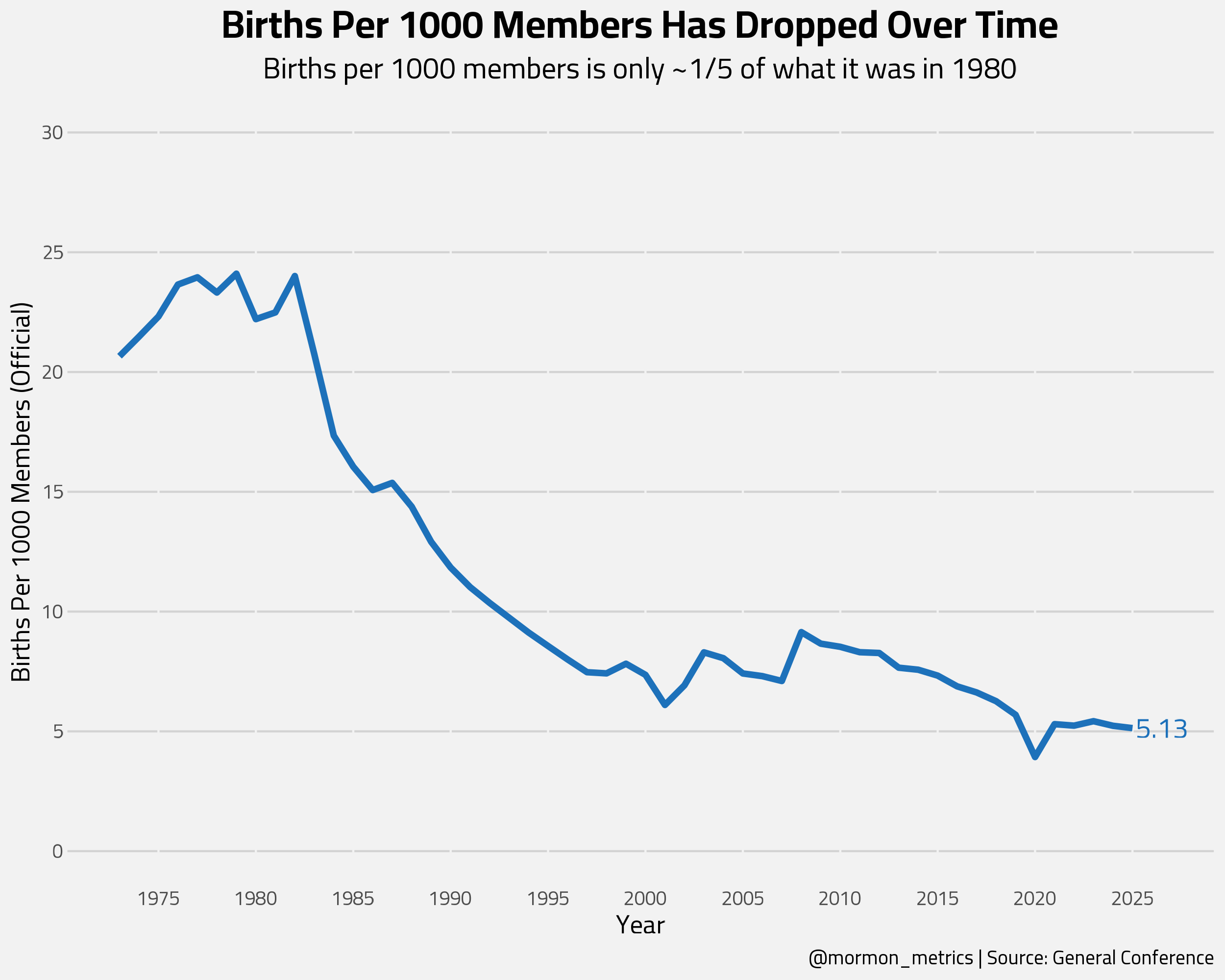
Births per 1,000 members now sits at 5.13, down from over 20 in the early 1980s. I said last year that a 5X decline is hard to explain by fertility rates alone. I stand by that. Something else is going on — most likely a combination of genuine fertility decline and increasing inactivity among members who simply aren’t blessing their children into the records.
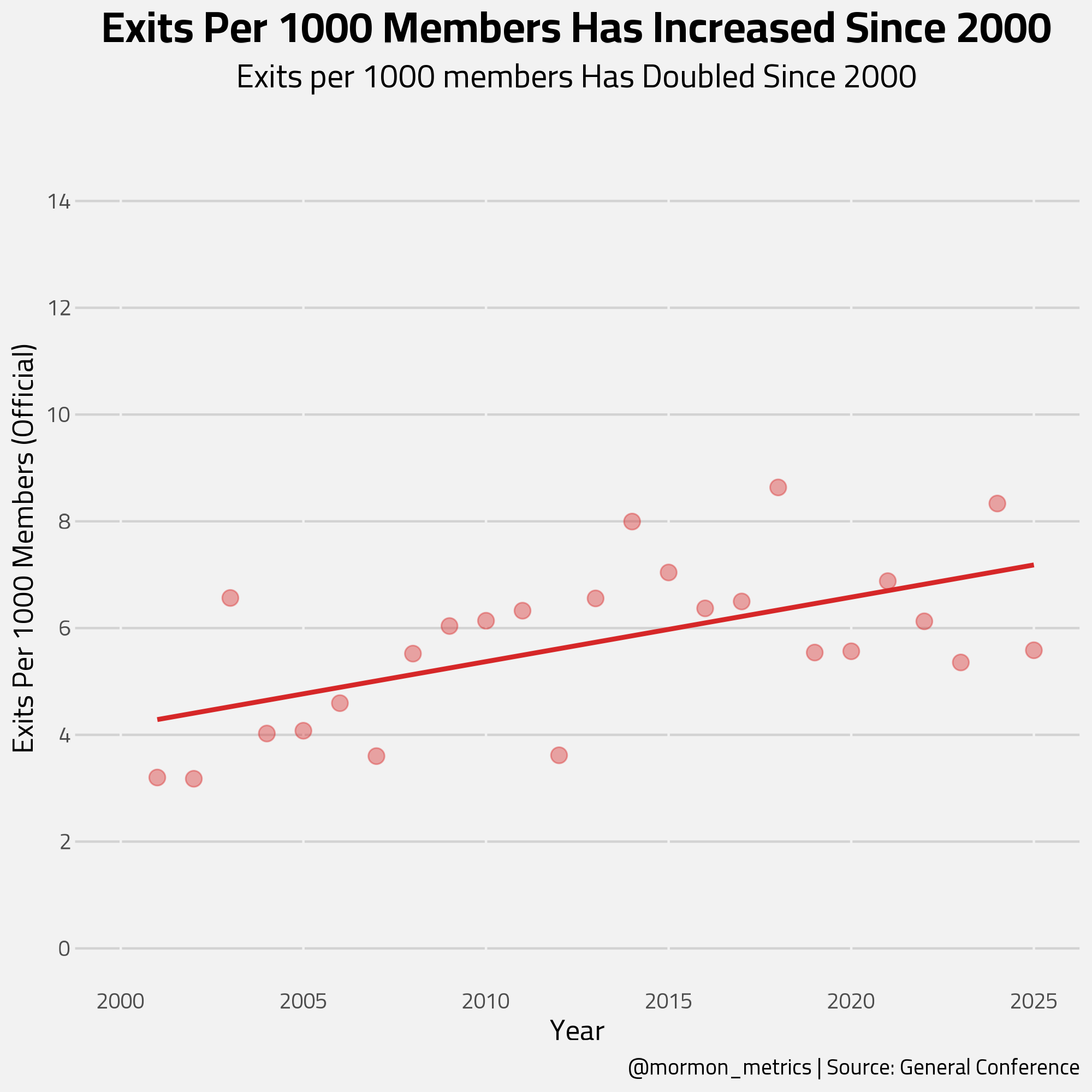
The exits story is also worth watching. Exits per 1,000 members has roughly doubled since 2000 with the 2024 year being 8.3 — near its highest levels in the data. However, this past year its dropped below 6. A meaningful decrease, but we’ll keep watching this trend.
If the trend line persists, record numbers are coming in the front door and leaving out the back door.
The Structural Picture: Convert-Driven Growth
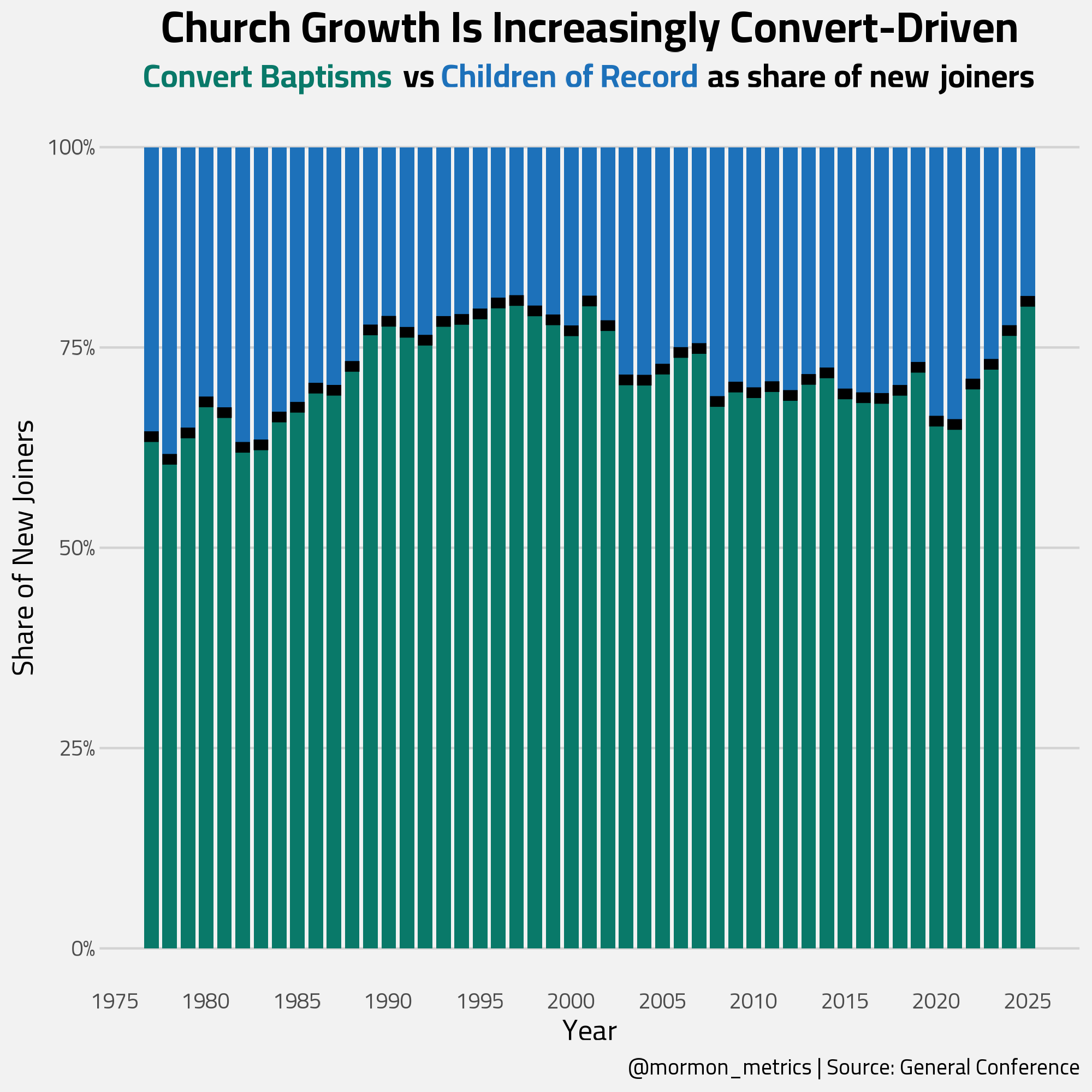
Here’s something worth sitting with. Church growth is now overwhelmingly convert-driven. Looking at the share of new joiners over time, converts have gone from roughly 60–65% of new joiners in the late 1970s to around 80%+ in 2025. Children of Record — kids born and blessed into active LDS families — are a shrinking share of total additions.
So What’s The Bottom Line?
The 2025 numbers are genuinely good news for missionary work. Record convert baptisms, improving missionary productivity, and a membership count that keeps growing.
But the underlying demographic picture is the same. The church is becoming more dependent on convert growth to sustain membership numbers, while organic growth through active families continues to weaken. Whether the 2025 baptism surge represents a durable shift or another cycle remains to be seen.
Worth watching next year: does the baptism trend hold, do exits stabilize, and how much does the new missionary age change reshape the missionary numbers?
Come back next week for an exciting release of a new dashboard I’m building out that I think will resonate with many folks here.
I see in your code that "Exits" = new people - (current membership number - previous membership number). So exits then primarily would refer to people who died, right? I don't think most people who stop identifying with the church formally remove their records (although that is an interesting research question...).
This was a great article to read, I really enjoy statistical analysis of the church reports every April that many do.
I figure the church would have this data, but obviously its unavailable to the public, but I would be curious to see convert baptisms broken down by age, or even the total average age of convert baptisms. With the relatively stagnant number of children of record, and an increasingly convert-driven growth model, I wonder what changes this might bring about in the church in the future? More and more members and leadership at all levels will be first generation converts, and have a wider array of religious or nonreligious upbringings that they bring to their time within the church.
If the number of children of record continues to stay the same, primary and youth classes and programs might experience a gradual diluting as more members are older within a single ward, and this could possibly lead to wards being structured to combine second hour classes with seperate sacrament meetings, or a greater focus on multi-ward and/or stake primary/youth activities to help younger people stay connected with each other. To present two possible scenarios.
Considering convert baptisms can include anyone as young as nine years old, and thus it's possible there are still lots of children and youth being baptized, just not at eight, I think an early sign of demographic decline in the church, if it happens, would be the disappearance of nursery programs as there becomes little need for them from decreasing class sizes. This is the one class that cannot be made up for by convert baptisms.